Mount Vesuvius
Hike Mount Vesuvius crater from Naples, Pompeii or Ercolano. Buses, tickets, weather closures, combo tours, and Lacryma Christi wine — 2026 guide.
Vesuvius National Park: Skip-the-Line Ticket and Audio Guide
Quick facts
- Summit elevation
- 1,281 m (crater rim ~1,200 m)
- Bus from Ercolano
- ~30 min, included in most tours
- Hike to crater rim
- 30–45 min uphill, 20–30 min down
- Entry ticket
- €14 (crater access, sold at 1,000 m car park)
- Last entry
- 17:00 (summer), 14:00 (winter)
- Closures
- Possible due to weather, wind, volcanic activity
Standing at the edge of Europe’s most dangerous volcano
Vesuvius is active. Not dormant — active. The last major eruption was in 1944, the most recent minor activity in the 1990s. The volcano is monitored 24 hours a day by the Osservatorio Vesuviano, the world’s oldest volcanological observatory (founded 1841), and the surrounding area is classified as a high-risk volcanic zone. Around three million people live within the designated red zone.
None of this prevents the crater hike, which is one of the more extraordinary experiences available as a day trip from Naples. Standing at the rim of a 200-metre deep crater on an active volcano, looking south over the Bay of Naples, Capri, the Sorrento peninsula, and the grey ash plain that entombs Pompeii, is genuinely unlike anything you will find elsewhere in Europe.
The hike itself is not technically demanding — it is a 30–45 minute walk on a well-maintained path. What requires planning is the access logistics, the unpredictability of closures, and the timing of any combination with Pompeii or Herculaneum.
| Where | Between Ercolano and Pompei, ~30 min bus from either |
| Cost | Around €14 crater entry, plus €3–14 transport depending on route |
| Time needed | Half a day; full day combined with Pompeii or Herculaneum |
| Getting there | EAV bus from Ercolano Scavi station to Quota Mille car park |
| Best time | Late morning (09:30–12:00), April–June or September–October |
Getting to Vesuvius
The volcano lies roughly between Ercolano (Herculaneum) to the north-west and Pompei to the south-west. There is no direct public transport to the crater — you take a bus or transfer to a car park at approximately 1,000 metres elevation, then walk the final 200 metres of elevation gain on foot.
From Ercolano (Herculaneum) — recommended base
EAV buses depart from Ercolano Scavi train station (the same station for Herculaneum) approximately every 40 minutes from 09:00. Single fare: about €3. The journey to the Vesuvius car park (Quota Mille) takes 30–35 minutes along a winding mountain road. Return buses run until around 16:00–17:00 depending on season.
This is the most practical option for independent visitors because Ercolano is easily reached by Circumvesuviana (15 minutes, €2.60 from Naples). It also lets you combine Herculaneum in the morning with Vesuvius in the afternoon — the Herculaneum guide covers the timing in detail.
From Pompei Scavi station
Several shuttle services run from the Pompei train station to the Vesuvius car park. These are typically operated by private minibus companies and cost €10–14 return. They are reliable but less frequent than the Ercolano buses. Useful if you are combining Pompeii + Vesuvius in one day; see Pompeii and Vesuvius same day.
By car
Drive the SS18 to Ercolano, then follow Vesuvius signs up the mountain road. The car park at Quota Mille costs €3. The road is narrow in sections. Parking fills early on weekends; aim to arrive by 09:30.
Guided tour with transport
The most logistically stress-free option is a guided tour that includes return transport from Naples or from Pompeii. These typically cost €35–65 per person depending on group size and whether Pompeii is included.
Vesuvius all-inclusive from Naples with transportEntry and the crater hike
At the Quota Mille car park, there is a ticket booth, a café, and souvenir shops. Crater entry is €14 (separate from any transport cost). This is collected at the gate where the path begins; you cannot buy it in advance online.
From the gate, the path to the crater rim is about 860 metres in length and gains roughly 200 metres of elevation on a steep, gravelly path reinforced in sections with wooden steps. Fit walkers take 25–35 minutes; a leisurely pace is 40–50 minutes. The surface is volcanic ash and loose rock — closed-toe shoes with some grip are essential. Flip-flops and sandals are prohibited and enforced.
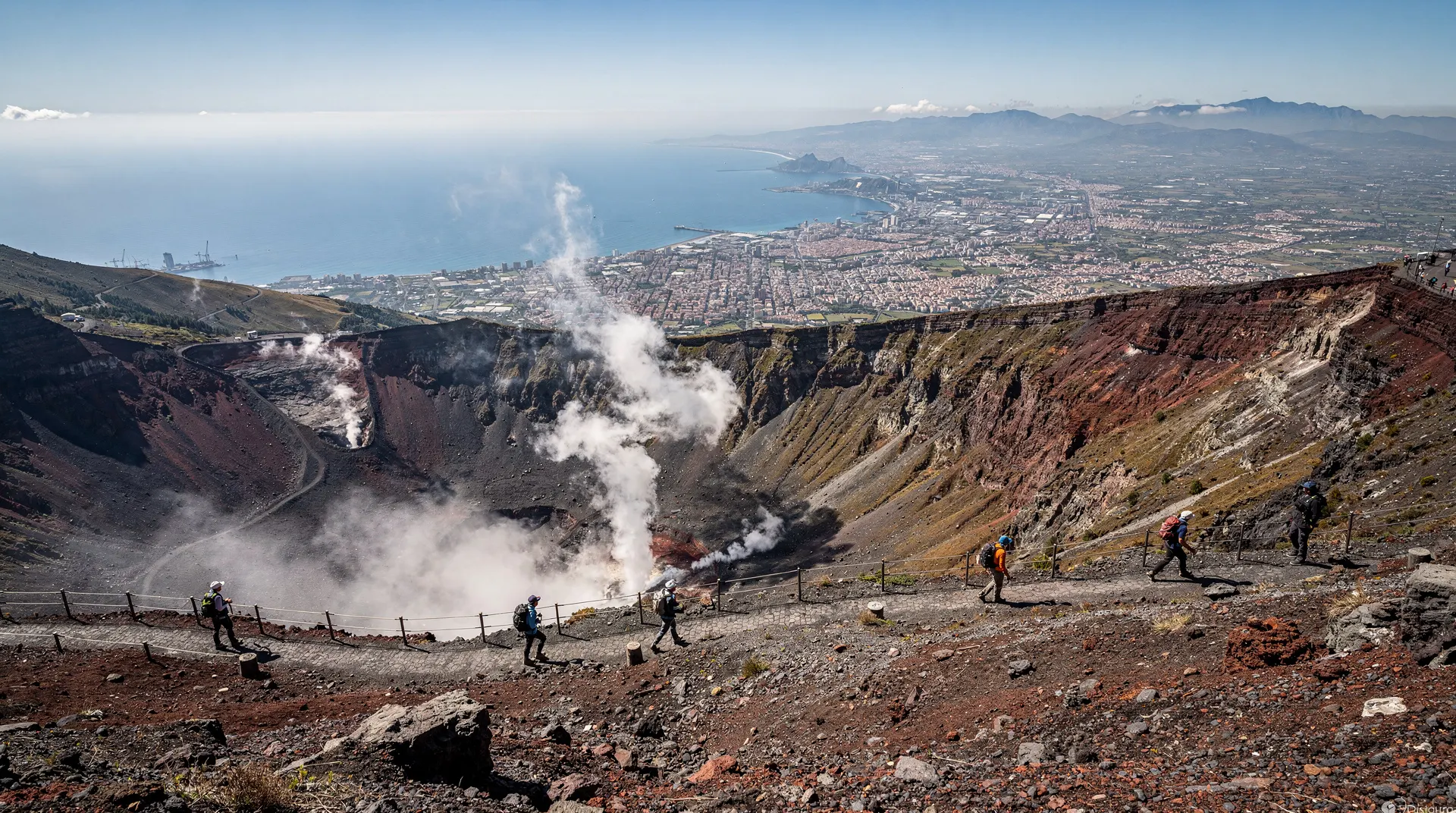
At the crater rim: the crater is approximately 2.4 km in circumference and 200 metres deep. A walkable section of the rim extends for about 200 metres in each direction from the viewing point. The path does not encircle the full crater. Steam vents (fumaroles) are visible at the crater floor and occasionally at the rim — sulphurous smell, not harmful in the open air.
Views on a clear day extend from Capri and the Sorrento peninsula to the south, across the Bay of Naples, to the Phlegraean Fields and sometimes the island of Ischia to the north-west. On a hazy or overcast day, visibility can be poor — this is worth noting when planning your timing.
Weather closures: the key risk
This is the aspect most visitors overlook. Vesuvius closes on orange and red wind warnings (the volcanic zone’s alert classification), for lightning, heavy rain, and occasionally for volcanic monitoring periods. Closures can be announced the same morning and are not compensated on most tour bookings.
Closure rates are highest from November to March and on summer afternoons when thunderstorms build over the Apennines. The most reliable window is late morning (09:30–12:00) in spring and autumn. Checking the Vesuvius closures and weather page before you go, and avoiding booking a tour that departs at 13:00 or later in unstable weather, reduces the risk significantly.
If you arrive at the car park and the crater is closed, the car park and views from 1,000 metres elevation are already impressive — it is not a wasted journey.
Combining Vesuvius with Pompeii or Herculaneum
Pompeii + Vesuvius is the most popular combination. The standard itinerary: arrive Pompeii at 09:00, explore until 13:00, take the shuttle to Vesuvius (30 min), reach the car park by 14:00, hike to crater (30–45 min), descent (20–30 min), leave car park by 16:00–16:30, back in Naples by 18:00. This is feasible but leaves limited time at both sites.
For Pompeii highlights + Vesuvius in one day:
Pompeii and Vesuvius full-day comboHerculaneum + Vesuvius is the more relaxed combination. Herculaneum takes 2–3 hours, and Ercolano station is the best departure point for Vesuvius buses. Morning at the excavations, afternoon on the volcano.
All three sites in one day (Pompeii + Herculaneum + Vesuvius) is physically possible but rushed and exhausting — not recommended except on a longer itinerary where each site has already been partially seen.
Lacryma Christi: wine from the volcano
The slopes of Vesuvius have been cultivated since Roman times. The volcanic soil (rich in minerals, excellent drainage) produces wines of distinctive character under the DOC designation Vesuvio and specifically Lacryma Christi del Vesuvio (literally “Tears of Christ of Vesuvius”). The myth behind the name — Christ wept over the devil’s theft of a piece of paradise and his tears fertilised the volcanic earth — is Neapolitan to its core.
The main grape varieties are Piedirosso (red) and Coda di Volpe and Falanghina (whites). The wines are not widely exported and are best tasted on site. Cantine Olivella and Cantine del Vesuvio (also known as Lacryma Christi) are the most accessible producers; several operators run combined Vesuvius hike + vineyard lunch tours:
Vesuvius hike with vineyard wine lunchMore on Lacryma Christi and Campania wines in the wine guide.
Vesuvius National Park
The summit crater is the most-visited part, but Vesuvius is surrounded by the Parco Nazionale del Vesuvio, established in 1995. The park covers about 8,500 hectares of volcanic slopes and includes several marked hiking trails below the summit zone. Trail 5 (Gran Cono) is the standard crater approach; other trails traverse the lower slopes through Mediterranean scrub and reach viewpoints over the Bay of Naples.
The park is also notable for reforestation efforts following the 2017 wildfires that burned much of the northern slopes. Some areas show dramatic regrowth; others remain visually scarred. This affects the aesthetics of the approach road but not the summit experience.
Park information and trail maps are available at the Visitor Centre near the Ercolano road junction. More details at Vesuvius National Park.
A brief history of eruptions
Vesuvius’ most famous eruption — the AD 79 catastrophe that buried Pompeii, Herculaneum, and Oplontis — was a Plinian eruption, named after Pliny the Younger, who witnessed and recorded it from across the bay (his uncle, Pliny the Elder, died attempting a rescue mission by sea). But it was far from the volcano’s only significant event.
Vesuvius has erupted dozens of times since AD 79, with major events in 472, 1631 (a catastrophic eruption killing an estimated 3,000–6,000 people and burying several towns), and a long series of smaller 19th- and early-20th-century eruptions that were, remarkably, tourist attractions in their own right — Victorian visitors rode a funicular up the slopes specifically to watch minor lava flows, a phenomenon commemorated in the song “Funiculì, Funiculà.”
The 1944 eruption, the most recent, occurred during the Allied occupation of Naples in the Second World War. Lava flows destroyed the villages of San Sebastiano al Vesuvio and Massa di Somma, and the ashfall damaged aircraft at the nearby Pompeii Airfield, disrupting Allied air operations. Since 1944, the volcano has been quiet at the surface, though the Osservatorio Vesuviano continuously records seismic and thermal activity beneath it.
Comparing Vesuvius with other volcano experiences
For visitors who have hiked other active volcanoes, Vesuvius is a relatively gentle introduction: the path is short, well-maintained, and does not require any specialist equipment. It compares favourably to more strenuous options elsewhere in Italy (Etna’s higher craters, for instance, require considerably more fitness and often guided access only) while offering a comparable sense of standing on genuinely active ground.
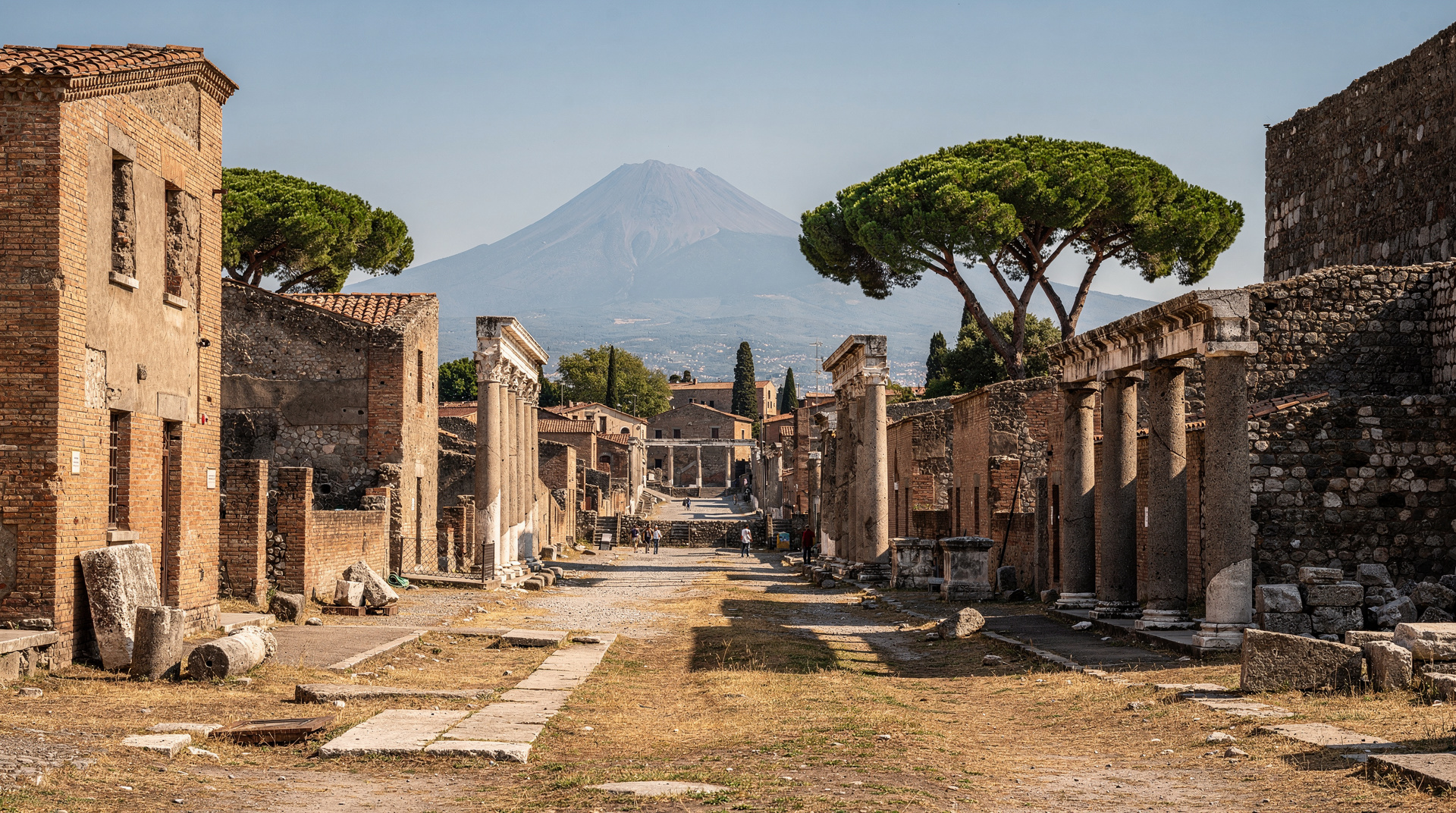
What makes Vesuvius distinctive rather than simply “a crater to look into” is the context: nowhere else can you combine an active-volcano hike with an ancient city preserved by that same volcano’s most famous eruption, all within a single day trip from a major city. The historical weight of looking down at the ash plain that entombs Pompeii from the summit that caused it is not replicated by any other volcano tourism experience in Europe.
Practical details
Shoes: closed-toe with grip — mandatory and enforced. The path is steep loose gravel in sections.
Water: bring at least 1 litre. The kiosk at the car park sells water at inflated prices.
Timing: first buses up in the morning give the best chance of clear visibility. Afternoon haze is common in summer, and afternoon thunderstorms are possible.
Guide on site: at the crater gate, local guides offer short commentary tours (30–40 minutes, tip-based, around €5–10 per person). These are optional but useful if you want to understand what you are looking at in the crater.
Photography: unrestricted. The crater views are excellent in clear conditions; consider a morning visit for the clearest light.
Children: the hike is suitable for children aged 8+ with reasonable fitness. The path is steep and can be slippery — proper shoes essential.
Frequently asked questions about Mount Vesuvius
Is Vesuvius safe to visit?
Yes, under current conditions. The volcano is continuously monitored, and the crater path closes automatically when any elevated activity or dangerous weather is detected. The current volcanic alert level is “green” (lowest, base state); any change is communicated immediately by the Osservatorio Vesuviano. The main risk to visitors is tripping on the path or getting caught in bad weather — not volcanic activity.
How difficult is the Vesuvius hike?
Moderate. The path is 860 metres long and gains 200 metres of elevation. It is steep and on loose gravel in places but does not require technical hiking skills. The main challenge for less fit visitors is the incline. Budget 40–50 minutes uphill if you are not a regular hiker.
What is the entry fee for Vesuvius crater?
€14 per person, collected at the gate at the top of the road (Quota Mille car park). This is separate from transport costs. Children under 6 are free.
Can Vesuvius close without warning?
Yes. Orange wind warnings, lightning, heavy rain, or volcanological monitoring can all trigger a same-day closure. There is no compensation if your tour group cannot access the crater. The most reliable window is late morning (10:00–12:00) in spring or autumn.
What is the best time of year to visit Vesuvius?
April–May and September–October. Temperatures at the crater are comfortable, visibility is typically excellent (low summer haze), and thunderstorm risk is lower. July–August is viable but the uphill walk in heat is tiring and afternoon storms are common.
Is there public transport to Vesuvius?
The EAV bus from Ercolano Scavi station is the main public option (€3, approximately every 40 minutes). There is no bus directly from Naples or Pompeii train station — you need to get to Ercolano first, or take a private shuttle.
Can I drive to Vesuvius?
Yes, to the Quota Mille car park (€3). The mountain road is narrow, particularly the upper section. Parking is limited and fills early on weekends and holidays.
When did Vesuvius last erupt?
1944, during the Allied occupation of Naples in the Second World War — lava flows destroyed two villages on the slopes. Since then the volcano has been quiet at the surface, though continuously monitored. Before that, the AD 79 eruption that buried Pompeii and Herculaneum is by far the most historically significant event.
How does the Vesuvius hike compare to other volcano hikes?
It is on the easier end — a short, well-maintained 30–45 minute path with no technical difficulty, unlike higher-altitude volcano hikes elsewhere in Italy such as Etna. Its distinctiveness comes from the historical context rather than physical challenge: few places let you combine an active volcano with the ancient city it destroyed in a single day.
Top experiences
Bookable activities with verified prices and instant confirmation on GetYourGuide.