Vesuvius national park: beyond the crater, what the park actually contains
From Naples: All-Inclusive Mount Vesuvius Half-Day Tour
What is in the Vesuvius national park beyond the main crater hike?
The Parco Nazionale del Vesuvio covers 8,482 hectares including the crater, lava fields, Mediterranean scrubland, reforested zones, the archaeological sites of Pompeii and Herculaneum on its flanks, and several marked trail networks. The crater hike is the main visitor draw, but the park has 11 marked trails of varying difficulty.
The park beyond the tourist trail
Most visitors to Vesuvius see one thing: the 2-kilometre path from the car park at 1,000 metres to the crater rim at 1,281 metres. This trail takes 45 minutes, the view of the crater is striking, and most people are back on the bus within two hours.
What most don’t know is that the Parco Nazionale del Vesuvio extends over 8,482 hectares of volcanic landscape — including the older Monte Somma volcano (the caldera rim of the original volcano that preceded the 79 AD eruption), extensive lava flow zones, Mediterranean garrigue, and significant biodiversity. The park also encompasses the flanks of the volcano where wine vineyards, nature trails, and the 19th-century observatory sit.
This guide covers both the standard crater visit and the broader park.
| Where | Parco Nazionale del Vesuvio, above Ercolano (30–40 min from Naples) |
| Crater fee | Around €10–12, no fee for lower park trails |
| Time needed | 1.5–2hrs for the crater; half a day for Monte Somma or vineyards |
| Getting there | Circumvesuviana to Ercolano Scavi, then shuttle or organised tour |
| Best time | Spring (broom in flower) or early morning for fewer crowds |
The crater hike
The main trail from the 1,000 m car park to the crater rim is short (2 km round trip), well-maintained, and moderately strenuous — steep loose ash and volcanic gravel on the ascent. The trail takes approximately 30–45 minutes going up and 20 minutes coming down.
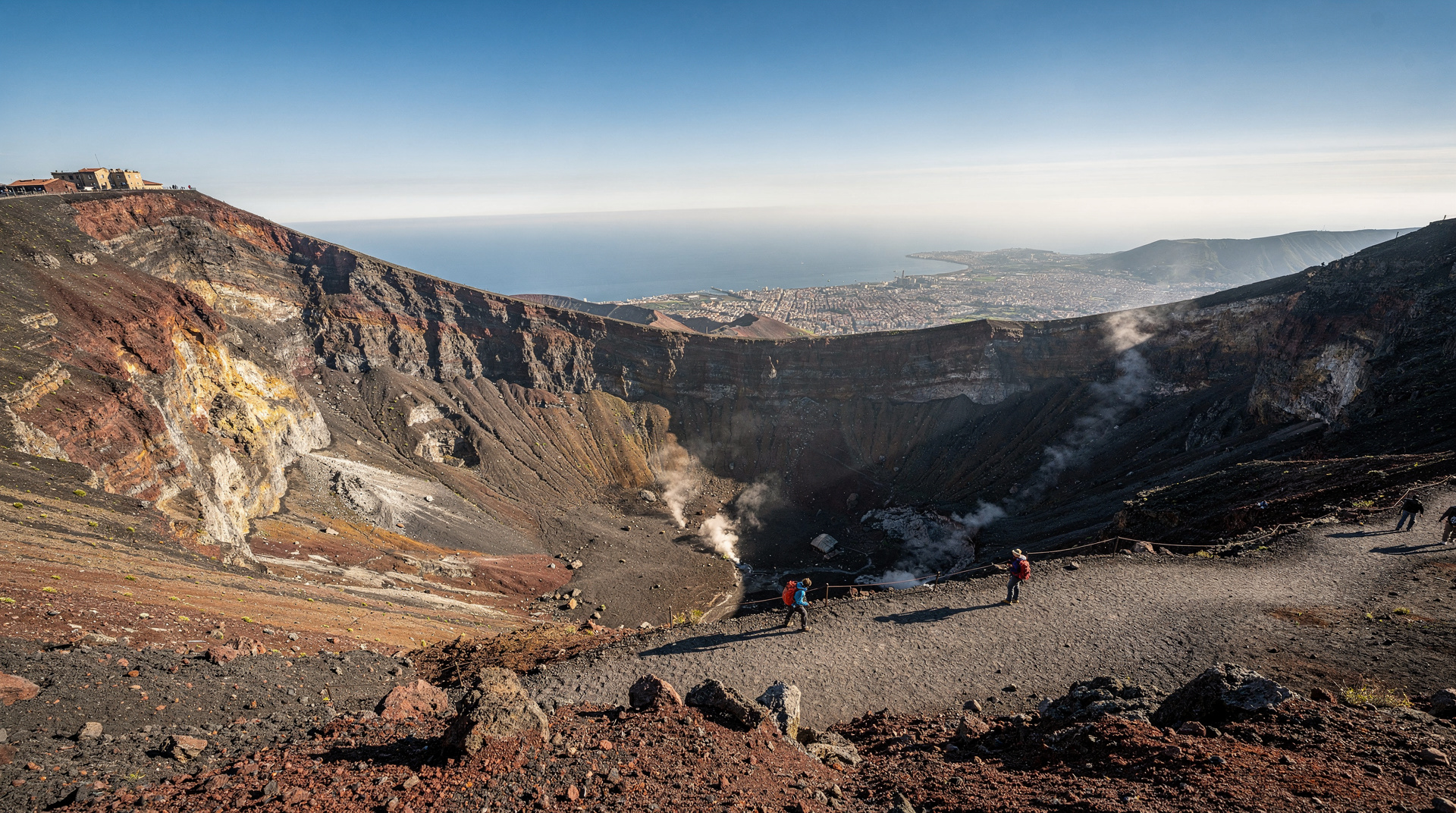
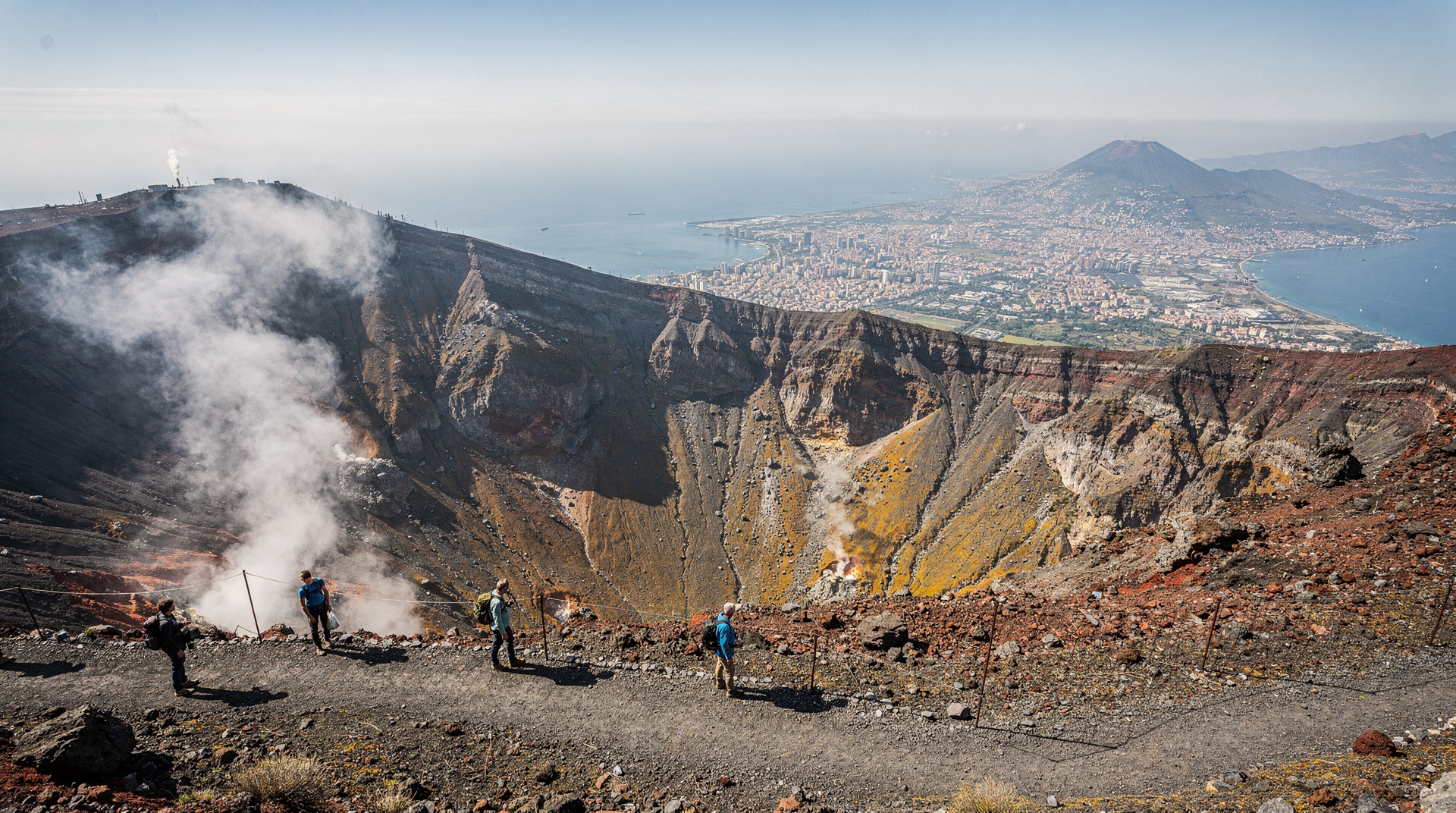
At the rim: The crater is 440 metres wide and 300 metres deep. Visible from the rim: steam vents (fumaroles) at the base and on the inner walls, solidified lava tongues from previous eruptions, the geological layering of the volcanic cone. The view back over the Bay of Naples, Pompeii, and the Sorrentine Peninsula is the best aerial perspective available without a helicopter.
Entry fee: Approximately €10–12 (collected at the gate before the final approach). This is usually included in guided tour prices.
Hours: 9:00–17:00 in winter (last entry 15:30); 9:00–18:00 in summer (last entry 17:00). Closed in severe weather.
Closures: The crater can close at short notice for volcanic activity, high winds, or maintenance. Check before going — see Vesuvius closures and weather.
Vesuvius skip-the-line with roundtrip transport from NaplesGetting to the car park
From Ercolano Scavi station (Circumvesuviana, 15 minutes from Naples Garibaldi, €2.60), local buses and organised shuttle services run to the Vesuvius upper car park (Quota 1000). The journey takes approximately 25–35 minutes up a very steep mountain road.
The shuttle service operates approximately April–October with regular frequency. In winter, service is reduced. A taxi from Ercolano to the car park costs approximately €20–25 one-way. See getting to Vesuvius.
Note: The road to the car park is not suitable for hire cars in summer due to traffic management restrictions — park shuttles and organised tours are the practical access method.
Monte Somma: the older volcano
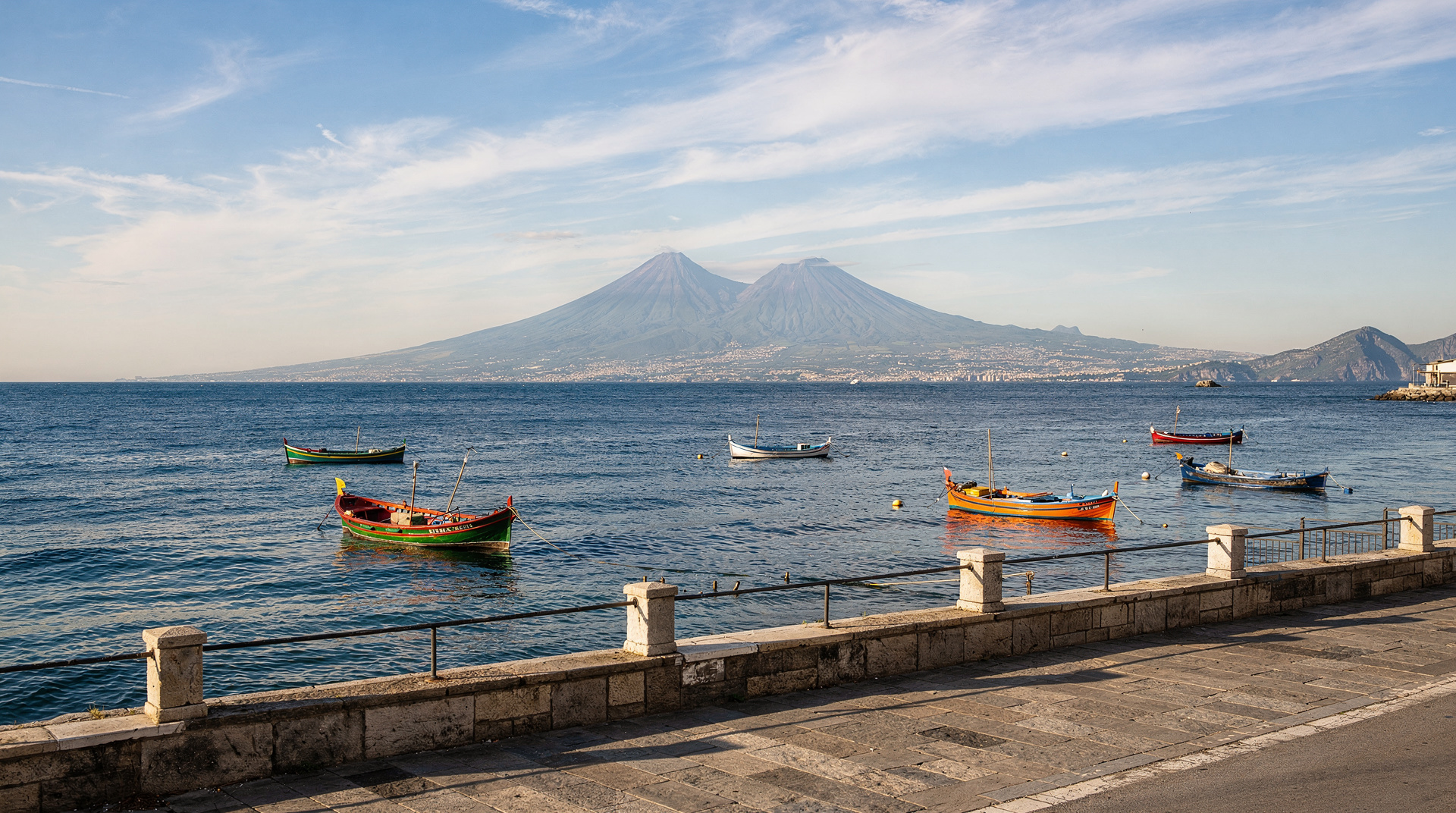
Vesuvius as seen today is actually the product of multiple volcanic events. The caldera of the original volcano (which was much larger than the current cone) is preserved as Monte Somma — the older, irregular ridge that curves around the northern and eastern sides of the Vesuvius cone. The Valle del Gigante (Giant’s Valley) between Somma and Vesuvius is the floor of the ancient caldera.
Sentiero 2 — Monte Somma circuit: A 10-km trail (allow 4–5 hours, strenuous) that traverses the Monte Somma ridge. Less visited than the crater trail and more botanically interesting — the northern Somma flanks support richer vegetation than the exposed southern face of the modern cone. The views into the Valle del Gigante are spectacular.
Access to this trail requires a guided visit or prior registration with the park — check the official website (vesuviopark.it) for current requirements.
The park’s ecology
Broom (ginestra): The park’s symbolic plant. Leopardi’s famous poem La Ginestra (1836) was inspired by the broom growing on the 1631 lava flows. In April–May, the yellow broom flowers cover the lower volcanic slopes in colour visible from Naples. The species Spartium junceum colonises fresh lava flows as one of the first plants to establish.
Birds: The upper cone supports kestrel, peregrine falcon, and common buzzard. Spring migration brings warblers and raptors passing through the volcanic peak. The park provides nesting sites for species that favour open rocky habitats.
Reptiles: The Italian wall lizard (Podarcis sicula) is abundant on warm rock surfaces throughout the park. The Aesculapian snake (Zamenis longissimus) — non-venomous, up to 1.5 m — occurs in the wooded lower flanks.
Lava ecology: The progressive colonisation of lava flows by organisms — from lichen on bare rock, through broom and ferns, to oak scrub — can be observed at different stages depending on the age of the flow. The 1944 lava (the last major eruption) is at the lichen/broom stage; older flows from the 1800s show denser vegetation.
Vesuvius vineyards
The volcanic soil of Vesuvius is notably fertile — the same minerals that make the volcano dangerous produce exceptionally flavourful wine grapes. The designation Vesuvio DOC covers both white (principally Coda di Volpe grape) and red (Piedirosso and Sciascinoso) wines from the slopes. The most famous label is Lacryma Christi del Vesuvio (“Tears of Christ from Vesuvius”) — a name with a religious-legendary origin and a long production history.
Several estate wineries on the lower slopes offer visits and tastings:
- Cantine Russo (Trecase) — family winery producing Lacryma Christi
- Villa Dora (Trecase) — larger estate with regular visitor hours
- Cantine del Vesuvio — historic producer with educational tours
A vineyard tour (approximately 1.5 hours, €20–35 including tasting) can be combined with a Vesuvius crater visit in a half-day. The combination gives an unusual perspective — the volcano that periodically destroys and fertilises, and the wine produced in the volcanic soil between eruptions. See Lacryma Christi wine guide.
Vesuvius vineyard tour with wine lunchThe Osservatorio Vesuviano
Established in 1841 by Ferdinando II (King of the Two Sicilies), the Osservatorio Vesuviano on the south slope of the volcano (608 m elevation) was the world’s first volcano observatory. The building — a neoclassical structure on a volcanic cliff — has a museum of historical instruments, original seismograph records, and information on volcanic monitoring.
Getting there: Accessible by car (signed from the Ercolano road), or on foot from the Ercolano railway area (about 2.5 km uphill, 1 hour). No public transport specifically to the observatory.
The observatory operates primarily as a scientific institute. The museum is open to visitors with advance booking (check vesuvioweb.com).
Combining Vesuvius with the archaeological sites
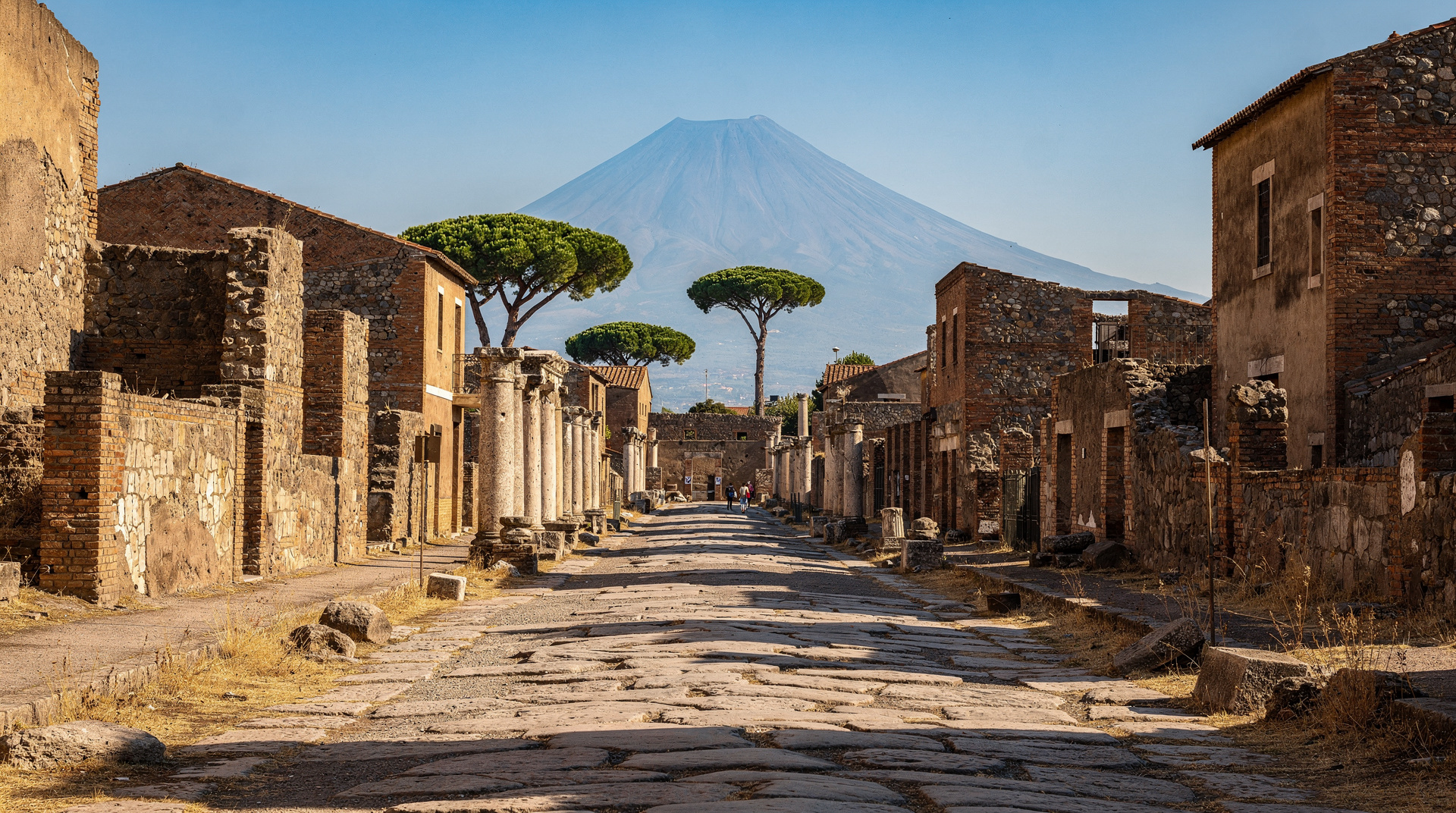
Vesuvius and Pompeii or Herculaneum are natural complements — understanding the volcano adds context to the ruins, and the ruins give the volcano emotional weight. The standard combination visits one archaeological site (usually Pompeii, 2.5–3 hours) and the crater (1.5 hours) on the same day. See Pompeii and Vesuvius same day.
The logical order is usually: Herculaneum (9:00–11:30, Circumvesuviana to Ercolano Scavi) → shuttle to Vesuvius (11:30–14:00) → Pompeii (14:30–17:00). This is ambitious but doable with an early start.
Planning a longer park visit
Most visitors treat Vesuvius as a two-hour add-on to Pompeii, and that is a reasonable way to see the crater — but if you have a full day and an interest in volcanology or hiking, the wider park rewards more time. A realistic plan for a dedicated park day: start early at the crater (8:30–10:00, before the tour buses arrive), descend and pick up the shuttle down to Ercolano Scavi, then either walk the lower vineyard lanes around Trecase and Boscotrecase, or — if you have booked ahead with a park guide — tackle the Monte Somma circuit (Sentiero 2) in the cooler afternoon. Bring more water than you think you need; there are no refill points beyond the car park kiosk, and the exposed volcanic terrain has little shade.
What to wear: Sturdy closed shoes are non-negotiable on the crater trail — the ash and gravel surface is genuinely slippery in trainers with worn soles, and sandals are not permitted past the ticket gate. A windbreaker is useful even in summer, since the exposed rim catches wind off the bay. On the lower trails through Monte Somma or the vineyard lanes, normal walking shoes are fine.
Photography: The clearest views back over the Bay of Naples, Pompeii, and the Sorrentine Peninsula are from the rim in the first two hours after opening, before haze builds up over the bay in the afternoon. The Monte Somma ridge gives a different, less-photographed angle looking down into the Valle del Gigante and across to the modern cone — worth the detour for anyone who has already done the standard crater shot.
Combining with Herculaneum: Because the shuttle departs from Ercolano Scavi, a Vesuvius morning pairs naturally with an afternoon at Herculaneum, which sits a short walk from the same station and is smaller and less crowded than Pompeii — a good option if a full Vesuvius-plus-Pompeii day feels too rushed. For transport logistics between the sites, see the Circumvesuviana guide.
Frequently asked questions about Vesuvius national park
Is the park fee the same as the crater entry fee?
The crater entry fee (€10–12) funds the national park and trail maintenance. If you only walk in the lower park areas (nature trails, vineyard areas) without reaching the crater, there is no entry fee.
Can I run in the national park?
Trail running is permitted on the marked trails. The lower trails (below the crater zone) are suitable for trail runners. The crater trail itself is compact (2 km) and is fine for running in the early morning before visitor crowds arrive.
Are dogs allowed in the national park?
Dogs on leads are permitted on the marked trails. The crater area is accessible with dogs. No dogs in the observatory museum.
What happens if weather closes the crater?
Refunds are generally available if the crater is officially closed on the day of your visit. If you have a guided tour, the operator handles this. If you have booked independently, check the park’s current cancellation policy.
Is the lava flow from 1944 still visible?
Yes. The 1944 eruption lava flow (the last major eruption) is visible on the western flank of the cone — a solidified black tongue of basalt now partially colonised by broom. The main tourist path skirts this flow, and guides point it out during the ascent.
Frequently asked questions about Vesuvius national park: beyond the crater, what the park actually contains
How much of the national park is accessible to visitors?
What wildlife lives in the Vesuvius national park?
Can I do a longer hike on Vesuvius besides the crater trail?
What is the Osservatorio Vesuviano?
What are the lava vineyards and can I visit them?
Is Vesuvius dangerous to visit?
Top experiences
Bookable activities with verified prices and instant confirmation on GetYourGuide.