Amalfi
The hub of the Amalfi Coast: historic Duomo, Cloister of Paradise, artisan paper mills, and the best ferry and bus connections on the coast.
From Naples: Full-Day Amalfi & Ravello Coast Tour
Quick facts
- Region
- Province of Salerno, Campania
- Population
- ~5,200 residents
- Key monument
- Duomo di Sant'Andrea (11th century)
- From Sorrento by bus
- ~1h 15min (SITA)
- From Salerno by ferry
- ~35–40 minutes (seasonal)
- Historic paper mill
- Museo della Carta
Amalfi gave the coast its name, and for five centuries it deserved the honour. Between the 9th and 11th centuries, the Maritime Republic of Amalfi was one of the most powerful trading states in the Mediterranean — a rival to Genoa and Venice, with merchant fleets reaching Alexandria and Beirut. Today the town of 5,200 people is smaller than the republic’s fame suggests, but it has a compact historic centre, a magnificent cathedral, and the best transport connections on the entire coast. For most visitors, it is the practical hub of any Amalfi Coast itinerary.
| Where | Province of Salerno, on the SS163 coast road |
| Cost to see the highlights | Around €7 (Duomo/cloister €3 + Museo della Carta €4) |
| Time needed | Half a day for the centre; a full day with the Valle dei Mulini walk |
| Getting there | SITA bus from Sorrento (~75 min) or seasonal ferry from Naples/Salerno |
| Best time | Morning before 10:00 or after 17:00, to dodge the tour-group crush on Piazza del Duomo |
The Duomo di Sant’Andrea and the Cloister of Paradise
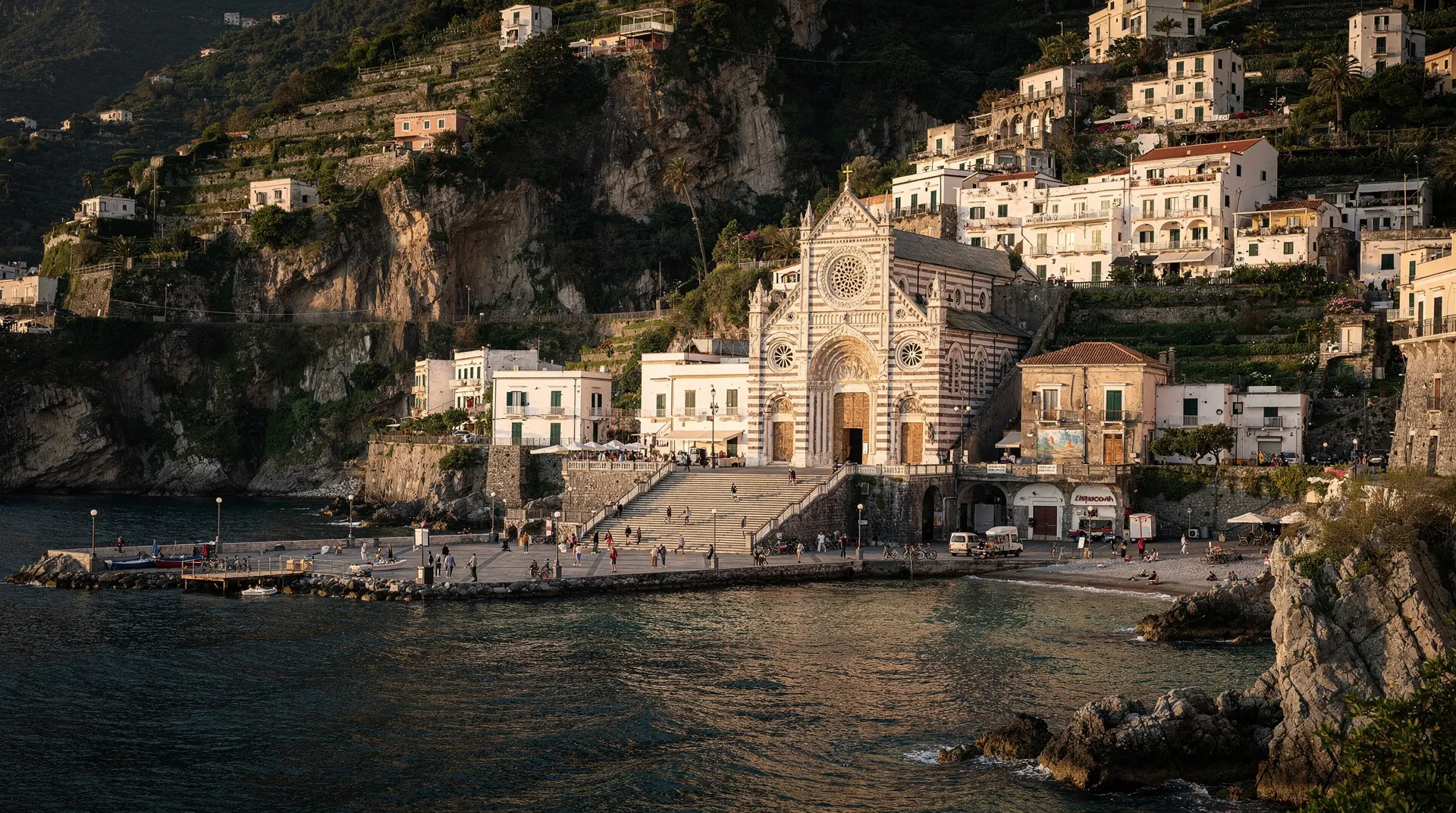
Amalfi’s centrepiece is the Cathedral of Sant’Andrea, consecrated in 1206 and occupying the high end of Piazza del Duomo. The facade you see today is a 19th-century neo-Arab-Norman reconstruction of the medieval original, but it is imposing: interlocking arches in black and white stone, a central mosaic (restored), and a 63-step staircase that gives the square a theatrical quality.
Entry to the cathedral itself is free; the crypt and the attached Cloister of Paradise (Chiostro del Paradiso) charge €3 combined. The cloister, built in 1266 to house the tombs of Amalfi’s wealthy citizens, is one of the most architecturally striking spaces on the coast — an Arab-influenced colonnade with slender interlaced arches around a courtyard garden. The mix of Gothic and Moorish elements reflects the republic’s commercial connections across the Mediterranean. Visit at 09:00 before the tour groups arrive; the light in the courtyard is best in the morning.
The crypt below the cathedral contains the relics of St. Andrew (Apostolo Andrea), transferred from Constantinople in 1208. This gave Amalfi spiritual significance across the Christian world and is why the town celebrated a patron saint’s festival that continues today (feast day: 30 November).
The Museo della Carta: Amalfi’s artisan paper tradition
The Valle dei Mulini (“Valley of the Mills”), the narrow gorge immediately behind the town, was once lined with paper mills from the 13th century onward. Amalfi craftsmen developed a bambagina paper — made from cotton rags rather than linen — that was traded across the Mediterranean and used for official documents. Most mills closed by the 19th century when industrial paper production made hand-manufacture uneconomical.
The Museo della Carta (Via delle Cartiere 23) occupies a 13th-century mill and demonstrates the traditional production process. The admission is €4, and the 30-minute guided tour (included) is genuinely informative rather than tourist-trap shallow. The shop sells Amalfi paper products; prices are high (€12 for a small notebook) but the paper itself is good quality. Walk up the gorge path above the museum for 10–15 minutes to see the ruins of former mills and the stream that powered them — most tourists do not bother.
Piazza del Duomo and the town centre
The main square functions as the town’s living room: café tables, families, fishermen sitting on the steps. The tourist presence is significant but the square has enough space to absorb it. A coffee at one of the café tables (€4–€5 sitting) is the standard way to watch the activity; counter coffee at the back of the same cafés costs €1.30.
From the piazza, Via Lorenzo d’Amalfi leads east toward the Arsenale della Repubblica, the 11th-century shipbuilding facility now used as a convention space and occasional museum. The two remaining arched dry-dock vaults are visible from outside; entry is free when temporary exhibitions run.
The covered market area near the seafront sells ceramic plates, limoncello, and lemon-based products — typical souvenir territory. Colatura di alici (anchovy extract), a fermented sauce produced further along the coast at Cetara, appears in several shops here as a high-quality culinary souvenir.
How to get to Amalfi
From Sorrento (most common route)
SITA bus from Piazza Tasso in Sorrento to Amalfi takes about 75 minutes in normal traffic. Buses depart roughly every 30–60 minutes depending on season. Fare is approximately €2.50. See the SITA bus guide for current schedules.
From Naples by boat (most scenic)
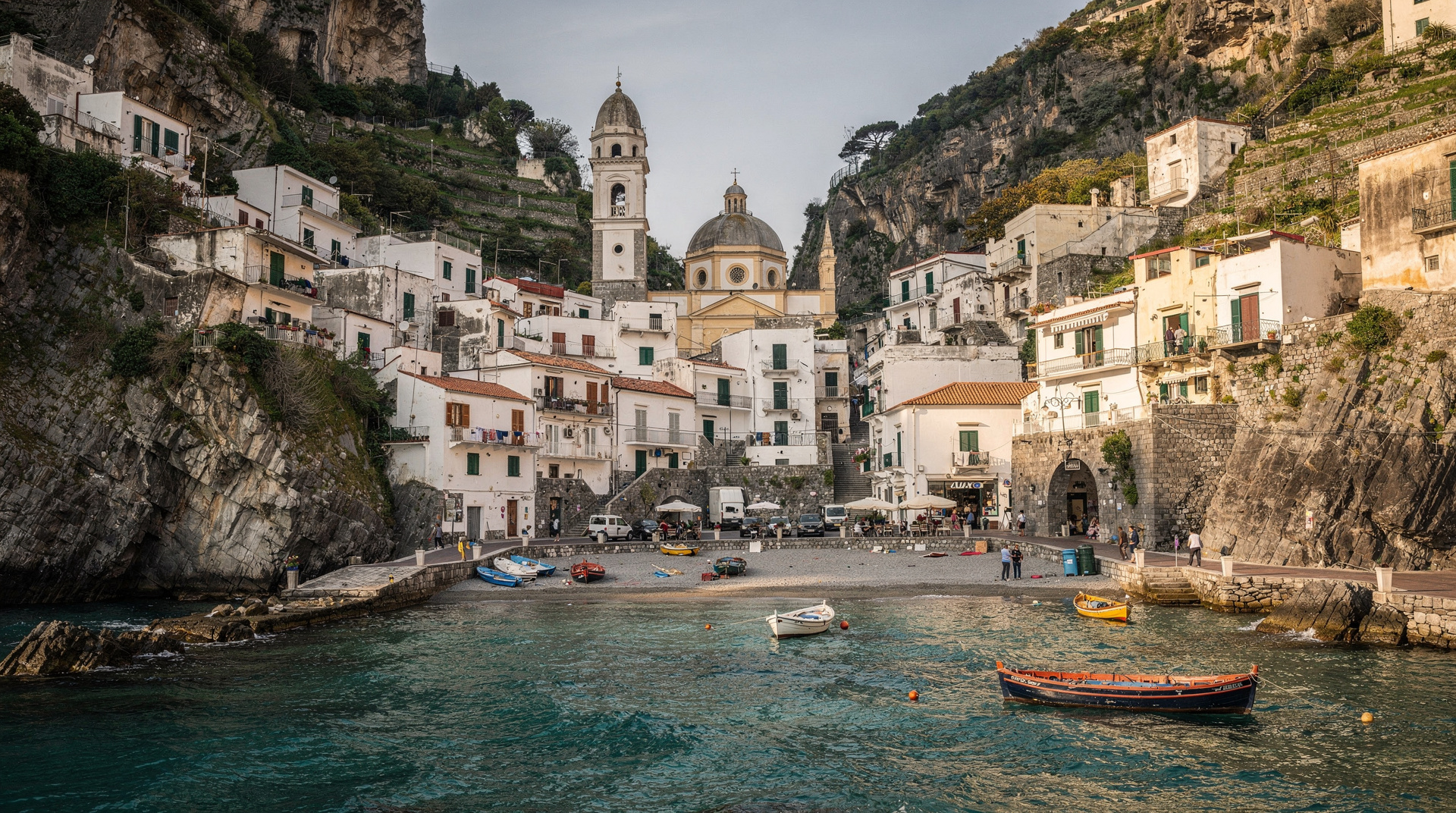
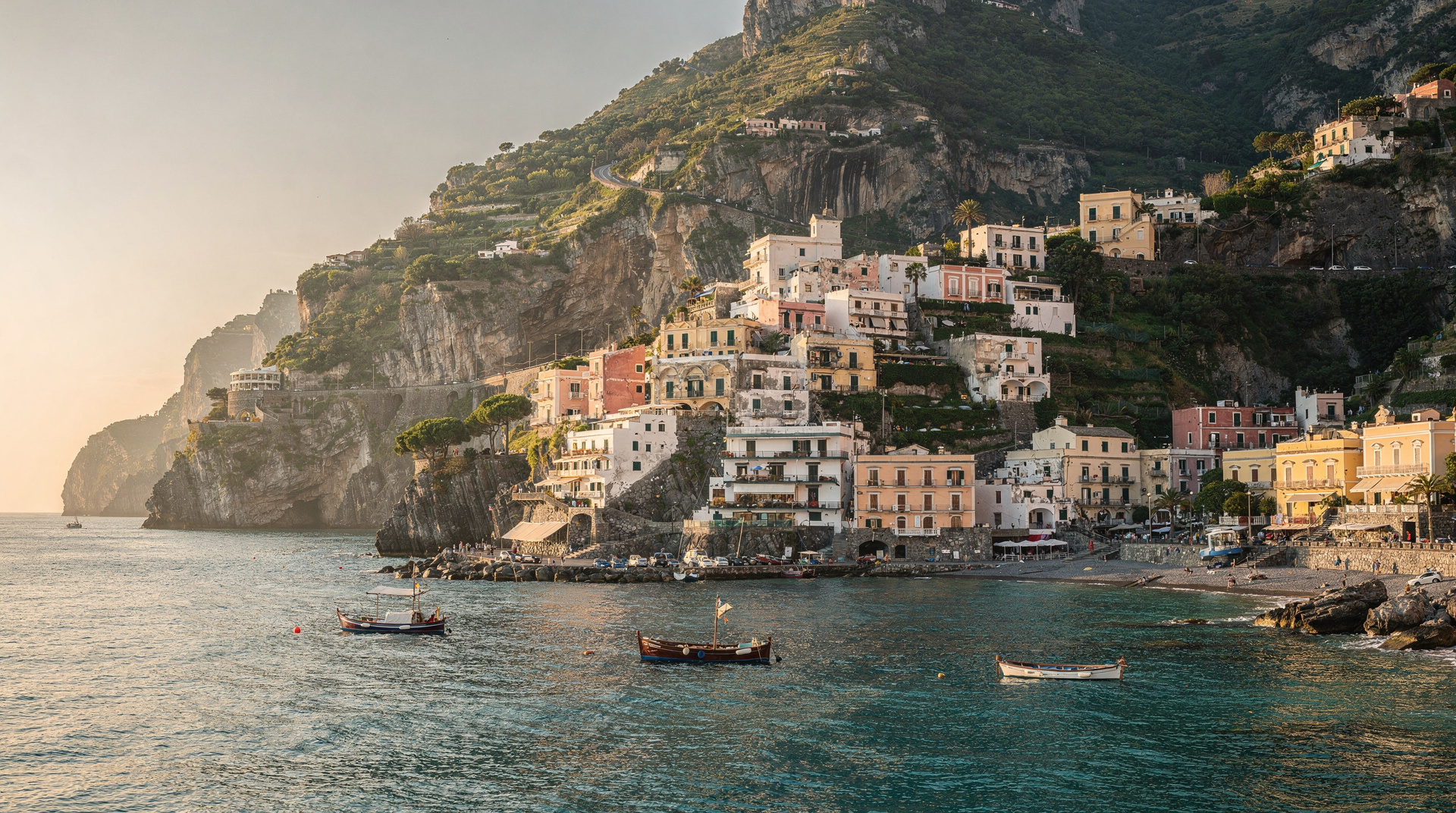
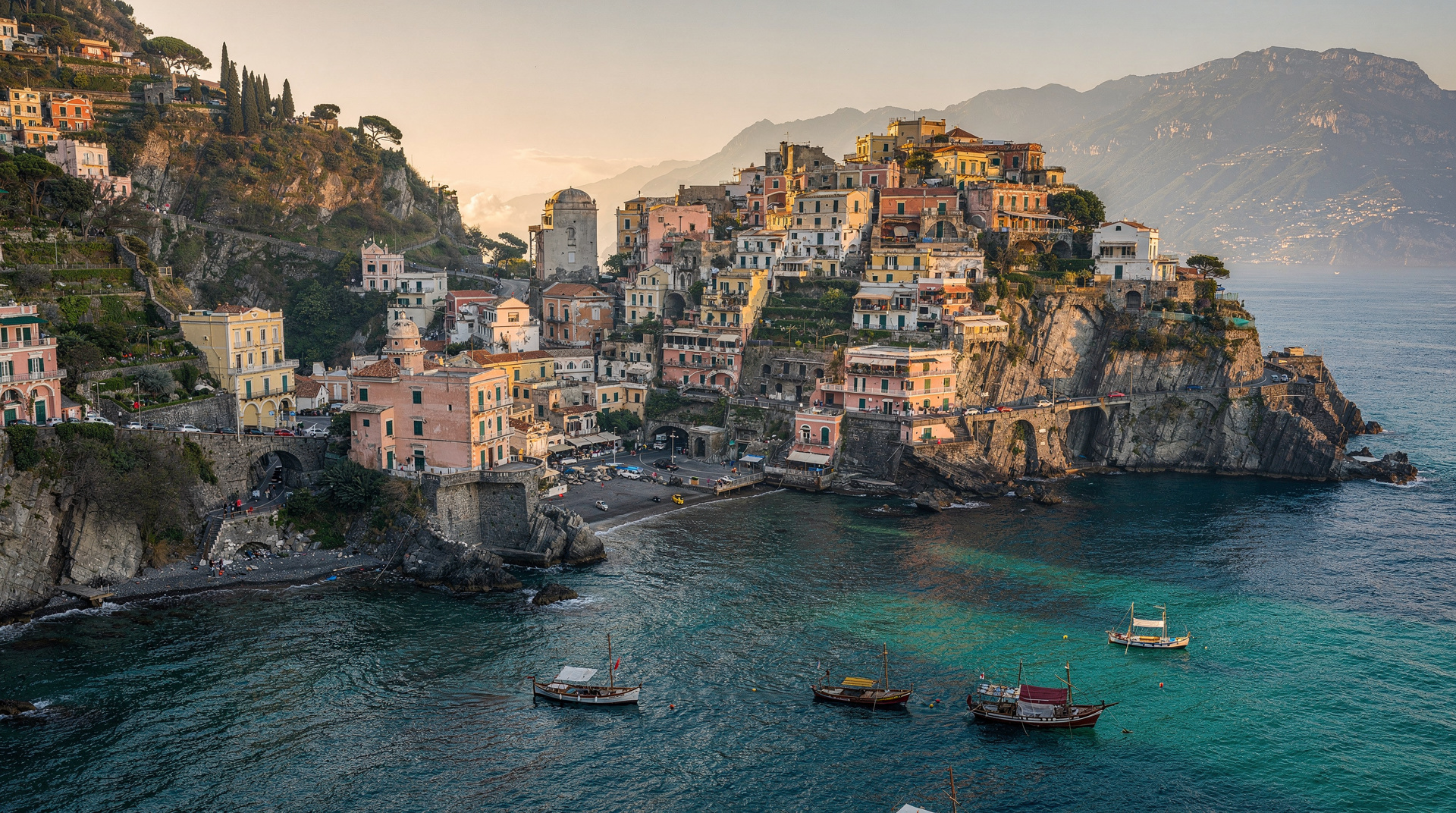
Seasonal hydrofoils and ferries run from Molo Beverello in Naples to Amalfi from April to October, approximately 1h 30min to 2 hours depending on the service. This is the most pleasurable way to arrive: the approach to Amalfi from the sea — with the white town rising above the harbour — is genuinely impressive. Tickets cost around €20–€25. Check ferries from Naples for operators.
From Salerno (cheaper and underused)
Salerno, 40 kilometres east, is connected to Amalfi by year-round boat service (Travelmar and others) and by SITA bus. The ferry takes 35–40 minutes and costs around €8. This route is popular with local commuters and cheaper than the Naples approach. Salerno is reachable from Naples by Frecciarossa train in 35 minutes (from €9 in advance).
Full-day tour from Naples covering Amalfi and RavelloFrom Positano by bus or ferry
SITA bus east from Positano to Amalfi takes ~35 minutes; ferry ~20 minutes in season.
Amalfi as a transport hub
This is probably Amalfi’s most underrated function. The town sits at the intersection of the coast road (SS163) and the inland routes up to Ravello (9 km by bus, ~20 minutes) and toward Agerola (the Path of the Gods trailhead). Ferries and hydrofoils call here from Naples, Salerno, Sorrento, and Positano, and SITA buses run in both directions along the coast plus up to Ravello.
If you are spending two or three days on the Amalfi Coast and do not want to drive, Amalfi town makes a logical overnight base: cheaper than Positano, easy connections to Ravello and the hiking trails, direct ferry back to Naples or Salerno.
Where to eat in Amalfi
Honest mid-range options
Trattoria San Giuseppe (Salita Ruggiero Ii 4, near the cathedral): no-frills Neapolitan menu, good spaghetti con le vongole (€14), grilled totanetti (€15). Lunch only; arrives late morning to find a table.
Osteria da Luisella (Via Lorenzo d’Amalfi, alley parallel to the main street): local crowd, daily specials board, fixed-price lunch €16 including primo, secondo, and water. Do not expect great service; do expect honest food.
Bar Il Duomo (Piazza del Duomo): for coffee and sfogliatella (€2.50 at the counter, €4.50 at a table). The riccia (crispy, flaky) version is better than the frolla here.
What not to expect
Amalfi is not a great fish restaurant town in the way Cetara is. Most seafood restaurants cater to tourists with pan-Italian menus. The better food is in the alleys away from the piazza.
The beach and coastal walks
Amalfi’s town beach is small, grey pebble, and pressed against the ferry pier — not a destination beach. The nearest decent beach is at Atrani, a five-minute walk east around the headland (see below). The Fiordo di Furore, a dramatic natural inlet, is about 6 km west toward Praiano and worth a SITA bus detour.
Day trips from Amalfi
Ravello (20 minutes uphill)
The hilltop town of Ravello is Amalfi’s most rewarding day trip. SITA buses depart from the main bus terminal (near the harbour) every 30–60 minutes; the ride climbs 350 metres in 20 minutes. The Villa Rufolo gardens and Villa Cimbrone (Terrazza dell’Infinito) justify the trip even without the Ravello Festival.
Atrani (5 minutes on foot)
Atrani is technically a separate town but feels like Amalfi’s quieter back garden. Walk east from the main piazza, through a low tunnel, and you emerge into a small square with a church, a couple of bars, and a narrow free beach. Almost no tour groups penetrate this far. See Atrani for details.
Valle dei Mulini hike
From the Museo della Carta, a trail continues up the gorge for another 2–3 km to the ruins of abandoned mills and a waterfall (seasonal water flow). This is excellent in spring and early autumn. Wear proper walking shoes; the path is uneven and can be slippery.
Small-group day trip from Naples via Sorrento and Positano to AmalfiPractical information
Luggage storage: there is a consegna bagagli service near the ferry dock charging around €5 per bag — useful if you are using Amalfi as a transit hub without a hotel room.
Toilets: public toilets in the main piazza, coin-operated (€0.50). Most café toilets are accessible to customers.
ATMs: several on Via Lorenzo d’Amalfi. Surcharges apply at private ATMs near the tourist areas; use a bank ATM.
Mobile signal: good on the main streets, weaker in the Valle dei Mulini.
High season timing: the Piazza del Duomo fills up with organised tour groups between about 10:30 and 16:00. Arriving at opening (08:30 for the cloister) or after 17:00 is noticeably more pleasant.
The Maritime Republic of Amalfi: a brief history
Between roughly 839 and 1073, the Republic of Amalfi was one of the four major maritime republics of medieval Italy, alongside Venice, Genoa, and Pisa. At its peak the republic controlled a fleet of warships and merchant vessels that operated across the eastern and western Mediterranean, establishing trading posts in Constantinople, Alexandria, Tunis, and Acre. Amalfitan merchants introduced Arab papermaking techniques to Europe. The Tabula de Amalpha, or Amalfi Tables, produced here between the 11th and 13th centuries, were the earliest maritime code in the western world, governing commercial relations and dispute resolution at sea.
The republic ended with two catastrophes: the Norman conquest of 1073, which brought Amalfi under Sicilian rule, and a series of natural disasters — a massive earthquake in 1343 caused much of the original harbour and lower city to collapse into the sea. What remains today is a fraction of the medieval city. The modern shoreline is several hundred metres further inland than the 11th-century harbour. The seafloor off Amalfi contains archaeological deposits that have never been systematically excavated.
This history matters for understanding the town’s current character. Amalfi is a place that was once much larger and more significant than it appears — a major city reduced by geology and conquest to a coastal town of 5,000. The Duomo, the Cloister of Paradise, and the Arsenale are relics of a scale that the present town cannot fully account for.
The SS163 through Amalfi: practical logistics
The Amalfi Coast road passes through the town, and the junction at Amalfi is where the inland road to Ravello branches off. This makes Amalfi the natural pivot of any SS163 itinerary. If you are driving the coast, parking in Amalfi for the day and using buses to reach Ravello (uphill) and the western towns (Positano direction) eliminates the need to drive the most difficult sections.
The main car park in Amalfi is at the lungomare (seafront), pay-and-display. It fills completely by 10:00 on summer weekends. A larger car park exists at Pogerola, 3 km uphill above Amalfi, with a free shuttle bus down to the town (check current operation locally). Some hotels on the approach road to Amalfi have private garages available for non-guests at a daily rate of €20–€25.
For the plate-number restrictions on the SS163 (even plates on even dates, odd on odd, 10:00–18:00, June–September), Amalfi itself is the boundary between the most restricted western section and the somewhat less congested eastern section toward Maiori and Salerno. Buses and motorcycles are exempt from the restriction.
Boat tours from Amalfi
Amalfi harbour is a departure point for seasonal boat tours covering the Emerald Grotto (Grotta dello Smeraldo), Positano, and the offshore sea caves. The Grotta dello Smeraldo, 3 km west of Amalfi near Conca dei Marini, is an illuminated sea cave with distinctive green water caused by refracted light entering through a submerged opening. Entry is by small rowing boat and costs €5 separate from the boat tour transfer. The experience is beautiful on calm days; on rough days the water slops and the cave is closed. Morning visits (08:00–09:00) have the best light conditions and fewest visitors.
A combined tour from Amalfi covering the Grotta dello Smeraldo and Positano by sea takes approximately 3–4 hours. Half-day boat rentals from the harbour start at around €80 for a small self-drive boat (no licence required under 40 hp), allowing independent exploration.
Lemons, limoncello, and the terraces above town
The steep terraces rising behind Amalfi and along the whole coast are planted with sfusato amalfitano, a large, thick-skinned lemon variety grown under characteristic chestnut-pole pergolas (pergolati) that shade the fruit and make the near-vertical terracing possible. The lemons are harvested nearly year-round but peak February–October, and Amalfi’s shops sell limoncello made from them alongside lemon-based sweets, marmalades, and delicato (a milkier, lower-proof cream liqueur).
A 500ml bottle of decent limoncello runs around €12–€18; anything much cheaper is unlikely to use real sfusato lemons. For a deeper dive into the production side, Sorrento’s limoncello guide covers the same tradition from the neighbouring peninsula, and wine tasting near Naples covers the region’s other agritourism options if lemons aren’t your focus.
A short, little-used path climbs from behind the Museo della Carta through active lemon terraces for about 20 minutes before rejoining the Valle dei Mulini trail — worth the detour if you want to see the pergola structures at close range rather than just from the road.
When to visit Amalfi: month by month
| Period | Conditions | Verdict |
|---|---|---|
| Nov–Mar | Cool, wet, many restaurants and the Museo della Carta on reduced hours | Quiet but limited; some SITA services also reduced |
| Apr–May | Mild, lemon terraces in bloom, ferries resuming | One of the two best windows |
| Jun | Warming up, tour groups increasing | Good but book Cloister of Paradise entry ahead |
| Jul–Aug | Hot, Piazza del Duomo overwhelmed 10:30–16:00, SS163 plate restrictions active | Manageable if you keep to early/late hours; avoid if crowds bother you |
| Sep–Oct | Warm sea, thinning crowds, Ravello Festival wrapping up | The other best window |
Amalfi’s festivals and the Regata Storica
Amalfi’s calendar has two fixed points worth planning around. Sant’Andrea’s feast day (30 November, plus a second celebration on 27 June) sees the patron saint’s silver bust carried in procession from the Duomo through the town, accompanied by fireworks over the harbour — a genuinely local event rather than a staged tourist spectacle.
The Regata Storica delle Repubbliche Marinare, a historic rowing regatta between Amalfi, Venice, Genoa, and Pisa recreating the rivalry of the medieval maritime republics, rotates among the four cities and lands in Amalfi roughly once every four years; when it does, the town fills with costumed processions and the race itself is rowed in replica period boats just off the harbour. Check the town’s tourist office site for the current year’s host city before planning a trip around it.
Frequently asked questions about Amalfi
Is Amalfi worth visiting compared to Positano?
For most travellers, yes. Amalfi has more substance: a genuine medieval monument (the Duomo), a functioning local town, better transport connections, and lower prices. Positano wins on visual drama and beach quality; Amalfi wins on history and practicality. See Amalfi Coast towns compared.
How long do you need in Amalfi?
Half a day is enough to see the Duomo, the Cloister of Paradise, the Museo della Carta, and have lunch. A full day adds the Valle dei Mulini walk, a trip to Atrani, and a boat excursion. Overnight stays make sense as a base for Ravello and the hiking trails.
Can you reach Amalfi without a car?
Easily. The town is exceptionally well connected by SITA bus (from Sorrento and Salerno) and by seasonal ferry from Naples, Salerno, Positano, and Sorrento. It is one of the easiest towns on the Amalfi Coast to reach without a car.
What is colatura di alici?
A fermented anchovy sauce produced by slow-draining salted anchovies through a chestnut barrel over 2–3 years. It is a culinary condiment used sparingly on pasta, vegetables, and bruschetta — a few drops replace salt and add umami depth. Produced primarily at Cetara (20 km east) but widely sold in Amalfi shops. A 100 ml bottle costs €8–€15 depending on quality; look for Cetara-labelled producers.
When does the Ravello Festival take place?
The Ravello Festival (classical and contemporary music) runs from late June through late September, with performances on the cliffside stage of Villa Rufolo. Tickets sell months in advance for headline concerts. See the Ravello guide for details.
Is the Cloister of Paradise worth the €3 entry fee?
Yes, clearly. It is one of the most distinctive pieces of Norman-Arab architecture in Campania, and the combination with the crypt makes it the most complete visit to a major medieval monument on the Amalfi Coast. The 30-minute combined visit is good value.
How do you get from Amalfi to Ravello?
SITA bus from the main bus terminal near Amalfi harbour, roughly every 30–60 minutes, 20 minutes, approximately €1.30. Taxis charge €20–€30. There is no other public transport option; driving is possible but parking in Ravello is limited. See Ravello for more detail.
Is limoncello from Amalfi different from Sorrento’s?
Not fundamentally — both use the same DOP-recognised lemon varieties grown on the Sorrentine-Amalfi peninsula, and quality depends more on the individual producer than the town. Amalfi shops sell plenty of mass-produced bottles alongside genuinely good small-batch versions, so check the label for “sfusato amalfitano” or ask before buying. See Sorrento limoncello guide for what to look for.
Guided 3-hour walk through the Valle delle Ferriere above AmalfiTop experiences
Bookable activities with verified prices and instant confirmation on GetYourGuide.