Atrani
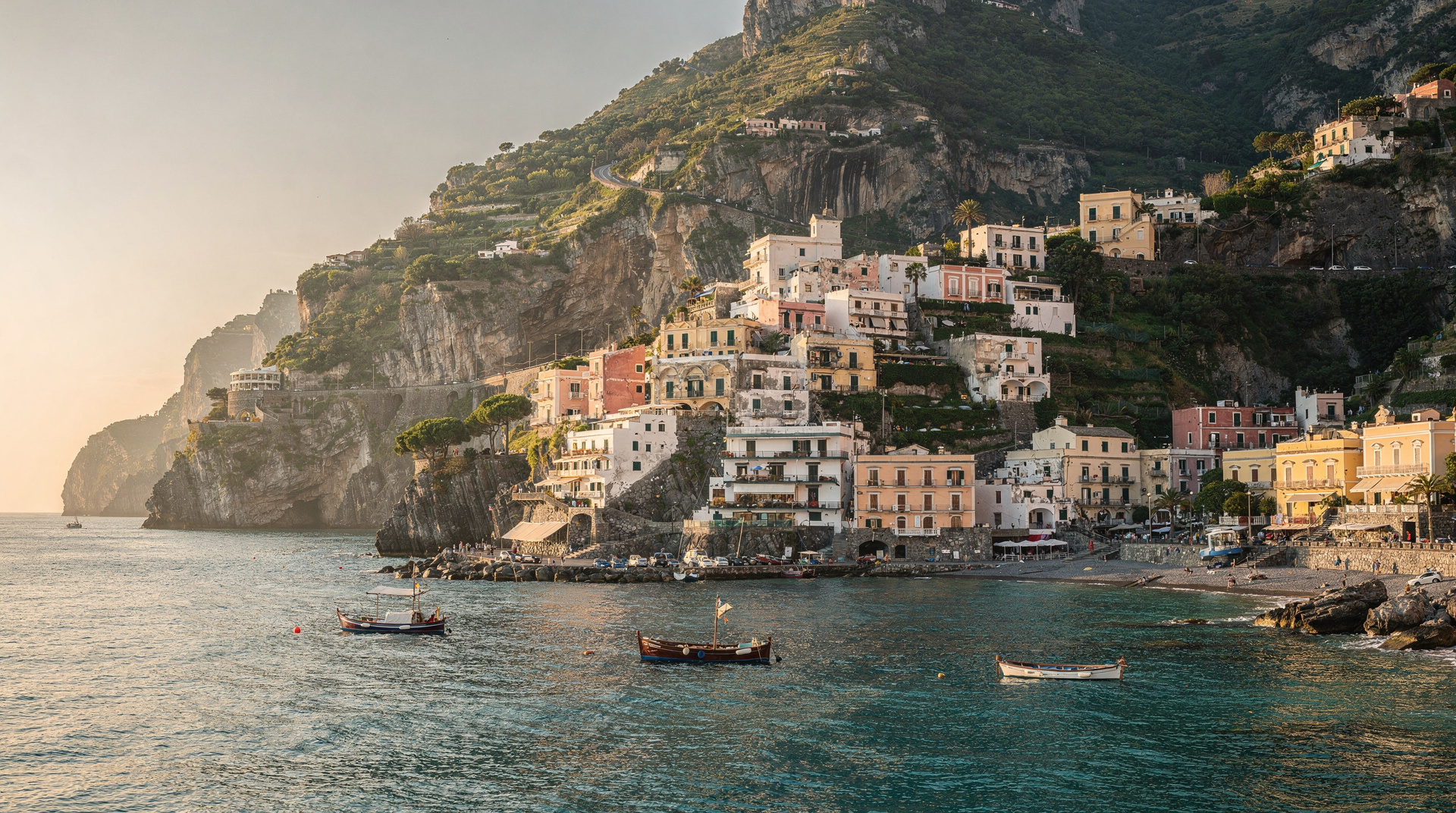
Atrani is the smallest commune in Italy, five minutes from Amalfi, with a free beach, a medieval piazza, and almost no tour groups. The honest guide for 2026.
From Ravello: Amalfi Coast Private Day Trip
Quick facts
- Population
- ~900 residents
- Area
- 0.12 km² — smallest commune in Italy
- Distance from Amalfi
- 500 m on foot
- Beach
- Small free pebble beach
- Key church
- Chiesa di San Salvatore de' Birecto (10th century)
- Crowds
- Low — almost no organised tours
Atrani has a peculiar distinction: it is, by official Italian reckoning, the smallest commune in mainland Italy by area — 0.12 square kilometres wedged between two rock spurs where the Dragone valley meets the sea, immediately east of Amalfi. The town has around 900 residents and almost no facilities aimed at tourists. This is exactly its appeal.
| Where | 500m east of Amalfi on foot, via a tunnel under the cliff |
| Cost | Free beach and piazza; lunch around €13–€20 per person |
| Time needed | 2–3 hours; a full half-day combined with Amalfi |
| Getting there | Walk from Amalfi (5 min) or SITA bus to the tunnel stop |
| Best time | April–October; late afternoon for the quietest, most local atmosphere |
Why Atrani matters on the Amalfi Coast
The Amalfi Coast has a predictable tourist circuit: Positano for photographs, Amalfi for the Duomo and transport, Ravello for the views. Atrani sits outside that circuit. Most organised tours do not stop here. Coach trips physically cannot enter — the access road is a single-lane tunnel under the cliff. The result is that even in July and August, when the coast 500 metres to the west is choked with visitors, Atrani’s central piazza is mostly occupied by local residents, old men on benches, and the occasional traveller who noticed it on a map.
Getting to Atrani from Amalfi
On foot from Amalfi: five minutes. Exit Amalfi’s main piazza heading east toward the seafront, follow the path under the cliff arch, and you emerge into Atrani. There is no bus stop in the core of the village; the SITA bus on the main coastal road stops at the tunnel entrance, a two-minute walk up.
Arriving from Ravello by foot: a trail descends from Ravello through the terraced hillside to Atrani in 45–75 minutes, passing through chestnut woodland and abandoned lemon terraces. This is one of the best short hikes in the area and largely unknown to most visitors.
Piazza Umberto I: the heart of the village
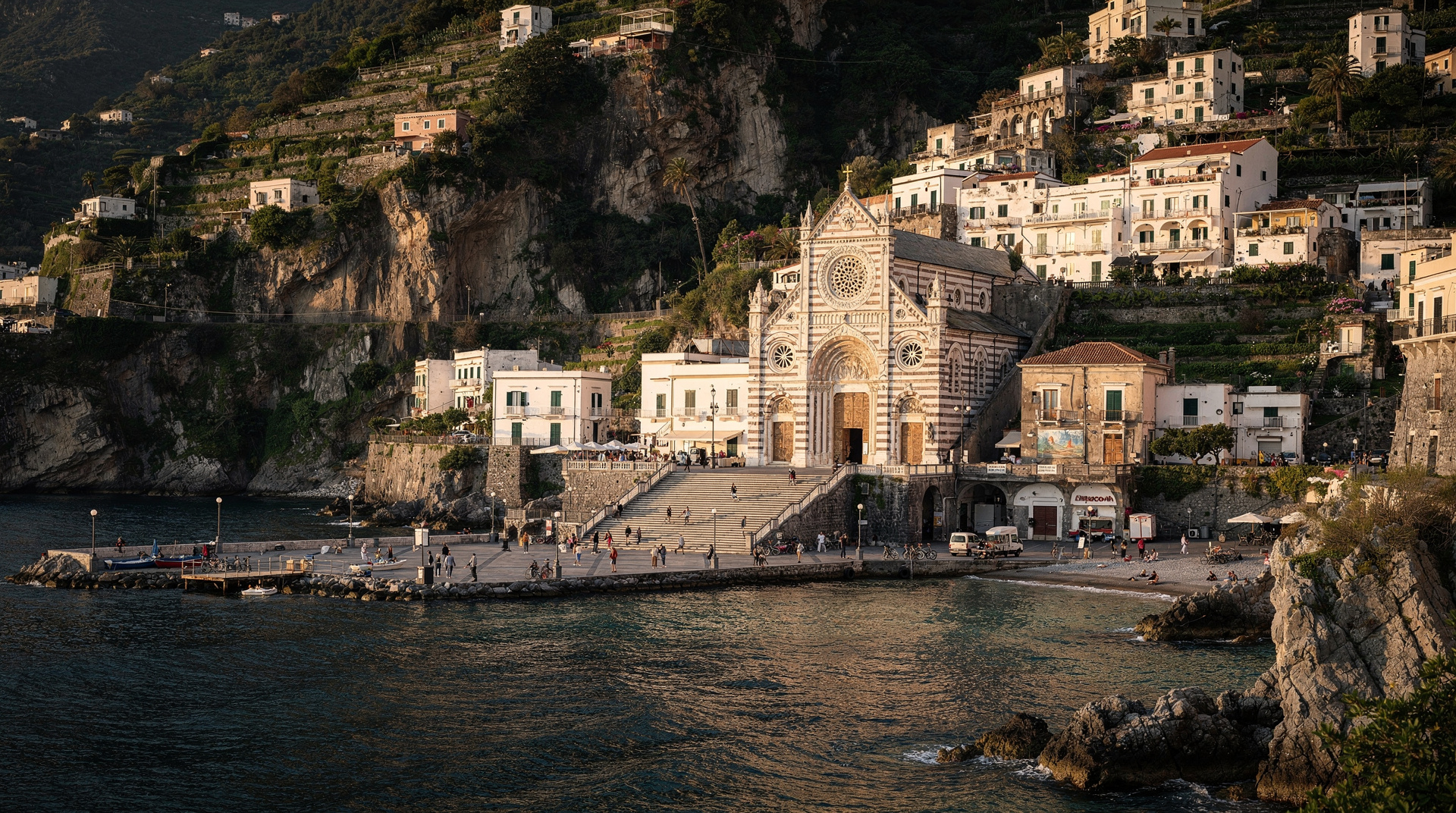
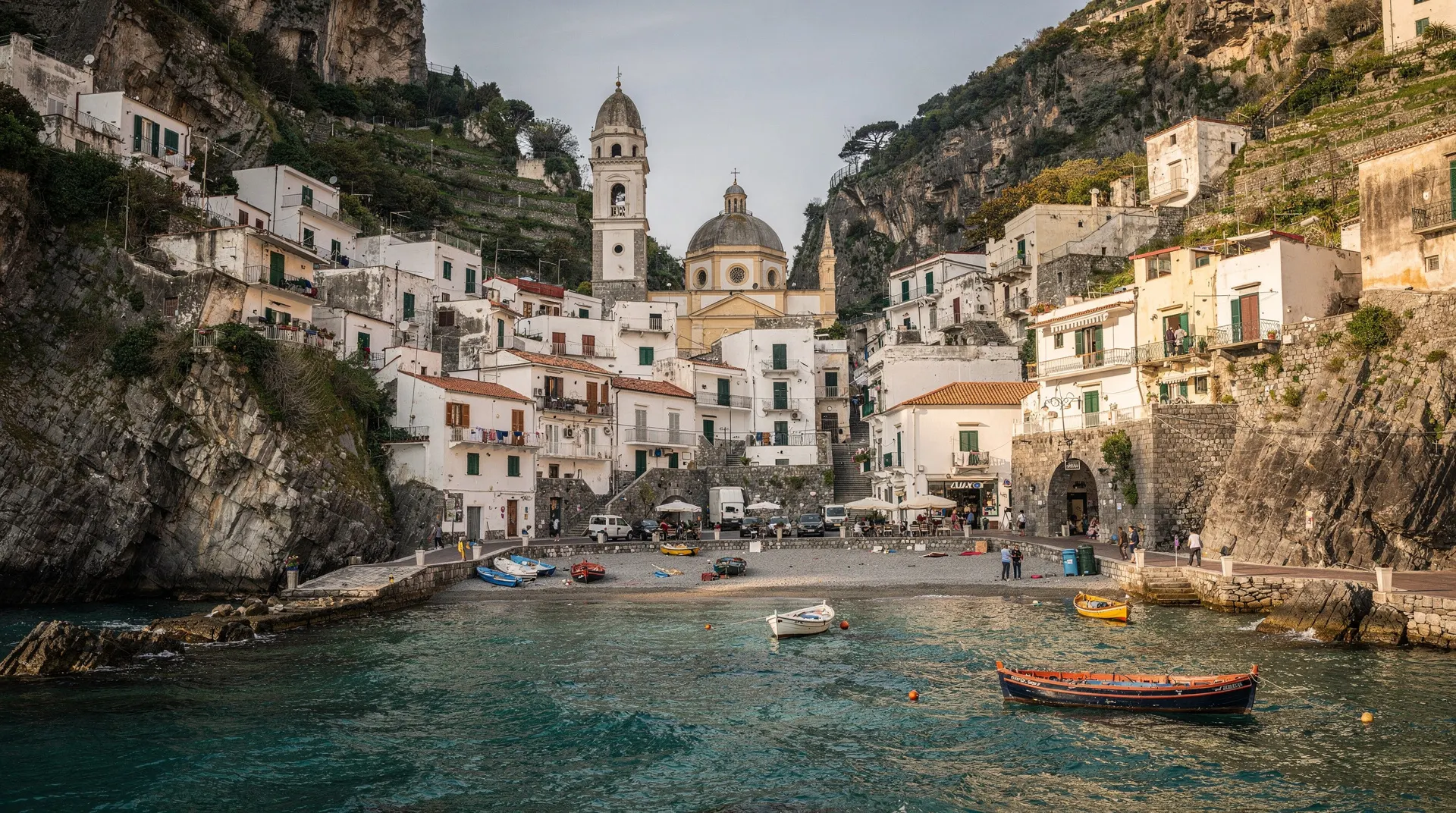
The tiny square at the bottom of the Dragone valley is, in a technical sense, one of Italy’s most scenic piazze. Two medieval churches flank it: the Collegiate church of Santa Maria Maddalena (18th-century facade over an older structure) and the lower portal of San Salvatore de’ Birecto. A café-bar occupies one corner — the same bar that has been there for decades under different names. Coffee at the counter: €1.30. An aperitivo as the afternoon light hits the church facade: €5 including olives.
The square floods regularly during heavy rain because the Dragone river runs under it via a culvert built in the 18th century. This occasional flooding is visible as watermarks on the lower church walls; local residents accept it as part of the town’s character.
Chiesa di San Salvatore de’ Birecto
The most historically significant building in Atrani is a 10th-century church at the upper end of the main piazza. Its bronze doors — cast in Constantinople in 1087, the same Byzantine metalwork tradition as the doors of Amalfi Cathedral — were the entrance through which the doges (rulers) of Amalfi formally received their investiture cap (birecto, the origin of the church’s full name). The church is usually closed except for weekend services; if open, entry is free and the interior contains a 15th-century fresco of the Annunciation.
The beach
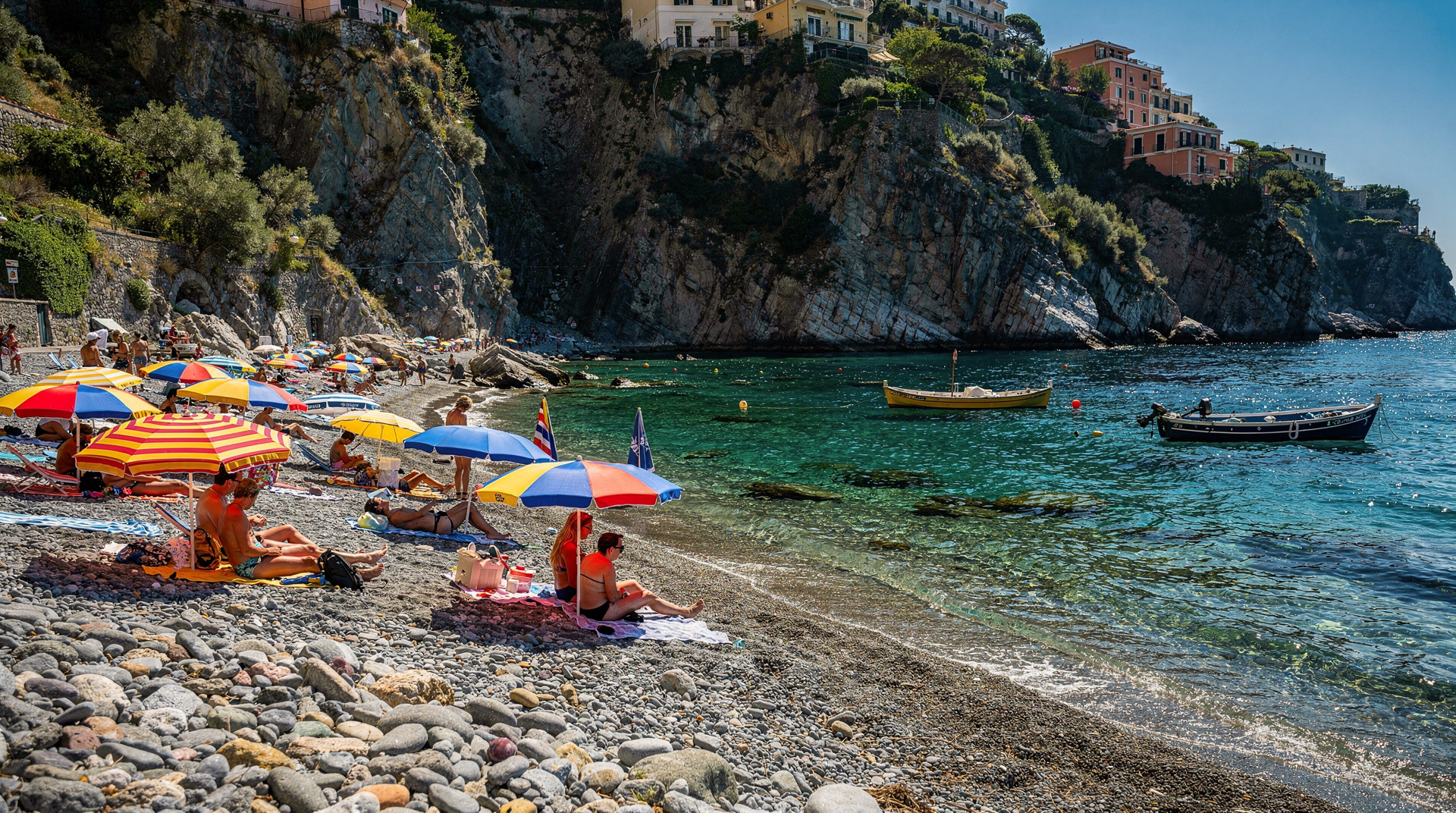
Atrani’s beach is tiny — perhaps 60 metres wide — pebble, and has a free public section (no sunbeds, no fee) directly in front of the town. A small private beach club operates the northern end with plastic sunbeds at around €15 per day. The beach is in the shadow of the surrounding cliffs by mid-afternoon in summer, which means cooler swimming but less sun after 15:00. The water is clean and the absence of large beach clubs and thumping music makes it a genuinely more relaxed alternative to Positano’s Fornillo.
Snorkelling around the rocks at the base of the eastern cliff reveals small caves and good fish populations — bring your own mask and fins as there is no equipment rental in the village.
Practical eating in Atrani
There are two or three restaurants in Atrani proper. Given the size of the village, the offer is limited.
A’ Paranza (Via Dragone): the best-known restaurant in the village, specialising in fish. Booking required in high season. Pasta with sea urchin (ricci di mare) around €18; grilled catch of the day €20–€25. Not cheap, but the quality is real and the prices are 20–30% below comparable Amalfi restaurants with sea views.
La Risacca (seafront, near the beach): casual, plastic tables, good for a long lunch after swimming. The linguine alle vongole (€13) and the mixed fried fish plate (frittura di paranza, €14) are the reliable choices.
For a coffee and pastry, the bar in Piazza Umberto I opens early and stays open late — a working bar for the village, not a tourist café.
Atrani vs. Amalfi: when to choose one over the other
For the authentic small-town atmosphere, free beach access, and a look at how Amalfi Coast residents actually live, Atrani is more interesting than central Amalfi town. For historical monuments (the Duomo, the Cloister of Paradise, the Museo della Carta), Amalfi is where you need to be. The obvious approach is to combine both in a half-day: arrive at Amalfi by ferry or SITA bus, spend 2 hours on the cathedral and the museum, then walk east to Atrani for lunch and a swim before catching a bus back to Sorrento or onward to Ravello.
Accommodation and staying overnight in Atrani
Atrani has a small but real accommodation market, almost entirely B&Bs and private-let apartments. Because the town is not on any organised tour circuit, prices are 20–35% lower than Amalfi town and 40–60% lower than Positano for comparable standards. A double room in a well-reviewed B&B runs €90–€150 in shoulder season (May, September, October) and €140–€200 in July–August.
The appeal of staying here is specific: you are within walking distance of Amalfi’s ferry and bus connections but sleeping in a town with no tourist infrastructure. The bars close at midnight at the latest. There are no clubs. The church bells wake you at 07:00. If this sounds pleasant rather than inconvenient, Atrani is your Amalfi Coast base.
Practical limitation: all accommodation requires carrying luggage up steps or through narrow alleys from the road. Most properties have no lift. Confirm stair counts with the host before booking if this is relevant.
What to actually do in Atrani (without overstating it)
Atrani is a town for being in rather than for doing things. The honest itinerary: arrive at 10:00, walk around the piazza, look at the church of San Salvatore de’ Birecto, walk to the beach for a swim, have lunch at A’ Paranza or La Risacca, walk to Ravello via the trail (45–75 minutes, one way), take the bus back to Amalfi, SITA bus or ferry onward.
That is a full and satisfying half-day. There is no need to manufacture significance. The village is not concealing a major monument or a world-class restaurant. Its value is comparative: it demonstrates what the rest of the coast looks like when the tourism layer is partially removed. This is useful information.
Connecting to the rest of the coast
From the SITA bus stop at the Atrani tunnel entrance, buses run west to Positano (35 minutes) and east toward Maiori (10 minutes) and Minori (15 minutes). The full SITA bus guide explains the ticketing and frequency in detail.
Atrani does not have ferry service — the nearest ferry port is Amalfi harbour, 500 metres on foot.
Evening in Atrani: what happens after the day-trippers leave
The evening in Atrani is the best argument for an overnight stay. By 17:00 the coastal road beyond the tunnel carries fewer buses; the piazza fills with school-age children riding bicycles in circles, which is objectively a better visual than any Instagram filter. The bar opens its terrace tables. The restaurants begin their dinner service. Local fishermen sit by the beach wall.
None of this is performative. No one is trying to appear “authentic.” The town is just doing what it does — living — and a traveller willing to sit quietly in the corner of the bar with a Campari soda gets to observe it without being an intrusion.
The lack of tourist infrastructure is a genuine inconvenience: no taxi stand, no pharmacy (the nearest is in Amalfi), one food shop with limited hours. The tradeoff is complete: if you want a beach holiday on the Amalfi Coast without the price and the noise, Atrani is the answer.
The Dragone valley above Atrani
The valley that the town sits at the mouth of — the Vallone di Atrani — is a narrow gorge that climbs steeply north into the hills. A path follows the stream bed for about 2 km, passing the ruins of a medieval mill and several abandoned terraced plots. This is not a well-maintained tourist trail but a rough walking path used occasionally by hunters and shepherds. The vegetation changes rapidly from coastal scrub to dense chestnut and oak; in spring, the stream carries real water from snowmelt above and the gorge is cooler than the coast by 5–6 degrees.
Do not attempt the gorge in heavy rain — the path can become a watercourse. In dry conditions (May through October) it is a pleasant 90-minute round trip that almost no visitor undertakes. Wear closed shoes and bring water.
What Atrani tells you about the Amalfi Coast
The Amalfi Coast has been managed for mass tourism since the 1960s, and the effect is visible at every famous viewpoint: coach parks, souvenir stands, restaurants with picture menus, prices adjusted upward for the assumed tourist budget. Atrani is what the coast looked like before that process completed — before the decision was made (or evolved by market force) that all available land facing the sea should generate maximum tourist income.
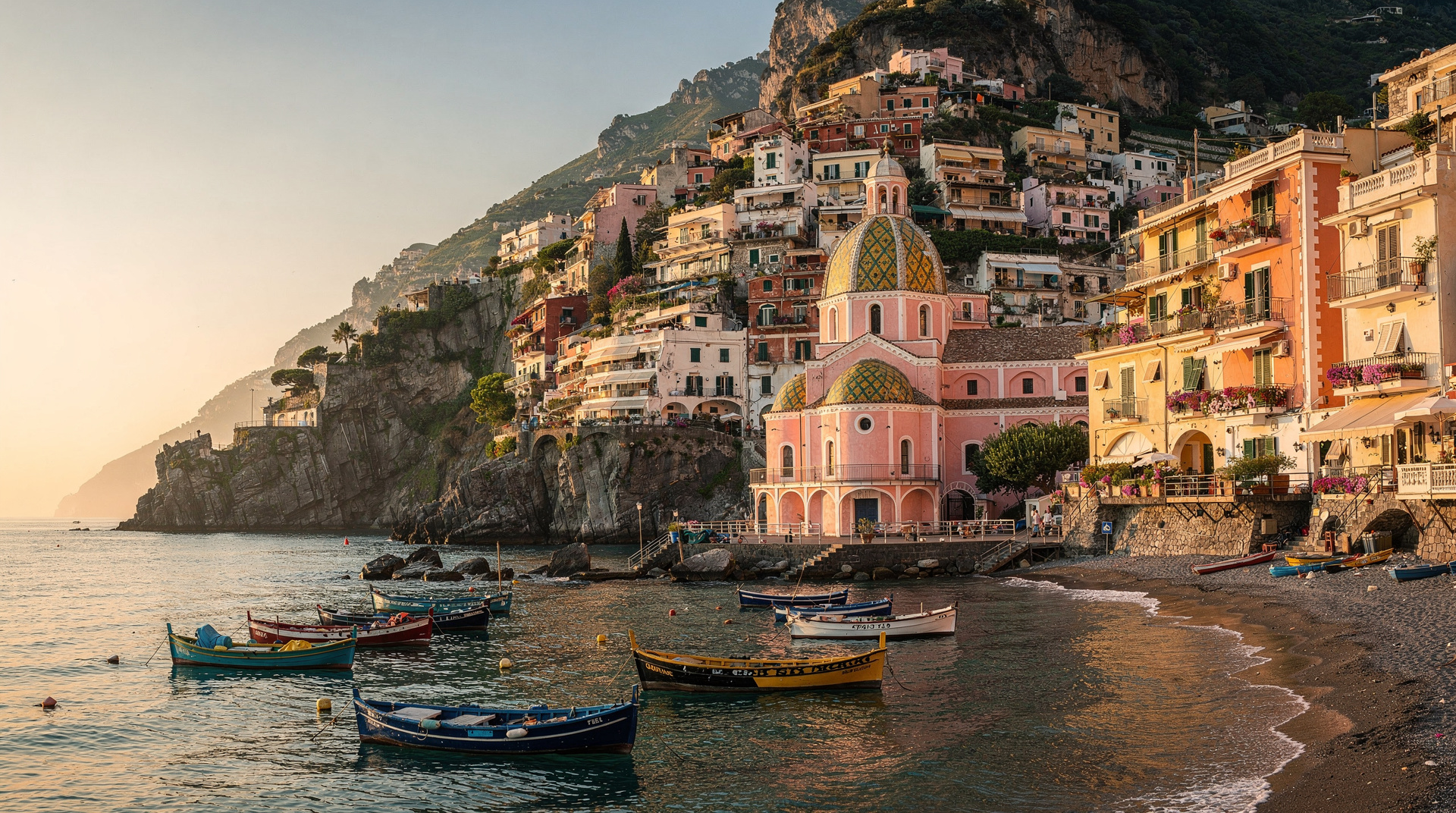
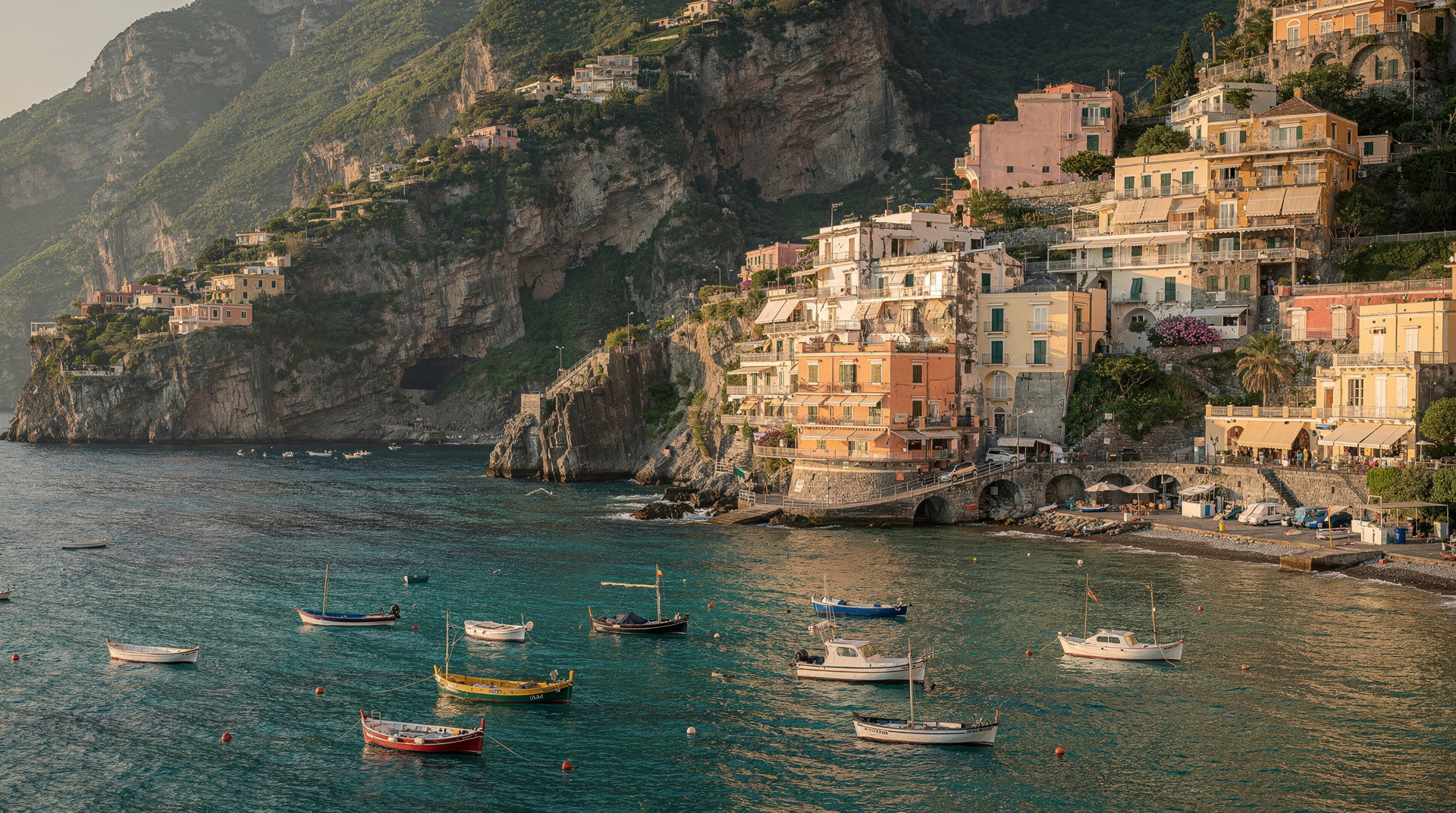
That does not make Atrani better than Positano, whose cliff-stacked houses are a genuine natural and architectural wonder. It makes it different in a way that changes the experience of the coast. Spending one afternoon in Atrani recalibrates your sense of what the coast actually is: a working landscape of fishing, farming, and small-town Mediterranean life that happens to have been discovered by tourists, rather than a destination that has always existed to be photographed.
Atrani and M.C. Escher
The Dutch artist M.C. Escher visited the Amalfi Coast in the 1930s and made several sketches of Atrani’s stacked houses and stairways; the town’s tightly layered architecture is credited by some art historians as an influence on the impossible-geometry staircases in his later lithographs, including the well-known Relativity.
Whether or not you buy the direct influence argument, standing in the piazza and looking up at the houses climbing the rock spurs on either side, the visual logic is easy to see: staircases disappearing behind buildings, doors opening onto what look like other buildings’ roofs, a settlement genuinely built into rather than onto the landscape. It is a useful lens for looking at the village even if you have no particular interest in art history.
Atrani compared to its neighbours
| Town | Distance from Atrani | What it offers instead |
|---|---|---|
| Amalfi | 5 min walk | Duomo, Cloister of Paradise, ferry/bus hub, restaurants |
| Ravello | 45–75 min hike or bus via Amalfi | Villa Rufolo, Terrazza dell’Infinito, music festival |
| Maiori | 10 min by SITA bus | The coast’s longest sandy-ish beach |
| Positano | 35 min by SITA bus | Cliff-stacked houses, Fornillo and Spiaggia Grande beaches |
Atrani’s value against this table is specific: it is the only one of these that costs nothing to enjoy properly and takes almost no advance planning — no timed tickets, no beach-club reservations, no festival calendar to work around.
A’ Paranza, La Risacca, and a longer look at eating here
Both of Atrani’s sit-down restaurants reward a slower visit than a rushed lunch stop. A’ Paranza’s fish comes from boats that tie up literally metres from the dining room in the early morning; the kitchen’s approach changes with what came in that day rather than running a fixed printed menu for the sea-urchin and catch-of-day dishes. La Risacca, being cheaper and more casual, is the better choice if you are coming straight from a swim and want an unfussy plate of pasta rather than a full seafood dinner. Neither restaurant does the extended English-language tourist menu common in Amalfi and Positano — a good sign for food quality, a minor inconvenience if your Italian is limited (pointing at the specials board works fine).
Walking and cooking tour along the Amalfi Coast, including tastings near Amalfi and AtraniFrequently asked questions about Atrani
Why is Atrani called the smallest town in Italy?
By land area: 0.12 km². This is an administrative classification based on the official commune boundary, which covers only the narrow valley mouth. Several other Italian comuni contest the “smallest” title using different measurements, but Atrani is consistently listed in official statistics.
Is Atrani worth visiting if I only have one day on the Amalfi Coast?
Yes, as an add-on to Amalfi rather than as a standalone destination. The five-minute walk from Amalfi piazza takes you out of the tourist circuit almost immediately. It adds 90 minutes to a half-day Amalfi visit and delivers a sense of the coast’s scale and character that the busier towns cannot.
Does Atrani have any accommodation?
A handful of B&Bs and private rental apartments operate here, typically priced lower than Amalfi and Positano. Staying in Atrani is unusual — most visitors use it as a walk-in day stop from Amalfi — but it is a quiet and genuine option for those who want to be on the coast without paying Amalfi prices.
Can you hike from Ravello to Atrani?
Yes. The trail descends through woodland and old terraces and takes 45–75 minutes. The path is not perfectly signposted; some trail knowledge or a detailed map helps. The ascent in reverse takes 60–90 minutes. It is a genuinely pleasant walk and much less trafficked than the main coastal footpaths.
Is the Atrani beach better than Amalfi town beach?
Atrani’s beach is small but has free public access, no tourist infrastructure, and a quieter atmosphere. Amalfi’s town beach is dominated by its ferry pier and is not a swim destination. For a proper swim, Maiori (10 minutes east by bus) has the Amalfi Coast’s longest beach.
Are there any festivals in Atrani?
The Feast of San Salvatore (18 August) is a traditional celebration with a procession, music, and a fireworks display over the small harbour. The scale is modest — nothing like Naples’ Ferragosto or Amalfi’s Santa Maria a Mare procession — but it is an authentic local event not staged for tourists. If you are on the coast in mid-August, the timing is worth noting.
Can you park in Atrani?
There is effectively no public parking in Atrani proper — the single access tunnel is not car-accessible. The nearest parking is on the SS163 coastal road near the Atrani/Amalfi boundary (pay-and-display, €3–€4/hour in season), about 5 minutes’ walk from the village. Most visitors arrive by SITA bus from Amalfi or on foot.
What is the best way to photograph Atrani?
The standard view is from the beach looking back toward the piazza and the church facades — best in morning or late afternoon light when the sun is low and the shadows define the architecture. An alternative angle: from the coastal path on the Ravello-to-Atrani trail, looking down on the village from above, which gives a sense of how the settlement is compressed into the valley mouth. Arrive early (08:00) for both views before the day-trip buses from Amalfi begin moving.
How does Atrani compare to the rest of the Amalfi Coast?
Of all the Amalfi Coast settlements covered in this guide — Positano, Amalfi, Ravello, Praiano, Maiori, Minori, Cetara — Atrani is the most genuinely residential. It has the smallest tourist footprint of any town within five minutes of a major tourist hub. The tradeoff is minimal facilities and a beach that is tiny compared to Maiori. For the right traveller — someone interested in the texture of an actual coastal community rather than in tourist amenities — it is the most rewarding of the smaller towns on the coast.
Is there anywhere to buy groceries or basics in Atrani?
One small food shop with limited hours, mostly serving residents. There is no pharmacy (the nearest is in Amalfi) and no ATM in the village core. Stock up in Amalfi or Salerno before settling in for the evening if you are staying overnight.
Top experiences
Bookable activities with verified prices and instant confirmation on GetYourGuide.