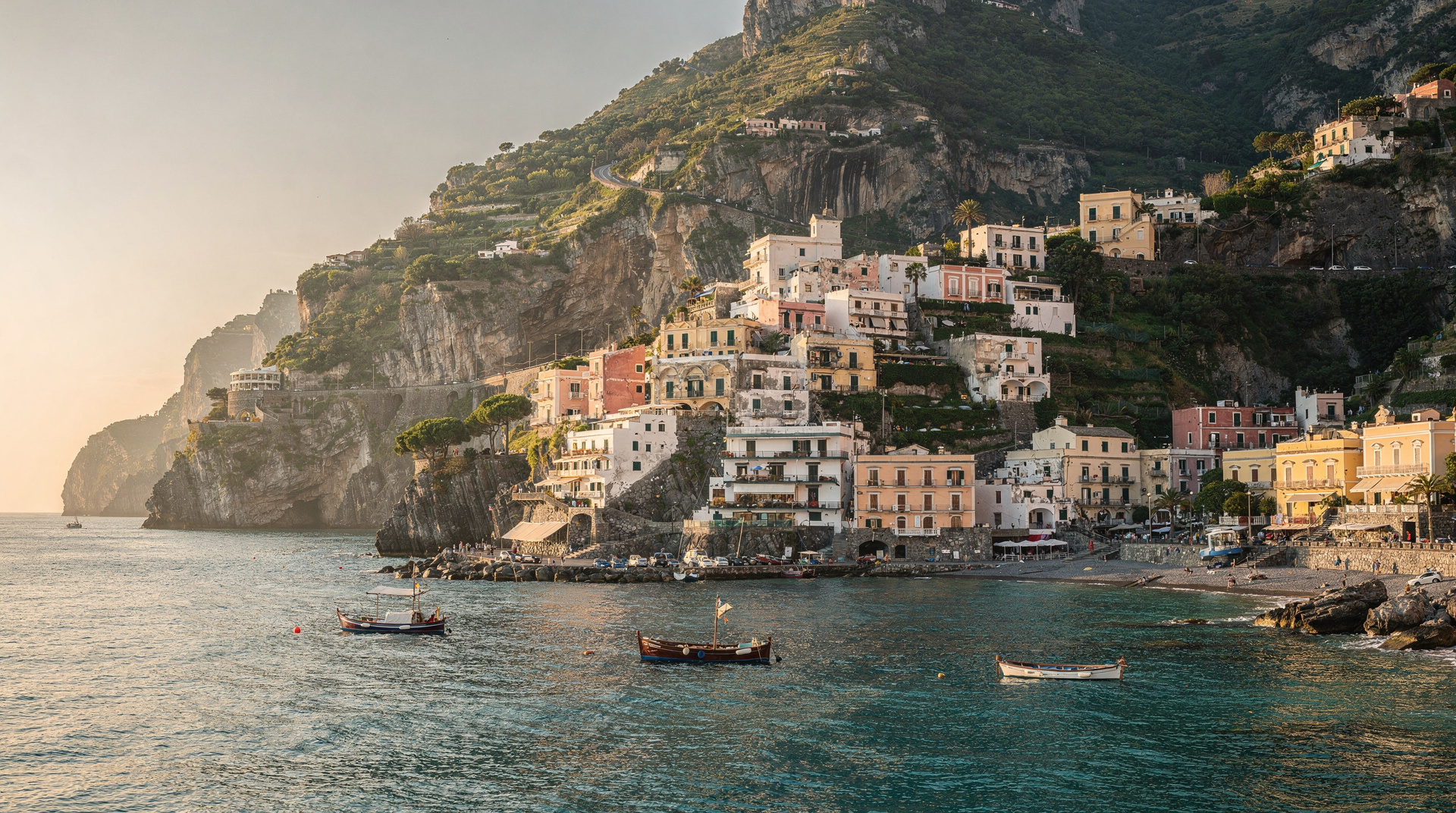
Maiori
Maiori has the Amalfi Coast's longest beach (300 m), lower prices, and good bus links — the honest guide for families and budget-conscious travellers.
From Sorrento: Full Day Tour of Positano, Amalfi & Ravello
Quick facts
- Beach length
- ~300 m — longest on the Amalfi Coast
- Beach type
- Dark sand and fine pebble (mixed)
- Population
- ~5,500 residents
- From Amalfi by bus
- ~15 minutes (SITA)
- From Salerno by ferry
- ~25–30 minutes (seasonal)
- Price level
- Lower than Positano or Amalfi
The Amalfi Coast has a beach problem: most of its shores are narrow, steep-sided, and dominated by expensive beach clubs. Maiori is the exception. Its beach stretches approximately 300 metres — the longest on the entire coast — and is wide enough to spread a towel without paying for a sunbed. For families, budget travellers, or anyone who simply wants to swim without navigating Positano’s crowds, Maiori is the most practical coastal town between Amalfi and Salerno.
| Where | Amalfi Coast, ~5 km east of Amalfi town |
| Cost | Free public beach section; sunbeds €12–18/day |
| Time needed | Half-day beach visit; 1–2 nights as a base |
| Getting there | SITA bus from Amalfi (~15 min) or seasonal ferry from Salerno |
| Best time | June–September for the beach; April–May and September–October for quiet sightseeing |
The beach
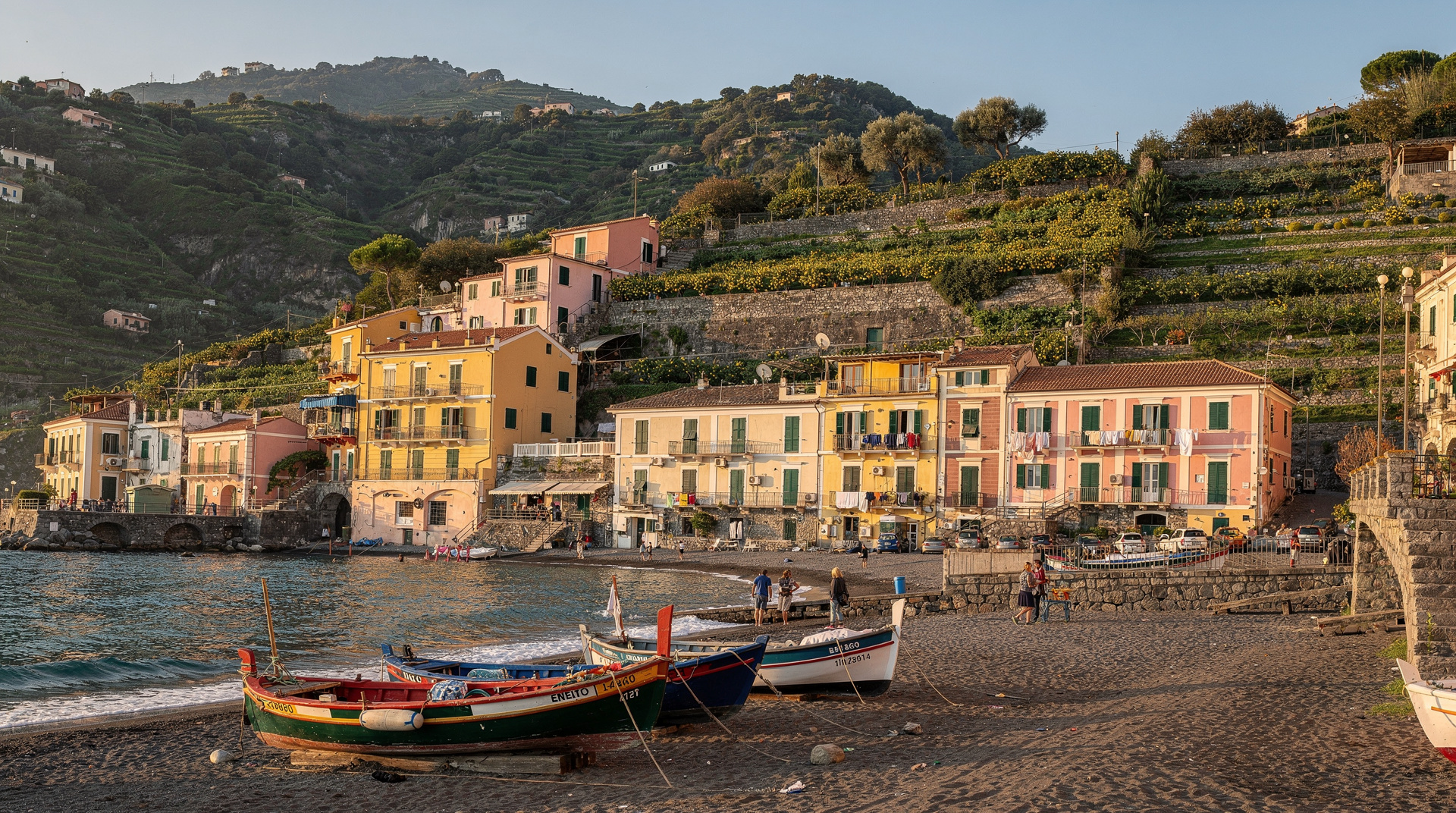
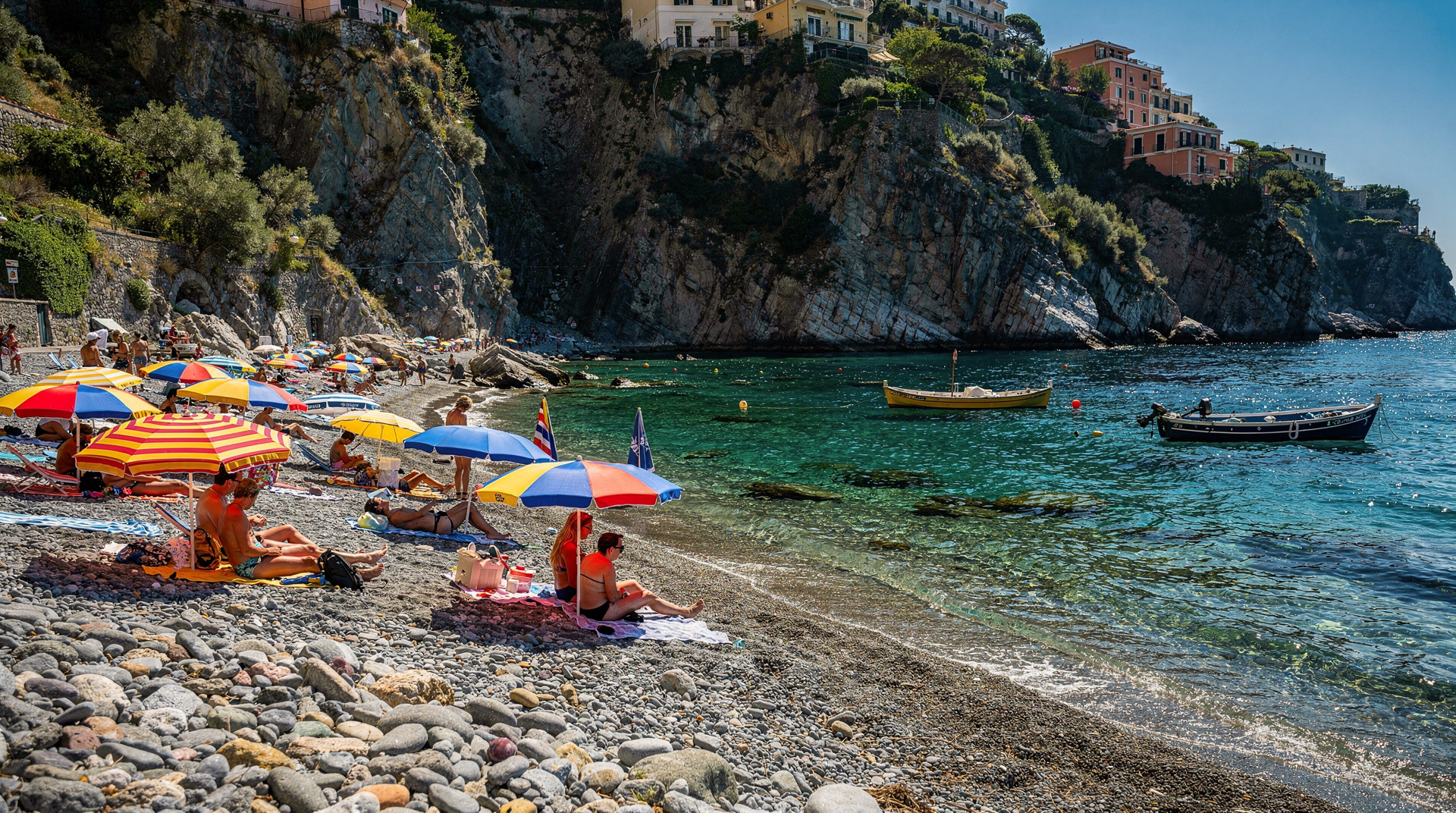
Maiori’s beach is a mix of dark volcanic sand and fine pebble — easier on bare feet than the coarse grey shingle at Positano or Amalfi. The seabed shelves gently, making it calmer for children and less confident swimmers than the steeper-entry coves further west.
The beach has both private clubs (sunbeds €12–€18 per day) and a free public section. The free section is the eastern third of the beach near the river mouth (Torrente Reginna Maggiore). This public strip fills up by 10:00 in August; arrive early or accept that sunbed rental is your practical option in peak season.
Water quality is generally good. The Torrente Reginna Maggiore creates some discolouration near the river mouth after heavy rain — avoid that area for 24 hours after significant rainfall.
The old town and the Corso Reginna
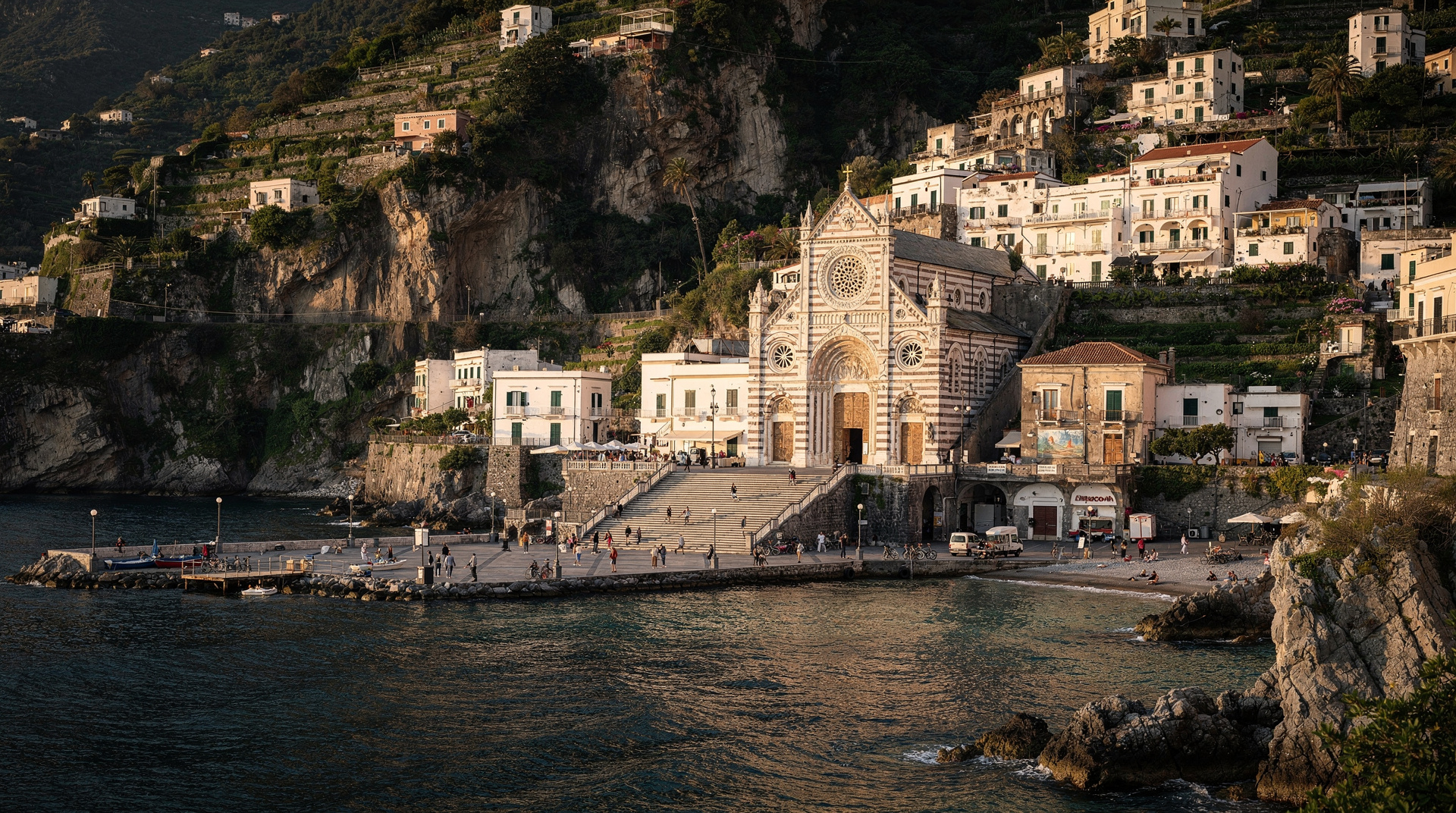
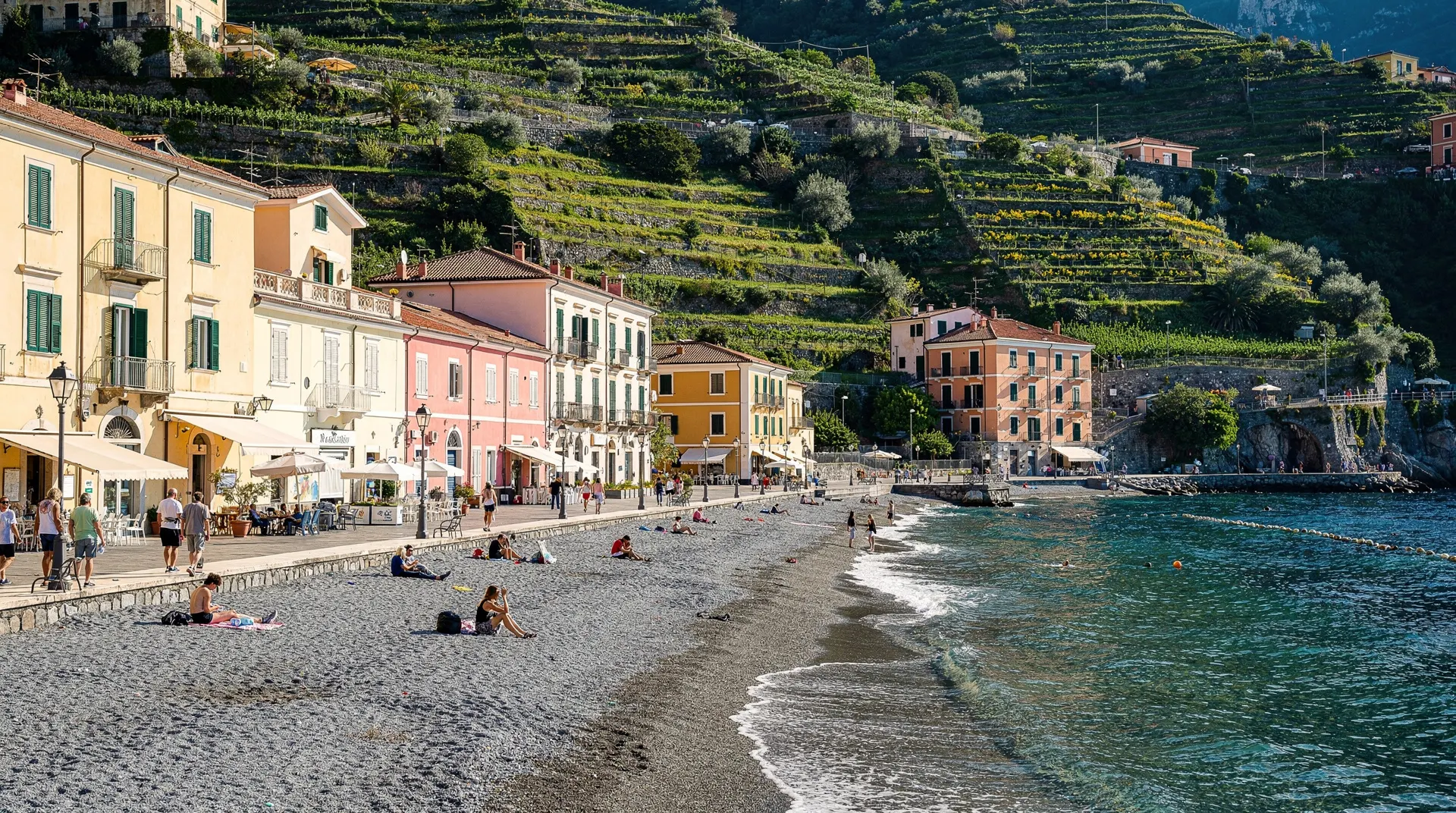
Maiori’s town centre has more substance than most visitors expect. The Corso Reginna — the main pedestrian street parallel to the beach — has bakeries, a fruit market, a small Spar supermarket, and the kind of bar where espresso costs €1.20 at the counter and locals actually use it. The 14th-century Collegiata di Santa Maria a Mare, on its own small hill above the beach, has a majolica-tiled dome and a crypt that floods at high tide (a known structural issue since the 18th century).
The old quarter behind the church, with its stepped alleys and washhouses, is typical southern Italian vernacular architecture: arched doorways, painted plaster, laundry on lines. Not restored for tourism, because there are not enough tourists here to justify restoration of anything except the church.
Hiking: Valle delle Ferriere from Maiori
The Valle delle Ferriere (Ferriere Valley) is a nature reserve and hiking corridor above Amalfi that is usually accessed from the Amalfi side. A less-used route approaches from above Maiori via the ridge above the Reginna Maggiore valley. This route passes through abandoned terraced farmland and ancient chestnut woodland. The round trip from Maiori’s upper village takes 3–4 hours; it requires trail familiarity or a guide, as signage is poor. The flora in the valley is among the most biodiverse on the coast — ancient ferns, cyclamens in autumn, streams with endemic freshwater species.
Guided hiking tour of the Valle delle Ferriere from MaioriGetting to Maiori
By SITA bus from Amalfi
The most common approach: SITA bus east from Amalfi, about 15 minutes, €1.30. Buses run every 30–60 minutes. This is the main connection west (via Amalfi to Positano and Sorrento) and east (toward Minori, Vietri sul Mare, and Salerno).
By ferry from Salerno
Seasonal ferry service (Travelmar and Metro del Mare) from Salerno to Maiori takes approximately 25–30 minutes and costs around €7–€8. Salerno is 35 minutes from Naples by Frecciarossa (from €9 in advance), which makes the Salerno→ferry→Maiori route a serious alternative to the overland approach from Sorrento. Particularly practical for a beach day without driving or enduring the crowded SITA buses through Positano.
Day cruise from Salerno to the Amalfi Coast stopping at Maiori and AmalfiBy car
The SS163 passes through Maiori. The alternating plate-number restriction (even plates on even dates, odd on odd, 10:00–18:00 June–September) applies through the entire Amalfi Coast section including Maiori. Car parking on the seafront is pay-and-display at €2–€3/hour. There is a larger car park at the eastern edge of town near the Torrente Reginna Maggiore.
Where to eat
Maiori’s restaurants do not court tourists the way Positano’s do, and the prices reflect this.
Trattoria da Gelsomina (Via Capone): the kind of place that does not appear on major review sites. A fixed lunch menu (primo + secondo + water + coffee) for €15. The pasta al ragù is slow-cooked and good; the dessert is whatever the owners made that morning.
Ristorante San Francesco (Corso Reginna): proper sit-down restaurant facing the beach, without the view premium of the coast-facing restaurants in Positano. Spaghetti alle vongole €13, local fish secondo €18–€22. A carafe of house white from the Amalfi valley is €7.
Pasticceria Andrea Pansa — note: the main Pansa bakery is in Amalfi, not Maiori, but the tradition of sfogliatella Santa Rosa (cream-stuffed, without the traditional crispy shell — see Minori) has influenced the pastry shops throughout the coast. Maiori’s bakeries on the Corso sell local versions for €2–€3.
Maiori as an Amalfi Coast base
The case for basing yourself in Maiori:
- Accommodation is 30–50% cheaper than Positano and 20–30% cheaper than Amalfi for comparable quality.
- The beach is the best on the coast for actual swimming and sunbathing.
- SITA buses from Maiori reach Amalfi in 15 minutes, Positano in 45 minutes, Salerno in 45 minutes.
- A ferry from Salerno provides an easy return route to Naples via Frecciarossa.
The case against: you are 15 minutes from Amalfi and 50 minutes from Positano, which means you will spend bus time every time you want to see a monument or a famous view. If seeing the full coast in two days, Amalfi town is more central. If you are staying three or more nights and want a genuine beach, Maiori makes strong sense.
Maiori’s history: from fishing to modest tourism
Maiori (historically “Maiuri” in Latin, possibly from the Roman “Maior Locus”) was one of the secondary ports of the Amalfi Republic and saw more modest trading activity than Amalfi itself. After the republic’s decline, Maiori became an agricultural and fishing settlement — the wide valley of the Torrente Reginna Maggiore provided more arable land than the narrow gorges west of Amalfi, which partly explains the town’s larger size and longer beach.
The 1954 Maiori flood — when the Torrente Reginna Maggiore overflowed during an exceptional storm, devastating the lower town and killing more than 20 people — is a defining event in the collective memory. The subsequent rebuilding created the wider seafront road and the reinforced river mouth that exist today. The flood also explains why the oldest historic buildings are on higher ground, away from the vulnerable seafront.
Tourism development in Maiori has been more restrained than in the western villages because the town lacked the visual drama (stacked cliffside buildings, famous harbours) that made Positano and Amalfi internationally recognisable. The result, inadvertently, is a town that functions for its residents as well as its visitors — a balance that the more aggressively touristed western towns have lost.
Diving and snorkelling around Maiori
The waters off Maiori’s western headland offer respectable diving conditions without the crowds of the more famous dive sites further along the coast toward Massa Lubrense. Rocky walls, posidonia meadows, and occasional wreck fragments from wartime and fishing losses attract a modest local dive scene. A guided shore dive with full equipment rental runs €40–55; PADI certification courses are occasionally available through operators based in Maiori or nearby Cetara.
Snorkelling from the rocks at either end of the beach — away from the main swimming area — is free and rewarding in calm conditions, particularly in the clearer water of May–June and September–October before and after the peak-season sediment stirred up by heavy beach use.
Practical information
Pharmacy: on the Corso Reginna, open standard Italian hours (09:00–13:00, 16:00–20:00, closed Sunday afternoon).
Supermarket: Spar on the Corso, open 08:00–22:00 in summer. More convenient for self-caterers than Positano’s tiny minimercati.
Children: the beach gradient, the free public section, and the calmer water make Maiori the most practical coastal town for families with young children on the Amalfi Coast.
August: the beach fills to capacity on weekends; the free public section can disappear entirely. Weekday visits are notably less crowded.
The Santa Maria a Mare church and religious heritage
The Collegiata di Santa Maria a Mare sits on a small elevated promontory at the western end of the beach, visible from most of the seafront. The current building dates from the 14th century with later Baroque modifications; the external staircase and majolica-tiled dome are the most photographed elements. The interior has a 13th-century Byzantine icon of the Madonna, brought from Constantinople and venerated as miraculous by the local community after a legendary episode in which the icon was found washed ashore. The icon is housed in an elaborate Baroque altar.
The church’s distinctive feature — its flooding crypt — is documented and accepted as a structural inevitability. The crypt floor is below sea level, and during spring tides and storm surges the lower chamber fills with water. This has happened repeatedly over centuries and is incorporated into the building’s maintenance cycle rather than treated as a problem to be solved. Visiting the crypt requires asking the sacristan; entry is free.
The religious festival of Santa Maria a Mare (15 August, Ferragosto) is the town’s main annual celebration: a procession carries a replica of the icon from the church down to the beach and onto a fishing boat, which sails along the shore accompanied by fireworks and smaller boats. This is a genuine popular festival rather than a tourist event and attracts the entire local population. If you are on the coast on 15 August, this is worth factoring into your itinerary.
Practical self-catering and local markets
For travellers staying in apartments or villas, Maiori offers the best self-catering infrastructure on the western Amalfi Coast (east of Sorrento). The Spar supermarket on the Corso is larger than anything in Positano or Ravello and stocks standard Italian produce, wine, pasta, olive oil, and dairy. A greengrocer near the beach market sells local lemons (sfusato amalfitano), seasonal vegetables, and the small, dark Gaeta olives used in local cooking.
A weekly market occupies the lungomare on Saturday mornings (seasonal; check locally) with stalls selling fruit, vegetables, household goods, and clothing. This is oriented toward residents rather than tourists and prices are market rates, not tourist premiums.
The local lemon products — limoncello, lemon marmalade, lemon-infused olive oil — are available in several small shops at prices lower than Positano or Amalfi. A 50 cl bottle of limoncello made from local sfusato lemons costs €8–€12 in Maiori; the same product costs €15–€18 in Positano with the tourist location premium.
Maiori compared with its neighbours
Choosing between the eastern Amalfi Coast towns comes down to what you want from a base:
| Town | Beach | Price level | Best for |
|---|---|---|---|
| Maiori | Longest on the coast (~300 m), sand/pebble | Lower | Families, budget, actual swimming |
| Minori | Short, similar sand/pebble | Lower | Food (De Riso pastry), Roman villa |
| Cetara | Small, working fishing harbour | Mid | Anchovy cuisine, quiet authenticity |
| Amalfi | Small, crowded in season | Higher | Central location, Cathedral, transport hub |
Maiori and Minori are close enough (5 minutes on foot) that most visitors treat them as a single half-day rather than choosing one. Cetara, 25 minutes further east, is a genuinely different experience — a working fishing port rather than a beach town — and pairs well with either as a food-focused add-on.
Boat trips and coastal excursions from Maiori
Beyond the beach and the bus network, Maiori’s harbour has a modest but useful boat scene. Small operators run short excursions west toward Amalfi and Positano, giving a sea-level view of the coastline that the SITA bus (which runs on the road above much of the route) does not provide. A round-trip boat excursion covering several coastal towns typically runs 3–5 hours and costs €40–70 per person depending on stops and whether lunch is included.
Sunset boat cruise along the Amalfi Coast with proseccoFor a longer full-day option that starts from the Naples side and works the entire coast by sea, see the Amalfi Coast by boat guide — a genuinely different way to experience the coast than the overland bus route, particularly useful in August when the SS163 is at its most congested.
Day trips from Maiori: using it as a base
Maiori’s central east-west position on the coast makes it a practical base for exploring the entire Amalfi Coast without a car. Day-trip options by SITA bus:
- West to Positano: ~45 minutes, change at Amalfi or direct
- West to Amalfi: ~15 minutes
- Up to Ravello: bus to Amalfi (~15 min), then Ravello bus (~20 min)
- East to Minori: ~5 minutes on foot or one bus stop
- East to Cetara: ~25 minutes east
For the sea-approach option, a seasonal ferry from Maiori to Salerno (~25 minutes, €7–8) gives access to the Frecciarossa back to Naples. This makes a full coast day trip from Naples logistically clean: train to Salerno, ferry to Maiori, SITA bus west to Positano, SITA bus back to Amalfi, ferry to Salerno, train to Naples.
Frequently asked questions about Maiori
Is Maiori beach sand or pebble?
A mixture: dark volcanic sand in the middle sections and fine pebble near the rock outcrops at either end. Significantly softer than the coarse grey shingle at Positano. Shoes are not needed for entry.
How far is Maiori from Amalfi?
Approximately 5 km by road. SITA bus takes about 15 minutes. By foot along the coastal path it is about 45 minutes (not a standard tourist route but walkable in spring/autumn).
Is Maiori cheaper than Positano?
Yes, substantially. Accommodation, restaurants, and beach services cost 30–50% less than Positano equivalents. This does not mean Maiori is cheap by general Italian standards — the Amalfi Coast is expensive — but the relative value is much better.
Can you reach Maiori from Naples in a day?
Yes. Naples → Salerno by Frecciarossa (35 min, from €9) → ferry from Salerno to Maiori (30 min, ~€7–8). Total journey under 2 hours with good connections. This is often faster than the Circumvesuviana/SITA route through Sorrento and Positano in summer.
Is Maiori good for families?
It is the best beach town on the Amalfi Coast for families with young children. The beach gradient is gentle, the water is calmer than the western coves, the free public section reduces costs, and the town has proper supermarket facilities, a pharmacy, and affordable restaurants.
What is the Ravello Festival connection to Maiori?
The Ravello Festival (June–September) takes place 25 minutes away by SITA bus. Maiori’s lower accommodation prices make it a practical alternative base for festival-goers who have not been able to book in Ravello or Amalfi. An evening festival concert at Villa Rufolo plus a taxi back to Maiori costs approximately €25–€30 for the return journey.
Are there water sports in Maiori?
Kayak and paddleboard rental is available from beach operators in season (June–September), typically €15–€20 per hour. A couple of dive centres operate seasonal programmes from Maiori’s beach, focusing on wall dives along the western cliff face. Windsurfing and sailing are not practical in the sheltered east-facing bay.
Is Maiori worth visiting in spring or autumn?
April–May and September–October are the best time to visit for anyone not prioritising beach swimming. The town functions normally, the restaurants are open, the hiking trails above the Valle delle Ferriere are excellent, and the crowds on the SS163 are minimal. Ferry service from Salerno typically starts in April. October brings mushrooms and chestnut season to the hills above the town; several restaurants add regional specials to their menus.
What is there to see near Maiori beyond the beach?
The coastal path to Minori (5-minute walk east) adds the Roman Villa Marittima and De Riso pastry to a half-day. The SITA bus west reaches Atrani in 10 minutes and Amalfi in 15. Uphill, the Valle delle Ferriere nature reserve (accessed by trail above Amalfi or by the path above Maiori) is among the best walking on the coast. Cetara is 25 minutes east by bus for the anchovy-sauce food experience. With a rental car, the interior farming villages of Tramonti (producers of the local DOC wine) are 15–20 minutes’ drive uphill and worth an afternoon for anyone interested in Campanian wine and olive oil.
Is Maiori a good base for exploring the whole Amalfi Coast?
Yes, more so than the western towns. Maiori sits roughly at the coast’s midpoint, so bus journeys to Positano and Amalfi are similar in length to those from Amalfi itself, while accommodation costs considerably less. The trade-off is time spent commuting to see the more famous sights, since Maiori itself is a beach town rather than a monument town.
Can you take a boat trip from Maiori?
Yes. Small local operators run excursions along the coast toward Amalfi and Positano, and organised sunset or day cruises depart seasonally. This gives a sea-level perspective on the coastline that the SITA bus, which runs largely on the road above, doesn’t provide.
Top experiences
Bookable activities with verified prices and instant confirmation on GetYourGuide.