Pompeii
Complete guide to visiting Pompeii — skip-the-line tickets, heat tips, Circumvesuviana vs Campania Express, guided vs audio tours.
Pompeii: Guided Tour with Skip-the-Line Entry
Quick facts
- Distance from Naples
- 23 km south-east
- Train (Circumvesuviana)
- ~30 min, €3.30
- Opening hours
- 9:00–19:00 (summer), 9:00–17:00 (winter)
- Entry ticket
- €18 (standard), €22 with MANN combo
- Best arrival time
- 9:00 sharp (heat and crowd management)
- Annual visitors
- ~4 million
Why Pompeii still surprises first-time visitors
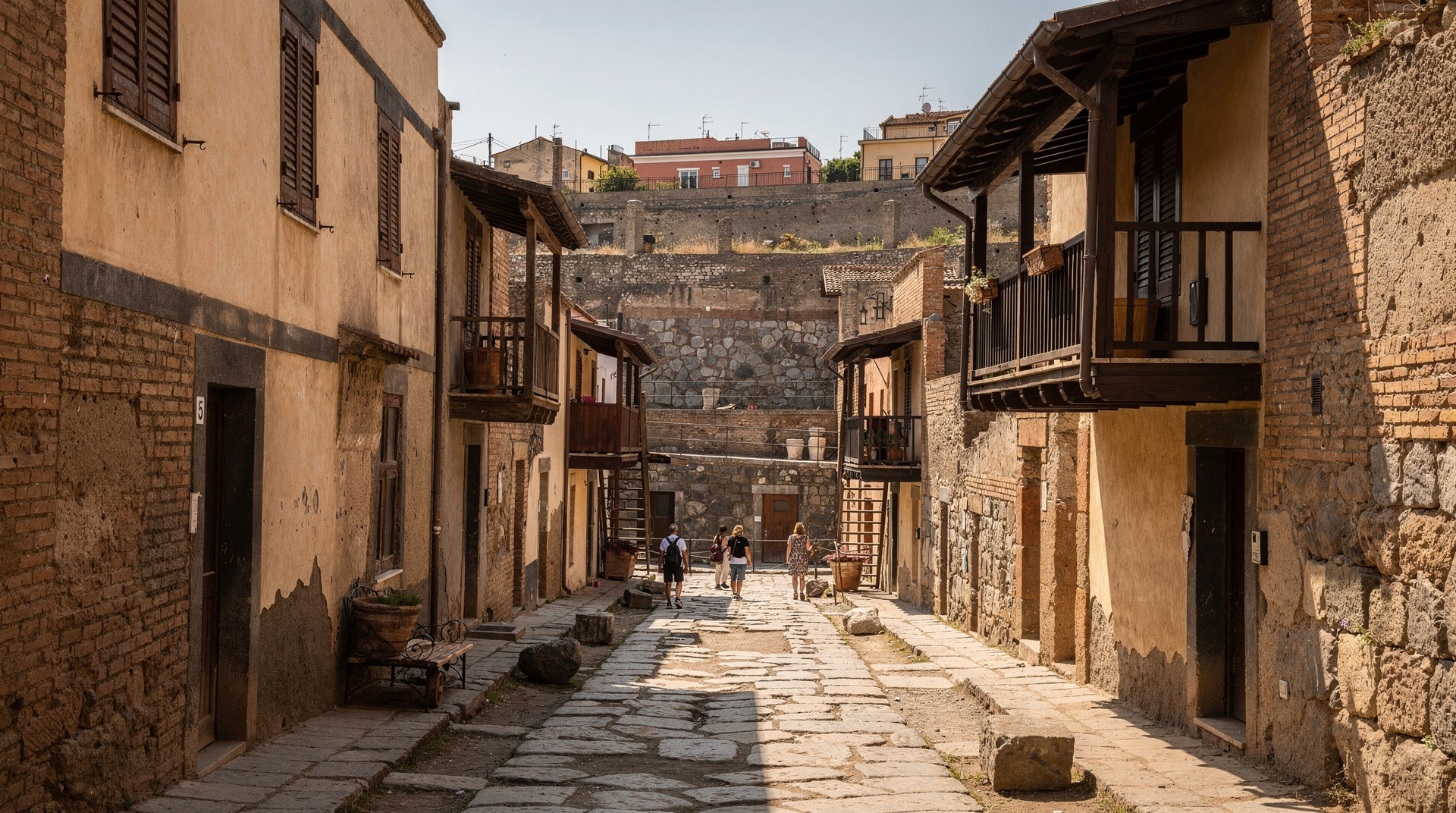
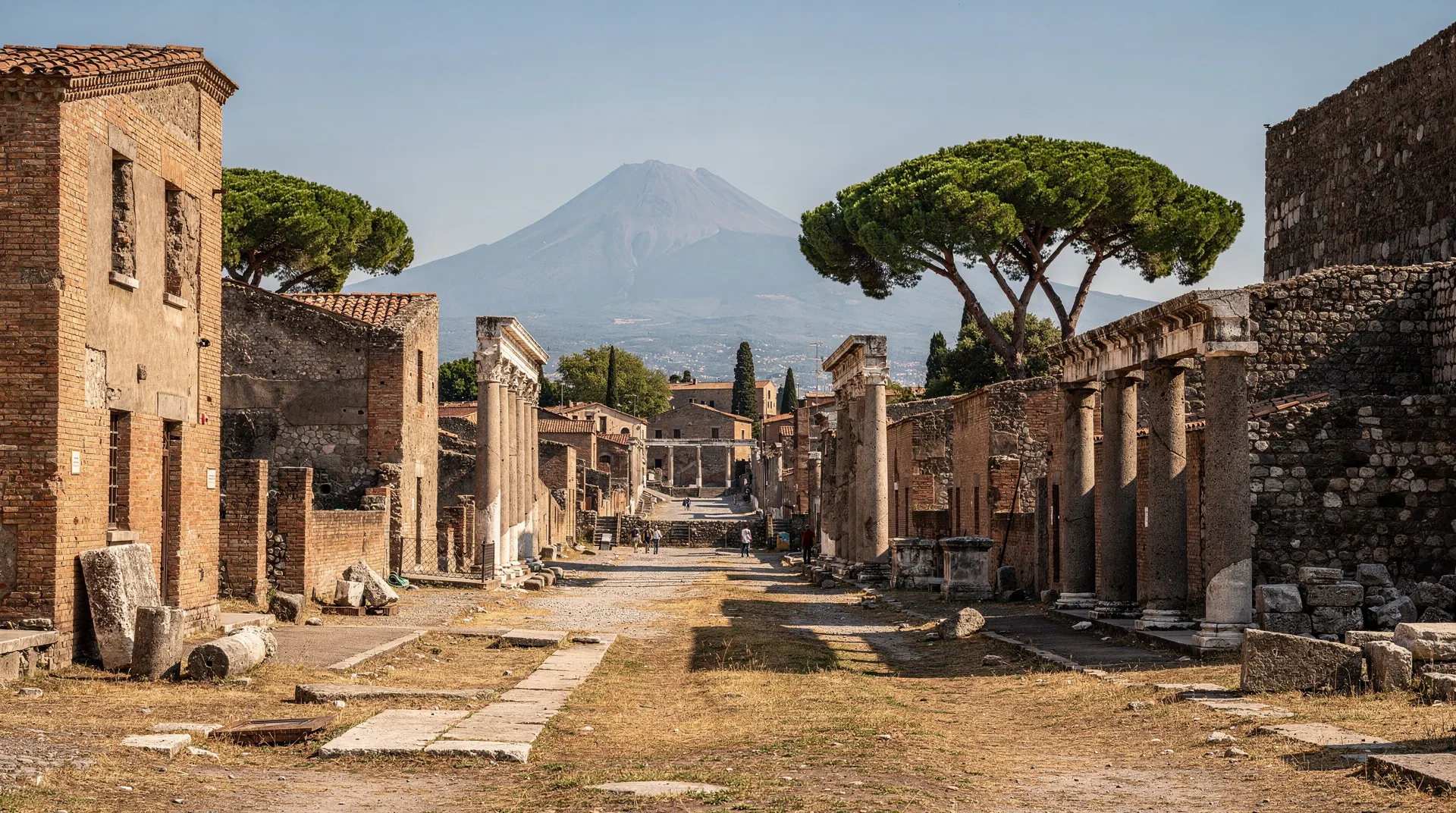
Photographs cannot prepare you for the scale. Pompeii covers 44 hectares — roughly 66 football pitches — and only about two-thirds have been excavated. Walking the stone-paved Via dell’Abbondanza on a clear morning, with Vesuvius looming in the background and wheel ruts carved into the basalt road still perfectly visible, produces a specific feeling that no other archaeological site quite replicates.
The city was buried in August AD 79 under approximately 4–6 metres of volcanic ash and pumice in around 18 hours. What that catastrophe preserved — painted walls, carbonised bread, plaster casts of victims, intact thermopolia (street-food counters), election slogans scratched on walls — is so detailed that historians continue to revise their understanding of Roman daily life from new excavations in the Regio V sector.
That said, the site also attracts four million visitors a year. Without a strategy, you will spend more time navigating crowds than absorbing history. This guide gives you that strategy.
| Where | 23 km south-east of Naples |
| Cost | €18 standard entry; €22 with MANN combo |
| Time needed | 3–6 hours on site; full day with Vesuvius combo |
| Getting there | Circumvesuviana to Pompei Scavi – Villa dei Misteri, ~30 min |
| Best time | 9:00 opening, April–May or September–October |
Getting to Pompeii from Naples
Circumvesuviana
The standard option is the Circumvesuviana commuter train, departing from the lower level of Napoli Centrale station (follow signs to “Garibaldi FS / Circumvesuviana”). Trains run roughly every 30 minutes from around 06:00 to 22:00. The journey to Pompei Scavi – Villa dei Misteri station takes about 30 minutes and costs €3.30 each way.
Practical reality: the Circumvesuviana is functional but uncomfortable. Carriages are often crowded, rarely air-conditioned, and sometimes delayed. The stretch between Naples and Pompeii is a known hotspot for pickpockets — keep bags in front, avoid the end carriages, and do not put phones in back pockets. The station immediately outside the main entrance (Porta Marina) is a straight five-minute walk from the train.
Campania Express
From April to October, the regional rail authority runs the Campania Express, a limited-stop, air-conditioned service on the same line. It stops at Ercolano (Herculaneum), Pompei, and Sorrento. Tickets cost €5–9 and include reserved seating. Seats fill up, so book a few days ahead online or at the ticket machines at Napoli Centrale. For families with luggage or visitors who want a calmer journey, this is worth the premium.
A detailed comparison of both options is in the Circumvesuviana guide and getting to Pompeii from Naples.
Private transfer
Several operators offer round-trip private transfers from Naples, including hotel pick-up. These cost €50–90 per group and make sense for families with young children or travellers who also plan Vesuvius on the same day. See the Pompeii day trip guide for logistics on combining sites.
Tickets: what to buy and where
Online booking is not optional — it is essential between April and October and strongly recommended year-round. The ticket windows at Pompeii sell out by mid-morning on peak days, and entry queues without a pre-booked time slot can reach 90 minutes.
Standard entry
€18 adults, free for EU citizens under 18. The standard ticket includes entry and a paper map. No guided content.
Audio guide
Available at the site for €8. The official audio guide covers about 25 key stops and is competent without being exceptional. Third-party apps (Audioguide Pompeii) offer more flexible routing and are cheaper — download offline before you arrive as mobile data can be patchy inside.
Combo tickets
The Pompeii + MANN combo (Museo Archeologico Nazionale di Napoli) at €22 gives access to the originals of many mosaics and sculptures that have been removed from the site for safekeeping — including the famous Alexander Mosaic and the “Secret Cabinet” of erotic art. It is good value if you plan to visit Naples’ archaeological museum, which is covered in the Capodimonte and MANN guide.
The Campania ArteCard (€32 for 3 days) includes Pompeii and two other sites plus transport — detailed analysis at Campania ArteCard guide.
Book Pompeii skip-the-line guided entryVisiting in summer: the heat problem
Pompeii is uniquely punishing in July and August. The site has very little shade, the black basalt roads absorb and radiate heat, and afternoon temperatures regularly exceed 35 °C. Visitors have needed medical attention from heat exhaustion.
The single most important rule: arrive at 9:00 opening, not at 11:00. The difference between a 9:00 arrival and a 10:30 arrival is around 4–5 °C on site, plus dramatically fewer crowds. By 11:30, the main streets are shoulder-to-shoulder and temperatures are climbing fast.
Essentials for summer:
- Minimum 1.5 litres of water per person (some fountains on site, but unreliable)
- Wide-brim hat — not a baseball cap, which leaves your neck unprotected
- Sun cream SPF 50+, applied before you arrive
- Light-coloured, loose clothing that covers shoulders and knees (some houses of worship require this, and it also reflects heat)
- Comfortable, closed-toe shoes — the basalt paving is uneven
If you must visit in July or August, the Pompeii in summer heat tips guide covers additional strategies including the least-exposed routes.
Guided tour vs self-guided: honest comparison
Self-guided with audio
Best for: independent travellers who prefer to linger, photographers, and repeat visitors who want to explore corners not on tour routes.
The main challenge is that context is everything at Pompeii. Without some background, you are looking at ruined walls. The official app and most audio guides provide the context, but they cover the same 15–20 stops as every guided tour. Self-guided takes 3–4 hours for a thorough visit.
Small-group guided tour
Best for: first-timers, families with children (good guides make it vivid), and anyone who wants the best-value density of information.
A qualified archaeologist-guide unlocks details no app covers: the evidence of social stratification in wall paintings, the graffiti that reveals Roman humour and political culture, the subtle clues about which buildings were shops versus homes versus brothels. Good guides also know the opening hours of individual houses, many of which are only accessible during guided tours.
Look for tours led by archaeologists (not generic “local guides”), maximum 10–15 people, and a duration of at least two hours on site (not total time including transfer). The Pompeii guided vs self-guided page breaks this down further.
Pompeii tour with archaeologist guideSite itinerary: what to prioritise
The site is too large to cover completely in a day, and several houses require advance booking or are accessible only on specific tours. Below is a logical route for a 3–4 hour visit that avoids backtracking.
Enter via Porta Marina (the main entrance, closest to the train station). This leads directly to:
1. Temple of Apollo — one of the oldest temples, with a copy of the Apollo statue (original in MANN). The views toward Vesuvius from here set the scene.
2. Forum — the political and commercial heart of the city. Standing here with the Vesuvius backdrop is one of the iconic Pompeii moments. The granary on the north side houses rows of amphora and several plaster casts.
3. Basilica — the law court and commercial exchange, now roofless but imposing.
4. Via dell’Abbondanza — the main high street, lined with thermopolia (street-food bars with amphorae still set in stone counters), bakeries (look for millstones and bread ovens), and election slogans painted on walls.
5. House of the Tragic Poet — contains the famous “Cave Canem” (Beware of the Dog) mosaic at the entrance. Small but one of the most photographed interiors.
6. House of the Faun — the largest private house in Pompeii, covering an entire city block. The original Alexander Mosaic was found here (copy on floor, original at MANN).
7. House of the Vettii — exceptionally preserved wall paintings including the famous ithyphallic Priapus. Check on-site hours, as it closes occasionally for conservation.
8. Lupanare (brothel) — the largest commercial brothel, with stone beds and painted panels depicting services offered. It receives queues; visit early or late in your tour.
9. Thermopolium of Regio V — one of the most recently excavated thermopolia (completed 2021), with stunning intact painted panels of animals, a duck, and a Nereid on a seahorse. Worth seeking out.
10. Amphitheatre — the oldest surviving stone Roman amphitheatre, built 80 BC. It is at the far eastern end of the site; budget 15 minutes’ walk from the Forum.
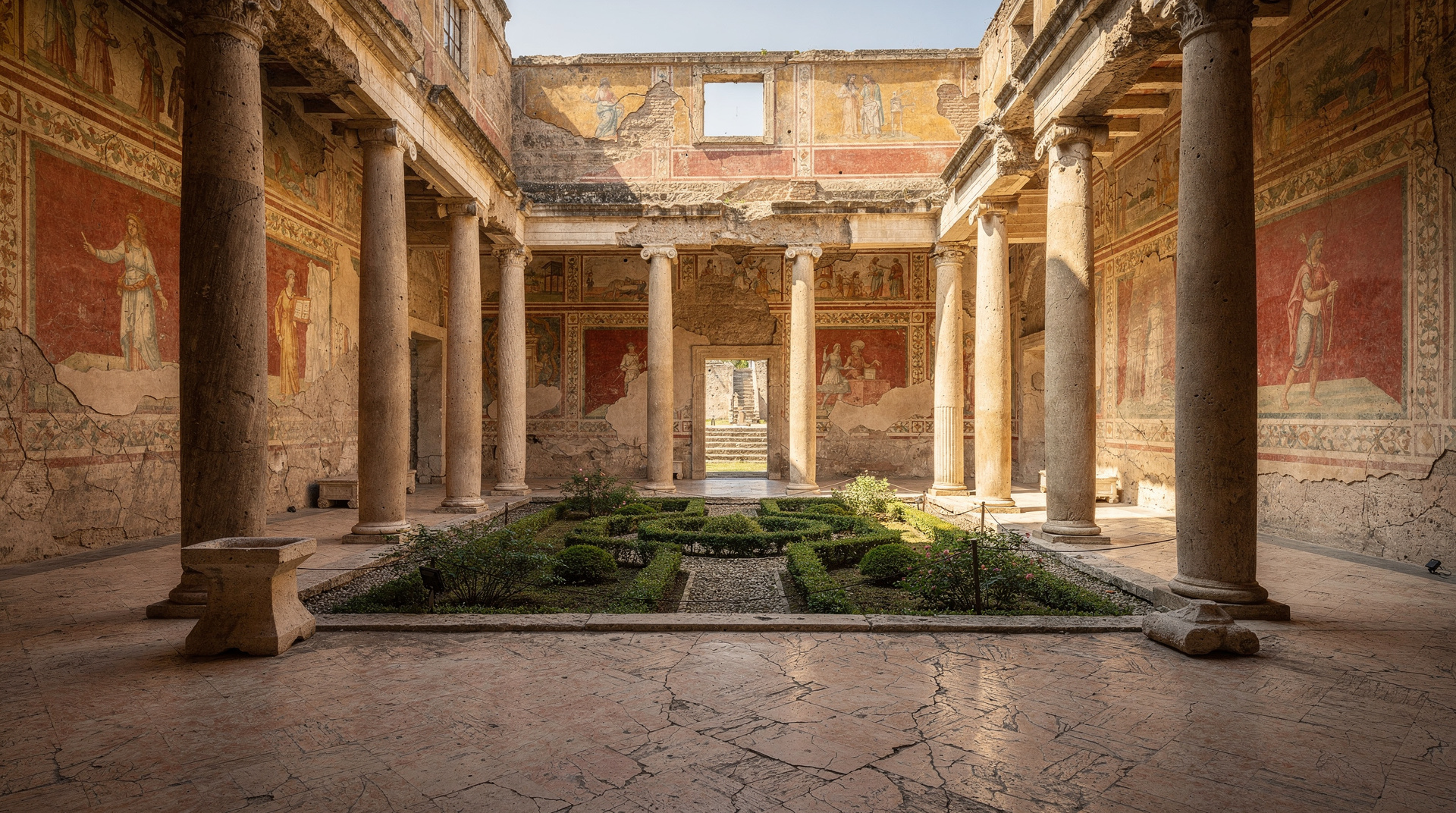
11. Villa of the Mysteries — outside the main walled area, a five-minute walk north of Porta Marina. Famous for the “Dionysiac frieze,” a continuous painted cycle in startling Pompeian red that remains one of antiquity’s great artistic mysteries. Do not skip it.
For deeper detail on each zone, see the Pompeii complete guide and Pompeii highlights.
Pompeii with children
Children aged 8+ generally find Pompeii gripping — the cast victims, the bakeries with carbonised bread still inside, the ruts left by Roman cart wheels, and the sheer improbability of a city frozen in time. Under 8, interest typically runs out within 90 minutes.
Key tips: bring snacks (food options on site are overpriced and poor), download the official app with interactive map, and pre-book a family-friendly guided tour — a good guide who works with children transforms the visit. More detail at Pompeii with kids.
Combining Pompeii and Vesuvius in one day
This is doable and popular, but requires careful logistics. The standard order is Pompeii in the morning (arrive 9:00, finish by 13:00) then transfer to Vesuvius by bus or shuttle from Pompei Scavi station.
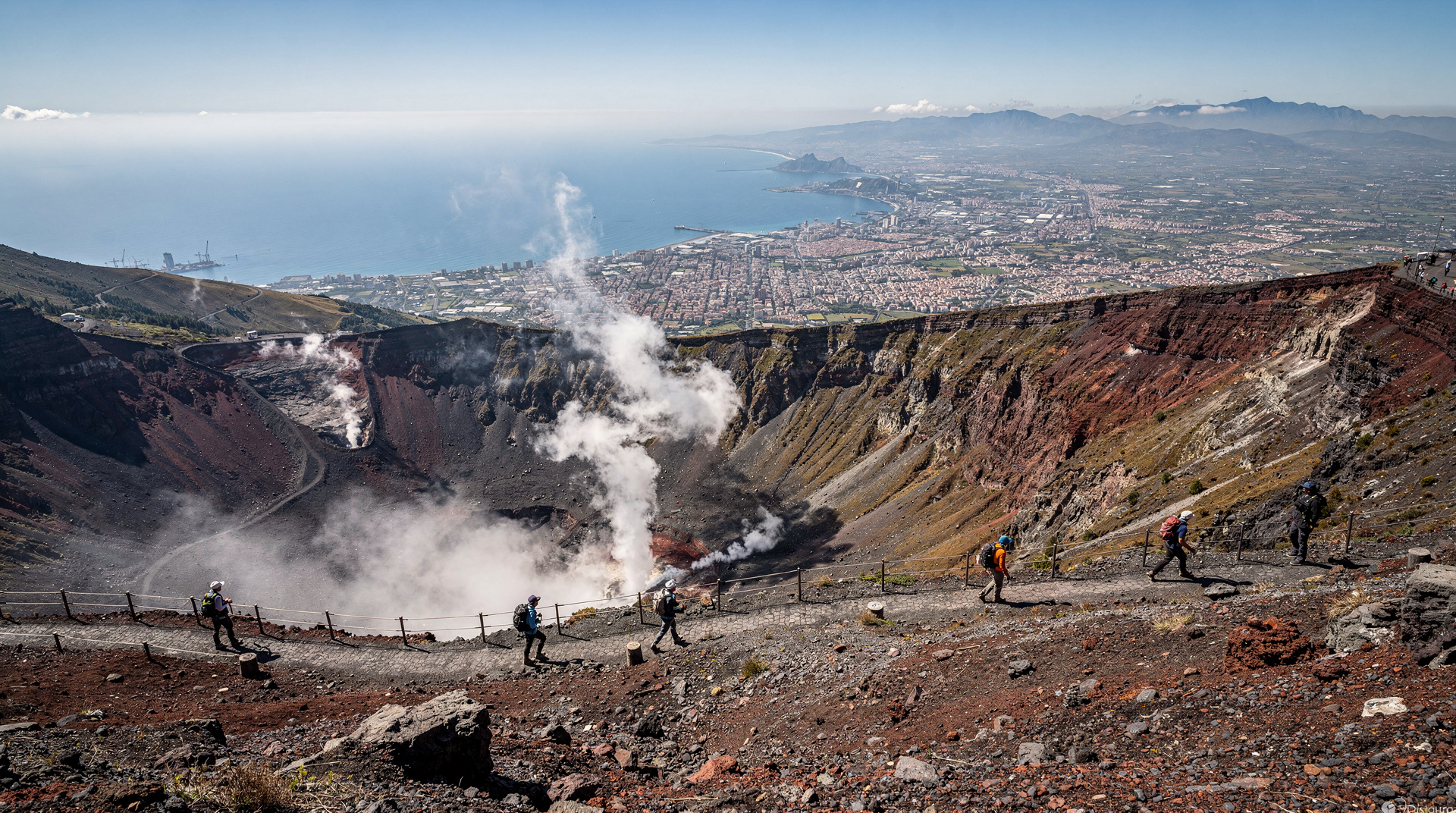
Allow 30–40 minutes’ bus transfer to the Vesuvius car park at 1000m elevation, 30–45 minutes’ hike to the crater rim, 20 minutes at the rim, and 20 minutes back. Last entry to the crater is 17:00 (summer), which means you need to board the Vesuvius shuttle by about 15:30.
The most common tour that combines both:
Pompeii and Vesuvius full-day tourDetailed logistics and bus options are in Pompeii and Vesuvius same day and getting to Vesuvius.
Food and practical facilities on site
Inside the site: there is a café near the Porta Marina entrance and several snack kiosks. Quality is mediocre and prices reflect the captive audience (€4–6 for a panino). Better to bring your own lunch.
Outside the gates: the strip of restaurants along Via Sacra and Via Plinio serves the tour-bus trade. Avoid the ones with laminated menus with photographs. A reliable option is to walk five minutes toward the town centre of Pompei (modern spelling, one “i”) — Ristorante President (Via Colle San Bartolomeo, €25–35 pp) is a formal Michelin-starred choice; for something simpler, the local pizzerias in the town square are perfectly honest.
Toilets: available near the entrances and at several points along Via dell’Abbondanza. Queue times can be long in peak season — use the ones near Villa of the Mysteries if you are there at the end of your visit.
Storage: no large luggage storage on site. Leave suitcases at your Naples hotel or at Napoli Centrale left-luggage (€6/bag).
Rediscovery and excavation: a 270-year project
Pompeii was rediscovered by accident in 1748, when workers digging foundations for a Bourbon summer palace hit ancient walls (Herculaneum had been found a decade earlier, in 1738, in similar circumstances). Early excavation was closer to treasure hunting than archaeology — diggers tunnelled toward valuable objects, sold or gifted finds to European royalty, and destroyed considerable context in the process. Systematic, scientific excavation only began under Giuseppe Fiorelli in the 1860s, who introduced the technique still associated with Pompeii today: pouring plaster into the voids left by decomposed bodies in the hardened ash, producing the haunting casts of victims now displayed around the site.
Roughly a third of the ancient city remains unexcavated, deliberately left for future generations and techniques. This isn’t neglect — it’s a considered position within Italian and international archaeology that current technology should leave some material in reserve rather than exhausting a finite resource all at once.
Recent discoveries: why Pompeii keeps making news
The Regio V excavation zone, opened progressively since 2018, has produced a steady stream of new finds that regularly make international news: the Thermopolium with its vivid animal frescoes (mentioned above), a fresco believed to depict an early version of pizza’s ancestor (flatbread with toppings, though not tomato-based), skeletal remains that reshape understanding of how victims died, and inscriptions that have revised the accepted date of the eruption itself — evidence found in 2018 suggests the eruption occurred in October AD 79, not the traditionally cited 24 August, based on a charcoal inscription referencing a date consistent with autumn.
This ongoing excavation work is one reason a single Pompeii visit rarely feels complete even for repeat visitors — new areas open periodically, and the site’s own understanding of itself continues to evolve. Following the Pompeii complete guide for updates on newly opened areas is worthwhile if you’re planning a return visit.
Frequently asked questions about Pompeii
How much time do I need at Pompeii?
Budget a minimum of 3 hours for a highlights visit, 4–5 hours for a thorough exploration including the Amphitheatre and Villa of the Mysteries. A combined Pompeii + Vesuvius day requires 7–8 hours total.
Do I need to book Pompeii tickets in advance?
Yes, strongly. Between April and October, tickets and timed-entry slots can sell out days in advance. Book directly via the official Pompeii ticketing site (ticketone.it/Pompei) or via a tour operator. Walk-up availability exists in winter but is not guaranteed.
Is there a free day at Pompeii?
The site participates in Italy’s “first Sunday of the month” free entry scheme for state museums. These days attract enormous crowds — some visitors find the free entry not worth the queuing time. Check the site’s official calendar before planning around a free Sunday.
Can I visit Pompeii independently without a guide?
Yes. Download the official app, buy an audio guide, and use the paper map included with entry. However, first-time visitors consistently report that a guided tour provides dramatically more context. Consider a 2-hour guided tour for the main forum area, then explore independently.
What is the Pompeii + MANN combination?
Several tours and tickets link Pompeii to the Museo Archeologico Nazionale di Napoli (MANN), which houses the finest portable finds from the site: the Alexander Mosaic, the Farnese Hercules, the “Secret Cabinet.” Seeing the originals in Naples alongside the site makes both visits richer.
Is it safe to drink the water at Pompeii?
The fountains on site are fed by the local water supply, which is technically drinkable in Campania. In practice, many visitors and locals drink bottled water. Bring your own.
What should I wear to Pompeii?
Comfortable closed-toe shoes are essential — the basalt paving is uneven and there are no flat surfaces. In summer: light clothes, hat, sun cream. Flip-flops are not appropriate. Some covered areas require shoulders to be covered.
Is Pompeii accessible for visitors with limited mobility?
The site has improved accessibility significantly. Several main routes (Forum, Via dell’Abbondanza) are passable by wheelchair, and a dedicated accessibility guide is available from the ticket office. The outer areas (Amphitheatre, Villa of the Mysteries) involve more uneven ground. Contact the site in advance for current accessibility maps.
When was Pompeii rediscovered?
In 1748, when Bourbon-era workers digging foundations struck ancient walls. Herculaneum had been found a decade earlier, in 1738. Early excavation was closer to treasure hunting than science; systematic archaeological method only began under Giuseppe Fiorelli in the 1860s, whose plaster-cast technique for preserving victim impressions is still used today.
Is more of Pompeii being excavated?
Yes. The Regio V zone, under active excavation since 2018, regularly produces significant new finds — frescoes, skeletal remains, and inscriptions that have even shifted the accepted date of the eruption toward October rather than August AD 79. Roughly a third of the ancient city remains deliberately unexcavated for future archaeology.
Top experiences
Bookable activities with verified prices and instant confirmation on GetYourGuide.