Pompeii highlights: what to see and what to prioritise
Pompeii: Skip-the-Line Small Group Guided Tour
What are the must-see highlights at Pompeii?
The Villa of the Mysteries (extraordinary painted frieze, less crowded), the Garden of the Fugitives (13 plaster casts in situ), the Forum with the Temple of Jupiter, the Amphitheatre, and the thermopolia street-food counters along Via di Nola. The Forum Granary houses additional casts and artefacts.
Navigating 66 hectares of Roman city
Pompeii is big. The excavated area covers 66 hectares across an irregular grid of streets, and only about two-thirds of the original city has been uncovered. Visitors with 3 hours cannot see everything — and trying to will mean seeing nothing properly. This guide prioritises the buildings and areas that deliver the most, and is honest about what tends to disappoint.
The coverage below goes roughly northwest to southeast (Porta Marina to Amphitheatre), with the Villa of the Mysteries treated separately as an out-of-perimeter site that most visitors underestimate.
| Must-see | Villa of the Mysteries, Garden of the Fugitives, Forum |
| Time needed | around 3 hrs for highlights, 5+ for the full route |
| Quietest area | Porta Nola, Via di Nola, northern streets |
| Busiest area | Forum and Lupanare from 10:00 onwards |
| Skip if rushed | House of the Tragic Poet interior, Temple of Isis |
| Compare with | see Pompeii vs Herculaneum if deciding between sites |
The Forum area
The Forum is the civic, commercial, and religious heart of Pompeii. It’s the first major space most visitors reach from Porta Marina, and it sets the scale of the city immediately.
What to see at the Forum:
- Basilica — the law court, largest building on the Forum. The brick columns are original; the upper structure is not. Impressive scale.
- Temple of Apollo — columns still standing, with a copy of the bronze Apollo statue in situ (original at MANN in Naples).
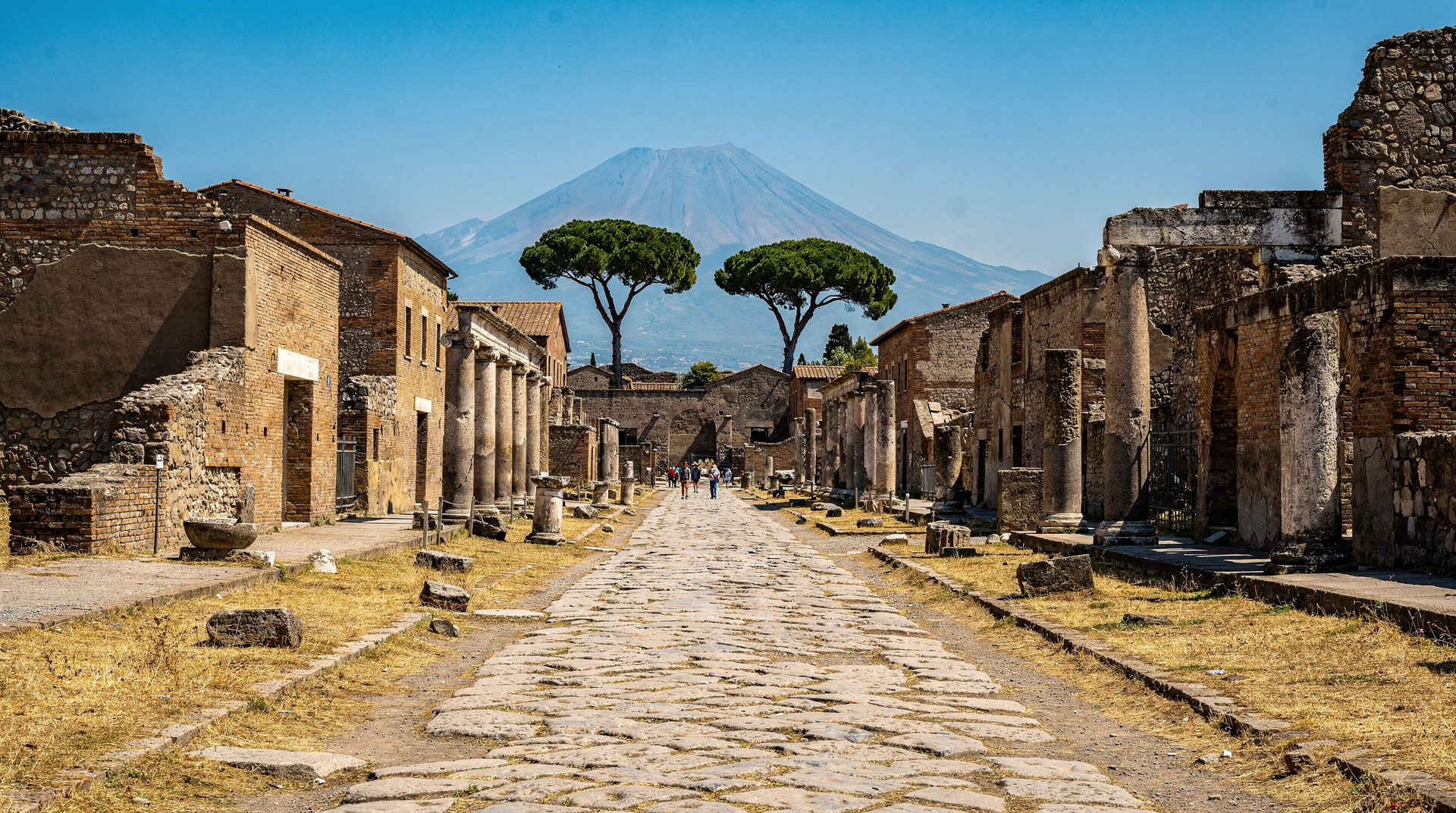
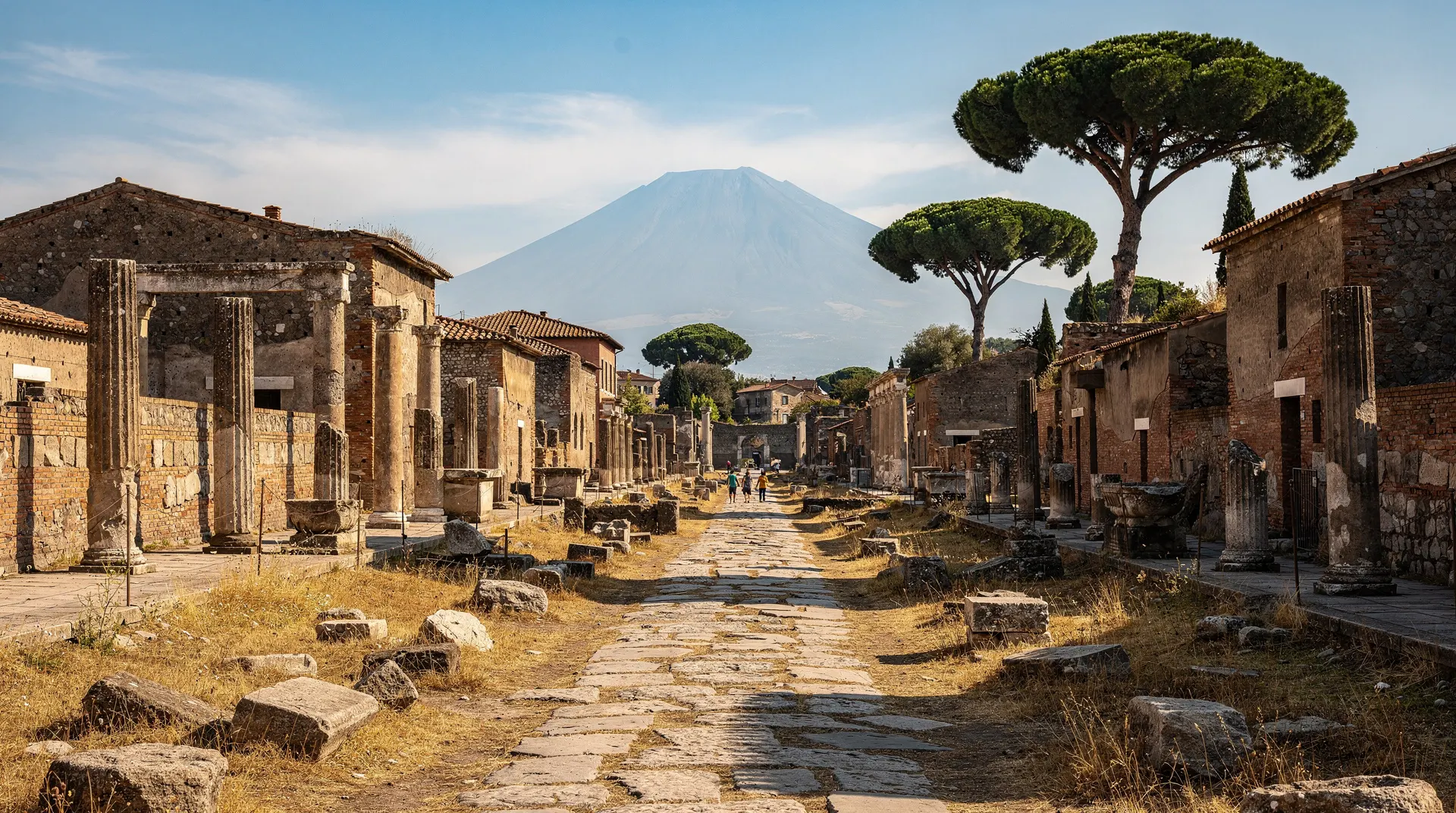
- Temple of Jupiter — at the north end, with Vesuvius visible behind it on a clear day. One of the most-photographed angles in Pompeii.
- Macellum (covered market) — the northeast corner; note the central courtyard with its original mosaic floor fragment.
- Forum Granary (Granarium) — houses plaster casts and a large collection of amphorae, ceramics, and tools. Usually not crowded.
Honest note: The Forum looks impressive from the first photo, but the area fills rapidly with tour groups from 10:00 onwards. Move through it relatively quickly and spend more time at the peripheral sites.
Via dell’Abbondanza
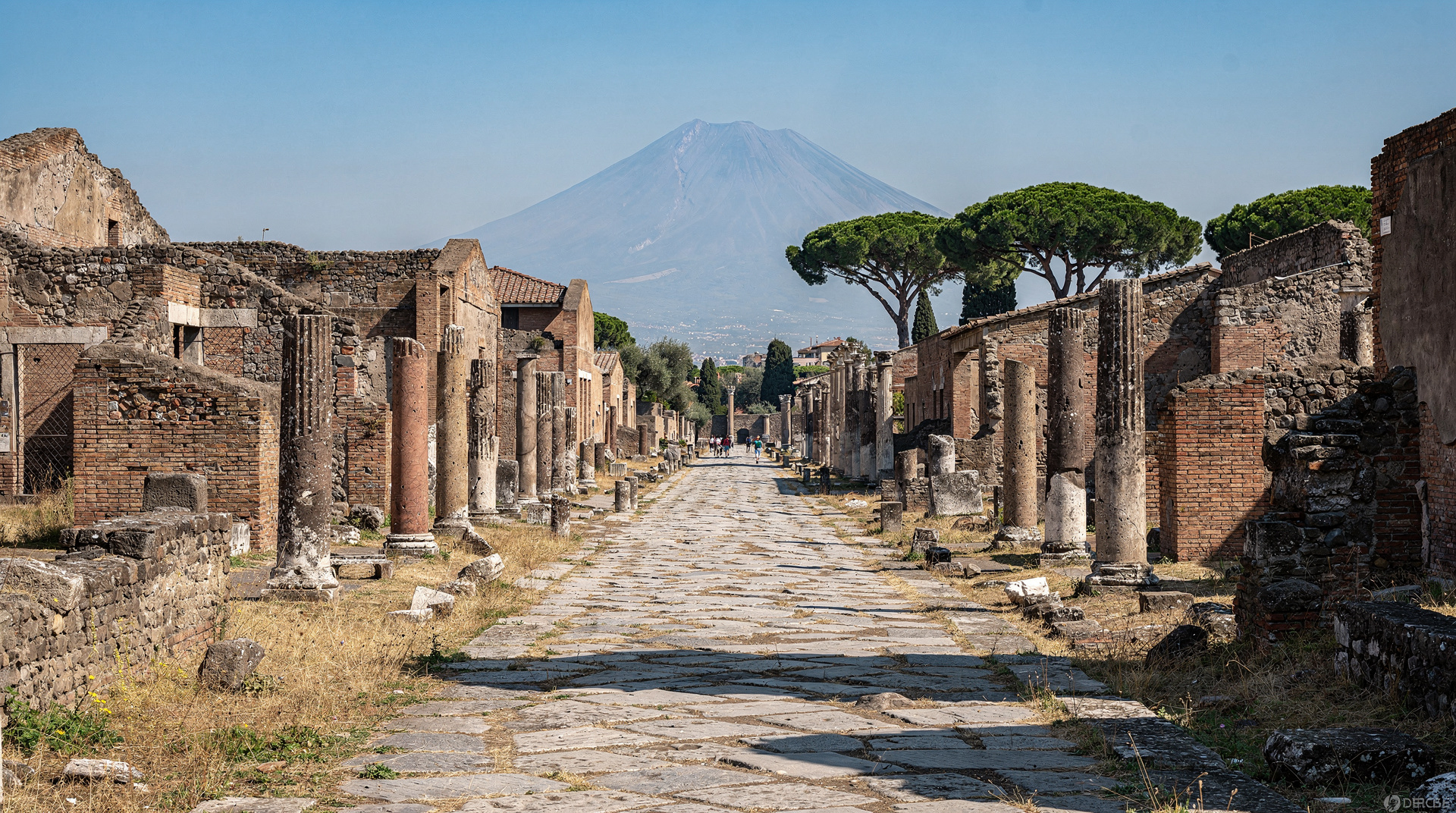
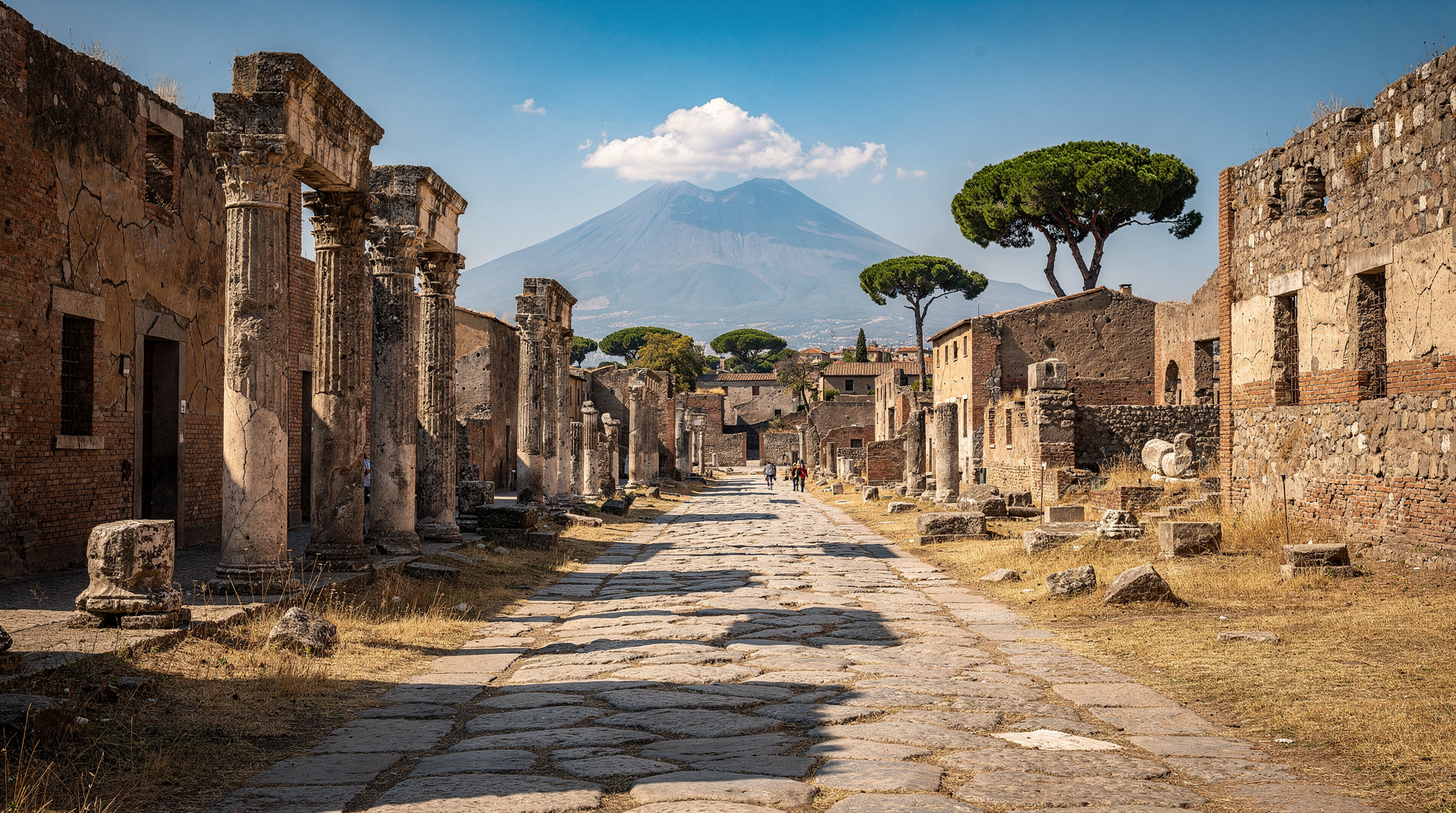
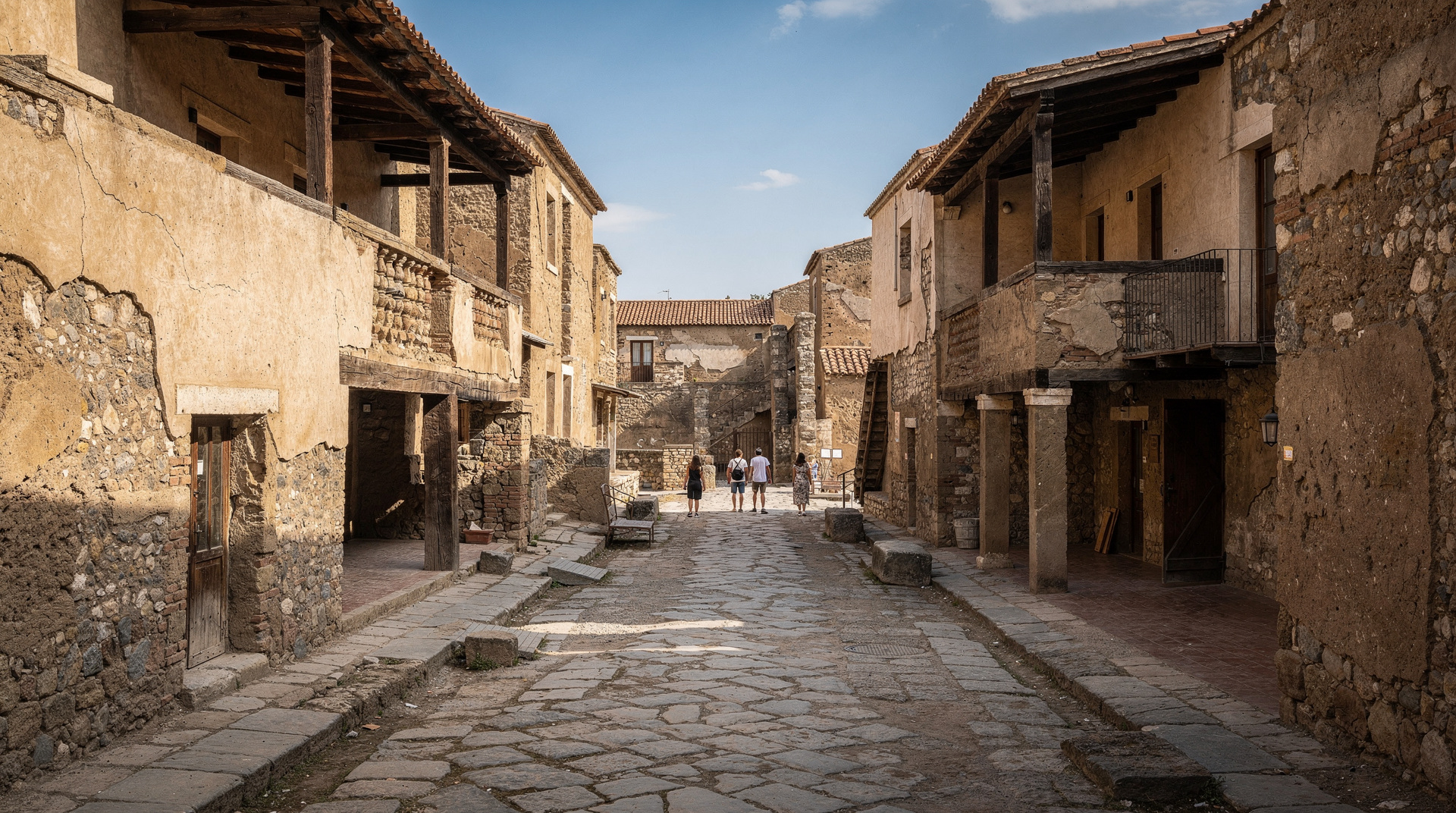
This is the main east-west commercial street of Pompeii — the closest thing to a Roman High Street. It is the most legible part of the site for most visitors because it feels like a street rather than a ruin.
Look for: shop fronts with original stone counters, stepping stones for pedestrians (positioned to let cart wheels pass in the gaps), political graffiti painted on exterior walls (“Vote Gaius Cuspius Pansa for aedile” — still readable in places), and water towers at intersections (a sophisticated pressurised water system supplied the city).
The Stabian Baths (Terme Stabiane) are on Via dell’Abbondanza — one of the most intact thermal bath complexes, with separate male and female sections, changing rooms with stucco relief portraits, and a plunge pool.
The Brothel (Lupanare)
The main Lupanare is a small two-storey building near the intersection of Vicolo del Lupanare and Vicolo del Balcone Pensile — about a 5-minute walk from the Forum.
It has ten rooms (five ground floor, five upper floor), stone beds with pillow-shaped headrests, and erotic frescoes above each doorway. The frescoes may have served as “menus” — what services were available in each room. The names of workers and clients are scratched into the walls (graffiti).
Honest assessment: Historically interesting, but the building is tiny and often has a 20-minute queue. Visit very early (9:00–9:30) or late afternoon. Don’t miss other sites prioritising this one.
The House of the Tragic Poet
A small house near the Forum, famous for two details:
- Cave canem mosaic — “Beware of the Dog” — at the entrance threshold
- Frescoes depicting scenes from Greek theatre in the atrium (gives the house its name)
The mosaic is set into the floor and protected by a perspex cover. It’s one of the most reproduced images from Pompeii. The house itself is small and not remarkable beyond these two features.
The House of the Faun
One of the largest and most luxurious private houses in Pompeii — covering an entire city block. Named after the small dancing faun (satyr) statue found in the impluvium (original at MANN).
The main draw is a mosaic copy of the Alexander Mosaic on the floor of the exedra (the original, one of the largest and most detailed mosaics from antiquity, is at MANN). The house’s scale — two atriums, two peristylea — gives a sense of how wealthy Pompeii’s merchant class was.
Pompeii tour with archaeologist guide from NaplesThe House of the Vettii
Check availability before planning around this. The House of the Vettii is intermittently closed for restoration. When open, it has the most impressive interior frescoes in Pompeii: the famous Priapus fresco at the entrance (a fertility deity with exaggerated anatomy, used as a talisman against the evil eye), elaborate mythological panels in the triclinium, and a kitchen frieze showing winged Cupids performing various crafts.
Two rich freedmen (former slaves who became wealthy merchants) owned this house in the first century AD. The quality of decoration reflects newly acquired wealth displayed with full intention.
Small-group Pompeii tour with licensed guideThe Villa of the Mysteries
This is the single most important site at Pompeii that most visitors miss.
Located outside the main Pompeii walls, roughly 400 metres west of the Porta Marina entrance. You exit through a dedicated gate and follow a path. Allow 15 minutes for the walk there and back.
The villa is named for a room (the large triclinium) with a nearly complete, 17-metre-long painted frieze. The subject is debated — most scholars interpret it as depicting the initiation of a bride into Dionysian mysteries — but the technical quality and state of preservation are extraordinary. The colours (Pompeian red, black, deep ochre) remain vivid.
Beyond the frieze room, the villa has well-preserved kitchens, storage rooms, and living quarters that illustrate how a large country estate functioned.
Crowds: Substantially fewer visitors than anything near the Forum. Often you will be in the frieze room with only a handful of other people.
The Garden of the Fugitives
Near the Amphitheatre, on the southeastern edge of the site. The name is accurate: this is where 13 people — probably a family group — were found trying to flee the eruption and died together. Their plaster casts are displayed in the positions they died, in situ behind a perspex barrier.
This is the most emotionally affecting site at Pompeii. The casts include adults, children, and what appears to be a woman sheltering a child. However prepared you are intellectually, seeing the actual shapes is different.
Crowds: Less busy than the Forum plaster casts at the Granary. Often accessible with space to stand and observe without queuing.
The Amphitheatre
The oldest surviving Roman amphitheatre anywhere (built 70–65 BC, predating the Colosseum by 150 years). Capacity approximately 20,000 spectators — roughly equal to the entire population of the city.
Visitors can walk in through the vomitoria (entry/exit passages), stand in the arena, and sit in the tiered seating. The scale is immediately comprehensible in a way that many buildings at Pompeii are not.
Adjacent is the Grande Palaestra — a large open gymnasium with colonnaded walkways and a swimming pool (drained). This is one of the quieter, more shaded areas of the site.
A realistic route by time available
| Time available | Suggested route |
|---|---|
| 3 hours | Forum, Via dell’Abbondanza highlights, Villa of the Mysteries, Amphitheatre |
| 5 hours | Add House of the Faun, House of the Vettii (if open), Garden of the Fugitives, Stabian Baths |
| Full day (with a guide) | All of the above plus the 2020 thermopolium, Grande Palaestra, and time to linger at the frieze in the Villa of the Mysteries |
If you’re deciding between a guide and going it alone for this route, our guided vs self-guided Pompeii comparison walks through the tradeoffs in more depth — the short version is that a guide earns its keep most on a first visit precisely because prioritising this list without help is harder than it looks.
What to see if you’re also visiting Herculaneum or the museum
Several of Pompeii’s most important finds — the House of the Faun’s original faun statue, the Alexander Mosaic, and countless frescoes lifted from the walls in the 18th and 19th centuries — now live at the Naples Archaeological Museum (MANN), not at the site itself. Seeing the museum either before or after your Pompeii visit changes how you read what remains in situ; many veteran visitors do MANN first so the objects are already familiar when they see the empty spaces where they once stood.
If you’re combining Pompeii with Herculaneum on the same trip, expect a different kind of highlight there: multi-storey wooden structures (carbonised but intact) and the boat-houses with skeletal remains, rather than the frescoes and mosaics that define Pompeii’s highlights list. The two sites complement rather than duplicate each other.
Timing your visit around the highlights
Heat changes which of these highlights are enjoyable and which become an ordeal. The exposed Forum and Amphitheatre have essentially no shade, while the Villa of the Mysteries path and the Grande Palaestra offer some tree cover. If you’re visiting between June and September, read Pompeii in summer heat before finalising your route — it explains how to sequence the shadeless highlights for the cooler parts of the day. Families should also check Pompeii with kids for which of these highlights hold children’s attention and which are better skipped with young kids in tow.
What tends to disappoint
The Basilica: Impressive once you understand what it was; empty stone without explanation.
The Temple of Isis: Religiously interesting (Isis cult was Egyptian, its presence shows Pompeii’s cosmopolitan character), but architecturally not dramatic.
The House of the Tragic Poet interior: Small. The mosaic is the main point. Don’t expect the cave canem to be larger than a doormat.
Anything at noon in summer: Any site becomes difficult to appreciate at peak heat. Plan peripheral walks (Villa of the Mysteries, Amphitheatre) for the morning when it’s cooler.
Frequently asked questions about Pompeii highlights
Can I see the Villa of the Mysteries without an extra ticket?
Yes. The Villa of the Mysteries is included in the standard Pompeii entry ticket. You exit through a side gate near Porta Marina and re-enter. There is no additional charge.
How long does the Amphitheatre visit take?
Walking from the Porta Marina to the Amphitheatre takes about 15 minutes on Via dell’Abbondanza. Add 15–20 minutes to walk around the arena and seating. The adjacent Garden of the Fugitives takes another 10–15 minutes.
Which plaster cast site is better: Garden of the Fugitives or Forum Granary?
Garden of the Fugitives for emotional impact — the family group in their final positions is more affecting. Forum Granary for variety — multiple casts including a dog, plus the artefact collection in the same building. Both are worth seeing.
Is the new 2020 thermopolium excavation open to visitors?
Yes. The thermopolium excavated in 2020 on Via di Nola (Regio V) is open as part of the normal site route. It is remarkable for its painted panels depicting animals (a rooster, a duck, a dog on a leash) and the preserved traces of food remains identified in the counter cavities.
What is the best single photography spot at Pompeii?
The view from the northern end of the Forum looking toward the Temple of Jupiter with Vesuvius in the background. Best in morning light (east-facing backdrop). Arrives in nearly every photographic survey of Pompeii for good reason.
Frequently asked questions about Pompeii highlights: what to see and what to prioritise
What is the most important single site at Pompeii?
Are the plaster casts visible to all visitors?
Is the House of the Vettii always open?
What is a thermopolium and why does it matter?
How do I find the Cave canem (Beware of the Dog) mosaic?
What is the Lupanare and should I visit it?
Are there any areas of Pompeii that are always quiet?
Top experiences
Bookable activities with verified prices and instant confirmation on GetYourGuide.