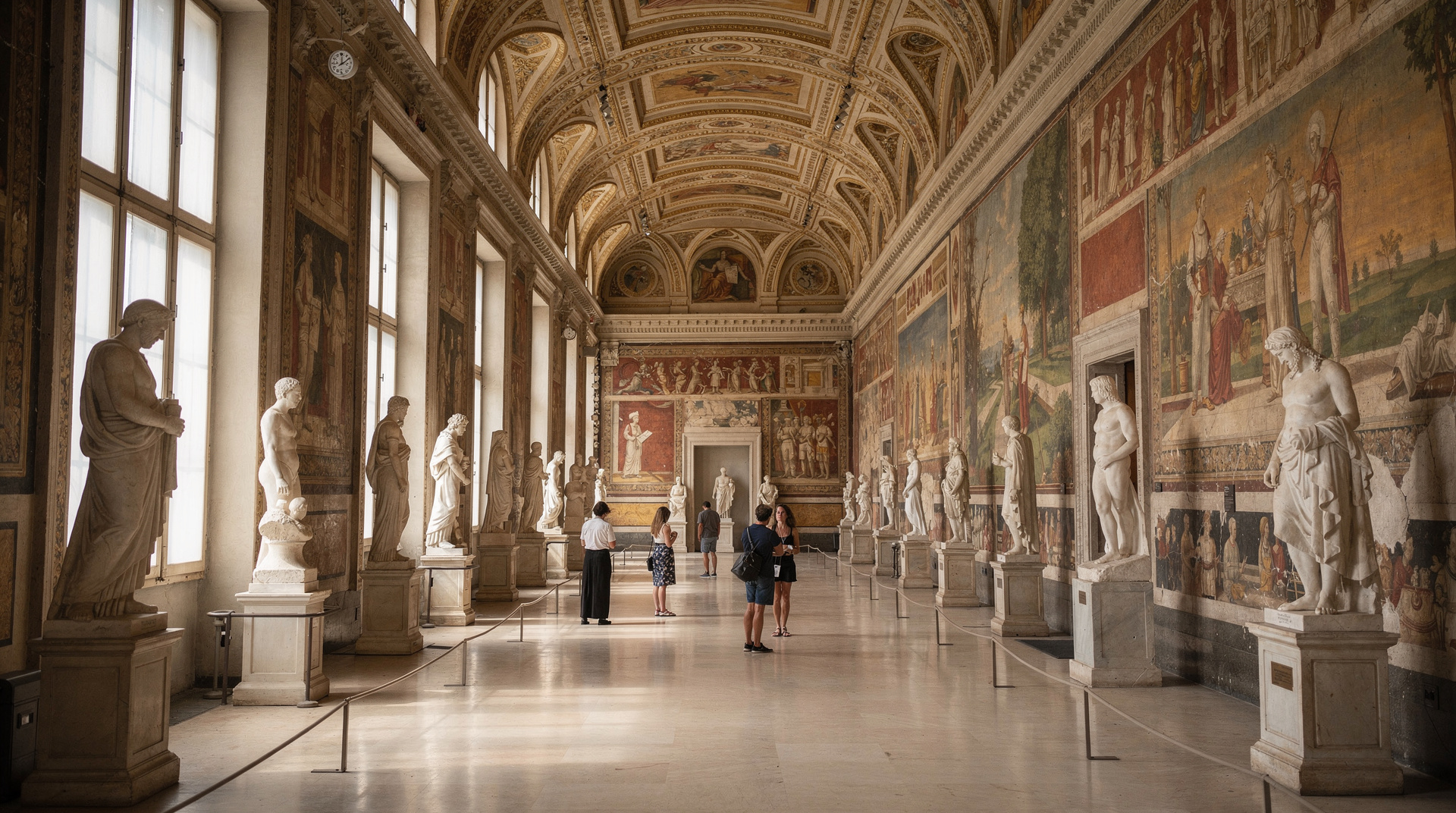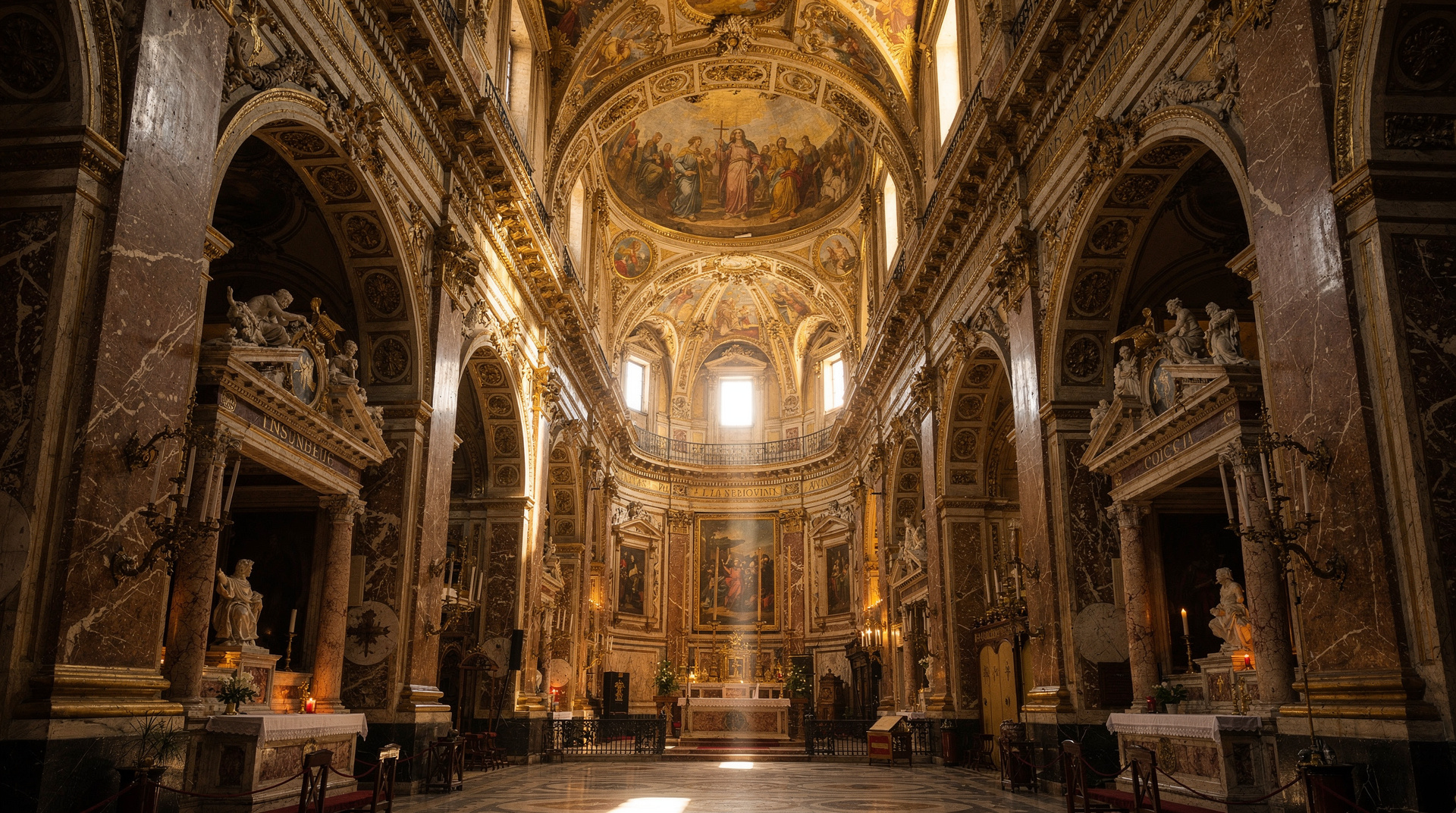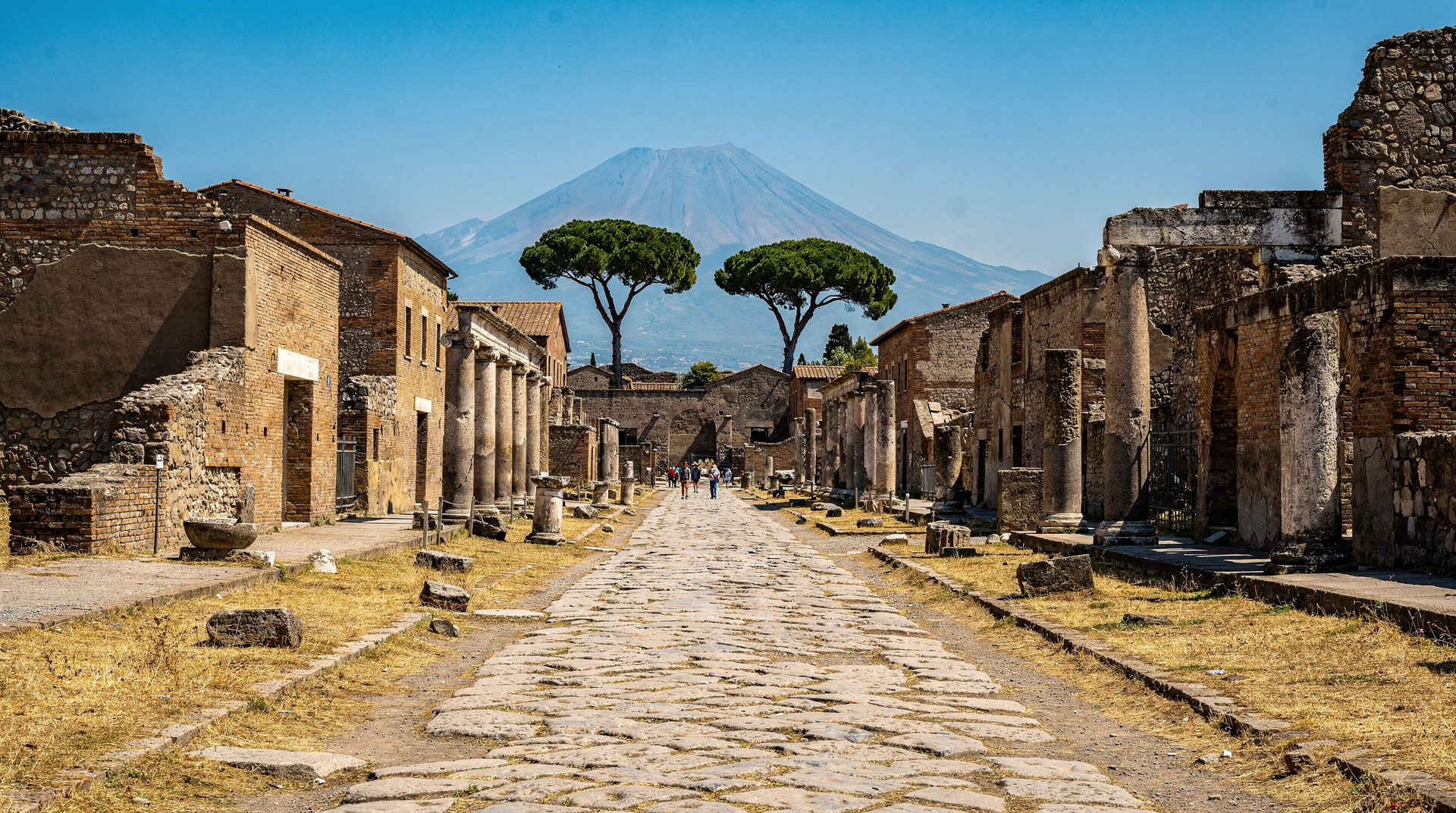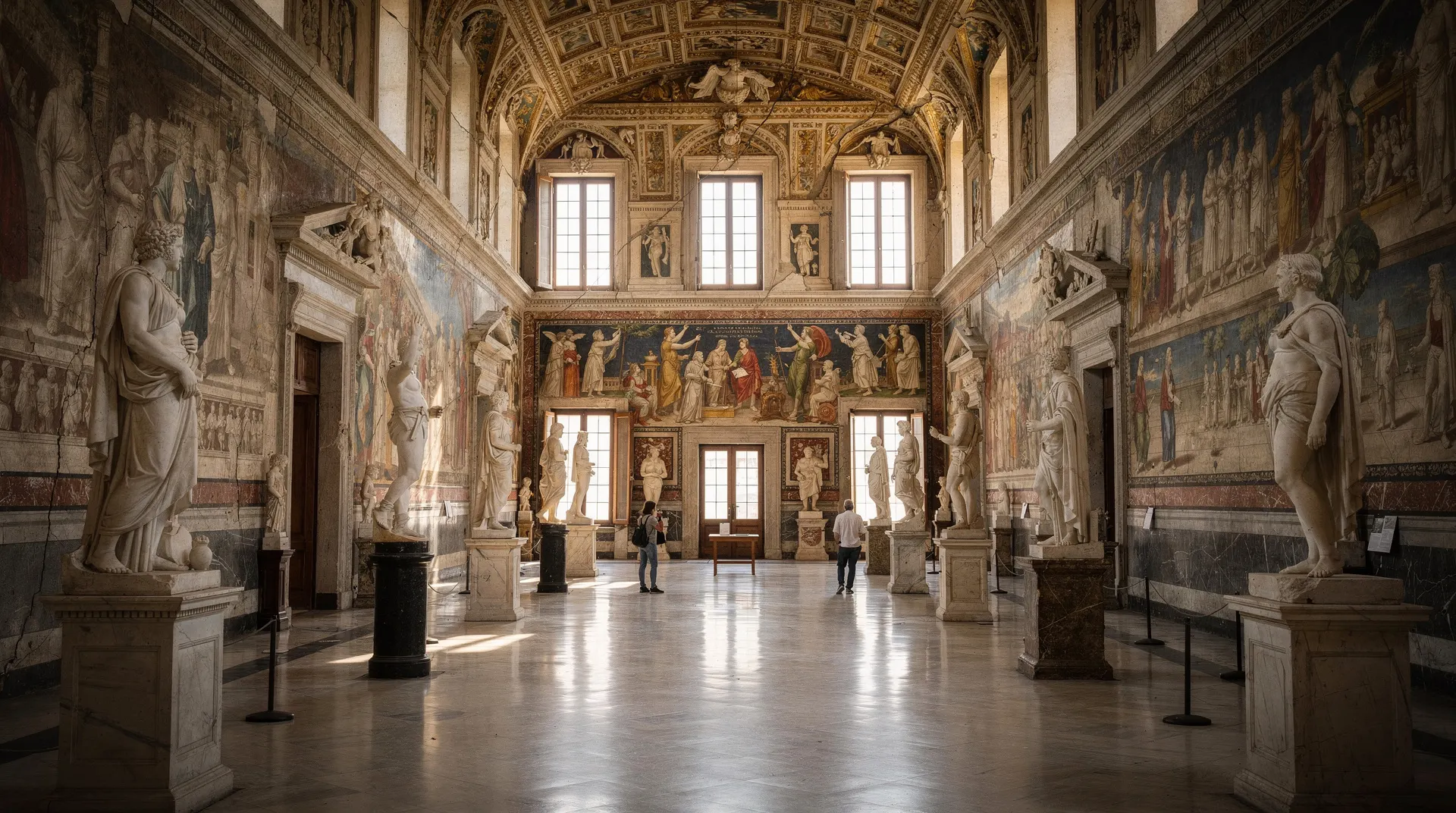
Naples archaeological museum (MANN) — complete visitor guide
Naples: National Archaeological Museum Guided Tour
Is the MANN Naples worth visiting?
Yes — it is one of the most important archaeological museums in the world. The original mosaics, bronzes, and sculptures from Pompeii and Herculaneum are here, not at the sites themselves. Budget 2–3 hours minimum; 4 hours for a thorough visit. Entry €22, closed Tuesday.
Quick answer: The MANN is the most important archaeological museum in the world for ancient Roman art. The Pompeii and Herculaneum originals are here, not at the sites. Allow 2–3 hours minimum. Entry €22. Closed Tuesday.
| Where | Piazza Cavour 19, Naples (Metro Museo/Cavour) |
| Cost | €22 adults; free EU under-18; free first Sunday of the month |
| Time needed | 2 hours minimum, 3–4 hours for a thorough visit |
| Best time | Weekday mornings, spring or autumn |
| Closed | Tuesdays, 1 January, 25 December |
Why the MANN matters more than the sites
Most visitors to Pompeii expect to find the famous mosaics in situ — the Alexander Mosaic, the theatrical masks, the Nile scene with pygmies. They are not there. They are in Naples, in the MANN.
When Pompeii and Herculaneum were excavated from the 18th century onward, the Bourbon kings had the most significant finds transported to their royal collection in Naples. What remains at the sites is impressive — the urban layout, the frescoed walls, the casts of the victims — but the finest individual objects are in the MANN. Understanding this reverses the usual tourist logic: the museum is not the supplement to the archaeological sites; in many respects it is the primary destination.
Getting to the MANN
Address: Piazza Cavour 19, Naples Metro: Museo (Line 1) or Cavour (Line 2) — both within 2 minutes’ walk By foot from the historic centre: 10 minutes north from Via dei Tribunali via Piazza Miraglia
The neighbourhood immediately north of the museum (Piazza Cavour) is perfectly safe and has several good coffee bars for a pre-visit espresso.
Opening hours and tickets
Hours: 9:00–19:30 (last entry 19:00). Closed Tuesday, January 1, December 25. Tickets: €22 adults; €2 EU citizens under 18; discount for EU citizens 18–24 and over 65. First Sunday of the month: free for all (queues are long — arrive at 9:00). Secret Cabinet (Gabinetto Segreto): €3 additional; book separately or at the desk.
Skip-the-line: Available via the official website (mann-napoli.it) and authorized tour operators. Recommended June–September and on weekends year-round. Door queues in summer regularly reach 45 minutes.
Guided MANN tour with skip-the-line entry (3h)Layout and orientation
The MANN occupies a former royal palace (Palazzo degli Studi, 16th–17th century). The collection is spread over three main floors and the mezzanine:
- Ground floor: Large mosaic collection from Pompeii and Herculaneum; Egyptian collection; prehistory
- Mezzanine: Secret Cabinet (Gabinetto Segreto)
- First floor: Farnese collection (Greek and Roman sculpture); numismatic collection; portrait gallery
- Second floor: Bronze room (Herculaneum bronzes); frescoes from Pompeii; vase collection
The ground floor is the most important for first-time visitors. Many visitors spend all their time here and skip the first and second floors entirely — this misses the Farnese Hercules and the Herculaneum bronzes, which are exceptional.
What to see: ground floor priorities
The Alexander Mosaic (Room 61/mezzanine)
The most important object in the museum. The mosaic (5.82 × 3.13 m, approximately 1.5 million tesserae) depicts the Battle of Issus (333 BCE) — specifically the moment of Darius III’s flight from Alexander. The psychological intensity — Alexander charging forward, Darius looking back with an expression that combines horror and desperate authority — is extraordinary. The detail is the most technically sophisticated work of mosaic in the ancient world.
Found in the House of the Faun at Pompeii (the largest house in the city), now on the mezzanine level just inside the main entrance. If you plan to visit the actual House of the Faun afterward, see the Pompeii complete guide for its location within the site — the house itself is impressive even with the mosaic gone, and understanding both halves of the story (object here, context there) is the strongest argument for visiting both.
The large floor mosaics from the House of the Faun (Room 57–60)
The house that contained the Alexander Mosaic also had a series of smaller but still exceptional floor mosaics: theatrical masks, fish and marine life, the Nile with pygmies, fauna and flora. These cover the room floors. Allow 20–30 minutes here.
Egyptian collection (Rooms 1–5)
One of the most significant Egyptian collections in Italy outside Turin. Primarily from Herculaneum’s Temple of Isis and private collections. The blue faience hippo is a single object worth seeking out.
The Secret Cabinet — Room 65
The Gabinetto Segreto contains approximately 250 objects with explicitly sexual content excavated from Pompeii, Herculaneum, and Stabiae. Entry requires a separate ticket (€3) and is through a controlled entrance from the main mezzanine.
What the cabinet actually shows is a mix of:
- Phallus lamps, amulets, and windchimes (apotropaic objects — the phallus was a fertility and protection symbol)
- Erotic frescoes from brothels and private houses
- Priapus statues from garden entrances
- Explicit narrative scenes on small objects and ceramics
The curatorial approach is increasingly sober and archaeological rather than sensational. The exhibition explains the social context of these objects — most of which were not private titillation but public or religious objects with specific functions in ancient Roman culture.
What to see: first floor
The Farnese collection
The Farnese family assembled one of the greatest collections of Greek and Roman sculpture in Renaissance Italy, inherited from Pope Paul III. It was acquired by the Bourbons and forms the core of the MANN’s sculpture collection.
Farnese Hercules (Room 11): A 3.17-metre marble copy of a 4th-century BCE Greek bronze by Lysippus, depicting Hercules resting after his Twelve Labours — leaning on his club, one hand behind his back holding the golden apples. The figure of exhaustion in a powerful body has been one of the most influential sculptural images in European art since its excavation at the Baths of Caracalla in 1545.
Farnese Bull (Room 10): The largest surviving ancient sculpture group (3.7 × 2.5 m), depicting the punishment of Dirce by the sons of Antiope — a scene of violent revenge involving a bull. Found at the Baths of Caracalla; carved from a single block of marble. Overwhelming in scale.
The Atlas (Room 12): A Roman copy of a 2nd-century BCE Hellenistic original, depicting the Titan Atlas supporting the celestial globe. The globe is one of the earliest surviving representations of the constellations.
Portrait gallery (Rooms 30–34)
A series of marble portrait heads from across the Roman world — emperors, citizens, private individuals. The level of individual characterization in Roman portraiture — showing age, personality, doubt — is remarkable.
What to see: second floor
Bronze room — the Herculaneum bronzes (Rooms 114–120)
The Villa of the Papyri at Herculaneum (still partially unexcavated) produced the greatest collection of ancient bronze sculpture found anywhere. The MANN holds nearly 100 pieces including:
The Runners (Epheboi): Two bronze young men, probably athletes. The surface detail and movement are extraordinary.
The Resting Hermes: A young Hermes seated on a rock, wings on his feet, expression alert. One of the most reproduced ancient sculptures.
Drunken Satyr and the Pan: Two pieces from a set of rustic figures.
Portrait heads: Several bronze portrait heads including “Pseudo-Seneca” (possibly Hesiod), remarkable for their psychological intensity.
Allow 30–45 minutes in this room. The Villa of the Papyri itself, where these bronzes were found, remains only partially excavated at Herculaneum — a reminder that the site still holds material that has never been brought to the surface.
Pompeii fresco collection (Rooms 71–77)
Frescoes removed from Pompeii include the famous series from the Villa of Cicero (theatrical masks, megalographia) and narrative panels from various houses. The painting technique (fourth Pompeian style, largely) is often as well-preserved here as anywhere in the world. Some panels remain vivid 2,000 years after painting.
Practical visiting advice
Best time to visit: Weekday mornings in spring or autumn. Avoid July–August afternoons.
For children: The MANN can overwhelm younger children. Focus on the Alexander Mosaic (there are giant reproductions visible), the Farnese Bull (scale and drama work for children), and the Secret Cabinet for older teenagers (educational). The Egyptian collection has approachable objects.
For limited time: Alexander Mosaic → Farnese Hercules and Bull → Herculaneum bronzes → done. This takes 2 hours.
Photography: Permitted without flash in almost all areas. The Secret Cabinet prohibits photography.
Café and shop: Café on the ground floor, open during museum hours. Shop has a good selection of scholarly publications on the Pompeii collection.
MANN digital experience — multimedia guide to major worksCombined tickets and ArteCard
The MANN is included in the Campania ArteCard. The 3-day Naples card (€25) covers entry to the MANN and two other sites plus metro travel. If you are visiting MANN plus Capodimonte or Certosa, the ArteCard is worth buying.
Combined MANN + Pompeii tickets are also available — see Pompeii tickets explained for current pricing.
Where the MANN fits in a Naples museum day
If you’re planning a museum-focused day or two in Naples, the MANN pairs naturally with Capodimonte (fine art rather than archaeology) or the Cappella Sansevero for the Veiled Christ, both reachable within a reasonable taxi ride or walk.
Trying to combine the MANN with a full Pompeii day in the same 24 hours is possible but tiring — most visitors get more out of treating them as two separate half-days. See top attractions in Naples for how the MANN ranks against the city’s other major sights when planning a first visit, and Naples in one day if you need to compress everything into a single tight itinerary.
Frequently asked questions about the MANN Naples
Is the MANN better than visiting Pompeii itself?
They are different experiences. The MANN has the best individual objects. Pompeii has the urban context — walking actual Roman streets, entering actual houses. Serious visitors should do both, starting with Pompeii (for context) and finishing with the MANN (for the best objects).
Can I visit the MANN without pre-booking?
Yes, year-round except during summer peak (July–August) and weekends. In low season, door queues are minimal. In summer, pre-booking skip-the-line is strongly recommended.
How do I find the Alexander Mosaic?
Enter the main hall, go to the mezzanine level just inside the main entrance (Room 61). It is the largest object in the room and cannot be missed. There are explanatory panels in English, Italian, and other languages.
What is the difference between the MANN and Capodimonte?
The MANN is primarily an archaeological museum — ancient Roman, Greek, and Egyptian art. Capodimonte is primarily a fine art museum — Renaissance, baroque, and modern Italian painting and decorative arts. Both are essential; they do not overlap.
Is the Naples archaeological museum free?
Not generally. Full price is €22. Free on the first Sunday of each month for all visitors (queues are significant). EU under-18s free. EU 18–24 discounted. The Campania ArteCard covers entry.
Frequently asked questions about Naples archaeological museum (MANN) — complete visitor
What is the MANN museum in Naples?
How do I get skip-the-line tickets for the MANN?
What is in the Secret Cabinet at the MANN?
How long does a visit to the MANN take?
Is there an audio guide for the MANN?
When is the MANN closed?
Is the MANN accessible by wheelchair?
Should I visit the MANN before or after Pompeii?
Can I buy a combined Pompeii and MANN ticket?
Top experiences
Bookable activities with verified prices and instant confirmation on GetYourGuide.