Capri
Capri: Blue Grotto, Anacapri, Faraglioni, ferry logistics from Naples and Sorrento, day trip vs staying overnight. Honest costs and crowd reality.
From Naples: Capri and Blue Grotto Day Tour
Duration: 9h
Quick facts
- Ferry from Naples
- ~50 min hydrofoil from Molo Beverello, €20–22
- Ferry from Sorrento
- ~25 min hydrofoil, €20–25
- Blue Grotto entry
- €18 surcharge on top of rowing boat (~€15)
- Best months
- May, early June, September, October
- Day trip or stay
- Day trip is enough; overnight costs €250+ for basic hotels
- Crowds
- July–August: very heavy; ferries may be capacity-capped
Capri is the most famous island in the Bay of Naples and, at peak season, one of the most crowded small islands in Europe. At 10 km² it fits roughly 14,000 day-trippers on a July afternoon alongside its 12,000 permanent residents and overnight guests. The narrow lanes around Capri town and the Blue Grotto queue can feel less like a Mediterranean island and more like an outdoor mall. This guide does not pretend otherwise. It does, however, explain what the island genuinely offers at its best — and how to see it under conditions that make the visit worthwhile.
| Where | Bay of Naples, ~10 km² |
| Cost for a day trip | Around €110–€160 per person (ferry, Blue Grotto, chairlift, lunch) |
| Time needed | 1 day trip; 2 nights if staying, budget allowing |
| Getting there | Hydrofoil from Naples (~50 min) or Sorrento (~25 min) |
| Best time | May, early June, September; avoid July–August if crowds bother you |
What Capri actually looks like
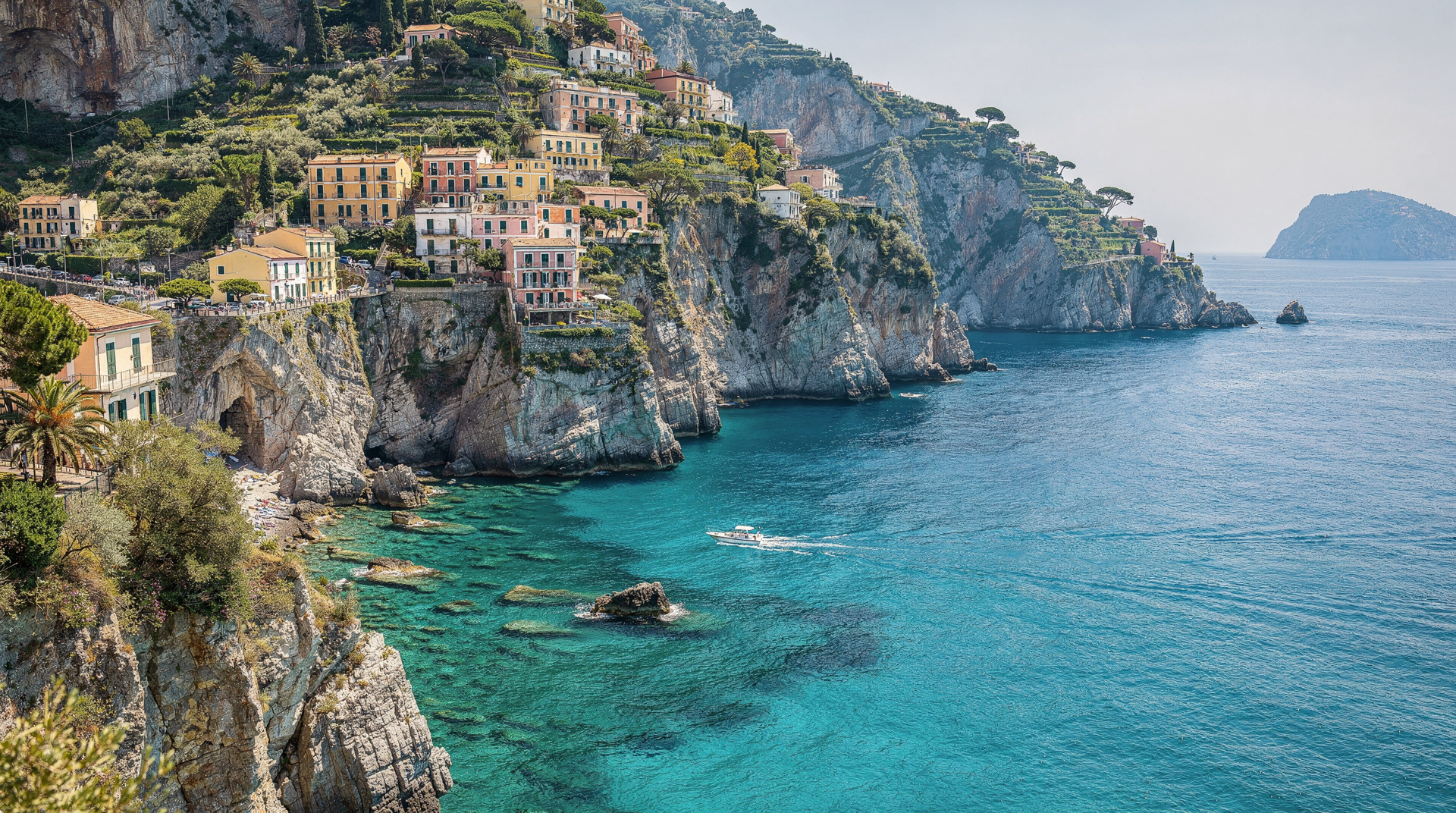
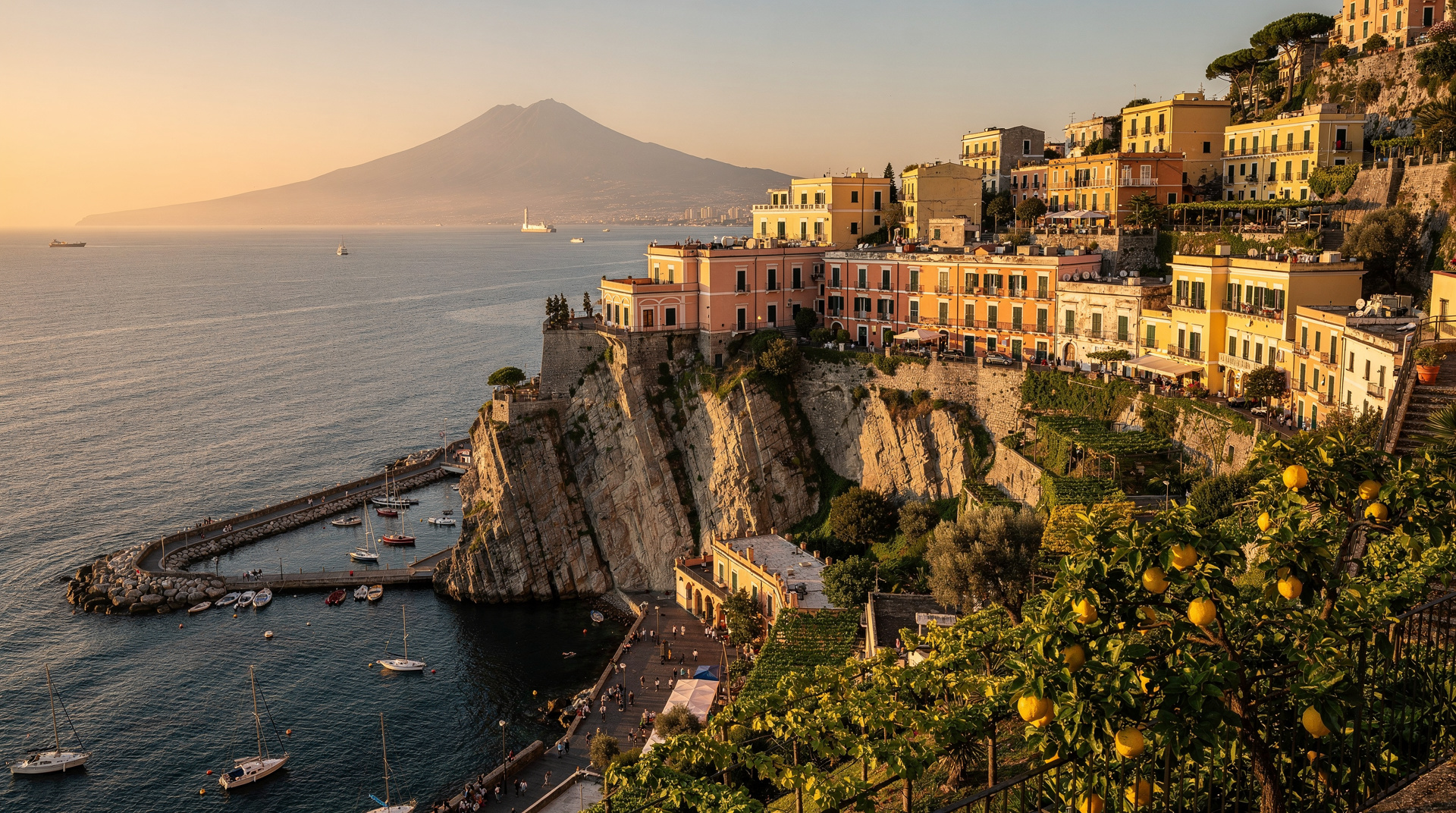
The island splits into two settlements: Capri (the main town) sits at about 150 metres above sea level, reached by funicular from the marina. Anacapri is higher up on the western plateau, quieter, and architecturally more intact. Between them: limestone cliffs, terraced lemon gardens, the Faraglioni rock arches jutting from the southern sea, and a coastline punctuated with sea caves. The water is clear enough to see bottom at 10 metres. The famous Piazzetta di Capri — officially Piazza Umberto I — is a small square surrounded by bars charging €8 for an Aperol Spritz. The scenery is world-class. The commerce is relentlessly tourist-grade.
Getting to Capri: ferries from Naples and Sorrento
Two departure points serve Naples: Molo Beverello (the main hydrofoil and passenger ferry port, central Naples) and Calata Porta di Massa (car ferries, farther east). For visitors without a car, Molo Beverello is the correct terminal. See ferries from Naples explained for the full breakdown.
From Naples (Molo Beverello): Hydrofoils take about 50 minutes and cost €20–22 each way. Ferries take about 80 minutes and cost €14–16. Operators include Caremar, SNAV, and NLG. In July–August, ferries can reach passenger capacity and turn people away — booking in advance is strongly advisable. Service runs roughly 6am–9pm in summer, reduced October–March.
From Sorrento (Marina Piccola): This is the faster and often more pleasant option, especially if you are already based on the peninsula. Hydrofoils take about 25 minutes and cost €20–25 one-way. The shorter crossing also means less exposure to rough seas if the wind picks up in the afternoon.
For a detailed comparison, see Capri from Naples vs Sorrento.
Getting from the marina to town: The funicular runs every few minutes, costs €2, and has queues at peak times. Alternative: 20-minute walk up a reasonable path. Buses also serve both Capri town and Anacapri from the Marina Grande bus stop.
The Blue Grotto: what to expect honestly
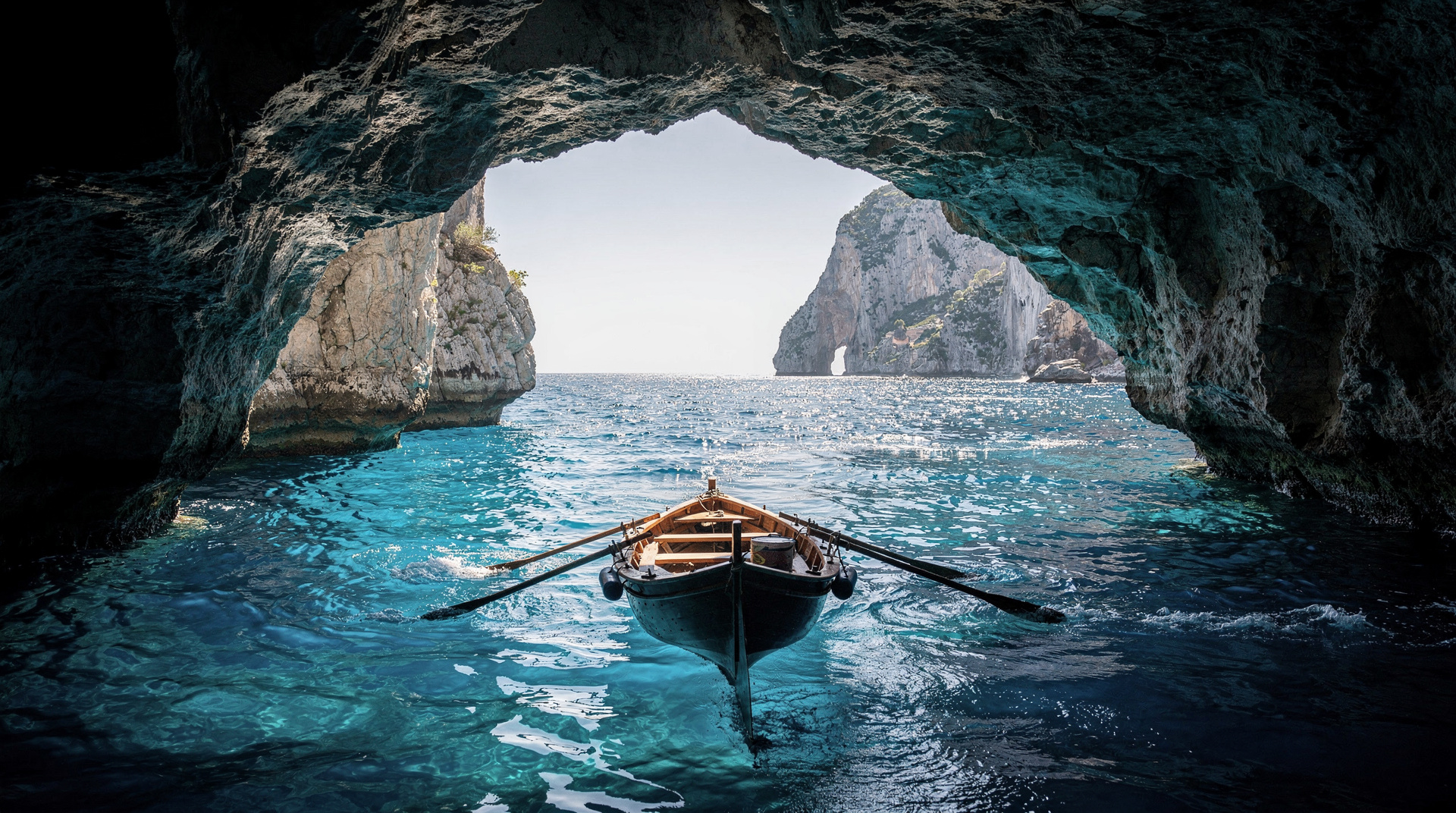
The Blue Grotto (Grotta Azzurra) is a sea cave on the northwestern coast of Capri where sunlight entering through an underwater opening illuminates the water a vivid blue. The effect is genuinely extraordinary — on a clear morning in May, the colour is almost unreal. What is also real: the logistics.
Access requires a rowing boat (the cave entrance is 1 metre high at normal tide; you lie flat). The rowing boat is not included in any ferry ticket — it is a separate operation run by local boatmen, costing approximately €15 per person for a very short trip (typically 3–5 minutes inside). On top of that, there is an €18 cave entry fee. Total cost per person: around €33.
In July and August, the queue for rowing boats can be 60–90 minutes. The cave closes entirely in high seas (this happens frequently in spring and autumn; check the morning of your visit). Going in May or September dramatically reduces both queue and closure risk. The detailed guide at Blue Grotto Capri covers access by boat tour versus the official entrance and gives honest closure statistics.
Capri island boat tour with Blue Grotto accessAnacapri is the half of the island most day trips never reach: a small-group Capri and Anacapri tour from Naples with the ferry included covers both levels and removes the ticket queue at Beverello.
Anacapri and Monte Solaro chairlift
Anacapri is the island’s second village — quieter, more residential, and architecturally more interesting than tourist-saturated Capri town. The Villa San Michele (former home of Swedish physician Axel Munthe, now a museum) offers gardens and views that are among the best free or low-cost experiences on the island. Entry around €8.
From Anacapri, a single-seat chairlift (seggiovia) ascends 589 metres to the summit of Monte Solaro in about 13 minutes. The views from the top encompass the entire Bay of Naples, the Amalfi Peninsula, and on clear days the southern Apennines. The chairlift runs roughly 9:30–17:30 (shorter hours in winter). Cost is approximately €14 round-trip. On busy days in summer there can be a queue of 20–30 minutes. The ride itself is open-air with no restraint beyond a bar — some visitors with height sensitivity find it uncomfortable; the views in both directions are excellent.
Monte Solaro chairlift with local wine tastingThe Faraglioni
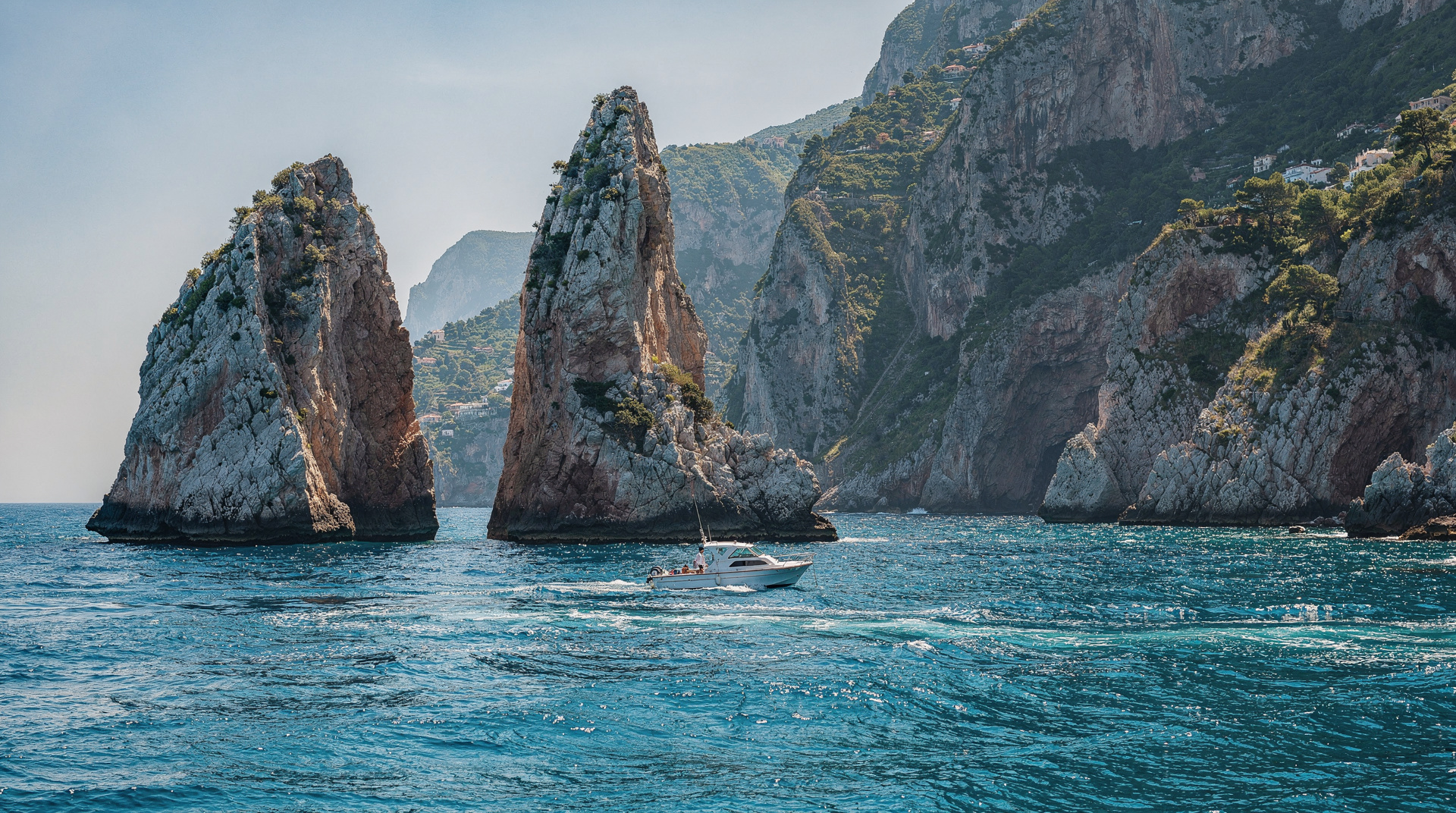
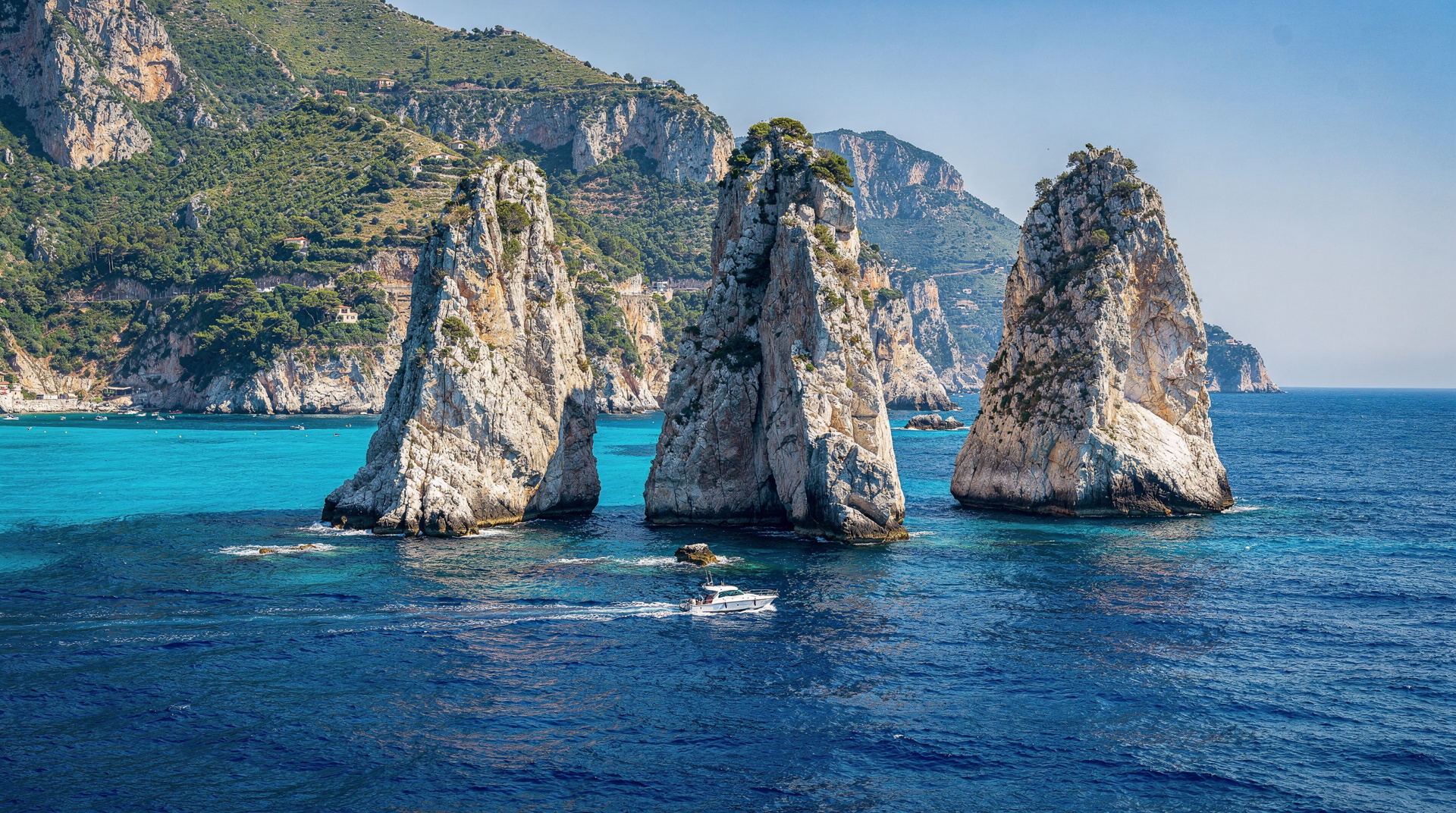
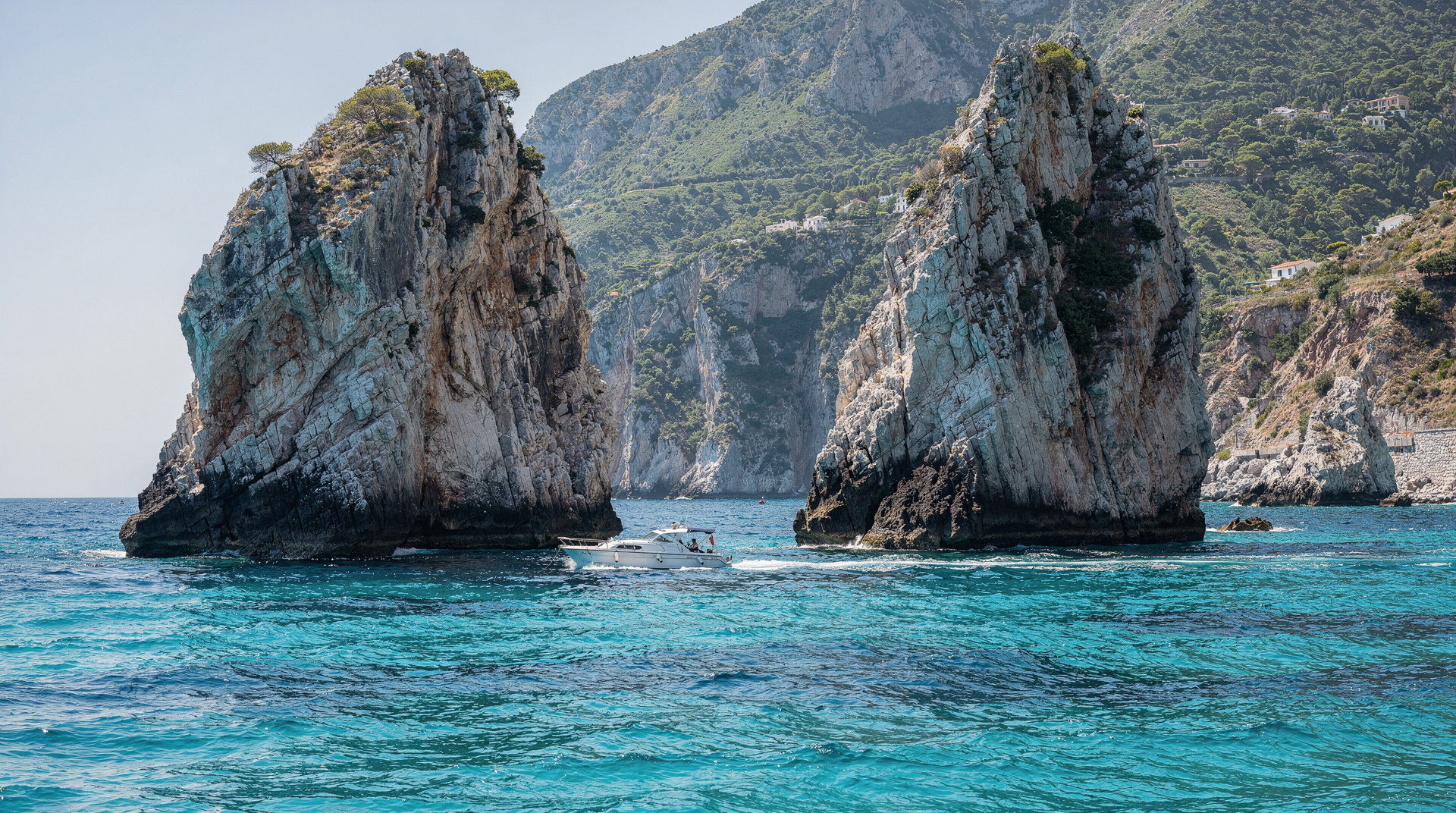
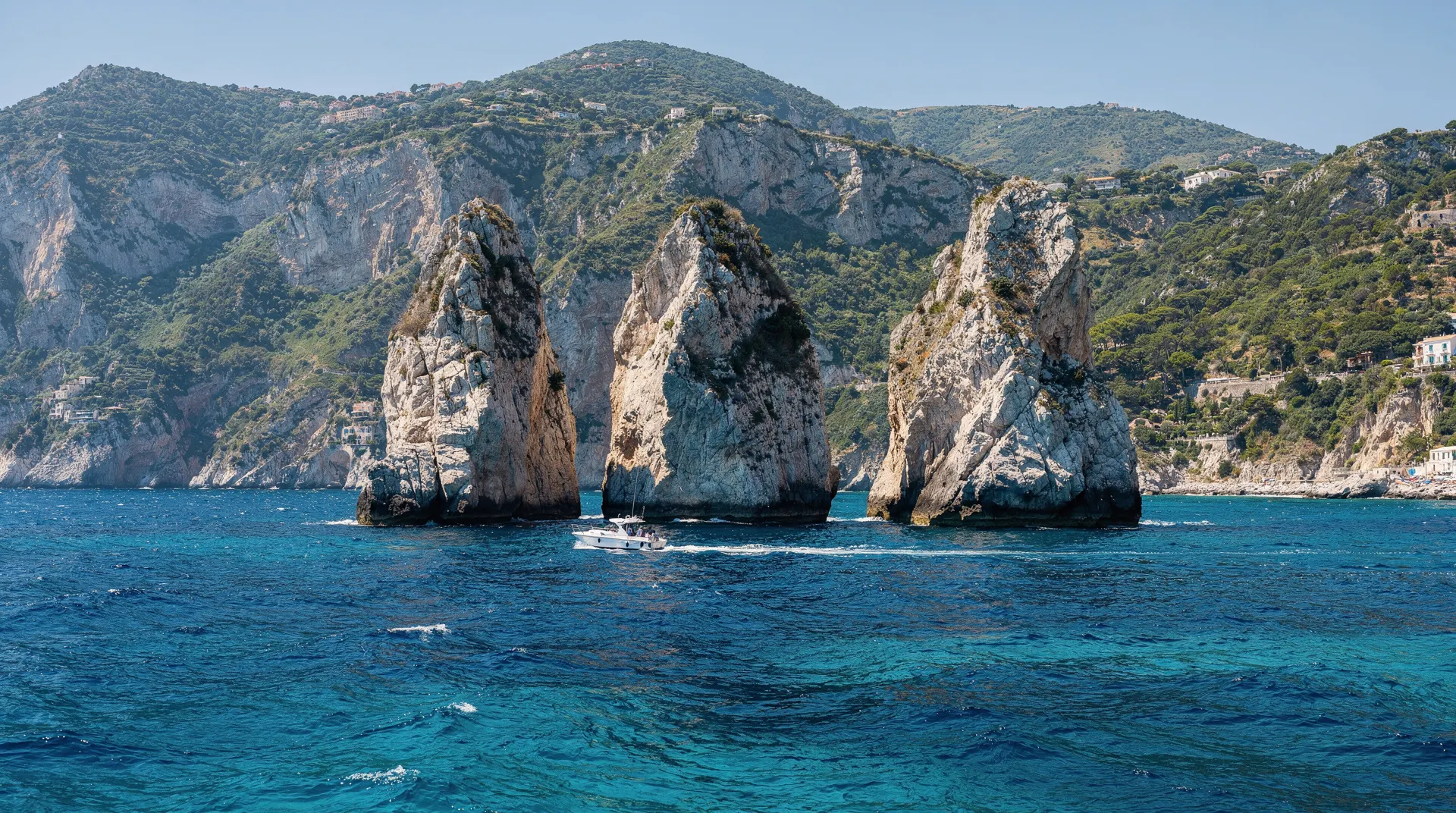
The three rock stacks off the southeastern coast are Capri’s most photographed feature. They are best seen from a boat — the scale and colour are more impressive at sea level than from the clifftop lookouts. The middle Faraglione has an arch large enough for small boats to pass through; traditional local boat tours do exactly this. The cliff path east of Capri town, Via Tragara, leads to the best land-based viewpoint, Punta Tragara — about 20 minutes’ walk from the Piazzetta.
Natural Arch and hiking the island
The Arco Naturale, a limestone arch on the eastern cliffs, is reachable on foot from Capri town in about 30–40 minutes via a signed path. Combined with the descent to the Grotta di Matermania (a Roman nymphaeum cave), this is one of the more rewarding walks on the island without paying for any attraction. Sturdy shoes are advised — the paths involve rough stone steps.
The island has additional trails, but the interior is not wild landscape — it is largely private gardens and villa grounds. The main hiking rewards are the coastal paths.
Day trip vs staying overnight
The honest answer: a day trip is enough for most visitors. The island’s main attractions — Blue Grotto, Anacapri, Monte Solaro, Faraglioni views, a boat circuit — can be fitted into 8 hours. The premium for staying overnight is real: basic hotels in Capri town start at €200–250 per night in season; the better properties run €400–1,000. What you gain by staying: the island after the day-trippers leave (the atmosphere from 7pm onward is dramatically quieter), better access to the best restaurants without crowds, and the sea at morning light.
If budget is not a constraint, one or two nights in late May or September is exceptional. If budget matters, a well-organised day trip from Sorrento or Naples is genuinely satisfying.
See is Capri day trip worth it? for a worked-out comparison.
Guided tours: when they make sense
Self-navigating Capri is straightforward — buses, ferries, and footpaths are well-marked. Guided tours add value in specific situations: if you want guaranteed Blue Grotto access (operators sometimes have priority boat arrangements), if you want a boat circuit of the island combined with swimming stops, or if time is tight and you want efficient routing.
Capri and Anacapri guided experience from NaplesThe boat tours from Sorrento combining Capri with swimming stops at sea caves are among the best-value experiences here — they bypass the crowded marina and provide access to the island’s coastline (the most spectacular part) that you cannot see on foot.
Eating on Capri
Budget eating on Capri barely exists at restaurant level. A pasta course at a sit-down restaurant costs €18–28; pizza starts at €14. Street food is the only affordable option: pizza al taglio (by the slice) and panini from small shops on the back streets of both Capri town and Anacapri keep costs manageable.
The one splurge worth considering: a seafood lunch at a restaurant along the Marina Piccola beach (not to be confused with Sorrento’s Marina Piccola). Restaurants like Da Luigi and La Canzone del Mare have genuinely spectacular settings directly on the water. Prices are high (€35–50 per person for two courses plus wine) but the setting is hard to replicate elsewhere.
For grocery shopping and picnic supplies: there is a small Eurospar in Capri town. Anacapri has a small supermarket on Via Giuseppe Orlandi.
Gardens and villas
Capri has several notable villa gardens, two of which are open to the public.
Villa San Michele (Anacapri, Via Axel Munthe): The former home of Swedish physician Axel Munthe (1857–1949), author of “The Story of San Michele”. The garden terrace offers views east across the bay and the sphinx sculpture at the far end has been photographed hundreds of thousands of times. Entry is approximately €8. The interior museum gives context on Munthe’s life and his work founding bird reserves on the island. Worth 45–60 minutes.
Giardini di Augusto (Capri town, Via Matteotti): Created by Friedrich Alfred Krupp in the early 1900s, this small terraced garden near the Certosa di San Giacomo offers another angle on the Faraglioni and the Marina Piccola bay below. Entry is €1. Small but pleasant.
Certosa di San Giacomo: A 14th-century Carthusian monastery at the southern end of Capri town. Currently partly used as a school and a museum. The two-cloister complex is architecturally interesting and often empty of visitors — a contrast to the crowded Piazzetta 200 metres away.
Where to stay on Capri
The island’s accommodation is famously expensive, but staying overnight genuinely transforms the experience. By around 6pm, the last day-trip ferries have left and the island’s permanent population reclaims the streets. The Piazzetta becomes a local gathering point rather than a tourist spectacle. Dinner at a good restaurant becomes possible without a 45-minute wait.
Budget options: Nothing truly budget exists. The least expensive options are small guesthouses in Anacapri (quieter, higher up) rather than Capri town. Expect €150–200 per night minimum in June–September.
Mid-range: Family-run hotels in Capri town, typically €200–350 per night in season.
Luxury: Capri’s famous luxury hotels (J.K. Place, Capri Palace, Grand Hotel Quisisana) start at €500–800 per night and represent a product that has its own logic — the views, service, and pool situations are exceptional if the category suits your budget.
Booking for July–August requires planning months in advance; the island’s accommodation capacity is finite and demand is very high.
What to skip
The Piazzetta bars in peak summer: The square is worth seeing, but the €8 Aperol Spritz and mandatory table service are not. Walk two streets back for the same drink at half the price.
Luxury brand shopping: Capri has an inexplicably large concentration of high-end boutiques for an island of 12,000 people. This is a tourist economy; prices are not better than mainland shopping districts.
The tourist train: A rubber-wheeled vehicle that tours the main road. Does not go anywhere you cannot walk faster and with more flexibility.
Practical information
Luggage: Capri has steep streets, steps, and no luggage storage at the marina that is reliable. Leave big bags at your Sorrento or Naples accommodation and travel light.
Cash: Many smaller operations (rowing boat operators, small bars) are cash only. Bring €50–80 in cash if doing a full day including Blue Grotto.
Weather: The ferries are cancelled in bad weather (Tramontane or Scirocco winds). Check the forecast the night before a planned day trip. If ferries are cancelled, the island’s authorities also close the Blue Grotto.
High season congestion: July and August ferries from Beverello can reach passenger cap. Online booking at least 48 hours in advance is recommended.
Villa Jovis and the Emperor Tiberius’s Capri
Above Capri town, at the island’s eastern high point, lie the ruins of Villa Jovis, the largest and most famous of the twelve villas the Emperor Tiberius built across the island during his final decade of self-imposed exile from Rome (AD 27–37). Ancient sources — mostly hostile, written by Suetonius and Tacitus after Tiberius’s death — describe the villa as the setting for extravagant and often lurid imperial excess, though modern historians treat the more sensational claims with scepticism.
What survives is a genuinely impressive engineering feat: a multi-level complex with its own cisterns collecting rainwater on a rock summit with no natural water source, imperial private apartments, and a sheer drop known as the “Salto di Tiberio” from which the emperor is said (again, on contested evidence) to have had prisoners thrown into the sea. The walk up from Capri town takes 45–60 minutes on a paved but uphill path; entry is a modest few euros and the site receives a fraction of the visitors at the Blue Grotto or the Piazzetta, making it one of the better quiet spots on an otherwise crowded island.
Capri vs Ischia vs Procida: the honest comparison
Travellers choosing among the Bay of Naples islands often overweight Capri’s fame relative to what actually suits their trip. A quick reference:
| Island | Best for | Day trip realistic? | Rough day-trip cost |
|---|---|---|---|
| Capri | Blue Grotto, Faraglioni, glamour | Yes — the classic circuit fits 8 hours | €110–160 |
| Ischia | Thermal spas, beaches, longer stays | Rushed as a day trip; rewards 2–3 nights | €70–110 |
| Procida | Pastel harbour, quiet, cheaper | Yes, easily, and less crowded | €50–80 |
If your priority is ticking off the Blue Grotto and the Faraglioni for the photos, Capri is worth the premium. If you want a relaxed, cheaper island day without giving anything up in atmosphere, Procida is the better value; the fuller Capri vs Ischia vs Procida guide breaks down the trade-offs in more depth.
Boat tours around the coastline: the case for skipping land altogether
A meaningful share of what makes Capri special — the Faraglioni arch, the sea caves along the eastern and southern cliffs, the Grotta Bianca and Grotta Verde beyond the Blue Grotto — is only fully visible from the water. A full island boat circuit (2.5–3.5 hours, departing from Marina Grande or as part of a Sorrento/Naples day trip) typically includes a swim stop, a pass through the Faraglioni arch if sea conditions allow, and views of the villas along the Marina Piccola cliffs that are invisible from any land viewpoint, including Villa Malaparte at Punta Massullo.
Given how much of the standard land itinerary is queuing (funicular, chairlift, Blue Grotto rowing boats), travellers with limited time sometimes get more genuine “Capri” per hour from a boat circuit than from the land-based highlights.
Private boat tour of Capri’s coastline from SorrentoFrequently asked questions about Capri
Is the Blue Grotto open every day?
No. The cave closes when seas are rough — this can happen in any season but is most common in autumn and spring. Even in summer, afternoon winds can cause closures. Check the morning of your visit. The island’s official tourist office posts updates. The Blue Grotto reality check guide covers this in detail.
How long should I spend on Capri?
A full day (8–10 hours including ferry time) is enough to see the Blue Grotto, Anacapri, Monte Solaro, and the Faraglioni views. If staying overnight, two days allows a more relaxed pace with morning sea light and less crowd pressure.
Is Capri better from Naples or Sorrento?
Sorrento is closer (25 minutes vs 50 minutes) and the ferry is less likely to hit rough open-sea conditions. If you are already in Sorrento, depart from there. If you are based in Naples and not going to Sorrento, Naples is fine — just book the ferry in advance in July–August. See Capri from Naples vs Sorrento.
How much does a day trip to Capri cost?
Ferry round-trip: €40–50. Blue Grotto (boat + entry): €33. Monte Solaro chairlift: €14. Lunch: €20–30 if eating from street food or small shops, €45–60 at a sit-down restaurant. Total realistic day: €110–160 per person.
Is Capri worth it in August?
The island is extremely crowded in August. If you are flexible, September is significantly better — sea temperature is warm, crowds thin, and the atmosphere is more enjoyable. That said, people do have good August visits by starting early (first morning ferry) and spending time at sea rather than in town.
Can I swim at Capri?
Yes, but the island has very limited sandy beaches. Most swimming access is from concrete ledges, wooden platforms, or boat directly. Marina Piccola has a small pebble beach. The sea itself is exceptional — very clear and deep. The best swimming is from a boat or kayak circling the coastline.
How do I avoid the crowds at the Blue Grotto?
Go in May or early October, arrive at the grotto by 9am (before the main ferry crowds arrive from Naples), and book a boat tour that includes priority grotto access where possible. The Blue Grotto boat tips guide covers the timing in detail.
Is Capri expensive to visit?
Yes — it is one of the most expensive day trips from Naples. Budget for €120–160 for a full day including ferries, Blue Grotto, chairlift, and a modest lunch. Accommodation if staying overnight starts at €200 for basic options. Capri vs Ischia vs Procida compares costs across the three islands.
Is a boat tour or a land-based day trip better for a first visit?
Most first-timers should do both if time allows: land highlights (Blue Grotto, funicular up to Capri town, Monte Solaro chairlift) in the morning, then a boat circuit or transfer in the afternoon to see the Faraglioni and sea caves properly. If forced to choose one, a boat tour with a swim stop generally delivers more per hour than queuing for land attractions in peak season.
Top experiences
Bookable activities with verified prices and instant confirmation on GetYourGuide.