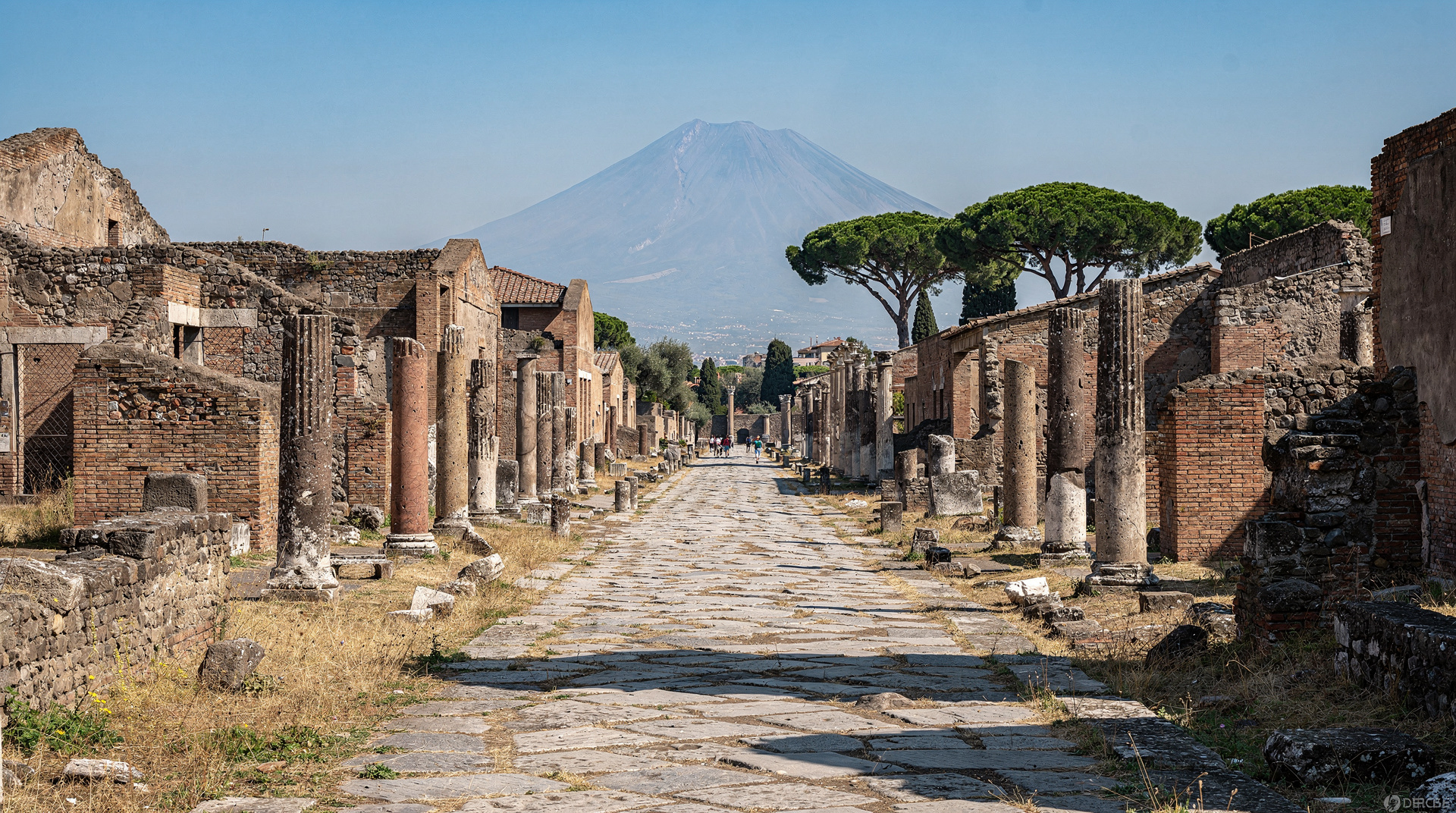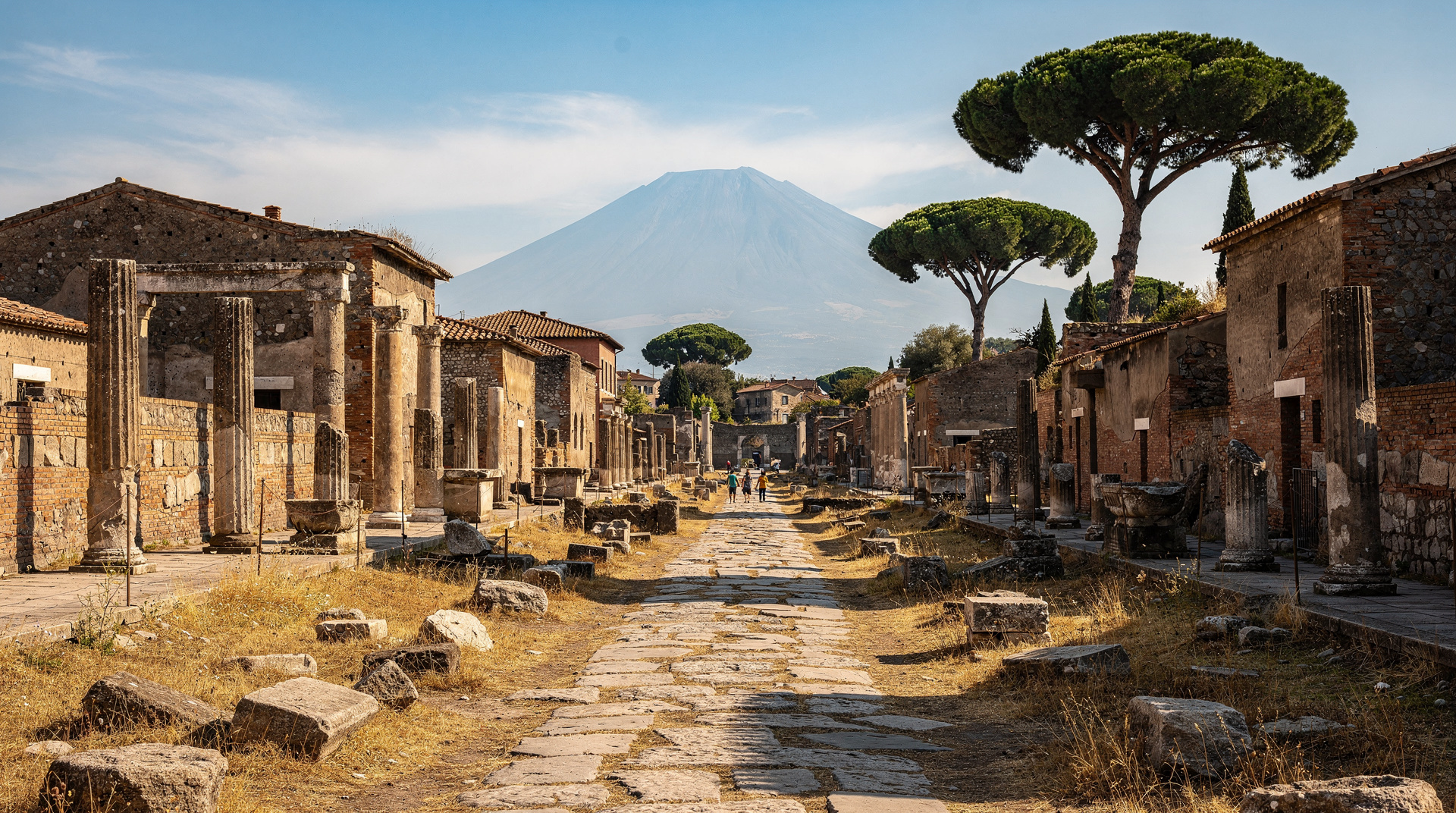
Pompeii guided vs self-guided: which option works best for you
Pompeii: Skip-the-Line Ticket + Guided Group Tour
Duration: 2h
Should you book a guided tour of Pompeii or visit independently?
For first-time visitors without background knowledge, a guided tour (€15–25 pp small group, €80–120 private) transforms the experience — empty stone rooms become legible. Self-guided with the Pompeii Sites app (free) or audioguide (€8) works well if you've prepared beforehand. The site is safe and navigable without a guide.
The fundamental question: does context change the experience?
At some tourist sites, a guide adds a pleasant layer of storytelling but the visual experience speaks for itself. At Pompeii, context is not a bonus — it changes what you’re able to see.
This is a site where you will walk past what looks like a blank wall and not realise it carries an election campaign slogan painted 2,000 years ago. You’ll walk through a room that looks like a stone box and not recognise it as a Roman fast-food counter. Without the background knowledge to decode what you’re looking at, Pompeii can feel impressive in scale but somewhat empty in meaning.
That said, excellent self-guided visits are entirely possible. The question is how much preparation you’re willing to do beforehand.
| Small-group guided | around €35–55 pp, incl. entry |
| Private guided | around €80–120 for the group |
| Self-guided | around €18 entry + free app, or €8 audioguide |
| Time needed | 2–3 hrs at the site either way |
| Best for guided | first visit, no background knowledge |
| Best for self-guided | prepared visitors, second visit, budget priority |
What a licensed guide actually adds at Pompeii
1. Identification. The buildings at Pompeii are not labelled comprehensively. Some have small signs; many do not. A guide knows which building type you’re in, what it was used for, who lived or worked there, and what the evidence shows.
2. Non-obvious details. A good guide points out the scratched graffiti on a wall (ranging from political endorsements to profanity), the water distribution infrastructure at street intersections, the ruts worn into crossing stones by cart wheels, and the height differential between Roman street level and current ground level. None of this requires specialist knowledge to appreciate, but you need someone to point it out.
3. Historical context. Understanding that Roman apartments mostly had no kitchens (because wood fires in multi-storey buildings were fire hazards) explains why there were 80+ thermopolia (street food counters) in the city. Understanding the client-patron system explains the layout of wealthy houses. A guide builds this context while walking.
4. Time efficiency. The site is 66 hectares. Without a plan, visitors spend too long near the entrance and run out of time for the Villa of the Mysteries (outside the perimeter) and the Garden of the Fugitives (far southeast). A guide keeps a route that covers the most significant sites in the available time.
5. Adaptability. A guide knows which buildings are open today and adjusts the route. They know that the House of the Vettii was unexpectedly closed this week and can route you to the Casa dei Dioscuri instead.
Small-group tour with licensed archaeologist guideThe self-guided case
Cost: The standard entry ticket is €18. An audioguide at the gate costs €8. A good free app (Pompeii Sites, Rick Steves Audio Europe) costs nothing. A small-group guided tour with entry costs €35–55. The saving is real.
Pace: Self-guided visitors can spend 45 minutes in the Villa of the Mysteries if they want to, or skip the Brothel queue entirely, or sit in the Amphitheatre for 20 minutes without a guide checking their watch. This freedom matters.
Preparation substitutes for a guide. If you’ve read Mary Beard’s “Pompeii” or watched the BBC documentary, or listened to the “The History of Rome” podcast episodes covering Pompeii, you arrive with enough context to decode most of what you see. The gap between a well-prepared self-guided visitor and a modestly informed guided visitor is small.
The App works. The official Pompeii Sites app (free, works offline, iOS and Android) has detailed building information, an interactive map, and audio commentary. Download it before you arrive.
Smart skip-the-line entry with digital guideTypes of guided tour: what to choose
Small-group guided tour from Naples The most popular option. A licensed guide collects groups at a Naples meeting point (usually at the train or at Pompeii gate) and leads a 2.5–3 hour site tour. Entry is usually included in the price. Groups should ideally be 12 or fewer — ask before booking. Price: €35–55 per person including entry.
Private guided tour (site only) A licensed guide meets you at the Pompeii entrance for a private tour of 2–3 hours. You book and pay for your own entry separately. Good for couples, families, or small groups who want an adaptable itinerary. Price: €80–120 for the group.
Tour + transport from Naples Some operators offer guided tours with minibus transport from Naples (not by Circumvesuviana). These cost more (€60–90 per person) but eliminate the train logistics. Worth considering if you’re travelling with elderly family members or with young children.
Full-day combo tours Tours that combine Pompeii with Vesuvius, Herculaneum, or Amalfi Coast. Typically 6–8 hours, licensed guide, minibus transport. See Pompeii and Vesuvius same day and best Pompeii tours for recommended combinations.
Small-group archaeologist-led Pompeii tourRed flags: what to avoid
Unlicensed touts at the station or gate: If someone approaches you outside Pompei Scavi station or at the Porta Marina gate offering to be your guide, decline. Licensed guides do not solicit outside the gate. These touts are unlicensed, uninsured, and often share only basic information available on any Wikipedia page.
Very large groups: Any tour advertised as “small group” that has more than 15 people has all the disadvantages of a guided tour (fixed pace, noise, congestion at narrow sites like the Brothel) with fewer of the advantages.
Tours that don’t include a licensed guide: Some cheap “guided tours” use a local with no professional qualification. Ask specifically whether your guide holds a Guida Turistica Abilitata (official regional guide licence). This is a legally significant distinction in Italy.
Tours that rush: A 90-minute site tour is not sufficient for Pompeii’s main highlights. If a tour advertises the full site in less than 2 hours, it is skipping significant sites.
The hybrid approach
Many experienced visitors use a compromise: book a guided tour for the first part of the visit (the Forum, Via dell’Abbondanza, the main houses — 2 hours with a guide), then stay in the site independently afterward to visit the periphery at their own pace (Villa of the Mysteries, Garden of the Fugitives, Amphitheatre). This gives you context where it matters most and freedom where you want to linger.
How this compares with Herculaneum and other sites
If you’re weighing a guide for Pompeii, the same logic applies to nearby sites, but the maths shifts. Herculaneum is far smaller (4.5 hectares against Pompeii’s 66), so a self-guided visit is much easier to do well in an hour or two without a guide — see our Herculaneum vs Pompeii comparison for the detail.
If you’re combining both sites in one day, a guide earns its keep more at Pompeii, where the scale makes route-planning genuinely difficult; you can afford to go self-guided at Herculaneum afterwards. For Vesuvius, the calculation is different again — the crater path is a single trail with numbered signage, so a guide adds context rather than navigation.
Ticket logistics also differ by format. If you haven’t already, read our Pompeii tickets explained guide before booking anything — some guided tours include entry, others don’t, and the wording on booking pages is not always clear about which.
Booking timing: how far ahead
Small-group guided tours from Naples sell out in July and August, particularly morning departures that avoid the worst heat — see visiting Pompeii in summer heat for why the early slots matter. Book those 1–2 weeks ahead in high season, and 2–3 days ahead is usually fine from October to April. Private guides have more flexibility because they aren’t filling a fixed group, but the good English-speaking archaeologist-guides still get booked out around Easter and in August, so a week’s notice is safer than a walk-up. Self-guided visitors don’t need to book anything beyond the entry ticket itself, which you can usually buy the day before online without trouble outside of the absolute peak weeks.
What each format feels like once you’re inside
A small-group guided tour moves as a unit: the guide stops at 10–14 points, talks for 3–6 minutes at each, and the group walks together between them. You’ll cover the Forum, Via dell’Abbondanza, one or two houses, the Stabian Baths, and usually the Amphitheatre or Garden of the Fugitives depending on time. You don’t choose the stops. Photography happens in the gaps, which is fine for most people but can feel rushed if you’re a slow photographer.
A private guide adapts in real time — if you linger at a fresco, a good private guide will read that and extend, or skip a stop you find less interesting. This is the single biggest practical difference between small-group and private tours, and it’s why families with children who have shorter attention spans for some rooms and longer for others tend to do better with private guides.
Self-guided visitors set their own rhythm entirely, but the tradeoff is decision fatigue: with no fixed route, it’s easy to spend 40 minutes near the entrance and then rush the far end of the site as closing time approaches. The app’s suggested itineraries help here if you follow one rather than wandering freely from the start.
Decision guide
| Profile | Recommendation |
|---|---|
| First visit, no background knowledge | Small-group guided tour |
| First visit, well-prepared | Self-guided with app |
| Second visit or historian | Self-guided |
| Family with children 7–12 | Private or family-oriented guided tour |
| Budget priority | Self-guided (€18 + free app) |
| Time limited (2 hours) | Guided tour — guide knows the efficient route |
| Want flexibility and photography | Self-guided |
What preparation looks like for a self-guided visit
The quality of a self-guided Pompeii visit scales directly with preparation time invested. Here’s a practical preparation menu:
1 hour preparation: Read a single good overview article (the official Pompeii Sites website has a solid introduction, as does Wikipedia’s Pompeii article). Download the Pompeii Sites app. You’ll arrive knowing the basic layout and the major buildings. This is the minimum viable preparation.
3 hour preparation: Watch the BBC “Meet the Romans with Mary Beard” documentary (free on YouTube). It covers the daily life, social structure, and material culture of Roman towns like Pompeii at a level that directly translates to what you’ll see on the ground. After this, the Forum, the baths, the thermopolia, and the houses all become immediately more legible.
5+ hour preparation: Read Mary Beard’s “Pompeii: The Life of a Roman Town” (a 300-page academic book written for general readers). This is the authoritative popular account of what archaeological evidence actually tells us about life at Pompeii. After reading it, you’ll understand things guides typically don’t explain: what the electoral graffiti actually says, why the street food counters are shaped as they are, and what the evidence tells us about Roman economic life.
Common misconceptions a guide corrects
Visitors often arrive at Pompeii with ideas that a good guide dismantles constructively:
“Pompeii was preserved in its 79 AD state”: Not quite. The city had suffered a major earthquake in 62 AD and was still being rebuilt in 79 AD. Several buildings were under repair. What you’re seeing is a city in partial reconstruction, not the intact 79 AD version.
“The plaster casts are everywhere”: The 86 casts are clustered at specific locations. Many visitors expect to encounter them throughout the site; instead, they’re concentrated in the Forum Granary, Garden of the Fugitives, and a few houses.
“The streets are all preserved”: The current ground level at Pompeii is significantly lower than the original 79 AD street level in most areas — centuries of excavation have removed upper layers. The stepping stones visible in streets show the original pedestrian crossing level.
“Pompeii was a minor town”: Pompeii was a wealthy trading city of 11,000 people — larger than many English towns in the same period. It had a sophisticated water supply system, multiple bath complexes, an amphitheatre older than the Colosseum, and significant artistic and commercial life.
The language question
Most small-group tours from Naples operate in English. If you’re booking a private guide, confirm the language upfront.
Italian-language guides who speak reasonable English are common; specialist English-speaking archaeologist-guides are available but book early in summer.
For Spanish, German, French, and other languages: guided tours are available from major Naples operators, but smaller groups and fewer operators. Self-guided with the app (which is available in multiple languages) is a practical alternative for non-English speaking visitors.
Frequently asked questions about guided vs self-guided Pompeii
Is it rude to leave a guided tour early?
Not at a commercial tour. If the group tour has seen the major sites and you want to stay longer to explore independently, it’s normal to thank the guide and stay behind when the group exits.
Can I hire a guide inside the site (not pre-booked)?
Yes. There is a licensed guide booking desk at the Porta Marina entrance. You can hire a guide on the spot for approximately €80–100 for a group. The quality is generally good. In peak season, guides may be fully booked — pre-booking is safer.
Is the guided tour available in English?
All major licensed guide operators offer English-language tours. Small-group tours from Naples are almost always in English. When booking, confirm language.
Does a guide know about which buildings are closed?
Yes. Any competent licensed guide checks the daily opening list before leading a tour and adjusts the route accordingly. This is one of the less-obvious advantages of hiring a guide.
Frequently asked questions about Pompeii guided vs self-guided: which option works best for you
What does a Pompeii guide actually add?
What is the difference between a licensed guide and a tour tout?
How much does a private guide cost at Pompeii?
What is the best small-group tour of Pompeii?
Is the audioguide at Pompeii a good substitute for a human guide?
Can I take photos during a guided tour?
How long does a guided tour of Pompeii last?
Top experiences
Bookable activities with verified prices and instant confirmation on GetYourGuide.