Oplontis
Oplontis (Torre Annunziata) holds one of the finest Roman villas in Italy — Villa Poppaea. UNESCO site, rarely crowded, often overlooked. How to visit.
Pompeii: Skip-the-Line Entry Ticket with Audio Guide or Tour
Quick facts
- Location
- Torre Annunziata, 3 km west of Pompei
- Train (Circumvesuviana)
- Torre Annunziata station, ~25 min from Naples (€3.10)
- Opening hours
- 9:00–19:30 (summer), 9:00–17:00 (winter)
- Entry ticket
- Covered by Pompeii combo ticket (€22)
- UNESCO status
- Part of the Pompeii World Heritage Site (1997)
- Visit duration
- 1–2 hours
Oplontis and Villa Poppaea: the site that most visitors miss entirely
On the stretch of the Circumvesuviana between Ercolano and Pompei, the train stops at Torre Annunziata. Most passengers barely glance up. Almost none of them get off. This is the access point for one of the most extraordinary Roman buildings to have survived anywhere in Europe — the Villa di Poplaea, or Villa Poppaea — and it receives a fraction of the visitors that crowd Pompeii fifteen minutes down the line.
Oplontis was the ancient name for the settlement that is now Torre Annunziata. When Vesuvius erupted in AD 79, it buried not just the cities of Pompeii and Herculaneum but a string of villas and suburban settlements along the coast. The Villa Poppaea is the most significant of these.
| Where | Torre Annunziata, 3 km west of Pompei |
| Cost | Covered by Pompeii combo ticket (€22); standalone ~€6 |
| Time needed | 1–1.5 hours |
| Getting there | Circumvesuviana to Torre Annunziata, ~25 min from Naples |
| Best time | Year-round; less exposed to heat than Pompeii |
What is Villa Poppaea?
The villa is named after Poppaea Sabina, the second wife of Emperor Nero. Whether she actually owned it is debated — the identification is based partly on an amphora stamp found on site. What is not debated is the building’s quality: this was a property of imperial rank, covering approximately 10,000 square metres, with a design vocabulary that anticipates the great imperial palaces of later centuries.
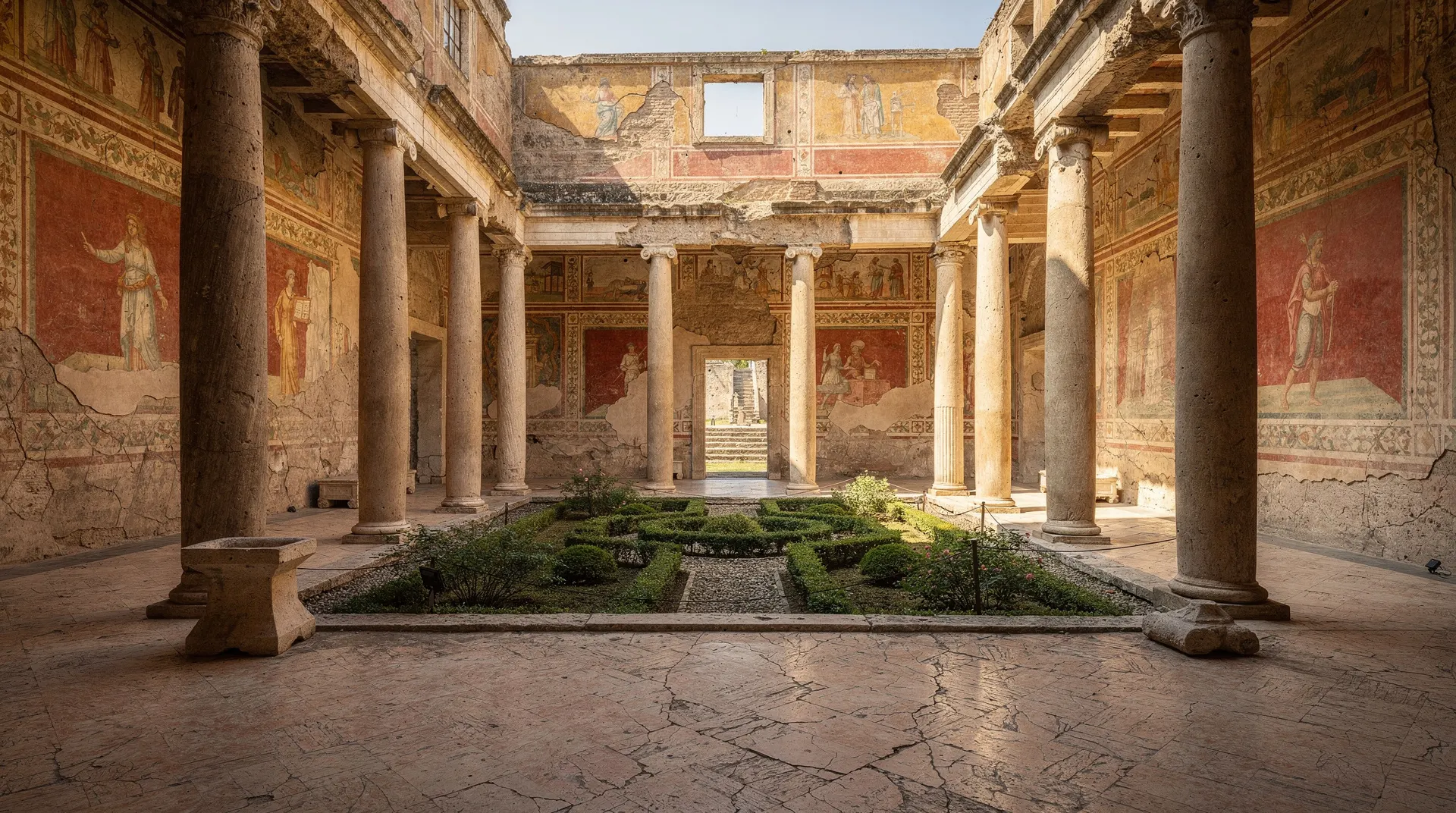
The villa was not a working farm but a villa otium — a luxury retreat, designed for pleasure, recreation, and display. It had multiple pools (including a large outdoor swimming pool of 61 × 17 metres, one of the largest known Roman pools), elaborate garden peristyles, baths, and a series of reception rooms decorated with some of the finest Second Style Roman wall paintings in existence.
The paintings are the reason to come. The Second Style (roughly 80–20 BC) involved painting trompe-l’oeil architectural vistas on walls — columns, porticoes, arcades — designed to make the room feel as though it opened onto an imaginary exterior space. At Villa Poppaea, these survive in exceptional condition: room after room of painted colonnades, figures of gods and mythological scenes, all in the Pompeian red, ochre, and deep blue that defined the aesthetic. Several rooms have painted garden scenes that prefigure the famous garden room at Livia’s Villa (now in the Palazzo Massimo in Rome).
The villa was under renovation at the time of the eruption — a fact that has helped preserve parts of it, as rooms under construction were sometimes sealed or protected differently. Several areas show evidence of ongoing work: stacked construction materials, partially painted walls, marble yet to be installed.
How to visit
Getting there: Take the Circumvesuviana from Napoli Centrale to Torre Annunziata station. This is the Poggiomarino or Sarno line — approximately 25 minutes, €3.10. From the station, walk toward the sea (south) for about 10 minutes; signs for “Oplontis Scavi” are posted. Alternatively, if visiting Pompeii on the same day, it is a short taxi ride (€8–10) or a 3 km walk between the two sites.
Tickets: Villa Poppaea is covered by the Pompeii area combo ticket (€22 for five sites over three days: Pompeii, Herculaneum, Oplontis, Stabiae, Boscoreale). If you already have a Pompeii ticket, entry to Oplontis is included in the combo at no additional cost. Standalone entry is around €6.
There is a second structure at the Oplontis site, Villa B (Villa di Lucrezio Frontone), a smaller warehouse-type building found nearby. It is occasionally included in visits but is less consistently open and considerably less spectacular.
Duration: A thorough visit to Villa Poppaea takes 1 to 1.5 hours. There is no need to rush; the site is rarely crowded, which allows genuinely unhurried exploration of the painted rooms — a luxury impossible at Pompeii.
Guided tours: No dedicated Oplontis-only tours operate from Naples. Most visitors combine it independently with Pompeii. If you are on a Pompeii guided tour, some operators include a stop at Oplontis — check the itinerary before booking. The three-site combo tour (Pompeii + Herculaneum + Vesuvius) does not typically include Oplontis. See Pompeii day trip for how to incorporate Oplontis.
Oplontis in the UNESCO designation
The Archaeological Areas of Pompeii, Herculaneum and Torre Annunziata were collectively inscribed as a UNESCO World Heritage Site in 1997. The inscription explicitly recognises Oplontis as part of the property — making Villa Poppaea a UNESCO site that most visitors to the region completely bypass.
The UNESCO citation notes the “outstanding universal value” of the ensemble as evidence of Roman civilisation in the first century AD, and specifically mentions the exceptional preservation of the Oplontis paintings as a key component of the property’s significance.
What to see: room by room highlights
Atrium complex (west wing): the main entrance zone retains its painted decoration in good condition. The trompe-l’oeil Second Style scheme here is intact on three walls.
North peristyle: the garden-facing colonnaded courtyard, framed by columns and containing fragments of the garden planting. Several large painted landscapes survive on the interior walls.
Triclinium (dining room) 14: arguably the finest painted room in the villa. Floor-to-ceiling architecture in painted illusion, with a central mythological panel and flanking figures. Colours remain vivid.
Room 15 (oecus): a large reception room with a complete painted ceiling cornice and frieze in stucco relief, unusual in its level of completeness.
Swimming pool and garden: the outdoor pool (61 × 17 m) is at the east end of the villa, partially excavated. The scale alone communicates the extravagance of the original design.
Baths complex: the thermal suite — frigidarium, tepidarium, caldarium — still shows its mosaic floor patterns and the hypocaust (underfloor heating) system.
Torre Annunziata beyond the villa
Modern Torre Annunziata is a working industrial town, historically known for pasta production — several of Italy’s most famous pasta brands (including Voiello) originated here, drawing on the local wheat-milling and drying conditions that made the area suitable for large-scale pasta manufacture in the 19th century. The town itself has little conventional tourist appeal beyond the archaeological site, and most visitors move straight from the station to Oplontis and back without exploring further.
This is worth knowing mainly so expectations are set correctly: come for Villa Poppaea specifically, not for a broader town visit. Food options near the station are limited and geared toward locals rather than tourists — a reasonable pizzeria or bar for a quick coffee, but nothing that justifies lingering.
Combining Oplontis with a wider Pompeii-area tour
Because no dedicated Oplontis-only tours exist, the practical way to include it with a guided experience is to book a Pompeii or Herculaneum tour that has flexibility, or to visit independently either before or after a guided visit elsewhere on the same day. If you already hold a combo ticket and want deeper context for the wider Pompeii area (including the archaeology that Oplontis exemplifies), a guided Pompeii experience the same day reinforces the connections between the sites.
Pompeii guided tour with an archaeologistFor visitors who want the fullest possible picture of the AD 79 eruption’s reach — Pompeii, Herculaneum, and by extension the Oplontis villa’s fate — a combined Pompeii and Herculaneum tour on the same day as an independent Oplontis stop covers the three most important sites the eruption affected.
Pompeii and Herculaneum combined day tourHonest assessment: is it worth a separate trip?
If you are making only one day trip from Naples to the Pompeii area, Oplontis probably does not warrant replacing either Pompeii or Herculaneum as your primary destination. But if you are spending a second day in the area, already holding a combo ticket, or specifically interested in Roman painting, it is an exceptional and underrated site.
The absence of crowds is itself a reason to visit. Spending an hour in painted rooms that would be physically inaccessible at Pompeii (due to visitor management restrictions) is a qualitatively different experience.
The Oplontis guide covers the art-historical context of the Second Style paintings in more detail.
Frequently asked questions about Oplontis
Is there a separate entry fee for Oplontis?
Not if you hold the Pompeii area combo ticket (€22), which covers five sites. If visiting Oplontis only, standalone entry is approximately €6. The combo ticket offers the best value if you plan any two or more of the sites.
Is Oplontis open every day?
The site follows the same general schedule as Pompeii (closed on some national holidays), but has more variable access than the main sites. Check the official Pompeii Parks website (pompeiisites.org) for current opening times before your visit — it is occasionally closed for maintenance.
Can I combine Oplontis with Pompeii in one day?
Yes. Torre Annunziata station is three stops from Pompei Scavi on the Circumvesuviana. Visit Oplontis first (9:00–11:00), then take the train to Pompeii (arrive 11:30). Alternatively, Oplontis is about 3 km from the Pompeii entrance — some visitors walk between the two.
Why do so few people visit Oplontis?
Lack of awareness is the primary reason. Pompeii overwhelmingly dominates marketing of the area. Oplontis is also harder to access independently (smaller station, less signage), and there are no dedicated tour packages from the major operators. Its obscurity is, in practical terms, its main appeal.
Are there guides at Oplontis?
There are site wardens who can answer basic questions, and information panels at key rooms. No audio guide rental is available on site. Download images and background material before your visit.
Is there anything else to do in Torre Annunziata?
Very little beyond the archaeological site. The town is primarily industrial, historically known for pasta manufacturing, and has minimal tourist infrastructure. Plan meals and downtime around Pompeii or Naples rather than Torre Annunziata itself.
Should I visit Oplontis before or after Pompeii?
Either order works logistically since Torre Annunziata is only three stops from Pompei Scavi. Visiting Oplontis first, when you’re fresh, lets you appreciate the paintings without site fatigue; visiting it after Pompeii means you arrive with more context for how the two sites relate as part of the same eruption’s story.
Top experiences
Bookable activities with verified prices and instant confirmation on GetYourGuide.