Oplontis and the Villa Poppaea: what to see and how to visit
From Naples: Pompeii and Herculaneum Tour
What is the Villa Poppaea at Oplontis and is it worth visiting?
The Villa Poppaea is a massive Roman luxury villa buried by the 79 AD eruption, located in the modern town of Torre Annunziata (10 minutes from Pompeii by train). It has arguably the best-preserved wall paintings in the Roman world, almost no visitors, and is included in the combined €22 ticket with Pompeii and Herculaneum. Yes, it is worth visiting.
| Where | Torre Annunziata, 1 stop / 5 min by Circumvesuviana from Pompei Scavi |
| Cost | €4 standalone, or free within the €22 combined ticket |
| Time needed | 1–1.5 hours (add 30–45 min if Villa B is open) |
| Best time | Mid-morning (10:00–11:00), when skylight reaches the frescoed rooms |
| Crowds | Minimal — often single-digit visitor counts |
Why almost nobody visits Oplontis — and why that’s their loss
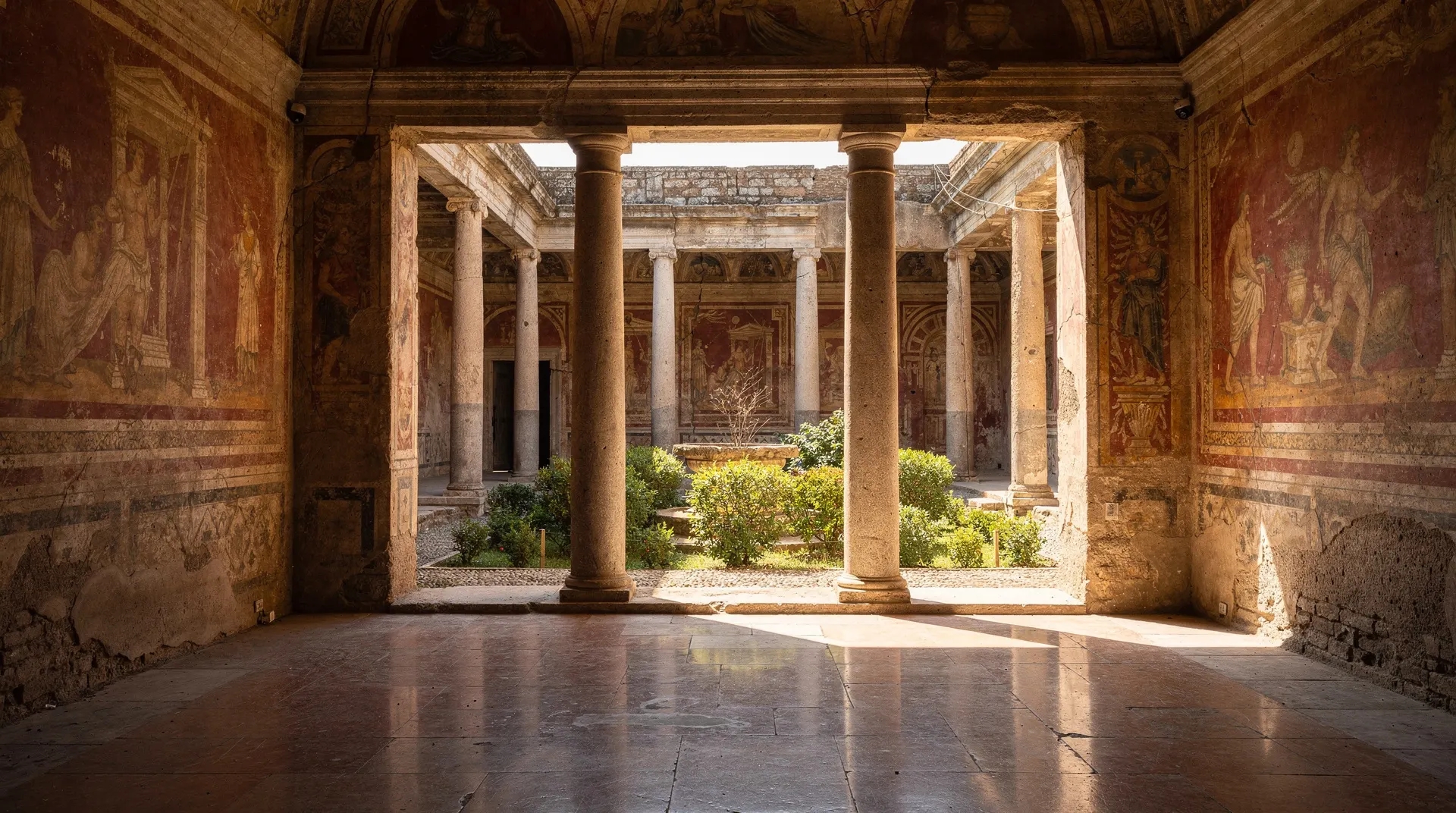
Oplontis is one of those open secrets in Campanian archaeology. Archaeologists rate the Villa Poppaea as containing the finest surviving examples of second-style Roman wall painting — illusionistic architectural frescoes that make the walls appear to open onto columns, gardens, and courtyards. The colours have survived in vivid detail. The scale of the villa (at least 99 rooms excavated) communicates extraordinary wealth.
And yet on any given day, you might be one of ten visitors inside the site. There are no queues, no crowds, no tour groups jostling for the best viewing angle. You can stand in a 2,000-year-old dining room with frescoes above your head and have it to yourself.
The reason for the low visitor numbers is pure logistics: Oplontis is in the modern town of Torre Annunziata, between Naples and Pompeii, and most visitors on the Circumvesuviana line pass straight through without stopping. The station is called Torre Annunziata, not Oplontis. There are no signs from the train.
This guide is intended to change that calculation.
What Oplontis is
Oplontis was a settlement (vicus) belonging to the territory of Pompeii — a suburban coastal location with luxury villas belonging to wealthy Roman aristocrats. The eruption of 79 AD buried it under the same pyroclastic deposits as Pompeii and Herculaneum.
The Villa Poppaea is the larger of two discovered villas. It covers at minimum 99 excavated rooms across two main wings (residential and service), with a large garden area, an outdoor swimming pool (55 metres long — one of the largest known from the Roman world), and elaborate architectural infrastructure including a wine production facility.
The attribution to Poppaea Sabina (Nero’s second wife, later deified after her death in 65 AD) is based on a painted inscription found inside the villa: “Secundo Poppaeae” — indicating a member of the Poppaea household. The attribution is conventional but not proven beyond doubt.
The frescoes: what makes them remarkable
The Villa Poppaea was decorated in the second style of Roman wall painting — a technique developed in the late Republic (approximately 80–20 BC) to create illusionistic architectural vistas. The walls are painted to appear as if they open onto colonnaded courtyards, garden scenes, and architectural spaces that don’t physically exist.
What’s extraordinary at Oplontis is the state of preservation and the scale. The frescoes in the oecus (a large dining/reception room) and the large triclinium have survived at near-original colour intensity. The architectural illusions — columns receding into depth, garden glimpses beyond false doorways — are technically as sophisticated as anything from the classical world.
At Pompeii, the most significant frescoes have been removed to the MANN in Naples for conservation. At Oplontis, the major frescoes remain in situ in the villa. This is unusual and invaluable — you’re seeing the paintings in the rooms they were painted for.
Getting there
From Pompeii: Circumvesuviana from Pompei Scavi toward Naples. Exit at Torre Annunziata (one stop, 5 minutes). From the station: walk south on Via Sepolcri for about 10 minutes. The site entrance is signed (look for brown archaeological site signs).
From Naples: Circumvesuviana from Napoli Garibaldi toward Sorrento. Exit at Torre Annunziata (approximately 15 minutes). Walk as above.
From Herculaneum: Circumvesuviana toward Sorrento from Ercolano Scavi. Exit Torre Annunziata (10 minutes, one stop before Pompei Scavi).
The walk from the station is flat and through ordinary urban streets. Torre Annunziata is not a tourist town — there are no souvenir shops or tour groups between the station and the site. This is part of its appeal.
Tickets
Standalone Oplontis ticket: €4 (a remarkable bargain for what you see).
Combined ticket (Pompeii + Herculaneum + Oplontis + Stabiae): €22, valid 3 consecutive days. If you’re already using the combined ticket for Pompeii and Herculaneum, adding Oplontis costs nothing in addition.
Opening hours: 9:00–19:30 (summer), last entry 17:30. 9:00–17:00 (winter), last entry 15:30. Closed Tuesdays.
No time slot booking required — walk-up tickets are standard. The site rarely reaches any capacity constraint.
What to see inside the villa
The west wing (residential): The main frescoed rooms. Start here. The rooms off the atrium show the range of second-style decoration — some illusionistic, some more geometric, some with figurative panels. The tablinum (study/reception room off the main atrium) and the large oecus are the best-preserved.
The garden and swimming pool: Walk through the residential wing toward the large garden. The outdoor swimming pool (55 metres long, 7.6 metres wide) is clearly visible as a depression in the garden area, with its original terracotta water pipes partially excavated. It’s the largest Roman domestic swimming pool known.
The east wing (service area and bath complex): Less dramatically frescoed but archaeologically significant — the bathhouse (caldarium, tepidarium, frigidarium) is well preserved, with original tile flooring and heating infrastructure visible.
The large triclinium (dining room): Accessible from the garden. Very large frescoed room with walls in near-original condition. The architectural frescoes here — showing columns, archways, and vegetation through false openings — are the strongest argument for Oplontis as the best-preserved single example of this painting style.
Villa B: the commercial estate
About 500 metres from Villa Poppaea is Villa B (Villa of Lucius Crassius Tertius). This is a wine and oil production estate rather than a luxury residence. It contains:
- A large wine cellar with original dolia (large terracotta storage containers) in situ
- A remarkable cache of jewellery and coins (now at MANN) found with skeletal remains — 54 people who sheltered in the villa at the time of the eruption
- Simpler frescoed decorations
Villa B opens on specific days — check with the on-site staff when you arrive at Villa Poppaea. It’s worth adding 30–45 minutes if it’s open.
Logistics for your visit
Food and water: There is no café inside the site. Bring water. Torres Annunziata has bars and bakeries near the station for pre-visit provisions. The town is unpretentious and local — don’t expect tourist restaurant facilities.
Photography: Free throughout. The frescoes are inside the villa rooms, which are darker than the outdoor areas. Bring a camera that handles low light or is comfortable with higher ISO settings.
Accessibility: The site is mostly flat. The entrance ramp is manageable for wheelchairs. Inside, surfaces are archaeological (uneven in places). Most main rooms are accessible.
Combination visits: The most logical combination is Oplontis as an add-on to either a Pompeii or Herculaneum day. Pompeii → Torre Annunziata (by Circumvesuviana, 5 minutes) → Oplontis → Naples is a natural sequence. If you’d rather not manage the Circumvesuviana connections yourself, a guided combo tour handles the transfers and typically bundles skip-the-line entry to Pompeii with it.
Pompeii and Herculaneum combined day tour from NaplesFor a full comparison of how Oplontis fits against the two headline sites, see our Pompeii vs Herculaneum guide — Oplontis is the natural third stop once you’ve decided between (or decided to combine) the two.
The context: Torre Annunziata as a place
Torre Annunziata is not a tourist town. The streets between the Circumvesuviana station and the Villa Poppaea pass through ordinary Italian urban life — bars, tabacchi, neighbourhood shops, a butcher, a hardware store. There are no English signs, no souvenir shops, no gelato stands aimed at visitors.
This is one of the more interesting aspects of the Oplontis visit: you arrive in the real Campanian city, not a curated tourist bubble. The contrast with the ancient luxury within the villa gates is stark and enriching.
The town itself has a complicated 20th-century history tied to the camorra. This is factual history, not a warning against visiting. The area is safe in daylight for tourists who are simply walking between the station and the site. The archaeological zone is distinct from the commercial and residential neighbourhoods.
The 2020 Oplontis excavations
Since 2018, the Villa B site (the commercial estate) has been subject to renewed excavations by the Oplontis Project, an international archaeological consortium based at the University of Texas at Austin. The project has produced significant findings about the site’s social history: the skeletal remains and jewellery cache from Villa B suggest that 54 individuals — a mix of wealthy women with jewellery and poorer people — sheltered here together during the eruption, suggesting the villa was used as a refuge across social classes.
This research is ongoing and has been published in academic journals (Journal of Roman Archaeology, various chapters in “Oplontis: Villa A”). The official Oplontis Project website (oplontisproject.org) has detailed reports for visitors who want archaeological depth before or after their visit.
Photography at Oplontis
Oplontis is one of the better Roman sites for photography precisely because it’s uncrowded. There are no queues, no groups blocking framing, and the frescoed rooms are lit primarily by skylights — the same natural light direction the rooms were designed for.
Best photography:
- The large triclinium frescoes in mid-morning light (10:00–11:00) when the sun angle reaches the interior
- The swimming pool garden, where the depression and terracotta pipes create compelling compositional geometry
- The entrance corridor frescoes, which have a strong spatial depth effect on camera
Use a camera that handles mixed artificial/natural light well. The rooms are darker than outdoor photos, and flash on frescoes is discouraged (ask the custodians about current guidelines).
The Oplontis Project and the future of the site
A significant portion of the Villa Poppaea remains unexcavated beneath modern Torre Annunziata. Current estimates suggest the villa extends further north beneath active streets and buildings. Excavation rights and funding are ongoing issues in Italian archaeological management.
The Packard Humanities Institute (which funds much of the Herculaneum Conservation Project) has been involved in Oplontis conservation. Conservation of the in-situ frescoes is a major ongoing challenge — exposure to weather and humidity since excavation has caused some deterioration, and the programme of protective covering and climate management is continuously refined.
What this means for visitors: some areas of the villa are covered for conservation protection (roof structures over the most significant frescoed rooms). The protective covering is functional rather than aesthetically pleasing but it has significantly slowed the deterioration.
Planning it around your wider Pompeii trip
Oplontis works best as a deliberate add-on rather than a destination you plan a whole day around — the site rewards an hour to ninety minutes of unhurried attention, not more. If you’re building out a full itinerary across the archaeological zone, our Pompeii complete guide and getting to Pompeii from Naples cover the logistics of the headline site, while the Circumvesuviana guide explains the wider rail network that connects Naples, Torre Annunziata, Pompeii, Herculaneum and Sorrento on one continuous line.
Travellers assembling a multi-day ancient-sites itinerary should also look at our ancient Campania itinerary, which sequences Pompeii, Herculaneum, Oplontis and Vesuvius across several days without doubling back on transport.
Because the combined €22 ticket already includes Oplontis at no extra cost, the only real planning decision is timing: slot it in directly after Pompeii (same line, one stop) rather than as a separate trip, and check Villa B’s opening status with staff the moment you arrive so you’re not left waiting around at the end of your visit.
Frequently asked questions about Oplontis and the Villa Poppaea
Is Oplontis open all year?
Yes, same schedule as other Archaeological Park of Pompeii sites. Closed Tuesdays and on 1 January and 25 December.
Why are the frescoes so much better preserved at Oplontis than at Pompeii?
Partly depth of burial (Oplontis was covered more deeply), partly the fact that the villa was apparently not in active habitation in 79 AD (archaeologists think it was undergoing renovation) so there was less disturbance of surfaces after burial. Major Pompeii frescoes were also removed to museums in the 18th–20th centuries; at Oplontis they largely remain in situ.
Is there an audioguide for Oplontis?
No dedicated audioguide as of 2026. The official Pompeii Sites app (free) has some Oplontis content. Staff at the entrance can provide basic orientation. The site is small enough that a printed map (available at the entrance) and preparation is sufficient.
Can I combine Oplontis with the Stabiae villas on the combined ticket?
Stabiae (Villa Arianna and Villa San Marco, near Castellammare di Stabia) is included on the same combined ticket. It’s about 20 minutes by Circumvesuviana from Torre Annunziata. The Stabiae villas are less visited than Oplontis and show a different estate type — worth adding if you have a full day.
How does Oplontis compare to the Villa of the Mysteries at Pompeii?
The Villa of the Mysteries has a more famous single room (the Dionysian frieze), but Oplontis has superior overall preservation across multiple rooms. They represent different fresco styles — Villa of the Mysteries is Dionysian narrative painting; Oplontis is architectural illusionism. They’re complementary experiences.
Frequently asked questions about Oplontis and the Villa Poppaea: what to see and how to visit
How do I get to Oplontis from Pompeii?
Is the Villa Poppaea free with a Pompeii ticket?
How long does an Oplontis visit take?
Who was Poppaea Sabina?
Are the frescoes at Oplontis better than at Pompeii?
Is there a second villa at Oplontis (Villa B)?
Top experiences
Bookable activities with verified prices and instant confirmation on GetYourGuide.