Herculaneum
Herculaneum is smaller, shadier, and far better preserved than Pompeii. Visitor guide covering tickets, combos, and what makes it worth the trip.
Herculaneum: Tickets & Tour with a Local Archaeologist
Duration: 2h
Quick facts
- Distance from Naples
- 10 km south-east (Ercolano)
- Train (Circumvesuviana)
- ~15 min, €2.60
- Opening hours
- 9:00–19:30 (summer), 9:00–17:00 (winter)
- Entry ticket
- €15 (standard); combo with Pompeii available
- Site size
- ~4.5 ha excavated (vs 44 ha at Pompeii)
- Visit duration
- 2–3 hours
Herculaneum: the archaeologist’s favourite — and why most visitors choose Pompeii instead
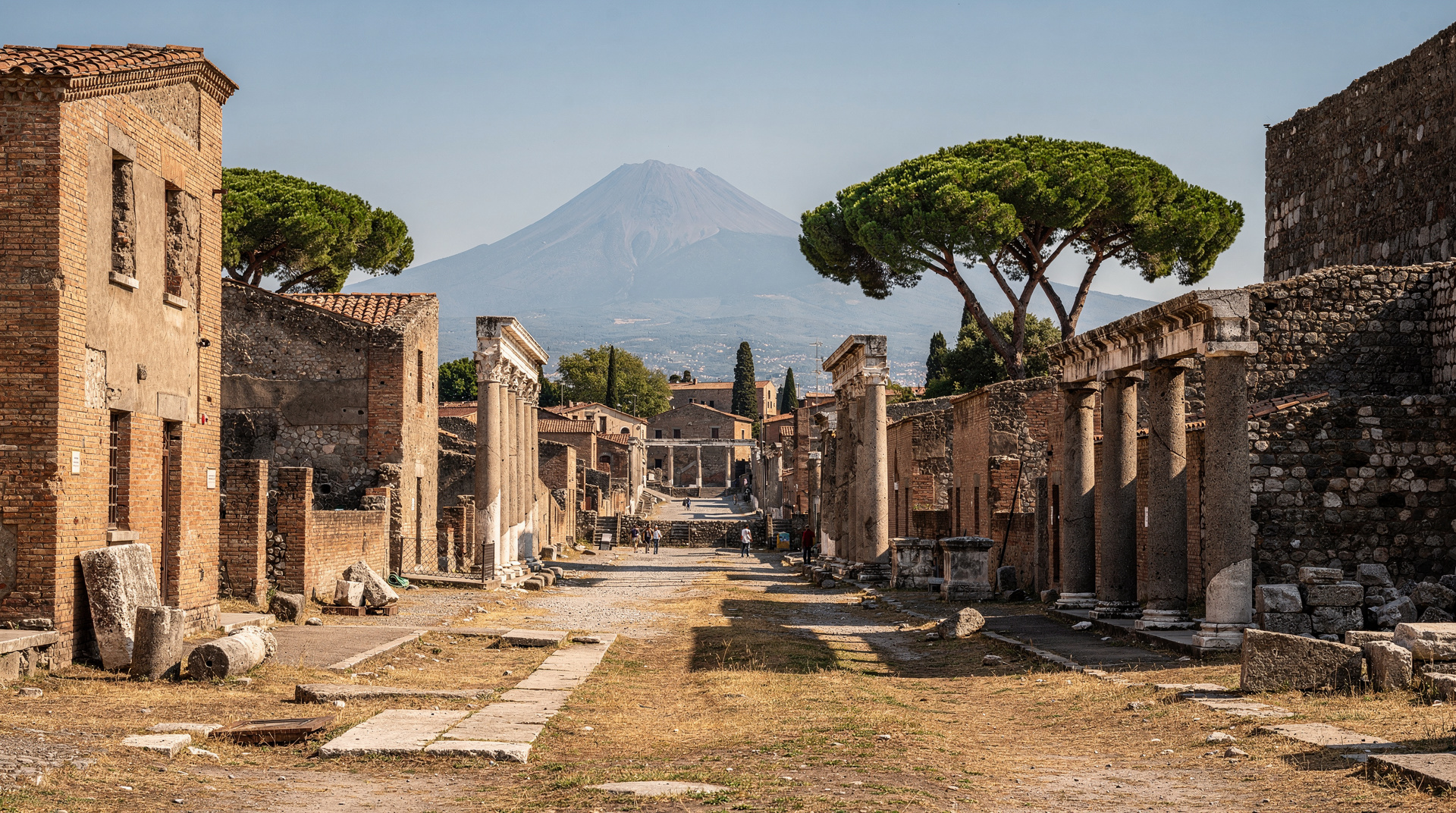
Herculaneum consistently ranks higher among archaeologists and repeat visitors to Campania than its more famous neighbour. It is better preserved, considerably less crowded, and compact enough to explore thoroughly in two to three hours. Yet the Circumvesuviana drops ten times as many tourists at Pompeii Scavi as at Ercolano. Understanding why reveals something useful for planning your own visit.
Pompeii was buried by volcanic ash and pumice — a relatively gentle, if lethal, process that preserved structures but left most organic material to decay over centuries. Herculaneum was hit by pyroclastic surges: superheated gas and rock moving at 100+ km/h at temperatures of 300–500 °C. Everything died instantly, and then the entire city was encased in volcanic material that set like concrete to a depth of 20 metres. That catastrophic burial is precisely why wooden furniture, cloth, food, papyrus scrolls, and carbonised wooden doors have survived two thousand years.
The trade-off: only about a quarter of the ancient city has been excavated. The rest lies beneath the modern town of Ercolano, and no large-scale excavation is planned in the near term.
| Where | Ercolano, 10 km south-east of Naples |
| Cost | €15 standard; €22 combo with Pompeii (3-day validity) |
| Time needed | 2–3 hours |
| Getting there | Circumvesuviana to Ercolano Scavi, ~15 min |
| Best time | Year-round; cooler and shadier than Pompeii in summer |
Getting to Herculaneum
Take the Circumvesuviana from Napoli Centrale (lower level, follow signs to Garibaldi FS). Trains to Sorrento or Poggiomarino/Sarno both serve Ercolano Scavi station. Journey time is approximately 15 minutes; single fare €2.60.
From the station, walk downhill (south) for about 10 minutes following signs to the Scavi (excavations). The descent is steep — if mobility is an issue, taxis wait outside the station.
The Circumvesuviana guide covers the full timetable, pickpocket warnings, and the Campania Express seasonal alternative (€5, air-conditioned, reserved seats).
The site entrance is at the base of the modern street, where you descend into the archaeological park via a ramp overlooking the ancient shoreline. The view from the ramp — looking down at an entire Roman town 20 metres below street level — is one of the first striking moments of the visit.
Tickets and entry
Standard entry is €15. Timed-entry slots should be pre-booked online (the site is smaller than Pompeii and capacity is genuinely limited). Walk-up entry is possible off-peak but not reliable in spring and summer.
Combo options:
- Pompeii + Herculaneum (€22): valid for three days, allowing both sites on separate days. Good value if you plan both.
- Three-site pass (Pompeii + Herculaneum + Boscoreale/Oplontis/Stabiae): €20–25 depending on configuration. See Oplontis for context on what is included.
- Campania ArteCard: includes Herculaneum among its covered sites. Details at the ArteCard guide.
Seeing both sites in one day only works if the tickets are already in hand: a Pompeii and Herculaneum group tour with tickets included removes the two separate ticket queues that otherwise eat the middle of the day.
What makes Herculaneum different from Pompeii
Organic preservation
This is the headline. At the House of the Bicentenary and House of the Wooden Partition, you can see original wooden doors, window frames, and internal screens — charred black but structurally intact. In the House of the Gem, a carbonised cradle still exists. These are not reconstructions.
Upper floors
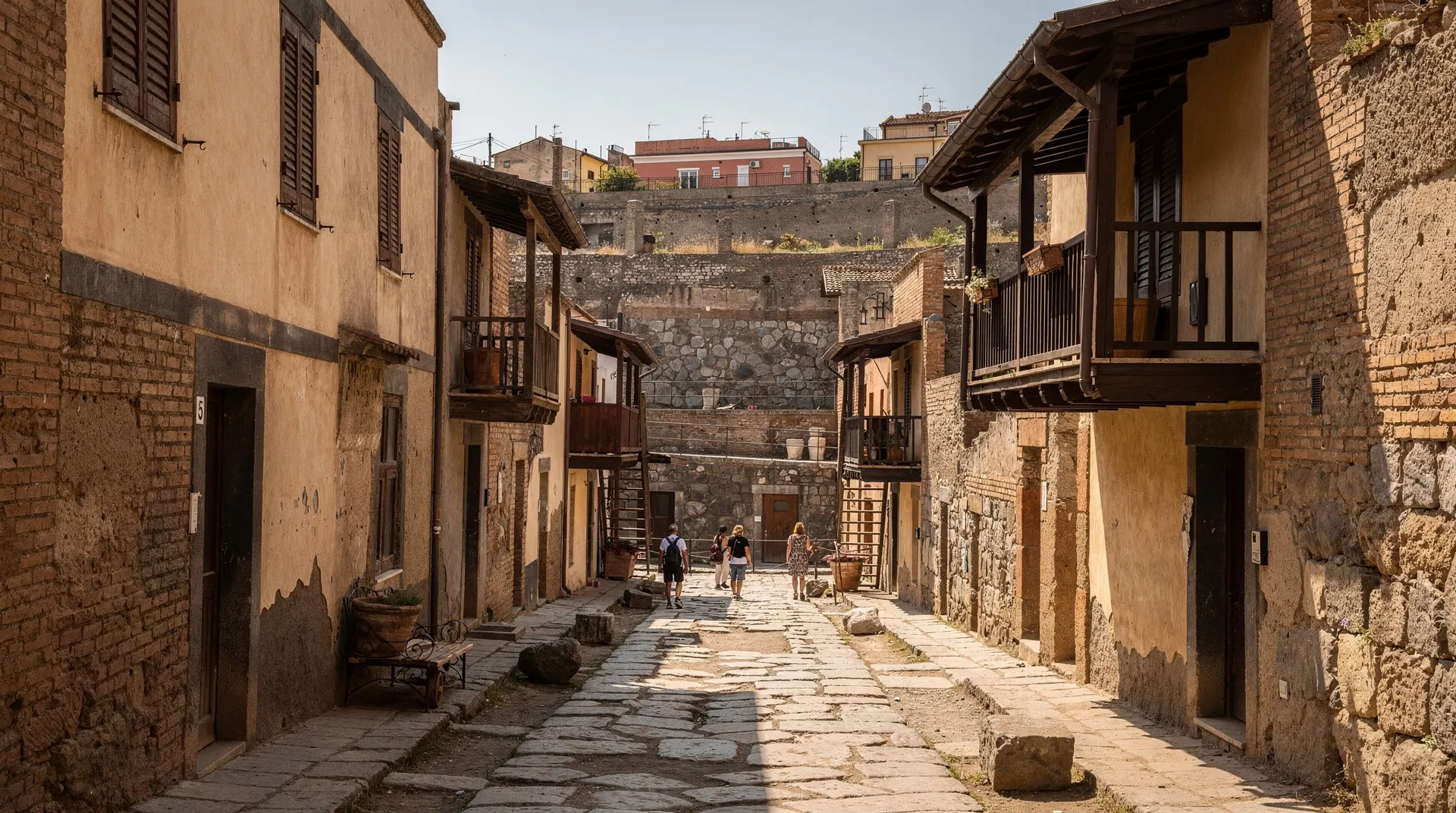
At Pompeii, almost all buildings survive only to ground-floor level. At Herculaneum, several insulae (apartment blocks) retain their first and sometimes second floors, including wooden balconies. This gives a far clearer sense of how a Roman town actually looked in three dimensions.
Wall paintings
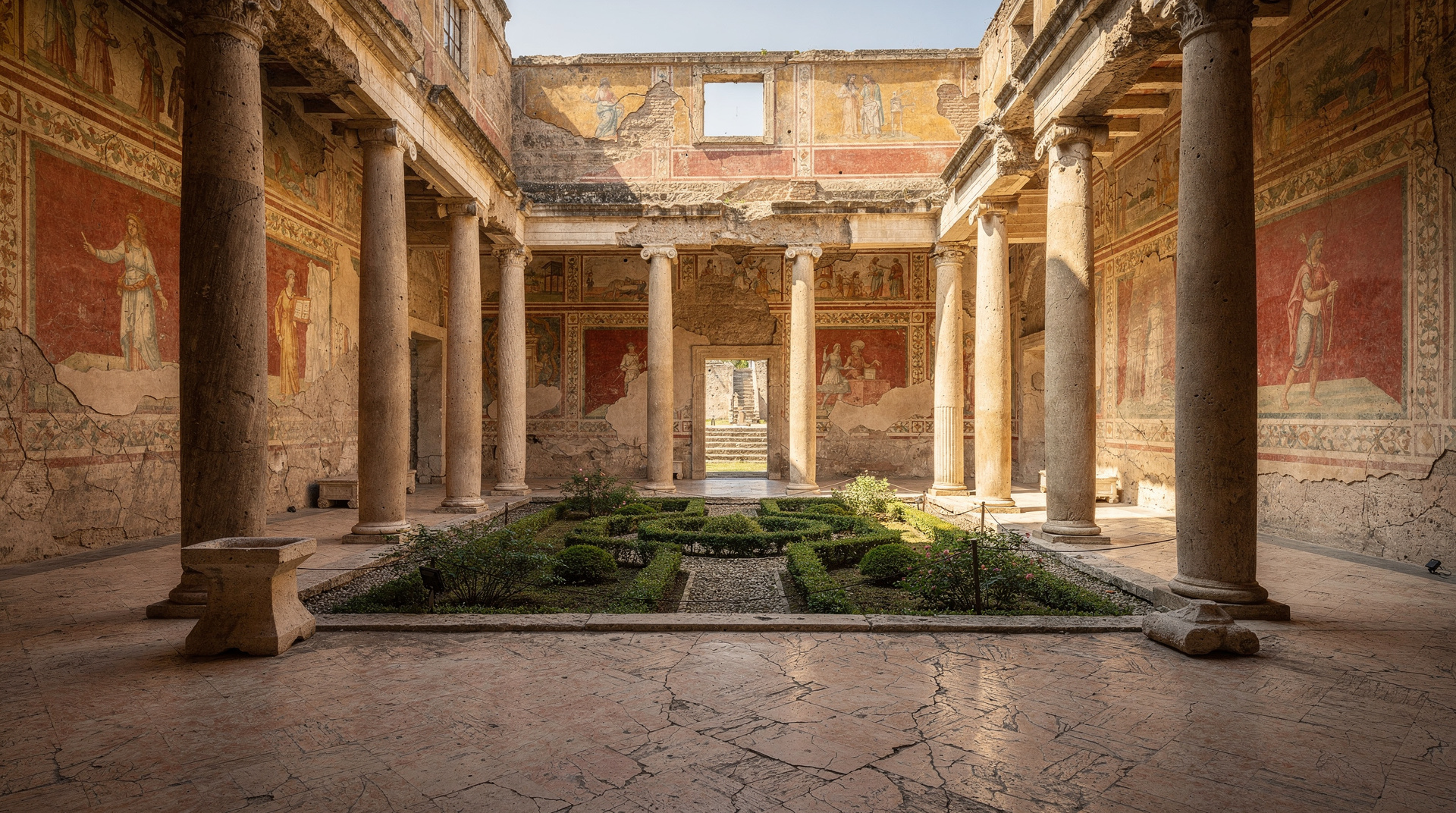
The paintings at Herculaneum are generally in better condition than at Pompeii, with colours more vivid due to the protective encasement. The House of Neptune and Amphitrite contains one of the most stunning mosaic tableaux in the Roman world — the sea-god couple framed in a garden setting with a brilliant blue background.
Boat sheds and the victims
At the ancient shoreline (the fornice vaulted boat sheds), excavators found the skeletal remains of approximately 300 people who had taken shelter waiting for rescue. The bodies are displayed in situ — a sobering counterpart to Pompeii’s plaster casts. The sheer volume of gold jewellery and coins found with some of the victims suggests the wealthier residents had grabbed their valuables before fleeing.
The papyrus scrolls (Villa of the Papyri)
The Villa of the Papyri lies just outside the main excavated area, partially under a modern building. It contained the only surviving ancient library: approximately 1,800 papyrus scrolls, mostly Epicurean philosophy texts. Most are still unread — they were so badly carbonised that the only recent progress has come through multispectral imaging and, since 2023, AI-assisted decipherment (the Vesuvius Challenge has successfully decoded several hundred words). The villa itself is not routinely open for visits, but the scrolls are displayed at the National Library in Naples and some at the Herculaneum Conservation Project.
Suggested walking route
The excavated site is compact and cannot easily be done out of order, as the layout is a grid of Roman streets descending toward the ancient seafront. Enter from the ramp on the north side and work south.
Cardo III and Cardo IV (the main north-south streets): walk the full length noting the street-level shop fronts — many still have wooden shelving or original counter surfaces.
House of the Wooden Partition: the most-cited example of preserved organic material. The folding wooden screen that divided the atrium from the tablinum (office) is the best-surviving example of its kind from antiquity.
House of the Mosaic Atrium: remarkable black-and-white geometric floor mosaics, undulating from the earth movement after the eruption, intact.
House of Neptune and Amphitrite: do not miss this. The garden nymphaeum (fountain feature) is covered in glass paste mosaic of extraordinary quality, with a hunting scene frieze above. The adjacent wine shop still has amphorae in place.
Collegium of the Augustales: the guild hall of the priests of the imperial cult, with an intact painted room showing Hercules (the mythical founder of Herculaneum) presenting himself to the gods.
Boat sheds and shoreline: walk to the south end of the site to see the boat sheds and the skeletal remains. This area is emotionally the most affecting part of the visit.
House of the Relief of Telephus: upper-class residence with a refined decorative programme, including the marble relief of Telephus (the son of Hercules) being suckled by a deer. The garden atrium gives a good sense of high-status Roman domestic architecture.
Herculaneum 2-hour guided tourHerculaneum vs Pompeii: which to choose
Both sites are covered thoroughly in the Pompeii vs Herculaneum comparison. The short version:
Choose Pompeii if: you have children who need scale and drama, you want the iconic amphitheatre and Villa of the Mysteries, or you want the broadest possible overview of Roman urban life.
Choose Herculaneum if: you are primarily interested in preservation quality, have limited time (2–3 hours vs 4–5 hours), want to avoid crowds, or are visiting mid-afternoon when Pompeii’s heat is brutal.
Do both if: you are staying in Naples for 4+ days and are genuinely interested in Roman archaeology. They are 15 minutes apart on the same train line.
Combining with Vesuvius
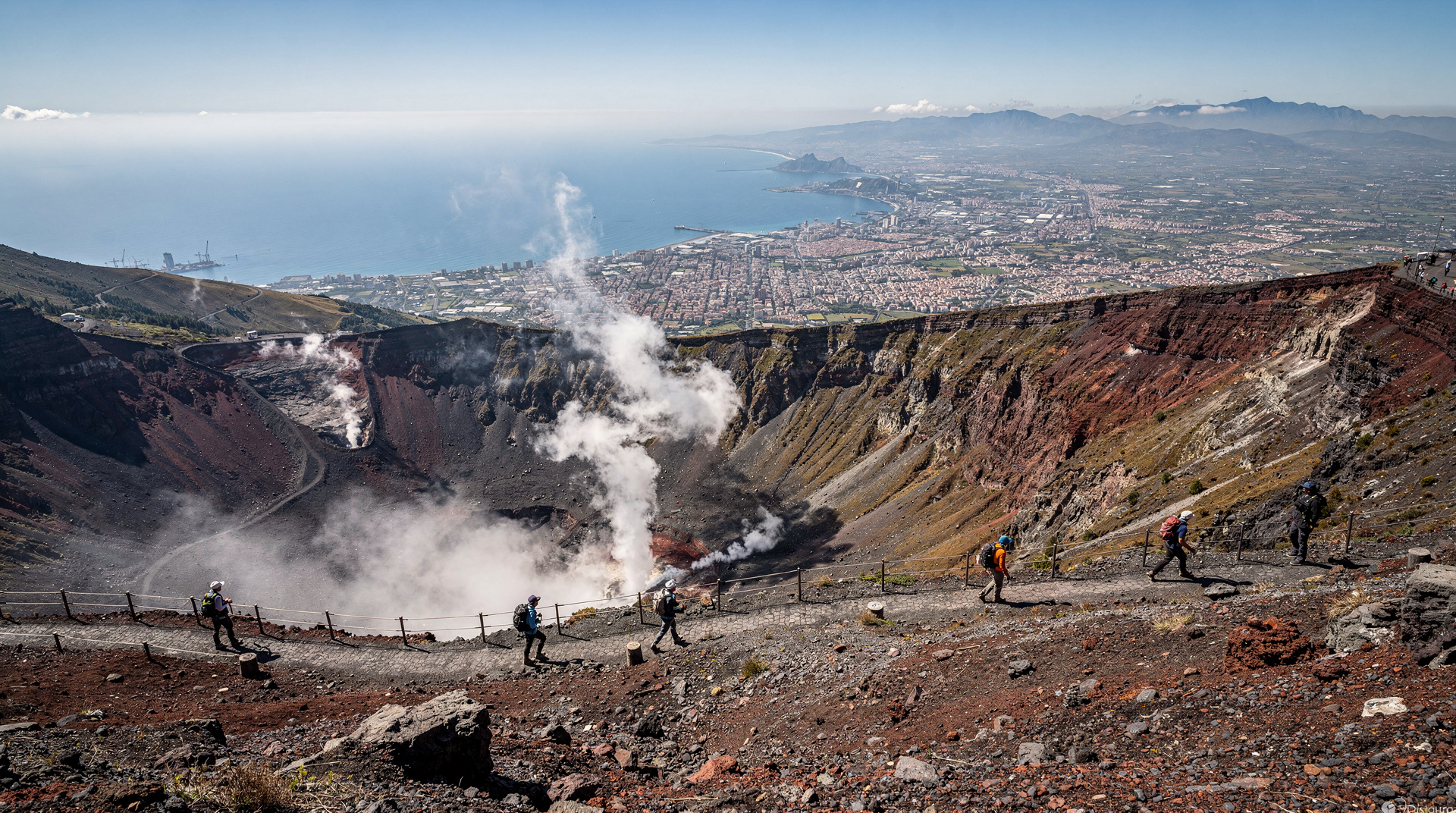
Herculaneum’s train station (Ercolano Scavi) is the main departure point for buses to Mount Vesuvius. This makes a Herculaneum + Vesuvius combo extremely logical: spend the morning at the excavations, then take the afternoon bus up to the crater. The round-trip EAV bus from the station to the Vesuvius car park takes about 30 minutes.
Details on timing and ticketing in the Mount Vesuvius guide and getting to Vesuvius.
Pompeii, Herculaneum and Vesuvius full-day tourPractical information
Food: there is a small café at the site entrance, and several restaurants along Via IV Novembre (the descent from the station). La Fornacella (Via IV Novembre 96) is a reliable spot for pizza and pasta before or after your visit (€12–18 pp). Avoid the tourist traps on the main drag immediately outside the ticket office.
Luggage: no storage at the site itself. The ticket office holds small bags. Leave large bags in Naples.
Accessibility: the main paths through the excavations are paved and manageable for wheelchairs, but the streets are uneven Roman flagstone. Call ahead (+39 081 857 5347) for current accessibility information.
Photography: allowed throughout without flash. Many of the preserved organic materials are behind glass.
The Herculaneum Conservation Project and ongoing threats
Herculaneum’s preservation is not a static achievement — it is actively managed. The Herculaneum Conservation Project, a partnership between the Packard Humanities Institute and the Italian state that began in 2001, addresses an ironic problem: the same wet, waterlogged burial conditions that preserved the wood and organic materials also make the site vulnerable to water damage now that it is exposed to air.
Ongoing work includes roofing sections of the excavation to control rainwater, monitoring groundwater levels, and stabilising wall paintings that begin to deteriorate rapidly once uncovered. This is part of why some houses are closed on rotation — not neglect, but active conservation triage on a site where every newly excavated surface starts degrading the moment it meets modern air. Visitors sometimes find a favourite house closed on a return trip; this is normal and not a sign of mismanagement.
Combining with Naples’ archaeological museum
Much of what was found at Herculaneum — bronze statues from the Villa of the Papyri, wall painting fragments, and everyday objects — is displayed at the MANN in Naples rather than at the site itself, where space and conservation needs limit on-site display. Visitors who want the fuller picture typically pair a Herculaneum morning with an MANN afternoon on a different day, since fitting both into one day makes each feel rushed. The Farnese collection and the Alexander Mosaic (from Pompeii, not Herculaneum) are also there, making the MANN the natural hub for understanding everything found across the Vesuvian sites.
Herculaneum skip-the-line entry with audio guideFrequently asked questions about Herculaneum
Is Herculaneum worth visiting if I have already been to Pompeii?
Absolutely. Most visitors who have seen both rank Herculaneum’s preservation quality higher, and the crowds are a fraction of Pompeii’s. The boat sheds, wooden partition, and Neptune mosaic are unlike anything at Pompeii.
How long does Herculaneum take to visit?
Two to three hours is enough to see everything well. It is a half-day site, unlike Pompeii which requires 4–5 hours minimum.
Can I combine Herculaneum and Pompeii in one day?
Yes, though it is a long day. The most common itinerary is Herculaneum in the morning (9:00–12:00), train to Pompeii Scavi, Pompeii 12:30–16:00, return to Naples. Both sites will be seen somewhat hastily. Better to allocate separate days if you have them.
Is Herculaneum better than Pompeii for children?
This varies by age and interest. Younger children (under 10) often find Herculaneum more manageable because it is smaller and cooler. The boat-shed victims are confronting for sensitive children — preview the content before your visit.
How do I get the Herculaneum audio guide?
An official audio guide is available for hire at the entrance (€6). The Herculaneum Conservation Project also offers a free online guide via QR codes at key points in the site.
Is the Villa of the Papyri open to visitors?
It is occasionally opened for special events and previews, but not routinely accessible to the public. The scrolls are displayed at the Biblioteca Nazionale in Naples and select content is being published online as the decipherment project advances.
Why are some houses at Herculaneum closed when I visit?
Active conservation work, not neglect. The Herculaneum Conservation Project rotates closures to stabilise wall paintings and manage water damage on a site where newly exposed surfaces are especially vulnerable. Check the official site map at the entrance for which houses are currently open.
Top experiences
Bookable activities with verified prices and instant confirmation on GetYourGuide.