Paestum
Paestum has three Greek temples older than the Parthenon and the best buffalo mozzarella in Italy. Day trip guide from Naples — train, tickets, and what to eat.
From Naples: Tour to Paestum – Temples of Magna Graecia
Quick facts
- Distance from Naples
- 90 km south (Cilento coast)
- Train
- ~1.5–2 h from Naples Centrale (Trenitalia Regionale, €8–10)
- Main sites
- Archaeological zone (temples) + Museo Nazionale
- Entry
- €12 (temples + museum combo)
- UNESCO status
- Listed 1998 (as part of Cilento and Vallo di Diano)
- Best season
- Spring and autumn; avoid August midday heat
Three Greek temples older than the Parthenon — and almost nobody goes
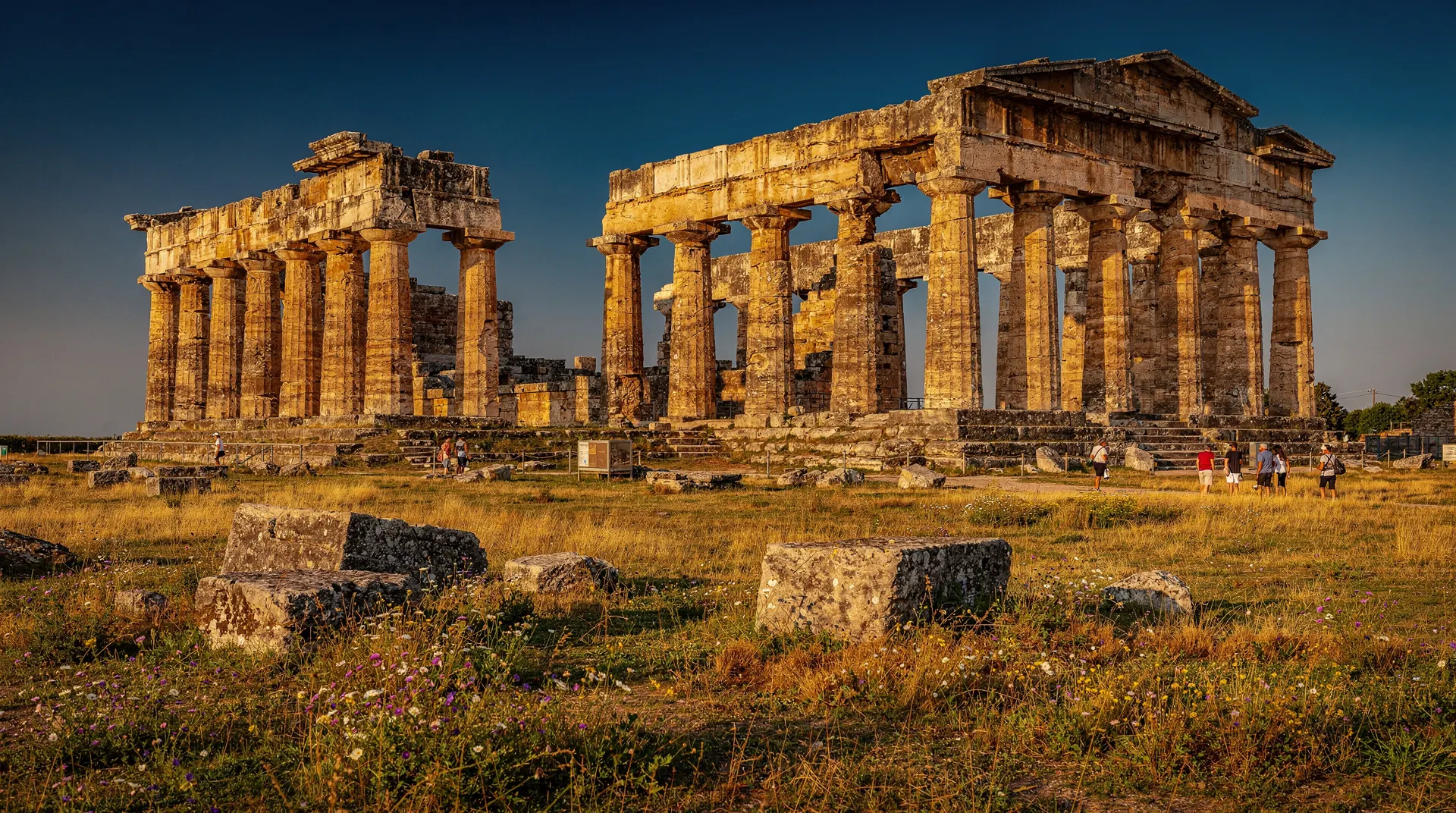
In 600 BC, Greek colonists from Sybaris founded a city called Poseidonia (later Romanised to Paestum) on the flat coastal plain of what is now the Cilento. They built temples. Three of them survive in extraordinary condition: the Temple of Hera I (the Basilica), the Temple of Hera II (the Temple of Neptune), and the Temple of Athena (the Temple of Ceres). The Temple of Neptune, dating to around 460 BC, has more standing columns than any other surviving Doric temple in the world, including those on the Athenian Acropolis. It predates the Parthenon by about 30 years.
The Parthenon, with several million visitors a year, has barriers, crowds, and scaffolding. The temples at Paestum are in the middle of a coastal plain in the Cilento, 90 kilometres south of Naples, and receive roughly 300,000 visitors annually. You can walk around the Temple of Neptune on a September morning and have it largely to yourself.
| Where | Cilento coast, 90 km south of Naples |
| Cost | €12 temples + museum combo |
| Time needed | Full day from Naples (travel + site) |
| Getting there | Trenitalia Regionale to Capaccio-Roccadaspide, ~1.5–2 h |
| Best time | April–June, September–October |
Getting to Paestum
By train (recommended for most visitors)
Take a Trenitalia Regionale train from Napoli Centrale toward Sapri or Reggio Calabria. The journey to Capaccio-Roccadaspide station (the station for Paestum) takes approximately 1 hour 30 minutes to 1 hour 50 minutes. Single fare: €8–10. Trains run roughly every hour to every 90 minutes in each direction.
From the station, the archaeological site entrance is about 2 km (a 25-minute walk) or a short taxi ride (€5–8). Taxis can be scarce; arrange one in advance if arriving by the first train. The town of Paestum itself is minimal — the main street has a few hotels and restaurants.
Important: verify the train schedule returns in the evening, as service thins out after 18:00. The last convenient train back to Naples departs around 19:00–20:00; confirm times on Trenitalia.it before travel.
Organised day trip from Naples
Given the distance and limited train frequency, an organised day trip is a genuinely practical option. The best ones combine the temples with a mozzarella farm visit — which is otherwise logistically tricky to arrange independently.
Paestum temples and mozzarella farm day tripBy car
Drive south on the A3 (Salerno–Reggio Calabria) to the Battipaglia exit, then SS18 south to Paestum. Journey time approximately 1 hour 15 minutes without traffic. Parking is available near the site (€3). A car makes sense if you want to also visit the nearby coastline or the Cilento National Park.
The archaeological site
Tickets: €12 adults (covers both the excavated site and the Museo Nazionale). EU citizens under 18 free; EU citizens 18–25: €2. The site is open 9:00–17:30 (last entry 16:30); summer hours may extend to 19:30 — check current times.
Temple of Hera II (Temple of Neptune)
The largest and most intact of the three temples, dated to approximately 460 BC. Thirty-four columns remain standing — all in the Doric order, heavy and powerful. The interior naos walls also survive partially. Despite the common name “Temple of Neptune,” modern scholarship identifies this as a temple to Hera. The visual impact is immediate and sustained: unlike the Parthenon, which requires climbing and crowds to approach, you can stand close and move around all four sides.
Temple of Hera I (the Basilica)
The oldest building on the site, dated to around 550 BC — approximately 90 years older than the Temple of Neptune. Fifty columns remain, in a heavier Archaic Doric style with distinctive bulging entasis (the slight swelling of the column shafts). The name “Basilica” is a misnomer coined by early excavators who assumed it was a civic building; it is in fact also a temple to Hera.
Temple of Athena (Temple of Ceres)
Smaller than the other two, dated to around 500 BC. Positioned slightly apart from the main group to the north, on a slight rise. Notable for incorporating both Doric exterior columns and Ionic capitals in the interior — an early experiment in combining the two orders.
The Forum and Roman city
The Romans took over Paestum in 273 BC and renamed it. The excavated area includes a substantial Roman-era overlay: forum, amphitheatre, underground sacellum (a sanctuary that contains the famous Tomb of the Diver paintings), and a grid of city streets. The contrast between the Greek and Roman layers is historically fascinating — the Romans built their forum directly over part of the Greek sanctuary zone.
The Museo Nazionale di Paestum
The museum, just outside the site entrance, is essential to complete the visit. It holds the painted metopes from the Temple of Hera at the mouth of the Sele River (from a subsidiary sanctuary about 9 km away), which include some of the best-surviving examples of Greek relief sculpture in Italy. More famous still are the Tomb of the Diver panels — five painted limestone slabs forming the complete walls and ceiling of a burial chamber from around 480 BC, depicting a diving figure and a symposium scene. These are among the finest surviving examples of ancient Greek painting anywhere in the world. Budget 45–60 minutes for the museum.
Paestum Magna Graecia guided day tripMozzarella di bufala: why Paestum and the Cilento
The coastal plain around Paestum (the Piana del Sele) is one of the primary production zones for mozzarella di bufala campana DOP (Protected Designation of Origin) — arguably the most important dairy product in southern Italian cuisine. Water buffalo have been raised here since the medieval period; the marshy wetlands of the Sele plain were naturally suited to buffalo grazing.
The regulations for mozzarella di bufala campana DOP specify that the milk must come from Italian water buffalo raised in a defined zone (parts of Campania, Lazio, Puglia, and Molise), with specific standards for processing. Fresh mozzarella is produced daily and should be eaten within 24–48 hours. What you buy in a supermarket vacuum pack in northern Europe is technically mozzarella but is categorically different from a 250-gram ball sold directly from a Paestum farm within hours of being made — still warm, in its own whey, with a texture and flavour that justify the DOP status.
Where to taste it: several buffalo farms in the Paestum area offer tastings or sales directly to visitors. Tenuta Vannulo (Contrada Vannulo, Capaccio) is the best-known — an organic operation that also produces buffalo-milk yogurt, gelato, ricotta, and butter. They run a shop and small café on site (no formal restaurant); arrive early as popular products sell out. Fattoria Barlotti and La Barricella also sell direct at the farm or the town’s Saturday market.
If visiting independently, the farms require a car or taxi (€10–15 from the archaeological site). Organised day trips that include a farm visit handle the logistics, which is why they are popular.
Why Paestum survived so well: the malaria factor
One reason the temples at Paestum are so remarkably intact, rather than quarried for building material like so many ancient sites, is malaria. After the fall of Rome, the coastal plain became increasingly marshy and malarial, and the population declined sharply through the medieval period. By the time the site was effectively “rediscovered” by European travellers in the 18th century (during the construction of a Bourbon road through the area), the temples had spent centuries standing largely undisturbed in an area too unhealthy for dense settlement or systematic stone-robbing.
This rediscovery had real cultural consequences. Paestum became a fixture of the Grand Tour, visited and sketched by artists and architects including Piranesi, whose engravings helped introduce Doric architecture to a European audience more familiar with the later, more refined Ionic and Corinthian orders. The temples’ “primitive,” heavy Doric style influenced early Greek Revival architecture across Europe and, later, the United States.
Velia: the other Magna Graecia site nearby
Roughly an hour south of Paestum by car lies Velia (ancient Elea), a second major Greek colony and the birthplace of the Eleatic school of philosophy (Parmenides and Zeno). Unlike Paestum’s temples, Velia’s remains are more fragmentary — city walls, an acropolis, and the famous Porta Rosa, one of the oldest surviving monumental gateways in the Greek world — but the site is even less visited and sits within the same UNESCO Cilento designation.
Velia requires a car and is not realistically combinable with Paestum in a single day trip from Naples; it is better suited to travellers already based in the Cilento for a few days, or driving the coast toward Calabria. For a Naples-based day trip, Paestum alone (plus the mozzarella farms) is the practical scope.
The Cilento National Park context
Paestum sits at the northern edge of the Parco Nazionale del Cilento, Vallo di Diano e Alburni, one of Italy’s largest national parks. The park was inscribed as a UNESCO Cultural Landscape in 1998, with Paestum and the nearby sanctuary of Velia (another Magna Graecia city) as key components.
The park itself — olive groves, medieval hill towns, coastal cliffs, the Cilento beaches — is a significant destination in its own right. But it requires a car and more time than a day trip from Naples permits. The best day trips from Naples guide puts Paestum in context alongside Caserta, Campi Flegrei, and the more obvious Pompeii circuit.
Paestum temples with mozzarella tastingPractical information
What to eat in Paestum: beyond mozzarella, the local restaurants do well by Cilento cuisine — anchovy dishes from the coast, hand-rolled pasta, and the local wine (Fiano di Avellino and Aglianico grapes feature). Nonna Sceppa (Via Laura) is a long-established restaurant near the site; Agriturismo Il Casolare is good for a farm-to-table lunch. Budget €20–30 per person for a proper meal.
Accommodation: several small hotels and agriturismi in the immediate area. Most Naples-based visitors do Paestum as a day trip, but an overnight — particularly in combination with exploring the Cilento coast — is worthwhile if you have time.
Timing: leave Naples on a morning train (07:30–08:30) to have maximum time at the site in reasonable temperatures. Avoid midday visits from July to August — the flat coastal plain is intensely hot and exposed.
Frequently asked questions about Paestum
Is Paestum worth a full day from Naples?
Yes, if you have a genuine interest in ancient history or want to experience mozzarella di bufala at source. The train journey (1.5 hours each way) is significant, but the temples are extraordinary and rarely crowded. A half-day does not do the site justice once travel is factored in.
How do the temples compare to Pompeii?
They are completely different experiences. Pompeii is a Roman city frozen in time; Paestum is a series of standing Greek temples in an open plain. Both are UNESCO sites of high significance. Paestum is less photogenic in an immediately dramatic way but more historically unusual for visitors from northern Europe, who can visit Greek ruins at home — standing inside a 460 BC Doric temple in Italy is a rarer experience.
What is the best Paestum tour from Naples?
Tours that combine the temples with a buffalo farm visit offer the best value from a pure experience perspective. They handle the logistics of reaching the farm (which requires a car) and often include a full mozzarella tasting. Check that the tour includes entry to both the site and the museum.
Can I buy mozzarella to take home?
Fresh mozzarella di bufala is highly perishable — it must be eaten within 24–48 hours at room temperature or kept in its whey in a fridge for up to a week. It is not practical to transport more than a day’s worth unless you have a cool bag for a flight. Some farms sell vacuum-packed versions with longer shelf life, though the quality difference is significant.
Is Paestum accessible by public transport without a car?
The train gets you close (2 km from the site). Within the Paestum archaeological area, it is walkable. Accessing the mozzarella farms without a car is difficult — taxi or guided tour is required.
Are there beaches near Paestum?
Yes — the Paestum shoreline has several kilometres of sandy beach, largely undeveloped compared to Amalfi Coast resorts. Popular with Neapolitan and Salerno families in summer. Combining a morning at the temples with an afternoon at the beach is a viable itinerary from May to September.
Why are the Paestum temples so well preserved?
Largely because the surrounding plain became malarial after the fall of Rome, discouraging dense resettlement and the systematic stone-robbing that destroyed many ancient sites elsewhere. The temples stood relatively undisturbed until their 18th-century “rediscovery” by Grand Tour travellers.
Is Velia worth visiting along with Paestum?
Only if you have a car and additional time in the Cilento — Velia is roughly an hour further south and cannot realistically be combined with Paestum in a single Naples day trip. Its remains are more fragmentary than Paestum’s standing temples, but it’s a genuinely significant site for anyone interested in Magna Graecia and early Greek philosophy.
Top experiences
Bookable activities with verified prices and instant confirmation on GetYourGuide.