Caserta
The Reggia di Caserta is Italy's largest royal palace — think Versailles without the crowds. How to get there, what to see, tickets, and time needed.
Royal Palace of Caserta: Guided Tour with Entrance Ticket – Skip the Line
Duration: 3h
Quick facts
- Distance from Naples
- 35 km north
- Train from Naples
- ~40 min (Trenitalia Regionale, €4–5)
- Palace entry
- €16 (palace + gardens), €10 (gardens only)
- Opening hours
- Wed–Mon 9:00–19:00 (last entry 18:00)
- Gardens
- 3 km long cascade; electric shuttle available
- UNESCO status
- Listed since 1997
The palace that outclasses Versailles on paper — and why you may never have heard of it
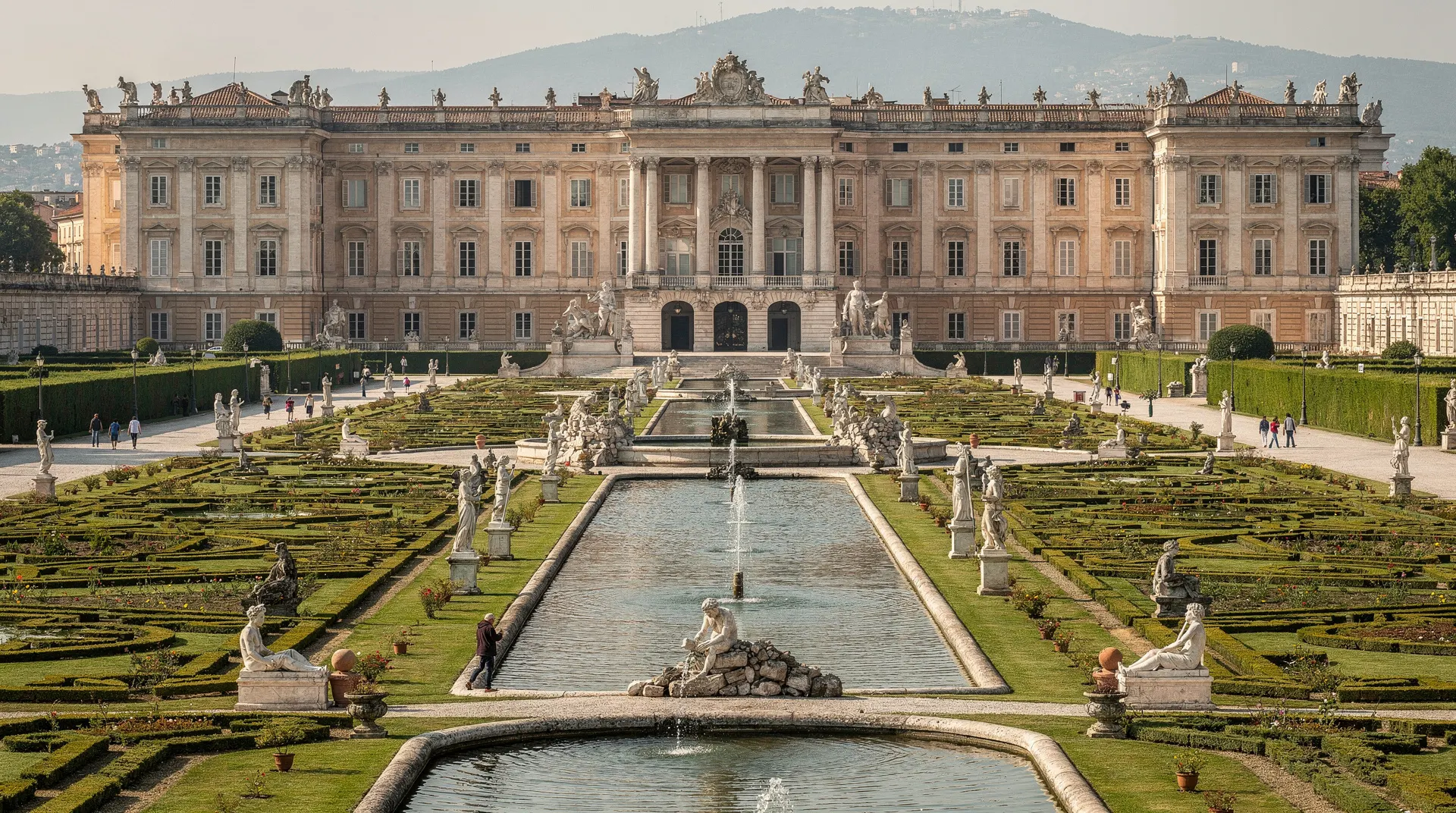
The Reggia di Caserta is, by floor area, the largest royal palace in the world. It covers 47,000 square metres across five floors, has 1,200 rooms, a staircase grand enough to ride a horse up, and a garden that stretches 3 kilometres to an artificial waterfall cascade. It was begun in 1752 for Charles III of Bourbon, designed by Luigi Vanvitelli, and took 30 years to build.
By any metric — scale, architectural ambition, state of preservation — it rivals or exceeds Versailles. And yet on a typical Tuesday in October, you might share the main staircase with fifty other visitors. The Palace of Versailles received 15 million visitors in 2023; the Reggia di Caserta attracted around 850,000. The gap in visitor numbers has almost nothing to do with quality and almost everything to do with Italy’s chronic under-marketing of sites outside Rome, Florence, and Venice.
For visitors staying in Naples, Caserta is 40 minutes away by regional train and makes an excellent day trip from mid-April to late October. The gardens in particular require reasonable weather and walking stamina to appreciate fully.
| Where | 35 km north of Naples |
| Cost | €16 palace + gardens, €10 gardens only |
| Time needed | 3 hours minimum; full day with the complete garden axis |
| Getting there | Trenitalia Regionale from Napoli Centrale, ~40 min |
| Best time | April–June, September–October; closed Tuesdays year-round |
Getting to Caserta
By train (recommended)
Trenitalia Regionale trains run from Napoli Centrale to Caserta station approximately every 20–30 minutes. Journey time: 35–45 minutes. Single fare: €4.40 (standard Regionale). The palace is directly visible from the station exit — a five-minute walk across the piazza.
Avoid travelling at rush hours (08:00–09:30, 17:30–19:00) if possible; these trains carry commuters and can be crowded. Mid-morning departures are comfortable.
By Frecciarossa / Intercity
Faster trains (Frecciarossa, Frecciargento, Intercity) also serve Caserta but cost €10–20 for a journey that takes only marginally less time. Not worth the premium for this short hop.
By car
The A1 motorway (Autostrada del Sole) passes near Caserta (exit Caserta Sud or Caserta Nord). Journey from Naples: 30–40 minutes without traffic, considerably longer at peak times. Parking is available near the palace but the access road can congest on weekends.
Organised day trip from Naples
Multiple operators run day trips that include transport and a guide. Useful if you want commentary on the palace’s history without managing logistics.
Caserta day trip from Naples with guideTickets and access
Standard ticket (palace + grounds): €16. This includes all the royal apartments, the private apartments, the Palatine Chapel, the theatre, and access to the English Garden and the main gardens (you can walk the 3-kilometre cascade route).
Gardens only: €10. Includes the full park and cascade but not the palace interiors.
Under 18 (EU citizens): free. EU citizens 18–25: reduced rate (€2).
Tickets can be purchased online in advance (recommended for weekends and public holidays) via the official Reggia di Caserta website. Walk-up availability is generally good on weekdays.
Opening: Wednesday to Monday, 9:00–19:30 (last entry 18:00). Closed Tuesdays.
Caserta palace skip-the-line guided tourWhat to see inside the palace
The Grand Staircase
The centrepiece of the arrival experience. Vanvitelli designed a staircase of theatrical dimensions — divided at the midpoint, rising through two flights to a vaulted vestibule — intended to impress visiting dignitaries with the power of the Bourbon monarchy. A colossal marble lion guards each lower landing. Everything about it communicates authority through scale.
The Royal Apartments
The state apartments occupy two wings. The Eighteenth-Century Apartments (the original Bourbon interiors) include the Throne Room, the Mars Room (with its extraordinary clock and trompe-l’oeil painted ceiling), the Astrea Room, and the private bedchamber of Ferdinand IV. The Nineteenth-Century Apartments were redecorated for the post-Unification Savoy monarchs and have a more restrained neoclassical character.
Both wings are furnished with their original contents: tapestries from the Royal Factory of San Carlo all’Arena, silk upholstery, Capodimonte porcelain, and some extraordinary pieces of Bourbon decorative art. Unlike Versailles, where many original furnishings are displayed behind barriers, at Caserta you can walk through fully furnished rooms at close quarters.
The Palatine Chapel
Directly modelled on the Royal Chapel at Versailles but with an unmistakably Italian interpretation. The barrel-vaulted ceiling, the altar with its coloured marble inlay, and the royal gallery (where the king could observe mass without mixing with the court) are all worth seeing.
The Court Theatre
A complete royal opera house inside the palace — small (only about 500 seats), perfectly proportioned, with painted tiers and exceptional acoustics. Occasionally used for performances. Check the Reggia’s event calendar if you are planning around a concert.
The pre-Unification context
Caserta was built to serve as the new capital of the Kingdom of Naples (later the Kingdom of the Two Sicilies), replacing Naples itself as the seat of government. The project was part of an ambitious Bourbon modernisation programme that also included new roads, factories (the silk works at San Leucio, a short drive away), and the Aqueduct of Carolino. Understanding this context — that Caserta was a planned royal capital, not merely a pleasure palace — transforms how you read the building. The Bourbon Naples history guide provides background.
The gardens: Versailles comparison and how to approach them
The gardens at Versailles are famous but heavily managed — geometrically precise parterres, jet-d’eau performances on schedule, enormous crowds on summer weekends. Caserta’s gardens are different in character: a long axis stretching 3 kilometres from the palace facade up a gentle hillside to an artificial waterfall, with a series of formal pools, fountains, and statuary groups at intervals.
The statuary is exceptional. The Fountain of Diana and Actaeon (the closest major group to the palace) depicts the mythological moment of transformation with figures by Gaetano and Tommaso Solari. The Fountain of Venus and Adonis further up the axis is similarly accomplished. At the top of the cascade, the Fountain of Diana’s Bath sits at the base of the waterfall.
Walking the full axis takes 2–3 hours at a moderate pace. The 3-kilometre distance is uphill (gently) on the way up, downhill on return. The footpath is comfortable.
Electric shuttle service: for those who cannot or prefer not to walk the full distance, an electric shuttle (€3–5 return) runs along the garden axis from near the palace to the top cascade. This allows you to take the shuttle up and walk back, or go straight to the top and return at leisure.
Bicycles: available for hire near the main fountain axis.
The English Garden (Giardino Inglese): to the right of the formal axis, this naturalistic garden was designed in the English style by Carlo Vanvitelli and an English landscape gardener, John Andrew Graefer, for Queen Maria Carolina in the 1780s. It features artificial ruins, streams, a small pond, exotic plants, and a deliberately informal character in contrast to the Baroque axis. Quieter and less visited than the main gardens, it is worth 30–45 minutes.
Caserta vs Versailles: honest comparison
Both sites are legitimate pilgrimage points for anyone interested in European royal architecture. The differences worth noting:
Versailles advantages: more famous, more original 17th-century content preserved, the Hall of Mirrors, better international visitor infrastructure, and the sheer weight of European history embedded in the building (here Louis XIV negotiated, here treaties were signed, here monarchies rose and fell).
Caserta advantages: dramatically fewer crowds, original furnishings in fully accessible rooms, an intact garden axis arguably better suited for a sustained walk, and a building that represents Bourbon ambition at its peak rather than a familiar postcard image.
For context on visiting both and the Italian grand tour circuit: best day trips from Naples.
Practical information
Food: there is a café inside the palace (near the ticket office) and a more substantial restaurant in the gardens. Both are adequate rather than exceptional. Caserta town centre, a 10-minute walk from the palace, has a good range of local restaurants and bars at non-tourist prices — the weekly Via Roma food market (Monday and Friday mornings) is worth a detour if your timing allows.
Luggage: left luggage is available at Caserta station.
Photography: allowed throughout without flash. Tripods require prior written permission from the administration.
Time needed: the palace alone: 1.5–2 hours. Full palace + main garden axis: 3.5–5 hours. Full palace + gardens + English Garden: allow 5–6 hours (full day).
Caserta palace and gardens guided visitCombining Caserta with other Campania day trips
Caserta pairs less naturally with the coastal day trips (it is a landlocked town north of Naples, in the opposite direction from Pompeii, Herculaneum, and the Amalfi Coast) but works well as a standalone day or combined with a Naples city day if your train schedule allows an early return.
Travellers building a longer Campania itinerary sometimes worry about “fitting Caserta in” alongside Pompeii or Paestum — in practice, treating it as its own separate day, rather than squeezing it into a coastal-focused itinerary, produces a far less rushed visit. The best day trips from Naples guide places Caserta in context against the region’s other major excursions.
The palace as a film location
The Reggia’s scale and relative emptiness compared to Versailles has made it a favoured film location for productions needing grand European interiors without the crowd-management headaches of shooting at more famous palaces. Scenes from Star Wars: Episode I and Episode II were filmed in the palace’s gardens and grand staircase (doubling for the Naboo royal palace), and Mission: Impossible III used the grounds as well. None of this changes what you actually see on a visit, but it is a useful data point for judging how the site reads on camera versus how it feels in person — considerably more atmospheric in person, once you factor in the near-total absence of a film crew’s controlled lighting and empty rooms.
Caserta Royal Palace guided tour with skip-the-line accessFrequently asked questions about Caserta
Is the Reggia di Caserta really bigger than Versailles?
By floor area, yes — 47,000 square metres versus Versailles’s 51,200 m² (the figures vary by what is measured, and Versailles counts differently). Caserta has more rooms (1,200 vs approximately 700 at Versailles). The gardens at Versailles are larger. By almost any measure of interior space, Caserta is the larger building.
How long do I need at Caserta?
A minimum of 3 hours for the palace and the first portion of the gardens. A full day if you want to walk the complete 3-kilometre cascade route and explore the English Garden. Most day-trippers from Naples spend 4–5 hours.
Is Caserta open every day?
No — closed Tuesdays. Open Wednesday to Monday, 9:00–19:30 (last entry 18:00). Check the official website for seasonal variations and occasional special closures for state functions.
Can I visit Caserta without a guide?
Yes. The palace has good information panels and an audio guide (€5). That said, the historical context of the Bourbon kingdom significantly enriches the visit — a guided tour adds considerable value, particularly for the 18th-century apartments.
Is there anything else to see near Caserta?
The Silk Works of San Leucio (about 2 km north of the palace) is a UNESCO-listed Bourbon manufacturing complex — essentially a planned utopian workers’ community built alongside the silk factory. Occasionally open for visits; check schedules. Caserta Vecchia (the medieval hill town above modern Caserta) is worth visiting for its Norman-Lombard cathedral and castle if you have time in the afternoon.
Should I combine Caserta with Pompeii or Paestum on the same day?
Not recommended. Caserta is north of Naples while Pompeii and Paestum are south and southeast respectively — combining them means long, tiring train connections through Naples for a rushed visit at both ends. Treat Caserta as its own day trip.
Top experiences
Bookable activities with verified prices and instant confirmation on GetYourGuide.