Pozzuoli
Pozzuoli is the gateway to the Phlegraean Fields — Solfatara volcano, the Flavian Amphitheatre, Rione Terra, and ferries to Procida and Ischia. Full guide.
Phlegraean Fields: Pozzuoli Guided Walking Tour
Duration: 2h
Quick facts
- Distance from Naples
- 16 km west
- Metro (Line 2)
- ~20 min from Naples (Pozzuoli station)
- Crater alert
- Yellow alert (bradyseism ongoing) — check before visiting Solfatara
- Key sites
- Solfatara, Amphitheatre, Rione Terra, Macellum
- Ferries
- Procida 30–40 min, Ischia 50 min (hydrofoil)
- Character
- Working port city, genuine Neapolitan suburbs
| Where | 16 km west of Naples, Metro Line 2, ~20 min |
| Cost | Around €4–10 per site; €2 metro fare each way |
| Time needed | Half a day; a full day combined with a ferry to Procida or Ischia |
| Getting there | Metro Line 2 to Pozzuoli station |
| Best time | April–October; check INGV alert status before Solfatara |
Pozzuoli and the ground that moves beneath your feet
Pozzuoli sits on one of the world’s most geologically unusual coastlines. The ground here does not stay still — it has risen and fallen by several metres over the past 2,000 years due to a process called bradyseism: the gradual inflation and deflation of the Campi Flegrei caldera as magma and hydrothermal fluids move beneath the surface. Roman columns in the ancient Macellum (market) still show marine borings from a period when the forum was underwater. In the 1980s, a bradyseismic crisis caused enough ground uplift to force the evacuation of 40,000 residents.
As of 2026, the Campi Flegrei system is on yellow volcanic alert (the second of four levels). This does not mean an eruption is imminent — the system has been on yellow alert intermittently since 2012, with episodes of uplift and minor earthquakes. It does mean the Solfatara crater, where the volcanic activity is most visible, operates with specific access protocols. Check the INGV (Istituto Nazionale di Geofisica e Vulcanologia) website for current status before your visit.
None of this should deter a visit. Pozzuoli and the Phlegraean Fields are one of the most geologically and archaeologically fascinating landscapes in Europe, and they are 20 minutes from central Naples by Metro.
Getting to Pozzuoli
Metro Line 2: from Napoli Piazza Garibaldi or Mergellina stations, take Metro Line 2 west to Pozzuoli station. Journey time approximately 20 minutes from Piazza Garibaldi, €2 (standard ANM network ticket). The station is at the top of the town; the port and historic centre are downhill (5–10 minutes’ walk).
Metro Line 6 / Bus: less convenient but also possible from Fuorigrotta/Bagnoli.
Car: SP59 or Via Domiziana west from Naples. Parking in central Pozzuoli is limited. Better to use Metro.
Solfatara
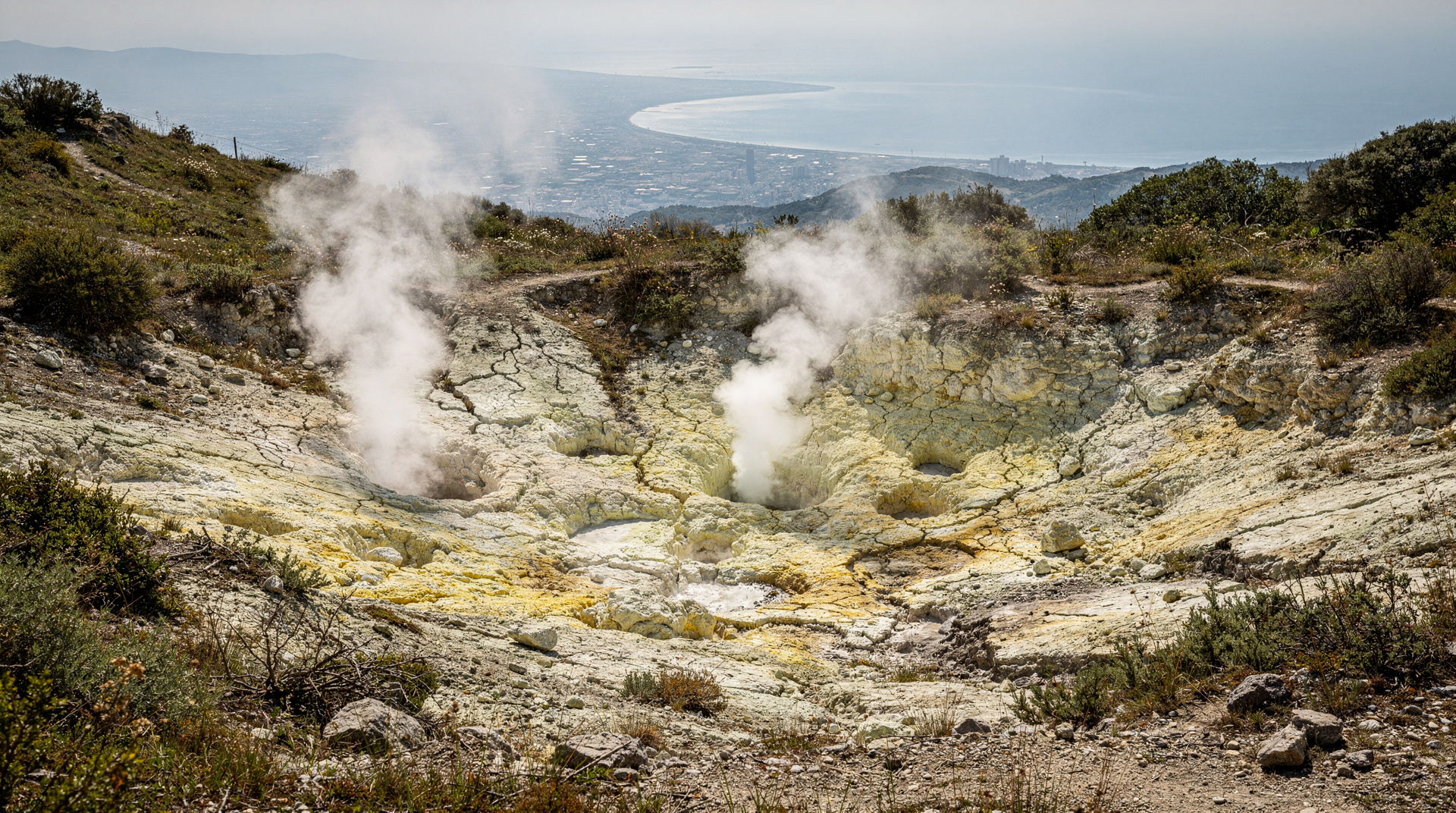
The Cratere Solfatara is a volcanic crater 2 km from central Pozzuoli — the most tangible evidence of the Campi Flegrei system for visitors. The crater floor is a flat, grey-white plain with steaming fumaroles (sulphurous gas vents), boiling mud pools (the fanghi bollenti), and areas of earth soft enough to feel warm underfoot. The sulphur smell is constant and moderately intense.
This is not a metaphor for volcanic activity — it is active volcanic activity, at low intensity, walkable on designated paths. The experience of walking on hot ground with gas venting a few metres away, inside a genuine volcano crater, is extraordinary.
Access: The site has been under restricted access since 2023 due to the ongoing bradyseismic activity and safety reviews. As of early 2026, guided access to limited areas of the crater is available; independent free-roaming access as existed before 2019 is not. Verify current access conditions and booking requirements through the official Solfatara di Pozzuoli website or through a tour operator before planning around it.
Entry: approximately €8–10 for current access areas (subject to change).
Phlegraean Fields burning volcanic tourFlavian Amphitheatre (Anfiteatro Flavio)
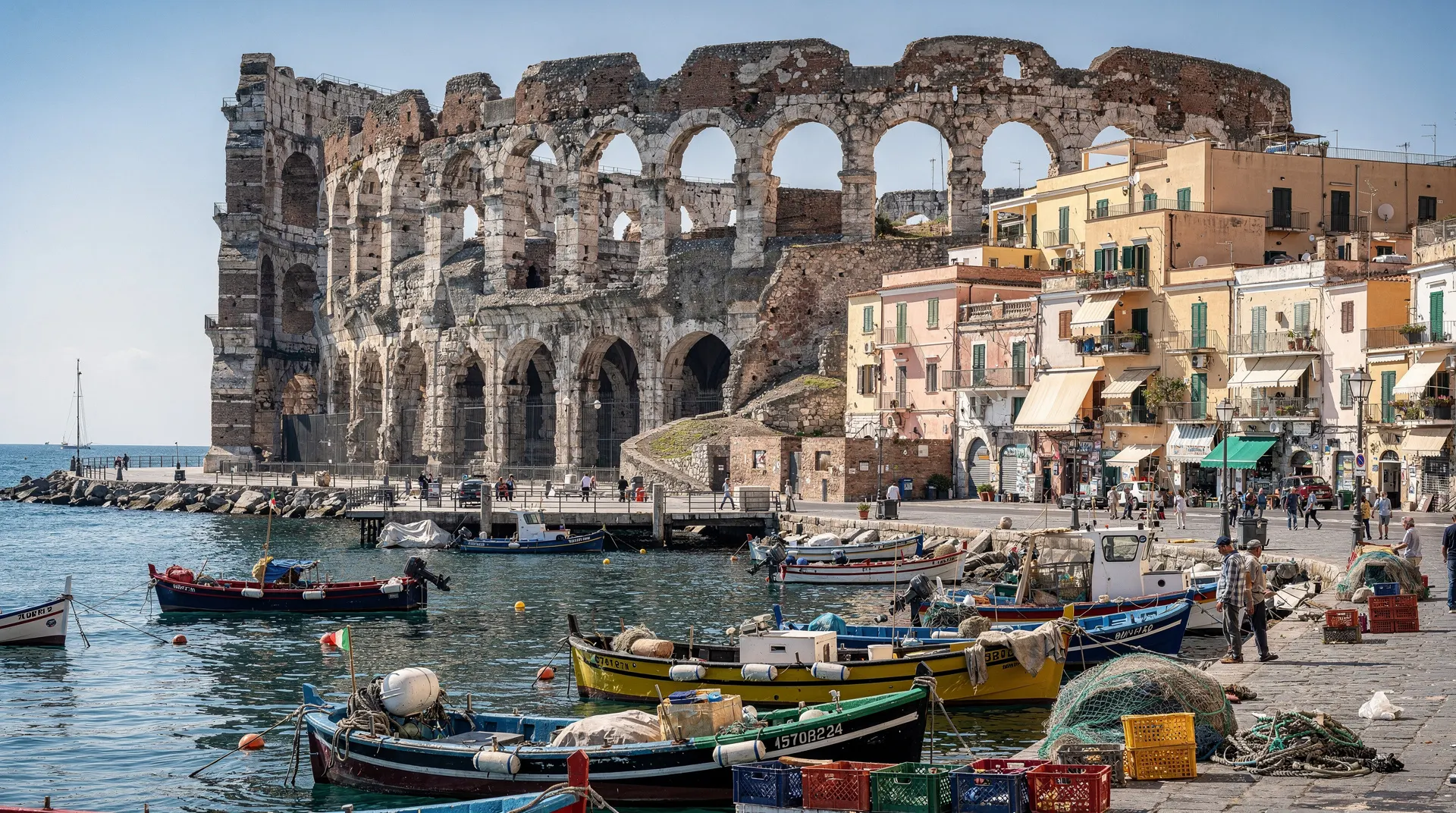
One of the largest Roman amphitheatres in existence — third in size after the Colosseum and the one at Capua — the Anfiteatro Flavio di Pozzuoli was built in the first century AD under the emperors Vespasian and Titus (of the Flavian dynasty, hence the name). It held approximately 40,000 spectators.
What makes it particularly notable: the underground hypogeum (the service tunnels and animal holding areas beneath the arena floor) is exceptionally well preserved and accessible. Walking through the network of passages where animals, gladiators, and stage machinery were held before ascending to the arena floor gives a concrete sense of how Roman spectacle was produced. The early Christian martyr San Gennaro (the patron saint of Naples) was reportedly condemned to the arena here before his execution at Solfatara around AD 305.
Entry: approximately €4–6 (check current prices). Combined tickets with other Phlegraean sites may be available. The site is typically open Tuesday to Sunday, 9:00–18:00.
Rione Terra
Rione Terra is a fortified tuff promontory at the edge of the harbour — the original site of the ancient Greek city of Dikaiarkeia and the Roman Puteoli. It was evacuated in 1970 following the bradyseismic crisis, and for decades sat abandoned. Excavations since 2003 have uncovered a remarkably complete Roman grid city beneath the 16th-century Spanish town built on top — effectively a stratified site with Greek, Roman, medieval, and Baroque layers in a small area.
Underground tours of the Roman layer (warehouses, streets, a brothel, bakeries — analogous in some ways to Pompeii) are available by guided tour only, typically booked through the Rione Terra visitor centre. Hours and availability are variable; check ahead. This is one of the most underrated archaeology experiences in the Naples area.
The Macellum (Temple of Serapis)
In the centre of Pozzuoli, near the harbour, stands a partially excavated structure known locally as the Temple of Serapis — though it was actually a macellum (market building) dating to the first century AD. What makes it significant: three columns still standing show a band of marine borings 3–4 metres above the current floor level, caused by shellfish when the ground subsided and the building was partially underwater in medieval times. It is the canonical illustration of bradyseism — physical evidence of the ground having been below sea level and returned to its current elevation — visible in the open air, in the middle of a modern city.
Ferry connections: Procida and Ischia
Pozzuoli’s port is one of the main departure points for ferries to the Bay of Naples islands, often more convenient (and cheaper) than the main Molo Beverello in Naples.
Procida: 30–40 minutes by hydrofoil (aliscafo), approximately 30–50 minutes by slower ferry. Several services daily from Pozzuoli with Medmar and SNAV. Fares from €14–18 return. Procida is small, car-free on most of its main areas, colourful, and one of the least commercialised of the three islands — see Procida guide.
Ischia: approximately 50 minutes (hydrofoil) to 80 minutes (ferry) from Pozzuoli. Medmar operates regular services. Fares approximately €16–22 return. Ischia is the largest of the bay islands, known for thermal springs and gardens — see Ischia guide.
The ferries from Naples guide covers timetables, prices, and the comparison between Beverello and Pozzuoli departure points.
Walking tour of historic Pozzuoli
The town centre has a pleasant, unpretentious character — real Neapolitan suburbs rather than tourist infrastructure. A 2-hour walk covers:
- Rione Terra promontory (exterior views if underground tour not available)
- Macellum (Temple of Serapis) — 10-minute walk from Rione Terra
- Via Solfatara and surrounding market streets — local food market on weekday mornings
- Port and waterfront — fishing boats, fish market (mornings), views toward Nisida island
- Anfiteatro Flavio — about 1 km north of the town centre
Eating in Pozzuoli
The seafood in Pozzuoli is excellent and considerably cheaper than in the tourist areas of Naples. The port area has several trattorias serving catches from the bay — spaghetti alle vongole, frittura di pesce, ricci di mare (sea urchin) in season, and fresh-grilled fish. Ristorante I Clavi (near the port) and Da Ciccio are local favourites. Budget €25–40 for a proper seafood meal with wine.
The local pane di Pozzuoli (a particular style of soft roll) and the Friday fish market at the harbour are both worth seeking out.
Combining Pozzuoli with the rest of the Phlegraean Fields
Pozzuoli is one entry point into the wider Campi Flegrei (“Burning Fields”) volcanic district, which extends west along the coast to Baia and Cuma. If Solfatara and the Amphitheatre only take up a morning, the ancient port town of Baia (submerged Roman villas visible through glass-bottomed boat tours, plus an archaeological park with surviving thermal complexes) and Cuma (site of the Cave of the Sibyl, one of the oldest Greek colonies in Italy) round out a full day. Both are a short drive or bus ride from Pozzuoli and are covered together in the Campi Flegrei guide and the Campi Flegrei day trip guide.
Travellers based in central Naples sometimes treat Pozzuoli as a same-day add-on to a Procida or Ischia ferry crossing, since the port sits right next to the metro station and departures are frequent in season. This is an efficient way to see volcanic Naples and a bay island without doubling back through the city.
Frequently asked questions about Pozzuoli
Is it safe to visit Pozzuoli with the volcanic alert?
Yellow alert (the current level) indicates elevated monitoring and some seismic activity, not imminent eruption risk. Pozzuoli city is open and functioning normally. The Solfatara crater has specific access restrictions. Always check current status from INGV before visiting Solfatara specifically.
Can I visit Solfatara independently?
As of 2026, full independent access is not available following the 2019 fatality and subsequent safety review, combined with ongoing bradyseism. Guided access to certain areas is available. Check the official Solfatara di Pozzuoli website for current ticketing and access areas.
How do I get to Procida from Pozzuoli?
The ferry to Procida (hydrofoil: 30–40 min, ferry: ~50 min) departs from the Pozzuoli port. Check schedules via Medmar Navigazione or Caremar. Ticket prices vary seasonally. The Procida day trip guide covers the island in full.
Is Pozzuoli worth a dedicated day trip?
Yes, particularly if combined with a ferry to Procida or Ischia. On its own, the main sites (Solfatara, Amphitheatre, Rione Terra, Macellum) fill a comfortable half-day. For a full day, add Baia or Cuma — covered in the Campi Flegrei guide.
What is bradyseism and is it dangerous?
Bradyseism is the gradual uplift and subsidence of the earth’s surface due to magma and hydrothermal fluid movement beneath a volcanic caldera. In Pozzuoli, the ground has risen and fallen by several metres over historical time. The slow uplift causes minor earthquakes (typically felt but not structurally damaging at current levels) and occasional deformation of buildings. At current alert levels, it poses no acute danger to visitors.
Top experiences
Bookable activities with verified prices and instant confirmation on GetYourGuide.