Naples Underground (Napoli Sotterranea) — Honest 2026 Tour Review
Naples: The Underground of Napoli – Trip to the Hidden City
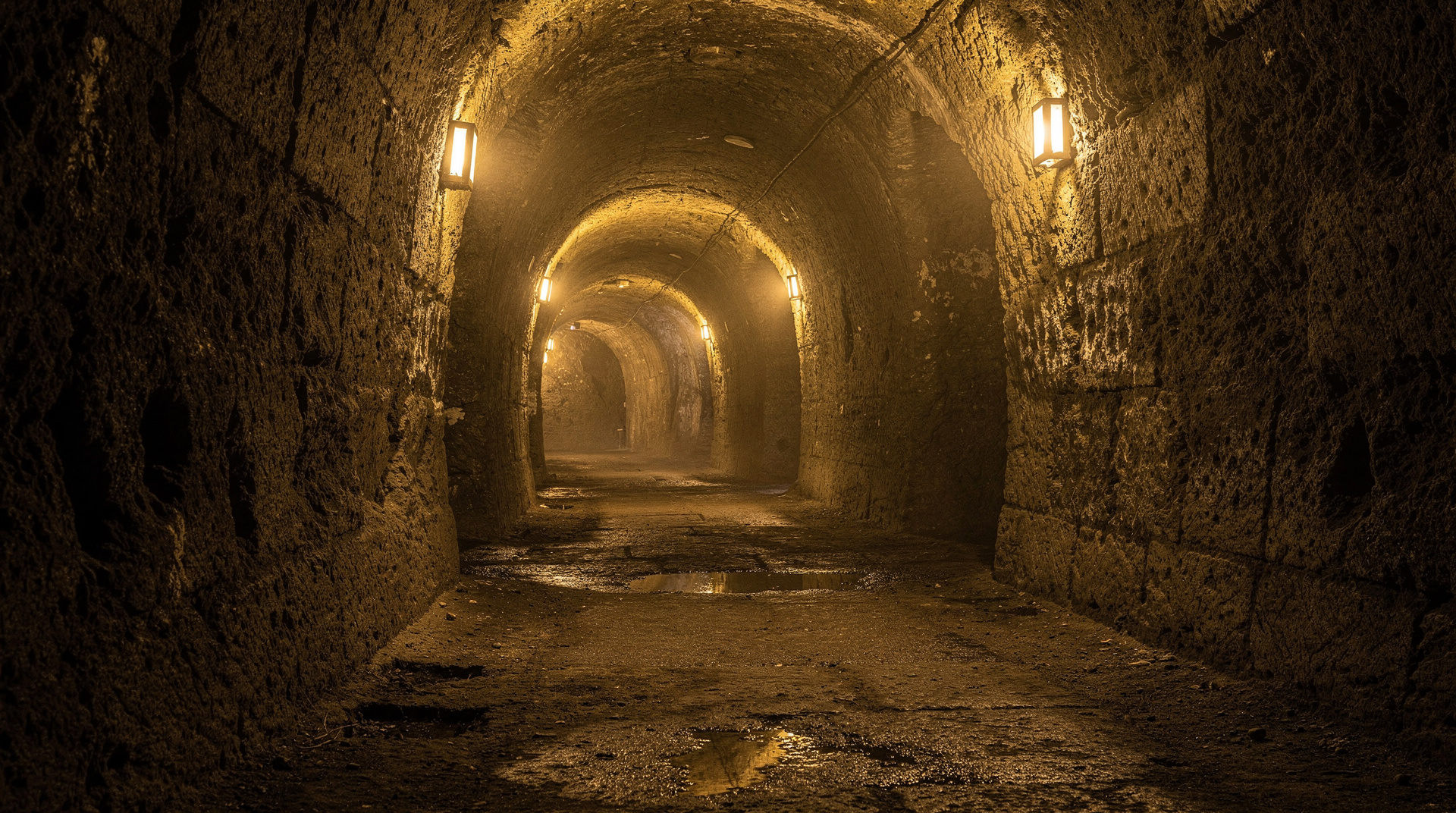
Forty metres below the chaos of Naples’ centro storico, the city keeps a second life entirely intact. The Naples Underground hidden city tour takes you through 2,400 years of layered history — Greek quarries, a Roman aqueduct, a WWII civilian shelter, and a buried theatre — via passages that have not changed since the ancients carved them. It is one of the most absorbing two hours you can spend in the city, and one of the few underground experiences in Europe that genuinely delivers on its billing.
| Where | Piazza San Gaetano 68, centro storico |
| Cost | around €15–20pp guided; €25–40pp combined tours |
| Time needed | 1.5–2 hours underground, allow 2 hours total |
| Getting there | 5-min walk from Piazza del Gesù Nuovo |
| Best time | Book ahead in July/August; constant 14–15°C year-round |
If you want to see how this tour sits alongside Naples’ other underground sites, the underground Naples compared guide is worth reading first — Napoli Sotterranea is only one of several options below the city.
What is down there: Greek quarries, Roman aqueduct, and a buried city
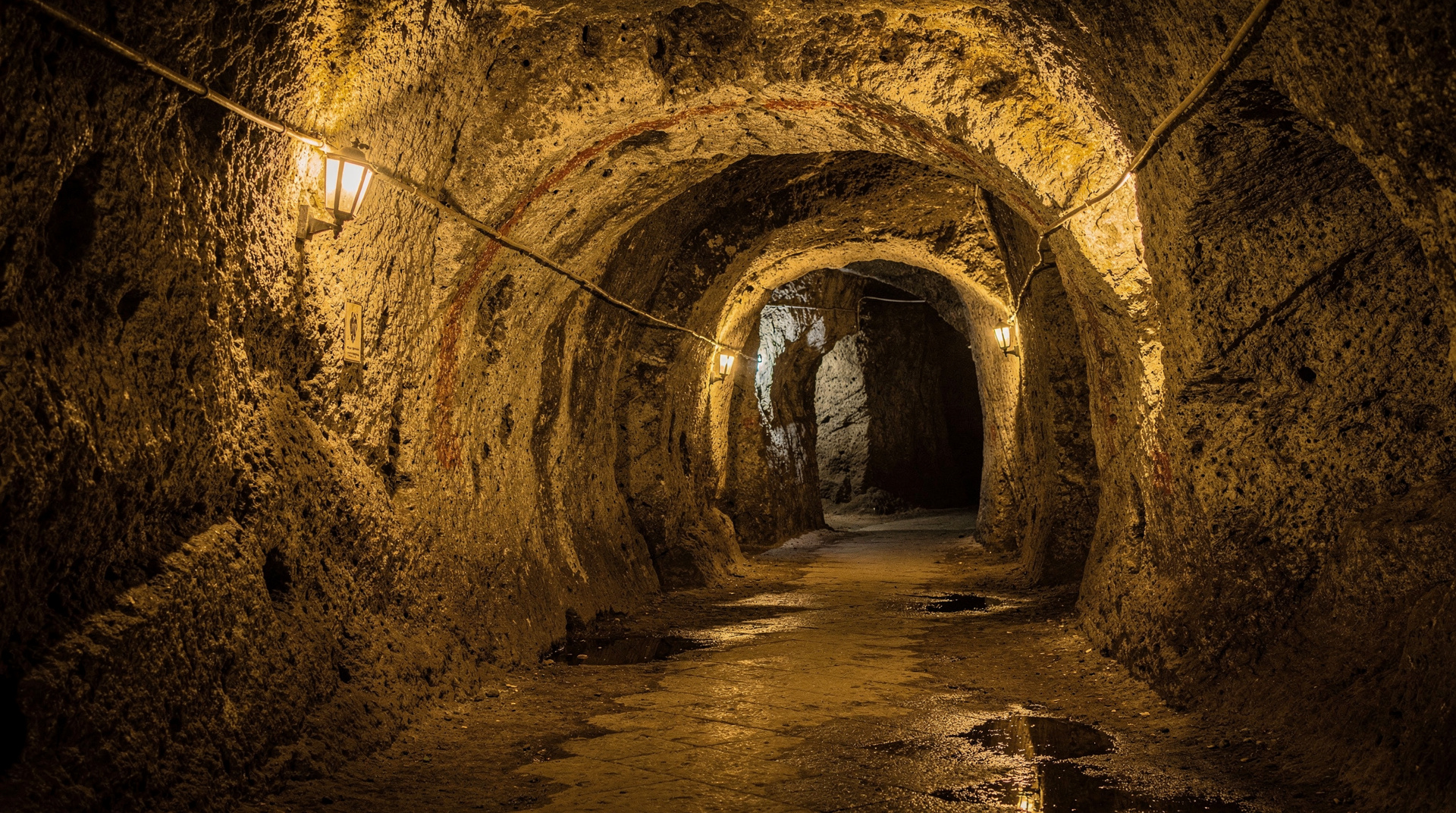
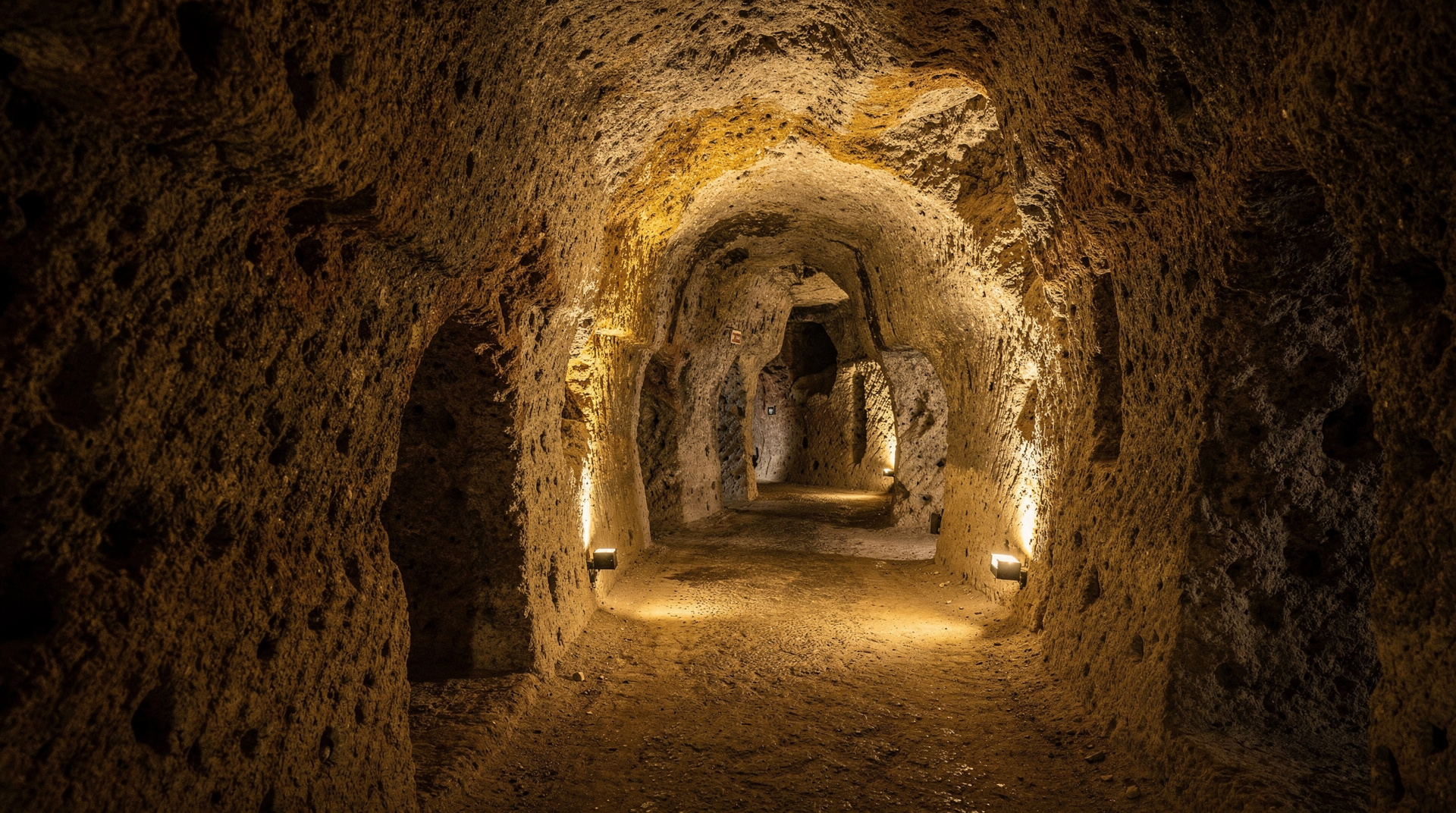
The underground Naples story begins in the 4th century BC, when Greek settlers quarried the soft volcanic tuff beneath the city to build the structures above. The result was a vast honeycomb of cavities — not a single tunnel but an interconnected network that eventually extended beneath most of the ancient city. These cavities were later converted by Roman engineers into one of the ancient world’s most sophisticated urban water systems: an aqueduct that channelled fresh water from the Serino springs, roughly 100 km to the east, through a labyrinth of cisterns and distribution channels to every major building in the city.
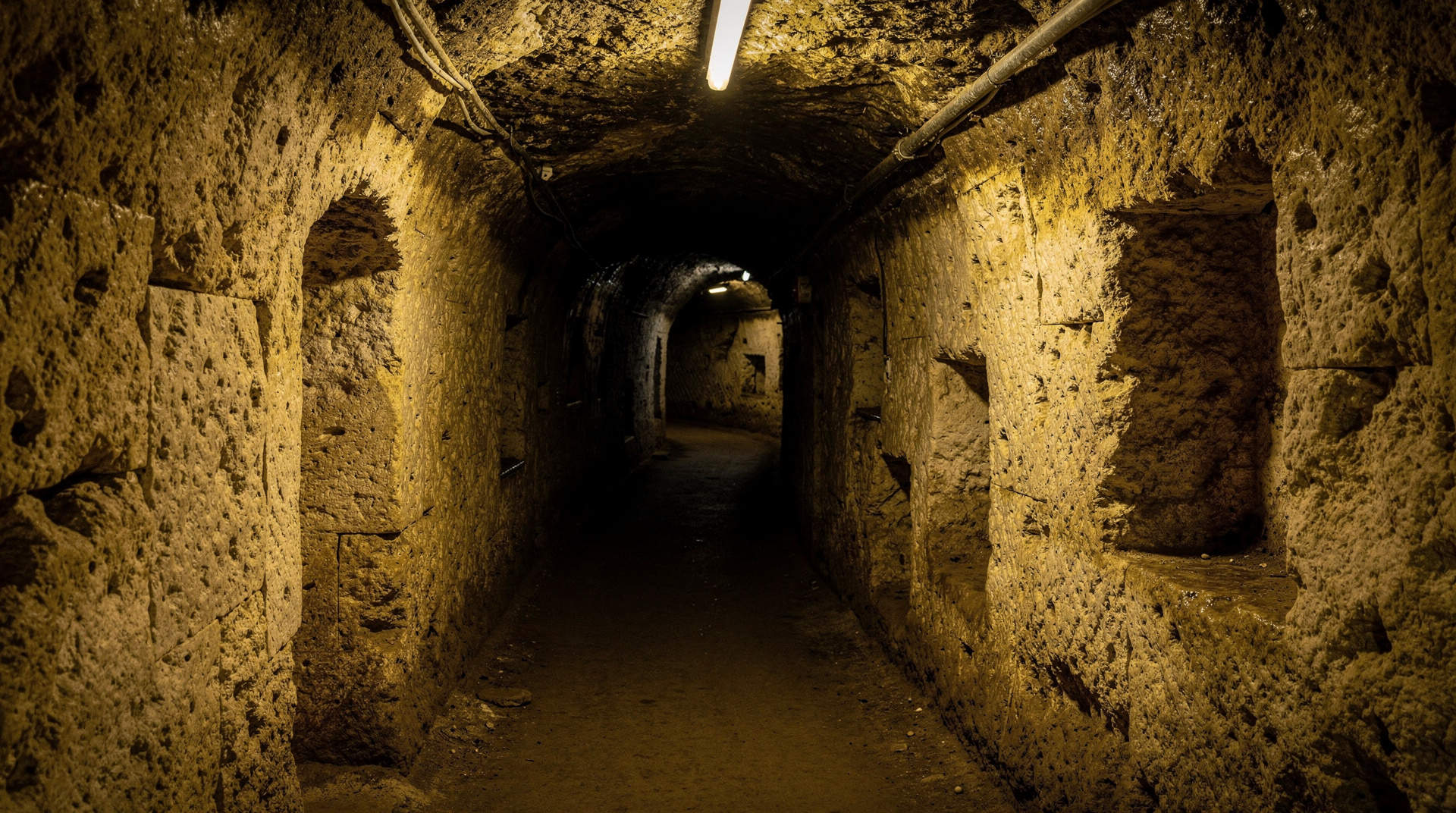
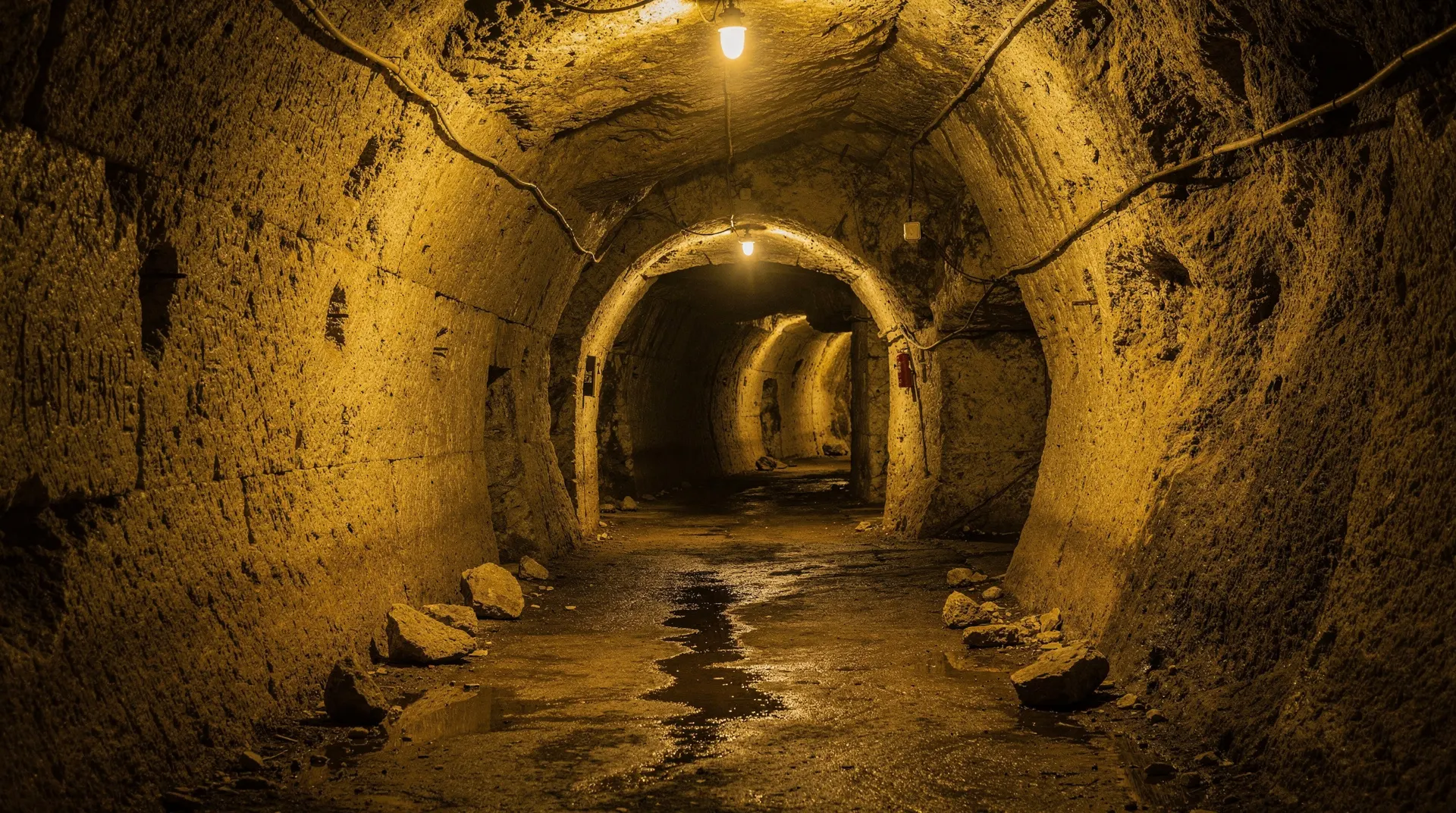
The aqueduct functioned continuously for nearly two thousand years. It was only decommissioned in 1885 following a catastrophic cholera epidemic — the contaminated above-ground water was partly blamed on the exposed cistern system — and afterwards the underground network was bricked up, forgotten, and slowly filled with rubble and domestic waste. What survives today, excavated painstakingly from the 1980s onwards, is a remarkably complete cross-section of ancient urban infrastructure: the channels themselves, the rectangular settling tanks, the weight-bearing arches, and tens of thousands of small objects discarded or lost into the cistern openings over two millennia.
The WWII air-raid shelter: Naples’ most intact wartime site
In 1940, the Italian civil authorities faced an immediate problem: they needed bomb shelter space for a dense urban population, fast. The solution was the ancient network beneath their feet. Engineers cleared and reinforced the underground cavities and opened them as public shelters within weeks. At the peak of Allied bombing in 1943, up to ten thousand civilians sheltered here at a time, sometimes for days without returning to the surface.
The shelter section on the main Napoli Sotterranea tour is exceptionally well preserved because it was sealed rather than cleared after the war. Original wooden bunks, rationing crates, personal items, propaganda posters, and hand-drawn murals are still in place. One room contains a complete model theatre — built and operated by Neapolitan families to keep children occupied during the bombing — which the guide explains in detail. The contrast between the ancient stone walls and the mid-twentieth-century artefacts creates an oddly moving effect that photographs do not fully capture.
The narrow candle-lit passage: the defining experience
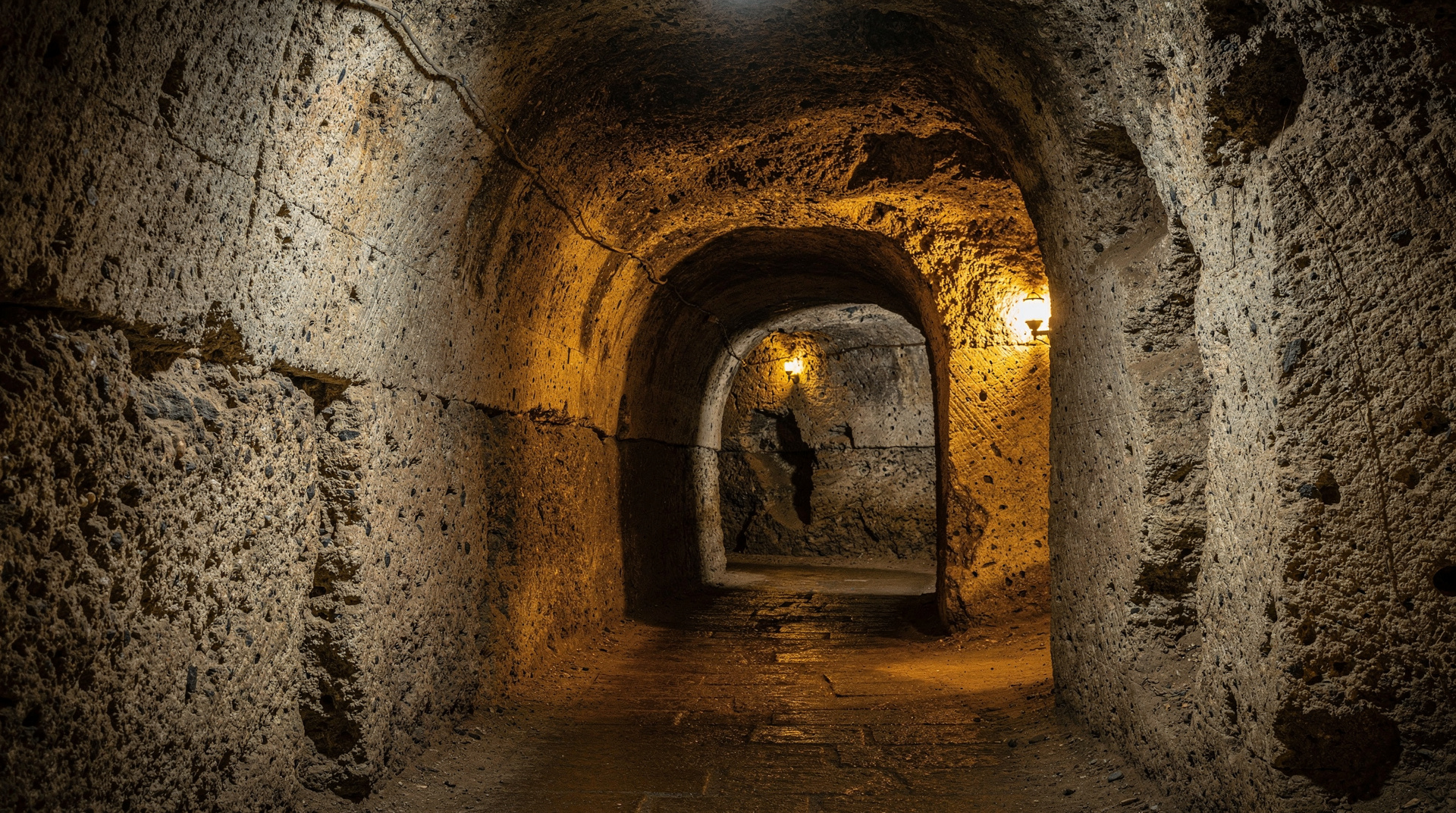
The tour’s centrepiece is a passage through a genuine section of the Roman aqueduct channel — not a reconstructed walkway beside it, but the channel itself. At its narrowest, this corridor is approximately 50 cm wide and requires walking sideways with your back against the wall and your chest facing the rock. Ceiling height varies but drops to around 80 cm at the tightest points. Each visitor carries a small oil lamp rather than a torch, and the guide leads the group through roughly 15–20 minutes of this passage by candlelight.
The experience is extraordinary precisely because it is real: the walls still carry the imprints of Roman tools, and the channel dimensions have not changed in two thousand years. However, it is not for everyone. Anyone with meaningful claustrophobia should read the FAQ entry above before booking. The passage is not optional once the tour has started — the only exit is forward. Guides are experienced at managing anxious visitors and the pace is controlled, but the physical reality of the space cannot be altered.
The 1.5-hour Naples underground tour covers the aqueduct passage and the WWII shelter in the most focused format; the longer variants add the Roman theatre excavation and additional historic rooms.
The hidden Roman theatre beneath the city
On selected tour routes, a separate stop leads to the partially excavated remains of a Roman theatre — specifically the theatre where the Emperor Nero is said to have performed publicly, a detail that contemporary Romans found scandalous. The theatre was built over during the medieval period and its existence was only confirmed relatively recently when systematic excavation beneath private buildings in the Piazza Bellini area revealed substantial sections of the ancient cavea.
Access is through private basements and cellars, and the theatre is visible in sections rather than as a complete whole — you see arched passages, seating tiers, and structural walls embedded in the foundations of buildings that have stood above them for a thousand years. The Decumans underground tour covers the Roman theatre route alongside the Decumani (the ancient main streets) for context on how the Greek-Roman urban grid survives in the modern street plan.
Other underground Naples experiences worth knowing about
Napoli Sotterranea is the most complete single underground visit, but it is not the only one. The Galleria Borbonica guide covers a separate Bourbon-era tunnel system with a distinct wartime-vehicle character, built as a royal escape route and later repurposed as an air-raid shelter of its own.
The Catacombs of San Gennaro guide covers an entirely different underground experience — early Christian burial catacombs with a more solemn, historical-religious atmosphere. Neither substitutes for Napoli Sotterranea’s layered Greek-Roman-WWII story, but either makes a strong second underground stop if the city’s below-ground history has hooked you. The general Naples underground guide is a good starting point for comparing all of them at once.
Who this tour is for — and the claustrophobia question
The Naples Underground suits almost anyone with a genuine interest in history, provided they have no serious claustrophobia and can manage 65–70 steep steps. The combination of Greek, Roman, and modern WWII history in a single continuous space is unusual even by Naples’ extravagant historical standards, and the guides on the main Napoli Sotterranea tours are consistently knowledgeable.
It is not the right experience for visitors who are mildly uncomfortable in confined spaces but expect to push through — the narrow passage is long enough that discomfort becomes distress for some people, and there is genuinely no quick exit. If there is any doubt, consider the Naples top sights and underground combined tour, which pairs a surface tour of the historic centre with a shorter underground section and moves at a more varied pace.
Families with children aged 8 and upwards are generally well served. The WWII shelter section holds attention well; the Greek and Roman history lands better with older teenagers and adults. Prams are not feasible and very young children are not admitted.
Practical information: prices, duration, and booking
Duration: The core Napoli Sotterranea tour runs approximately 1 hour 30 minutes underground, plus a brief introduction above ground. Allow two hours total. Extended routes covering the Roman theatre and additional rooms run to two and a half hours.
Prices: Admission to Napoli Sotterranea (self-guided access plus basic orientation) starts at around €10–12 per person. Guided tours in English — which are significantly better value given the interpretive context — typically cost €15–20 per adult, with reductions for children under 10. Combination tours with surface sights or other underground sites run €25–40.
Temperature underground: A constant 14–15°C. Bring a light layer in summer; a warmer one in winter, when the temperature difference between surface and underground is more jarring.
Access and booking: The main Napoli Sotterranea entrance is at Piazza San Gaetano 68, in the heart of the centro storico, a five-minute walk from Piazza del Gesù Nuovo. Tours depart regularly; English-language departures run at least twice daily outside of low season. Book ahead in July and August.
What to wear: Closed shoes are required — the tuff floor is uneven and occasionally damp. The candle-lit passage can be hard on light-coloured clothing pressed against the rock walls.
Combining with the surface city: Because the main entrance sits in the centro storico, it’s easy to pair this tour with a walk through the surrounding streets before or after. Many visitors combine an underground visit with a stop at the nearby Duomo or a wander through Spaccanapoli, turning the underground portion into the anchor of a half-day rather than a standalone outing.
Verdict
The Naples Underground is the best two hours you can spend beneath any European city, and it is not a close contest. The layered history — Greek quarrymen, Roman hydraulic engineers, and wartime families sheltering from Allied bombs, all in the same physical space — is genuinely unique, and the candle-lit aqueduct passage is one of those rare travel experiences that stays with you for years.
Book the guided English-language tour rather than self-guided access: the physical space makes sense with interpretation and is just a pleasant cold walk without it. If you have specific interests in the Roman theatre or want to combine underground Naples with the Decumani above ground, the extended routes add real depth.
And if claustrophobia is a concern, read the FAQ carefully and decide honestly — the narrow passage is the tour’s best moment for most visitors and its hardest moment for others. There is no shame in choosing a format that keeps you comfortable; the WWII shelter alone, minus the aqueduct crawl, is worth the trip underground. For the full site background beyond this tour review, see the Napoli Sotterranea guide.