Galleria Borbonica: Naples' royal escape tunnel
Naples: Underground Entrance Ticket and Guided Tour
Duration: 1.5h
What is the Galleria Borbonica?
The Galleria Borbonica is a 19th-century tunnel commissioned by King Ferdinand II of Bourbon as an escape route from the Royal Palace to military barracks. It was converted to a wartime shelter in 1942 and now contains abandoned vehicles, medical equipment, and war-era objects. Standard tours cost €10 and last 75 minutes. Several adventure formats are also available including a raft section through flooded tunnels.
The Galleria Borbonica has the strangest origin story of any attraction in Naples. It was built to be a private road for a paranoid king to flee popular uprising. It was completed just in time for that king’s dynasty to collapse by other means. It sat unused for decades, was converted to a car depository, then a wartime shelter, then forgotten again — until explorers in the 1980s pushed through the rubble blocking the entrance and found an intact time capsule of several different eras of Neapolitan history preserved in the dark.
The result is a visit that is substantively different from the other underground options in Naples. There are no ancient cisterns, no Christian frescoes, no bones. Instead: a wide Bourbon-era road, rusting automobiles from the 1920s and 1930s, operating-theatre equipment from a wartime medical facility, and the accumulated debris of a city that used its underground as a very long-term storage space.
| Where | Via Morelli 61, Chiaia — 10 min walk from Piazza del Plebiscito |
| Cost | around €10 standard, €15 adventure route |
| Time needed | 75 minutes (standard), longer for adventure |
| Getting there | Metro Line 1 to Municipio + 15 min walk, or bus C25 |
| Best time | Weekday mornings for fewer crowds; Torch Route in the evening |
The Bourbon escape route: what was planned and why
Ferdinand II, King of the Two Sicilies, had good reasons to be nervous about his subjects. The 1848 revolutions that swept Europe had reached Naples — there had been a constitutional uprising, a brief constitutional period, and then a royalist crackdown. Ferdinand had survived by alternating concessions with military force, but the memory of the Paris barricades and the Vienna revolution lingered.
In 1853, he commissioned a tunnel connecting the Royal Palace (Palazzo Reale) on Piazza del Plebiscito with the Pizzofalcone military barracks — a carriage road wide enough for royal horses and guards, running underground from palace to barracks without crossing open streets where crowds might gather. The route was planned to continue to the military port at Molosiglio, giving the king a complete escape sequence from palace to barracks to ship.
The project took seven years and cost an enormous sum. The engineer Errico Alvino oversaw construction; the tunnel required cutting through tufa, shoring sections with masonry, and managing drainage in sections that pass below the water table. The work was finished in 1861 — but by then, Ferdinand II was dead (1859), his son Francis II had already fled Naples (1860), and the Kingdom of the Two Sicilies had been dissolved into the new Italian state.
The tunnel was never used for its intended purpose.
Repurposing: vehicles, workshops, and the wartime hospital
The abandoned tunnel found various uses in subsequent decades. In the early 20th century, sections were used as a vehicle depository for municipal and private vehicles taken off the road — broken-down or impounded automobiles stored cheaply in the dry underground space. Some were repaired in situ; others were simply never retrieved.
During WWII, the Galleria was incorporated into Naples’ civil defence shelter network. The large dimensions that had been designed for carriages could accommodate hundreds of civilians during Allied bombing raids. The deepest section was converted to a hospital ward — operating tables, medical equipment, and supply storage were installed. Naples was bombed extensively between 1942 and 1944 (around 100 Allied raids), and the shelter was used continuously.
When the war ended and residents returned to the surface, the shelter was sealed. The vehicles, the hospital equipment, and the personal objects of shelter inhabitants remained inside. Exploration only resumed in the 1980s when a group from the local spelunking association pushed through the rubble sealing the Vico del Grottone entrance and found everything more or less as it had been left.
What you see on the tour
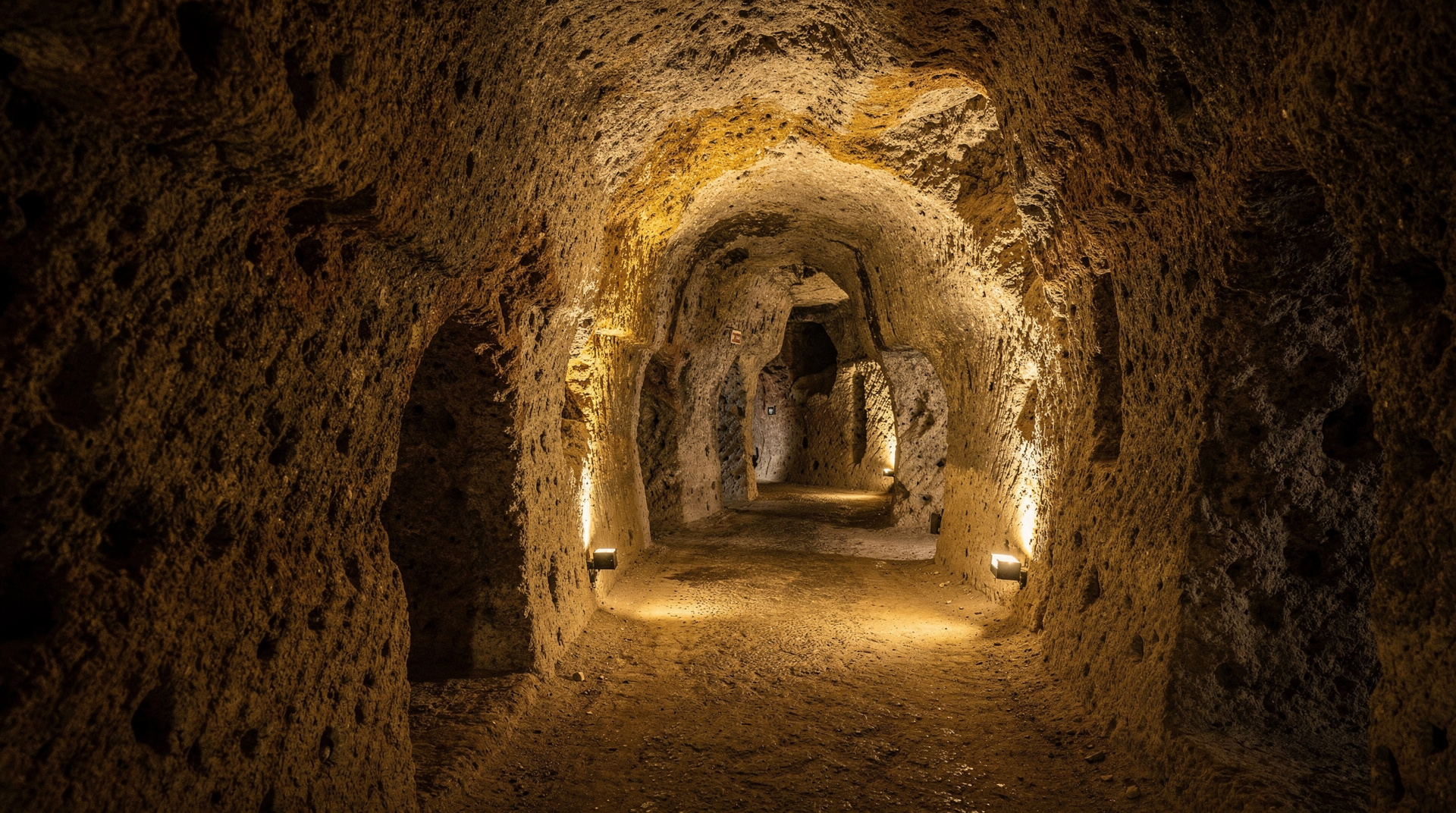
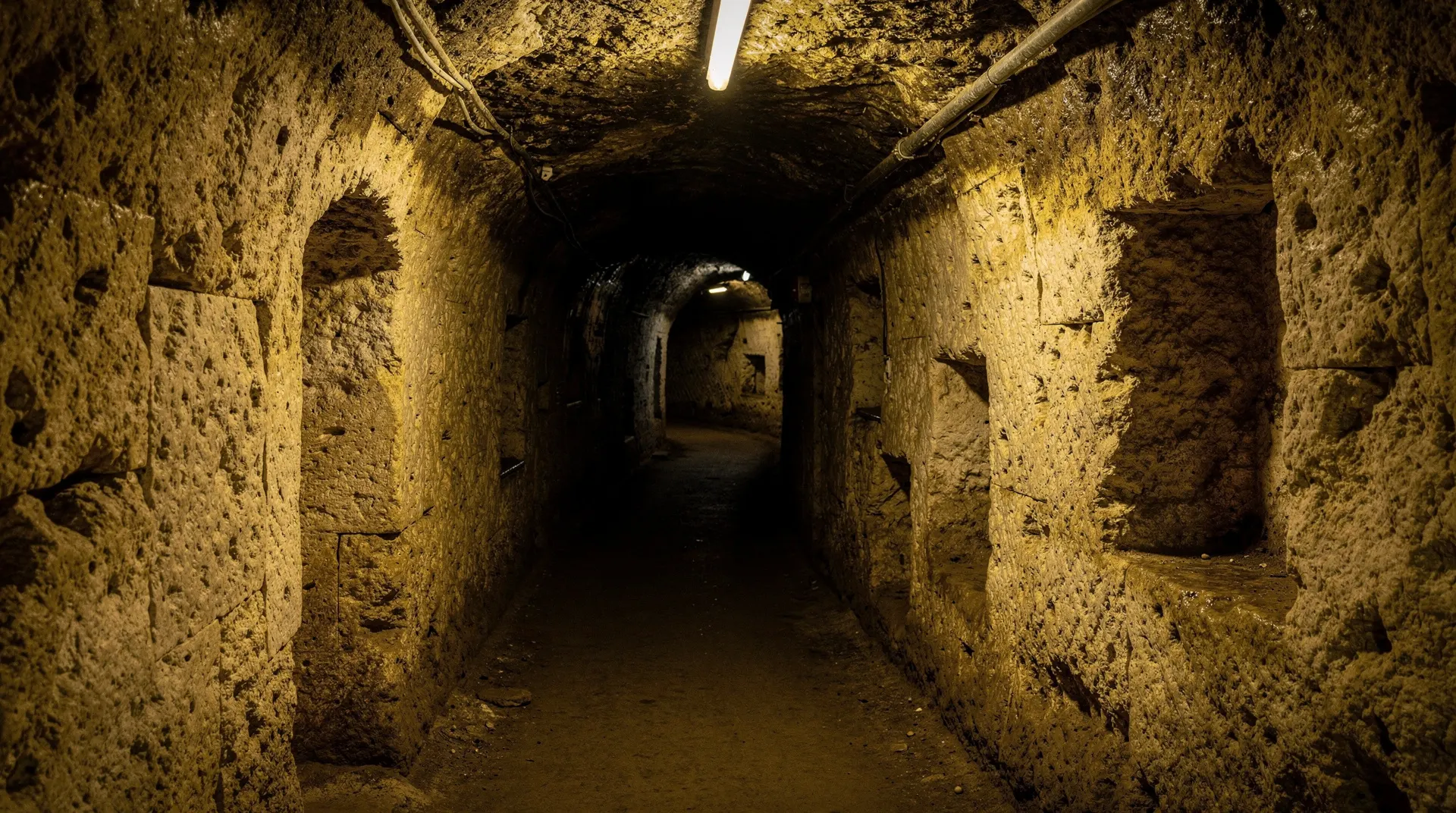
The standard tour enters from Via Morelli and follows the main tunnel axis for approximately 700 metres of the accessible route. Key elements:
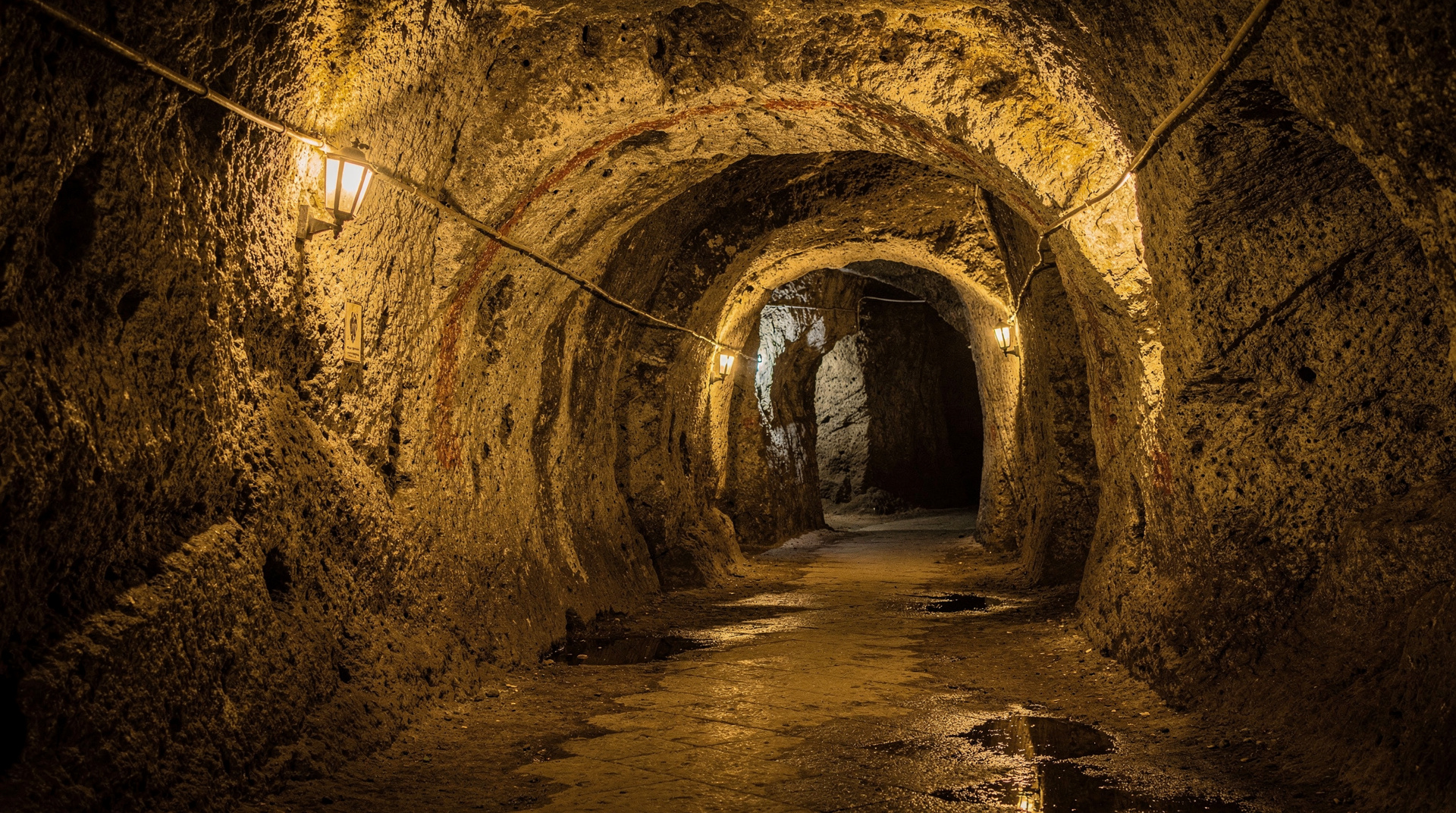
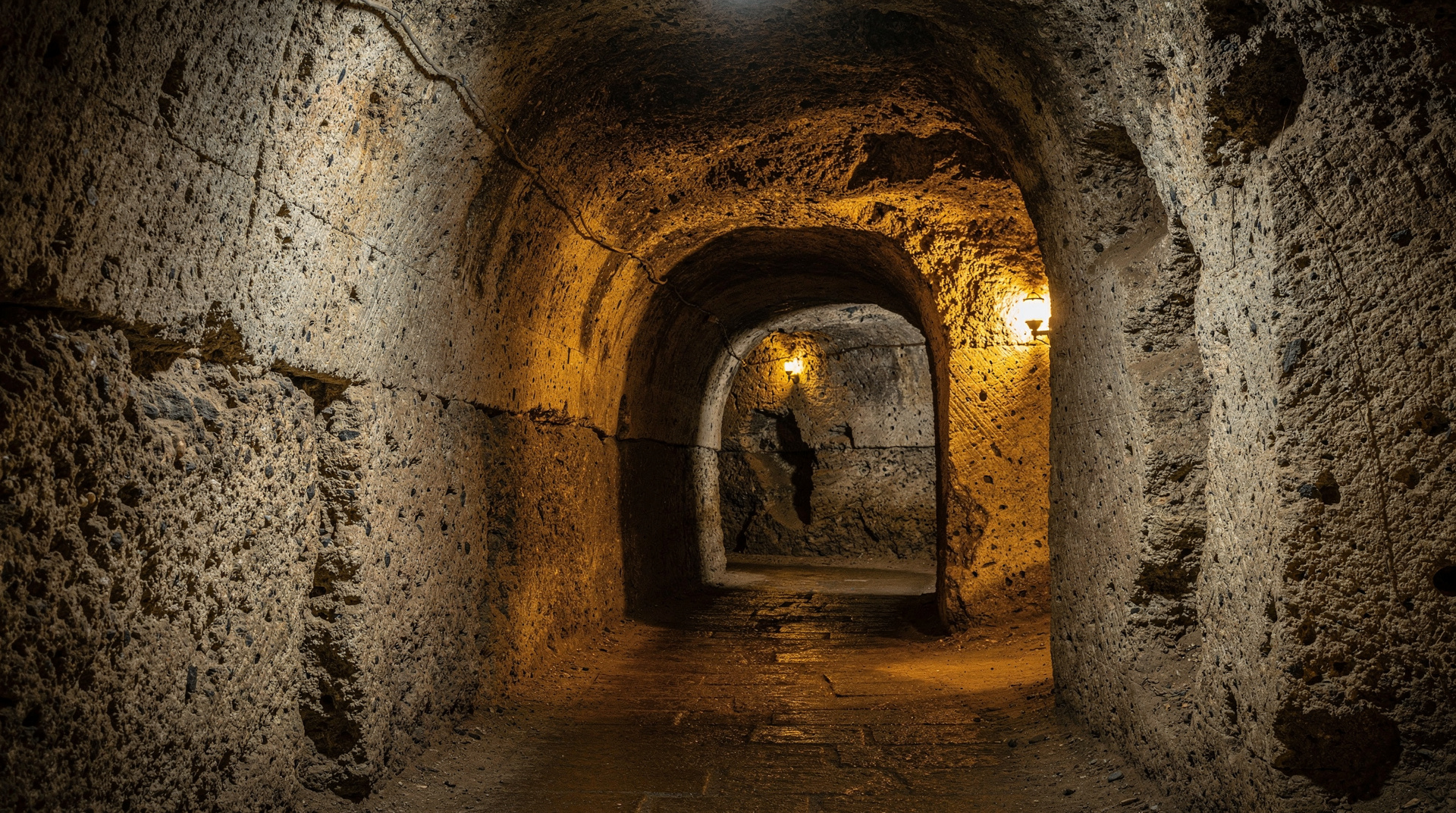
The carriageway itself. The road is wide — designed for two carriages to pass — and its dimensions immediately communicate the scale of the original project. The masonry lining is still intact in most sections. The road surface is paved, though covered in water and debris in some sections.
The vehicle collection. Several automobiles remain in varying states of deterioration: a 1927 Lancia Lambda, a FIAT 1100 Berlina from the late 1930s, a FIAT Topolino (the small economy car common in pre-war Italy), and various vehicles that have not been fully identified due to deterioration. Military vehicles from the WWII period include a motorcycle frame and components from a light utility vehicle. The vehicles are not restored or stabilised — they are deteriorating slowly in situ, which gives them an archaeological quality absent from museum displays.
The wartime hospital section. The deepest accessible chamber contains the remains of the medical facility: operating tables, lighting equipment, oxygen tanks, supply boxes, and basic ward furniture. The objects were simply left when the shelter closed. The guide contextualises what was used here and who was treated — the shelter served both civilian casualties and wounded military personnel from 1942 onward.
Sculpture fragments from bombed buildings. During the Allied raids, stone and bronze sculpture from bombed churches, palaces, and public buildings was moved underground for safekeeping. Some of this material was never returned after the war — either because the buildings were completely destroyed, ownership was disputed, or the retrieval was simply never organised. Fragments of architectural elements and sculpture pieces remain stacked against the tunnel walls.
The spring and water system. The lower sections of the gallery pass through areas where the original Bourbon drainage system managed groundwater — the water table in this part of Naples is relatively high, and managing seepage was a constant challenge during construction. Some sections have standing water, which is the reason the adventure tour includes rafting.
Tour formats in detail
Standard Route (Via Morelli entrance): The most visited option. 75 minutes, walking on dry surfaces throughout, standard lighting. €10 adults. Departures throughout the day — check the schedule on the official website as times vary by season.
Adventure Route: Combines the standard route with sections that require wading through waist-deep water, crawling through low passages, and a short raft section. Requires appropriate clothing and footwear provided by the site. €15. Not suitable for mobility restrictions, pregnancy, or young children. Maximum group size is smaller than the standard tour.
Torch Route: Standard routing conducted with period oil lamps instead of electric lighting. Evenings only. €10. Creates an atmospheric experience comparable to the Napoli Sotterranea lamp passage but in a wider space.
Getting there and practical details
Address: Via Morelli 61, 80121 Naples. Secondary entrance at Vico del Grottone 4.
Getting there: From the Royal Palace, walk south along Via Cesario Console for about 8 minutes. From Piazza del Plebiscito: 10 minutes southeast on foot. Metro Line 1, Municipio station: 15-minute walk. Bus C25 runs along Via Morelli.
Opening hours: Generally daily, but tours depart on a fixed schedule. The website (galleriaborbonica.com) lists current departure times — typically starting at 10:00 and running through 18:00 or later.
Temperature: Around 17°C in the main tunnel — warmer than the deep cisterns of Napoli Sotterranea because the gallery is less deeply buried. Still significantly cooler than the street in summer.
Photography: Permitted throughout. The vehicles and hospital section are well-lit for the standard tour. A phone with a decent camera will capture the main elements.
Accessibility: The standard route involves flat, paved surfaces for most of its length, but there are a handful of steps and uneven sections near the entrances; the site is not fully wheelchair accessible. The Adventure Route is unsuitable for anyone with mobility limitations, given the wading, crawling, and raft passage. Visitors with limited mobility should call ahead to confirm the current standard-route layout, as sections are occasionally rerouted for maintenance.
What to wear: Comfortable closed shoes with grip are recommended even on the standard route, since the tunnel floor can be damp in places. A light layer helps, since 17°C feels noticeably cooler than a Naples summer afternoon. The Adventure Route requires clothes that can get wet — the operator provides some protective gear, but you’ll still finish damp.
Who runs the site and how the vehicles survive
The Galleria Borbonica is managed by a private cultural association rather than the city’s main heritage bodies, which is why its opening hours and tour formats can shift more often than a state museum’s — always check the official site before travelling across town for a specific slot.
The vehicles and hospital equipment are deliberately left unrestored: there is no climate control beyond the tunnel’s natural stable temperature, and the association’s approach favours authenticity over conservation polish. This is part of the appeal for visitors who have already done the more curated Museo di Capodimonte or the National Archaeological Museum (MANN) and want something that feels genuinely undisturbed since the 1940s.
Comparing the three Naples underground experiences
Naples has three distinct underground attractions, and confusing them is the most common planning mistake. Napoli Sotterranea covers Greek-Roman aqueduct cisterns beneath the centro storico, reached via a narrow staircase and including a WWII shelter section of its own. The Galleria Borbonica covers 19th-century royal infrastructure and its WWII repurposing, in a much wider carriage-scale tunnel under Chiaia.
Bourbon Naples’ catacomb network in Rione Sanità is a third, separate strand covering early Christian burial. The underground Naples compared guide breaks down which one suits claustrophobic visitors, families, and history specialists, while the general Naples underground overview is the starting point if you are deciding how many of the three to fit into your trip.
How the Galleria fits into a Naples itinerary
The Galleria Borbonica is in Chiaia — the affluent neighbourhood south of the centro storico. This makes it a natural addition to:
- A day exploring the Royal Palace, Castel dell’Ovo, and the Lungomare Mergellina
- An afternoon in Chiaia followed by an evening walk along the seafront
- A history-focused itinerary combining the Galleria with the National Archaeological Museum (MANN) and/or the Cappella Sansevero
It sits at some distance from the centro storico underground sites (Napoli Sotterranea) and the Rione Sanità catacombs — combining it with either of those on the same day involves significant transit.
Frequently asked questions about the Galleria Borbonica
Is the Galleria Borbonica suitable for families with young children?
The standard route is manageable for children aged 7 and above. The wide tunnel, the cars, and the wartime objects tend to interest children. The adventure route is not appropriate for young children. Young toddlers are not safe on the uneven surfaces.
How is it different from Napoli Sotterranea?
Napoli Sotterranea covers Greek and Roman cisterns — ancient infrastructure for water supply. The Galleria Borbonica covers Bourbon-era royal construction and WWII civilian history. The two sites are in different neighbourhoods, from different historical periods, and have a completely different atmosphere. Serious underground enthusiasts visit both.
Are English tours available?
Yes. English is available on the standard route; check the schedule on the official website as English departures are at specific times rather than on request.
Can I visit without booking?
Walk-ins are possible if a tour slot has space. Weekday mornings in spring and autumn are the least likely to have capacity issues. Weekend slots in summer fill quickly.
Is the adventure route worth the extra cost?
Depends on interest level. The flooded sections and raft passage add genuine adventure for visitors who enjoy that kind of experience. For most visitors content with the standard archaeological experience, the standard route is sufficient. The adventure route does not reveal historically significant additional material — it is primarily an activity experience.
Frequently asked questions about Galleria Borbonica: Naples' royal escape tunnel
Why was the Galleria Borbonica built?
What tour formats are available?
What are the abandoned cars inside?
Is the Galleria Borbonica suitable for people with claustrophobia?
Where is the Galleria Borbonica entrance?
Is advance booking required?
How does it compare to Napoli Sotterranea?
Top experiences
Bookable activities with verified prices and instant confirmation on GetYourGuide.