Underground Naples compared: which site should you visit?
Naples: Naples Underground Entry Ticket and Guided Tour
Duration: 1.5-2h
Which Naples underground site is best for first-time visitors?
Napoli Sotterranea is the best starting point: it covers the most historical layers (Greek, Roman, WWII), runs tours every 30 minutes, and is centrally located on the Spaccanapoli tourist axis. Second choice is the Catacombs of San Gennaro for early Christian art. The Galleria Borbonica and Fontanelle cemetery are complementary add-ons for visitors spending 2+ days.
Naples has more underground sites open to the public than almost any other European city. The choice, as a result, is genuinely complicated: five substantively different experiences, spread across different neighbourhoods, covering different historical periods, operating on different logistical models. This guide cuts through the comparison so you can decide what to actually visit given your time, interests, and physical comfort level.
| Sites covered | Napoli Sotterranea, Galleria Borbonica, San Gennaro, San Gaudioso, Fontanelle |
| Best single choice | Napoli Sotterranea |
| All-sites cost | Around €37 total |
| Time needed | 90 min for one site; a full day for two neighbourhoods |
| Booking | Advisable for weekends in July–August |
Quick comparison: the five main sites
| Site | Location | Duration | Cost | Claustrophobia risk | Best for |
|---|---|---|---|---|---|
| Napoli Sotterranea | Centro storico | 80 min | €12 | High (narrow lamp passage) | Greek/Roman/WWII history |
| Galleria Borbonica | Chiaia | 75 min | €10 | Low (wide carriage road) | 19th-century and WWII history |
| Catacombs San Gennaro | Rione Sanità | 60 min | €9 | None (large chambers) | Early Christian art and history |
| Catacombs San Gaudioso | Rione Sanità | 45 min | €9 | None | 17th-century skull portraits |
| Fontanelle ossuary | Rione Sanità | 45–90 min | Free | None | Unique folk tradition |
Napoli Sotterranea: the most complete single visit
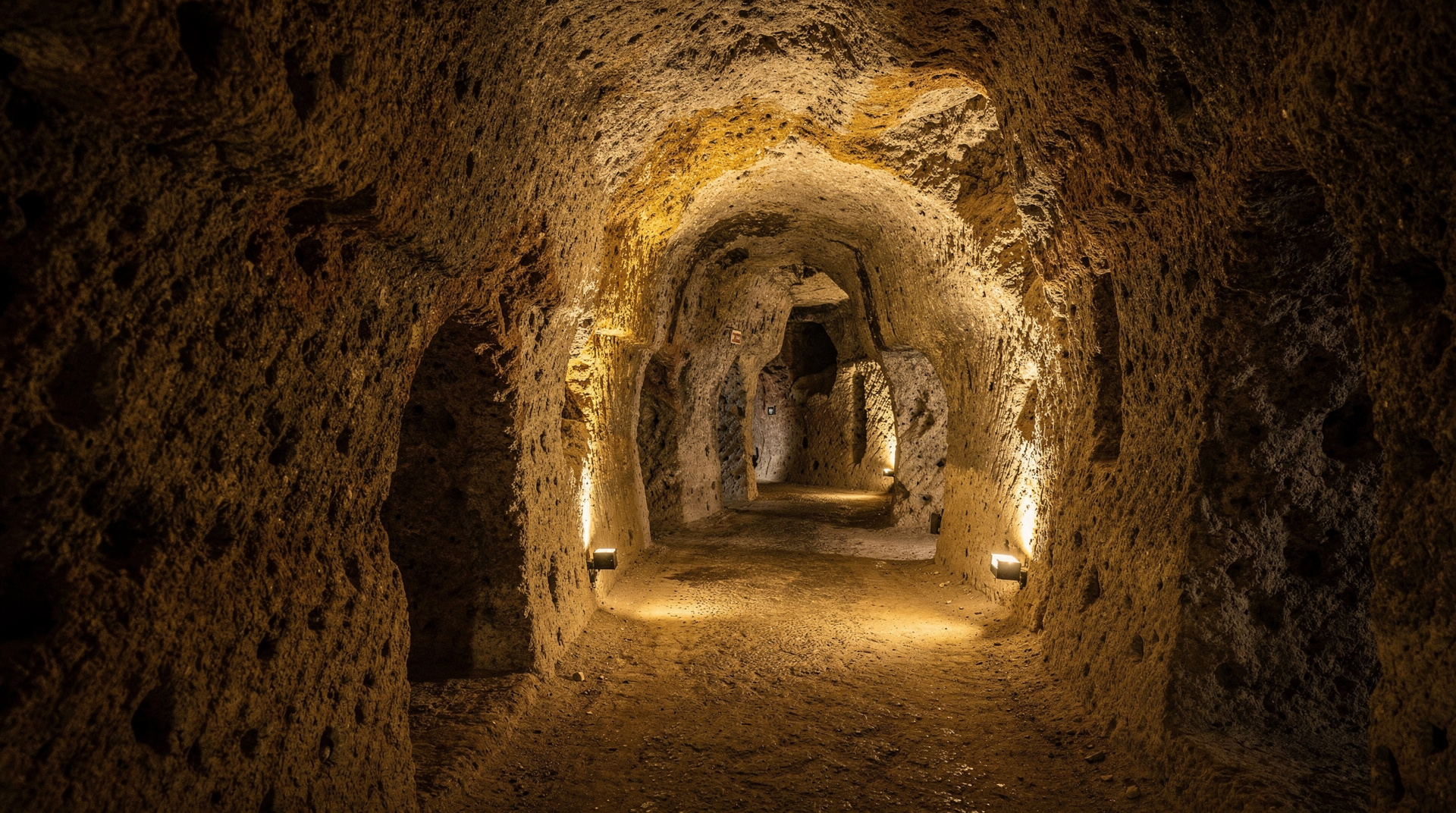
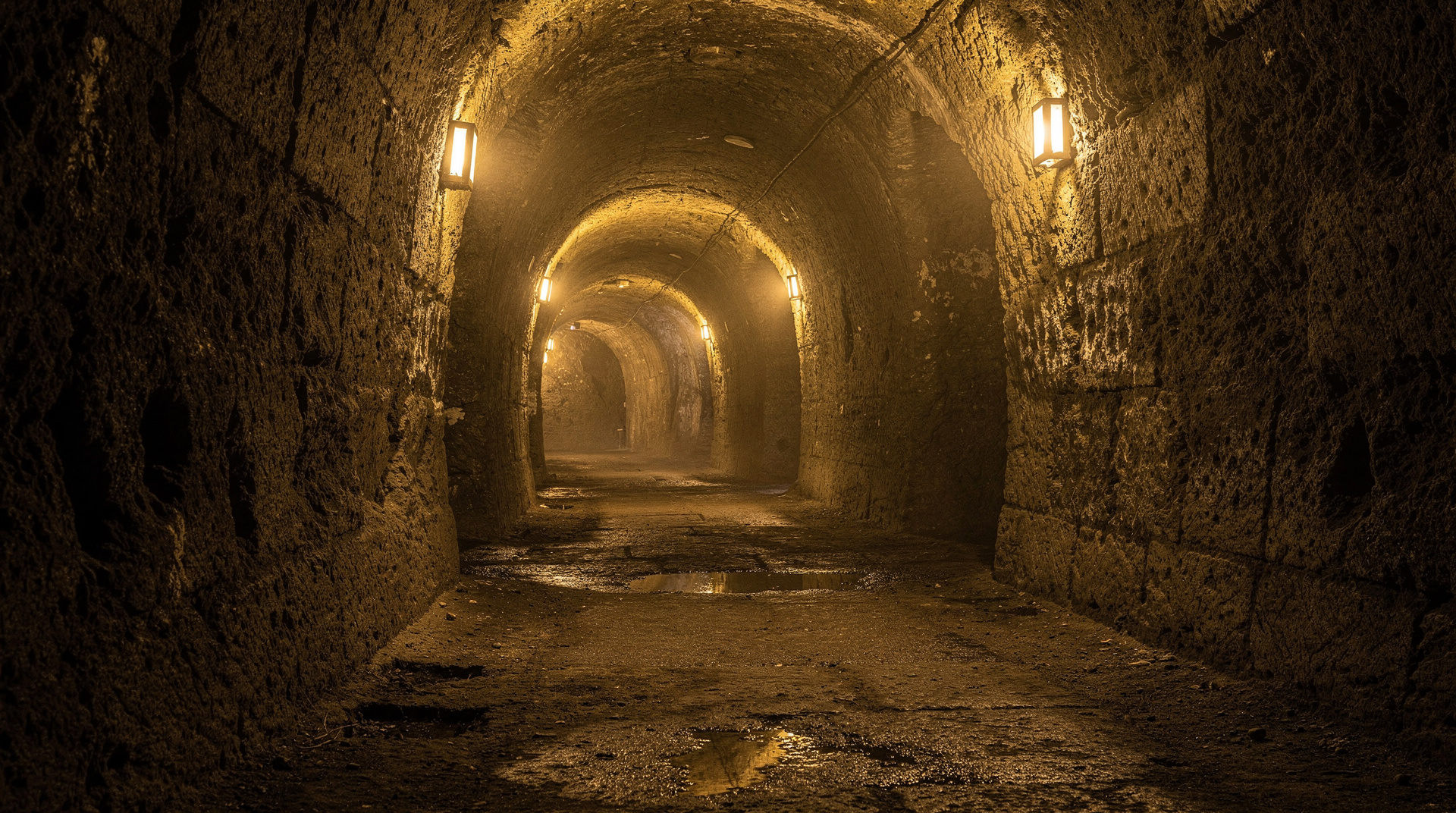
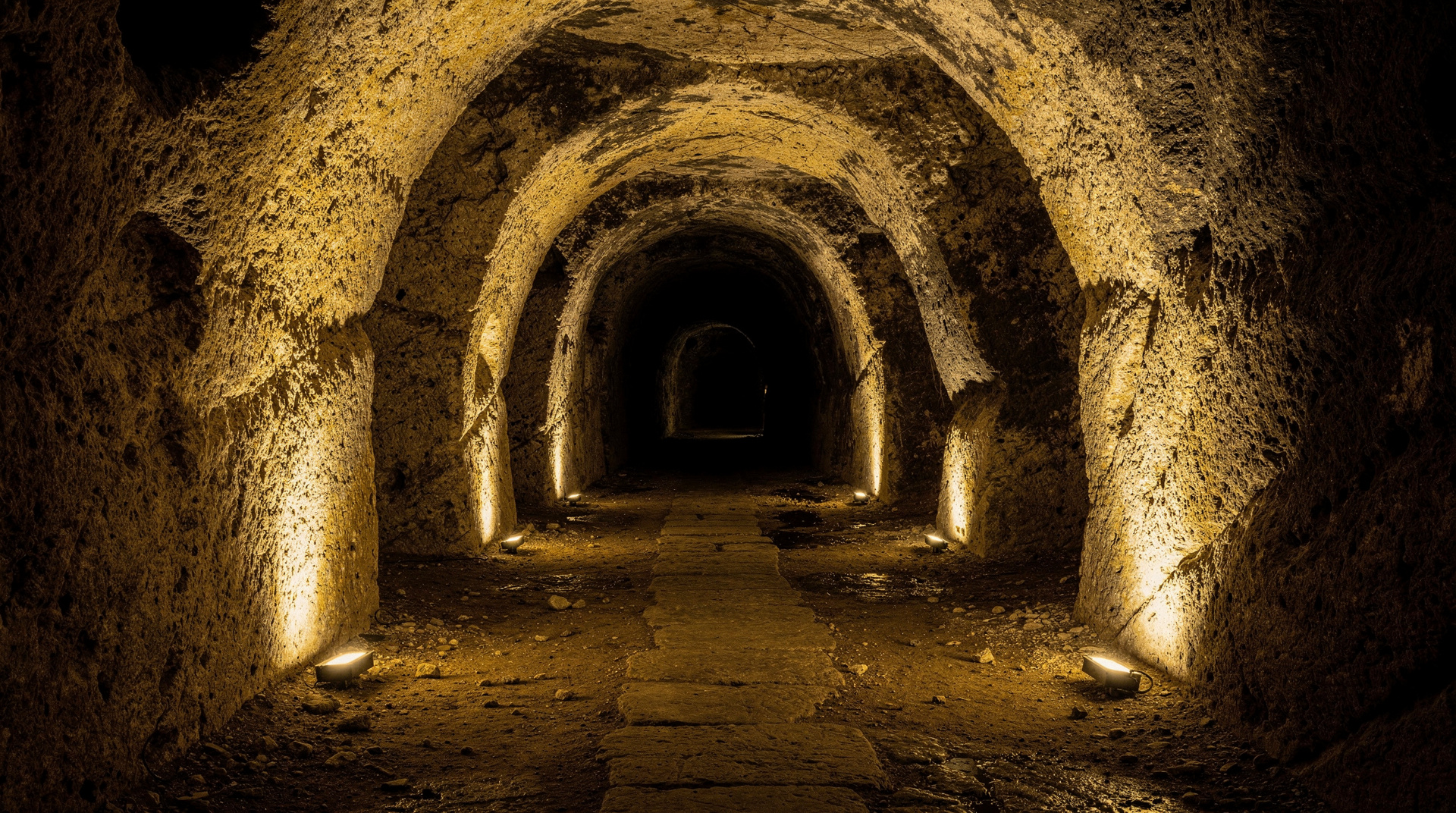
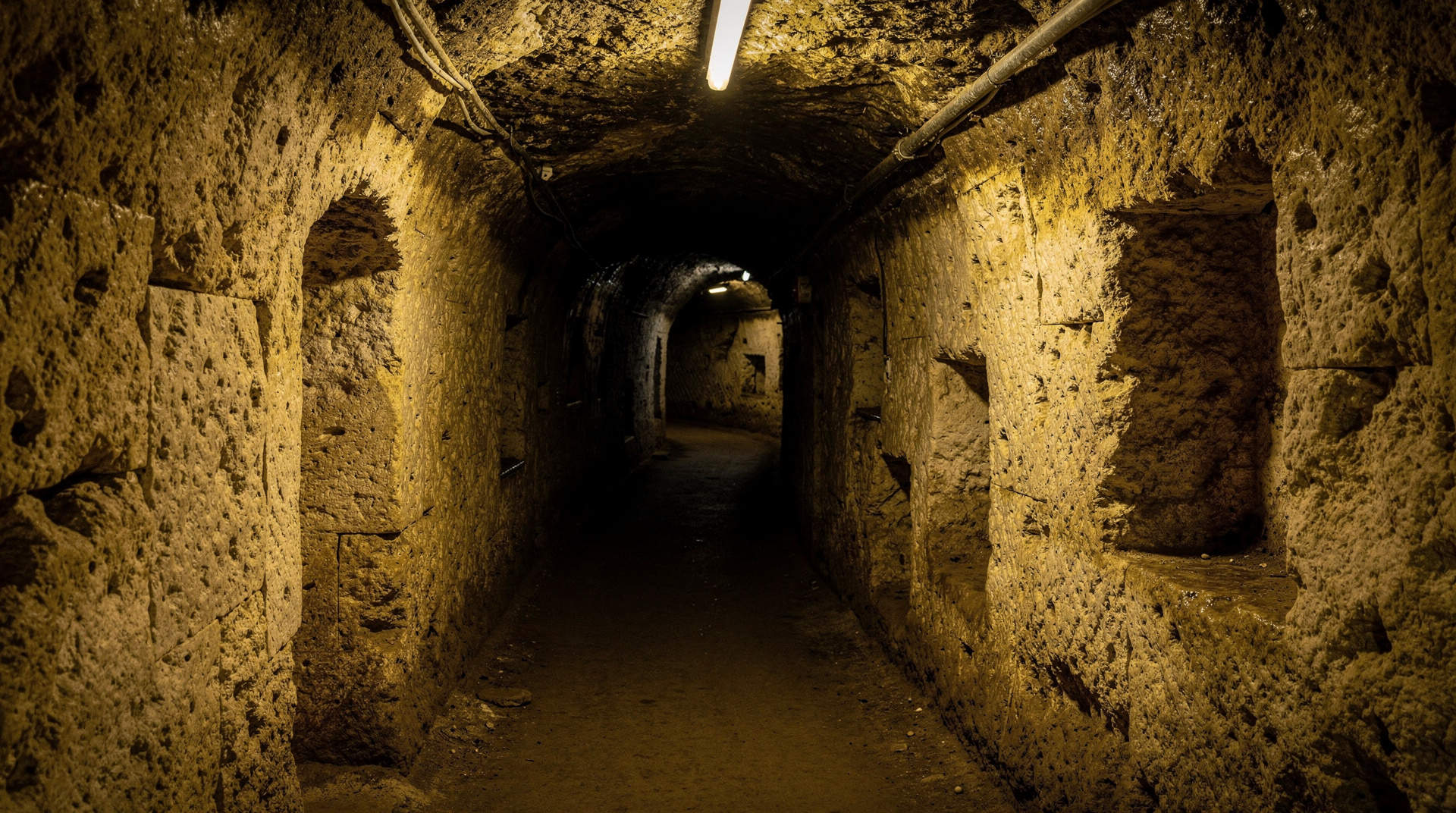
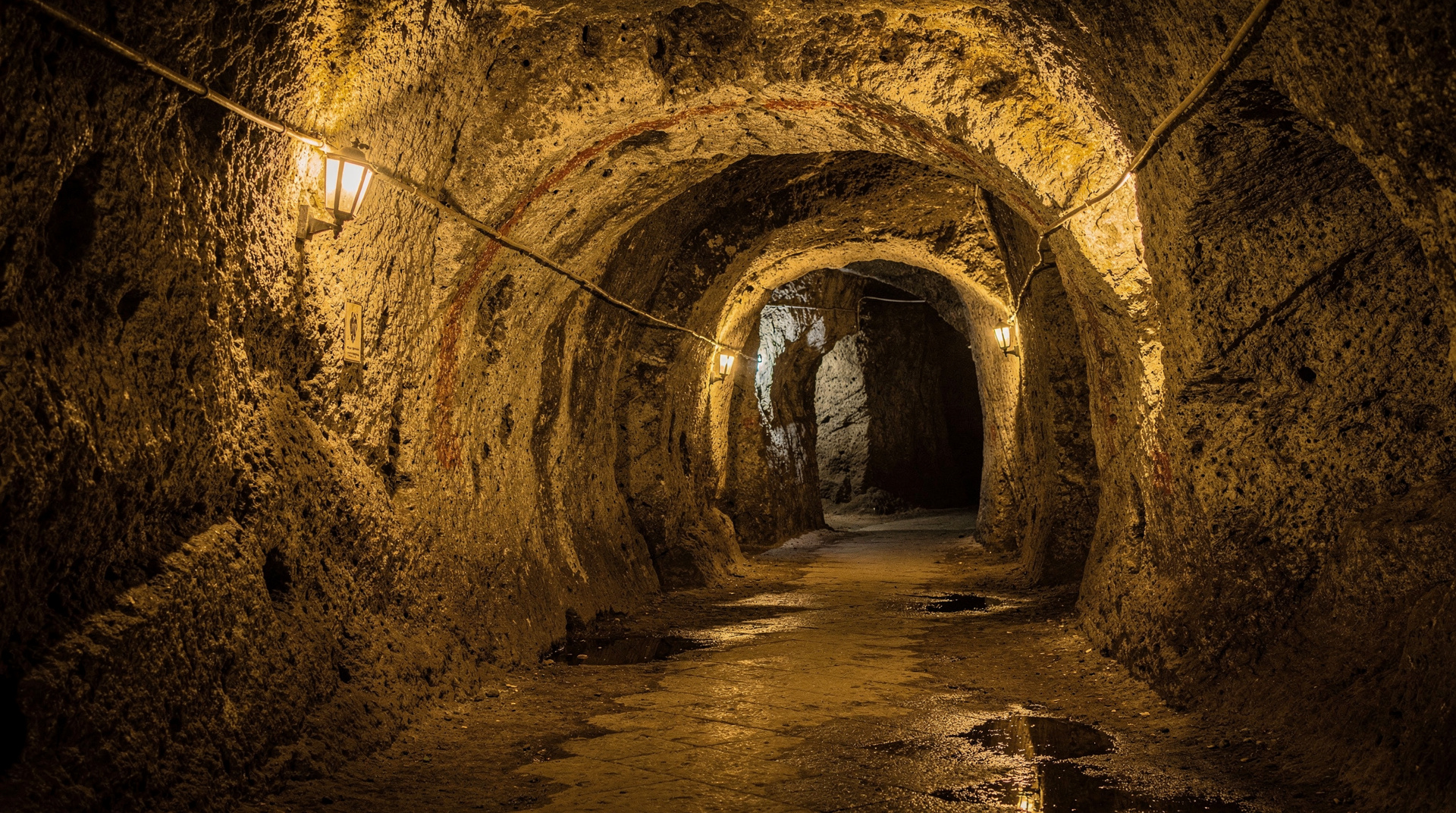
If you visit only one underground site in Naples, Napoli Sotterranea covers the most ground — both literally and historically. The tour takes you through Greek cisterns from the 4th century BC, Roman expansion of the same network, and a WWII air-raid shelter still containing personal objects of people who lived here during Allied bombing campaigns.
What makes it distinctive: The layered chronology. You are walking through infrastructure that was Greek, then Roman, then abandoned, then repurposed, then abandoned again, then bombed over. Each layer is physically present. The WWII section has the most immediate emotional impact for most visitors — the scale of the Greek and Roman engineering is intellectually impressive but hard to personalise; the shoes and handwritten calendars of shelter inhabitants from the 1940s are legible at a human scale.
The honest drawback: The lamp passage. A 50-metre section with passages 45 cm wide, navigated by oil lamp light. Some visitors find this the highlight; visitors with significant claustrophobia will find it genuinely distressing. The guide will show you the width before you enter and will not pressure you if you want to bypass this section.
Best for: First-time visitors, anyone interested in Roman engineering or WWII history, older children, visitors who want a complete underground narrative in a single visit.
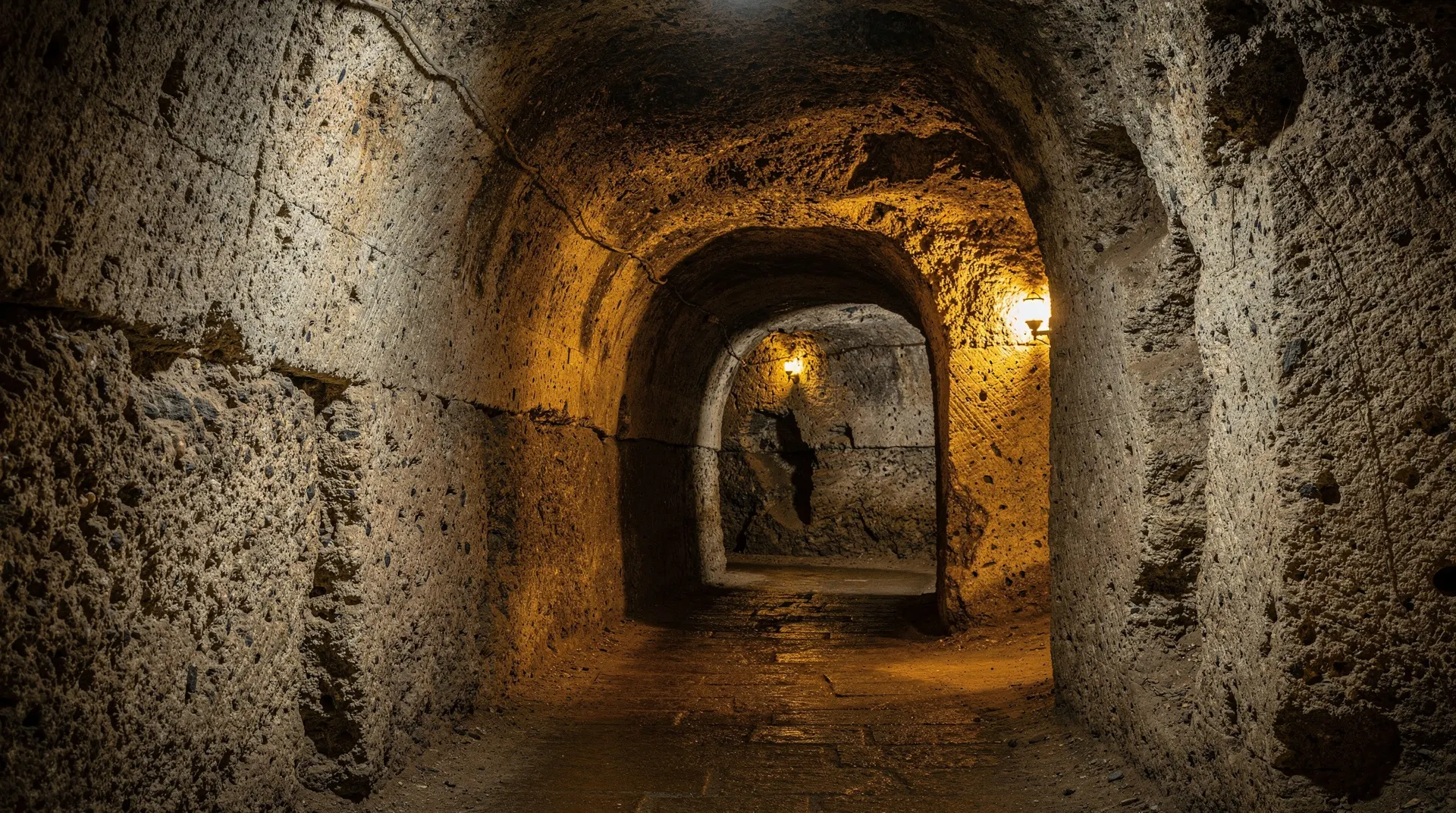
Napoli Sotterranea: official guided tour under SpaccanapoliGalleria Borbonica: the strangest collection
The Galleria Borbonica is the outlier in the Naples underground landscape — it has nothing ancient in it. The tunnel is from 1853–1861. The cars rusting inside are from the 1920s–1940s. The hospital equipment is from WWII. The abandonment is from 1945.
What makes it distinctive: The vehicles. A 1927 Lancia, a FIAT Topolino, a military motorcycle — deteriorating in situ in a dark tunnel, as they have been for 80 years. No museum exhibit replicates this. The wartime medical facility section (operating tables, oxygen tanks, abandoned supply boxes) has the same quality: not staged, not restored, just left.
The honest drawback: Less historical depth than the other sites. If you are primarily interested in ancient Naples, the Galleria provides almost none. Its historical richness peaks at 1853 and ends at 1945 — a narrow band compared to the 2,500-year span at Napoli Sotterranea.
Best for: Visitors interested in 19th-century Bourbon history, WWII urban history, or industrial archaeology. The adventure tour format (wading through flooded sections) suits active visitors who want a physical experience. Also suited to visitors with claustrophobia — the main tunnel is wide enough for a carriage.
Location note: The Galleria is in Chiaia, away from the other underground sites. It pairs naturally with the Royal Palace and the Lungomare rather than with the Rione Sanità sites.
Catacombs of San Gennaro: for early Christian art
The Catacombs of San Gennaro are the most archaeologically and artistically significant of the underground sites — but their appeal is more specialist. The frescoes require some knowledge of early Christian iconography to fully appreciate. The 2nd-century loculi and the 5th-century bishops’ portraits are significant historically, but visiting without context produces a dimly lit experience of undifferentiated old paint.
What makes it distinctive: Age and continuity. These chambers have been in continuous use — first as active burials, then as a pilgrimage site, then as a tourist monument — since the 2nd century AD. The earliest known portrait of San Gennaro is here. The social history of the La Paranza cooperative that manages it adds another layer: this is community-owned cultural tourism in one of Naples’ most complex neighbourhoods.
The honest drawback: The visit requires active engagement. Visitors who want spectacular visual impact — like the cars of the Galleria or the narrow tunnels of Napoli Sotterranea — may find the catacombs underwhelming. The frescoes are fragmentary and dimly lit. A good guide makes a substantial difference to the experience.
Best for: Visitors with genuine interest in early Christian history, Roman-period social life, or the development of Christian art. Pairing with San Gaudioso on the same day (combined ticket €15) gives a complete picture of the Rione Sanità underground in a single half-day.
Catacombs of San Gennaro: guided visitCatacombs of San Gaudioso: worth adding to San Gennaro
San Gaudioso is smaller, shorter (45 minutes), and has a narrower historical focus than San Gennaro. Its 17th-century skull-and-portrait installations — where a painted portrait of the deceased sits above a niche containing their actual skull — are unlike anything in the San Gennaro complex or anywhere else in Naples.
What makes it distinctive: The Counter-Reformation burial practice. Noble families having their skulls displayed below their portraits is simultaneously a theological statement, an artistic commission, and a very direct confrontation with mortality. The iconography is explicit in a way that more conventional religious art avoids.
The honest drawback: It doesn’t stand on its own as a primary destination — the historical narrative is thinner and the visit shorter. It is best experienced as an extension of a San Gennaro visit rather than independently.
Best for: Anyone visiting San Gennaro (the combined €15 ticket makes visiting both the obvious choice). Also suits visitors specifically interested in Baroque religious culture or the history of death practices.
Fontanelle cemetery: uniquely confrontational
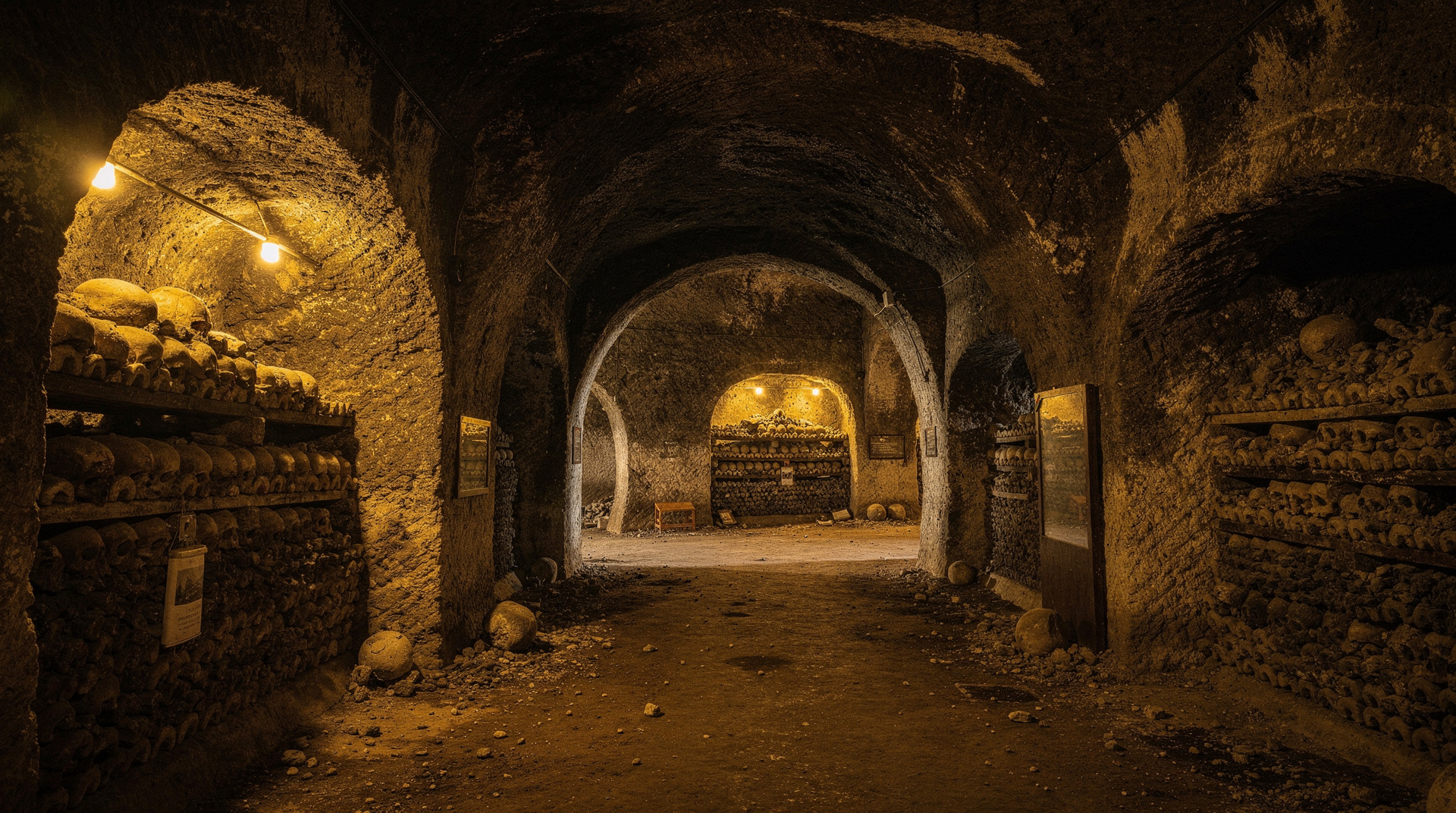
The Fontanelle cemetery defies comparison with the other sites. It is not a tour in any formal sense. It is a tuff cavern containing 40,000 skulls and bones, open and viewable, with no theatrical mediation. Entry is free.
What makes it distinctive: The scale, the directness, and the folk tradition associated with it. The anime pezzentelle practice — in which local residents adopted anonymous skulls, maintained small altars, and petitioned the dead for intercession — is historically documented, specifically Neapolitan, and completely unlike anything in mainstream Catholic practice. The physical traces of this tradition (altar platforms, the glass-cased Capitano skull) remain visible.
The honest drawback: It can be a difficult experience. 40,000 skulls are not comfortable regardless of how one intellectualises them. Some visitors find the directness powerful; others find it overwhelming or distressing. Children under 8 should probably not visit; even older children require parental judgment.
Best for: Visitors interested in the social and cultural history of death, folk religion, or the specific culture of Naples. Free entry makes it low-risk to visit briefly and assess in situ. Pairs naturally with San Gennaro and San Gaudioso as part of a Rione Sanità half-day.
Recommended itineraries for the underground
One day, primary interest in ancient history: Morning: Napoli Sotterranea (10:00 tour, in the centro storico). Afternoon: walk to Rione Sanità for Catacombs of San Gennaro (14:00 tour) and Fontanelle cemetery.
One day, broader Naples context: Morning: Napoli Sotterranea. Afternoon: Galleria Borbonica (different neighbourhood — involves transit via metro or taxi from centro storico to Chiaia).
Half-day dedicated to Rione Sanità: 10:00 Catacombs of San Gennaro. 12:00 Catacombs of San Gaudioso. 13:30 Fontanelle cemetery. Neighbourhood lunch in the Sanità at the midpoint.
For visitors with limited time: One site only: Napoli Sotterranea. It is in the most central location, has the most frequent tours, and covers the broadest historical sweep.
The question visitors always ask: which is “better”?
The honest answer is that they serve different interests and are not really comparable. Napoli Sotterranea is the best introduction to underground Naples as a phenomenon. The Catacombs of San Gennaro are the most historically significant in terms of art history. The Galleria Borbonica is the most unusual. Fontanelle is the most viscerally direct.
If someone with limited time in Naples asked for one recommendation, Napoli Sotterranea would be the answer — because it synthesises the most layers, is easiest to reach, and has the most varied content. But the recommendation changes if the visitor says: “I am specifically interested in early Christian art” (San Gennaro), “I want something unusual that isn’t about ancient Rome” (Galleria Borbonica), or “I want to understand Neapolitan culture specifically” (Fontanelle and the anime pezzentelle tradition).
Naples: top sights and underground combined guided tourFrequently asked questions about underground Naples
Should I book all underground tours in advance?
Napoli Sotterranea: not usually necessary for weekdays, advisable for July–August weekends. Galleria Borbonica: recommended as it runs on a fixed schedule. San Gennaro: recommended for weekends. San Gaudioso: same as San Gennaro. Fontanelle: no booking needed (free, walk-in).
Are the underground sites accessible for people with reduced mobility?
None of the main sites are wheelchair accessible. All involve staircase descent and uneven surfaces. Some have more significant accessibility barriers than others (Napoli Sotterranea requires about 45 steps; San Gennaro around 30). Visitors with walking difficulties should check specific access requirements with each site.
Do I need to tip the guides?
Tipping is not expected or required in the Naples underground sites. The guides are employed staff, not independent operators. If you receive an exceptionally good tour — and the guides at La Paranza in particular are often excellent — a small tip is appreciated but genuinely optional.
Is there a discount for multiple underground sites?
Only the La Paranza combined ticket (San Gennaro + San Gaudioso, €15). No other multi-site discounts exist. The Campania Artecard does not include underground sites.
Which underground site is the scariest?
None is intentionally scary. Napoli Sotterranea has the darkest, most physically confined section (the lamp passage). Fontanelle is the most psychologically confrontational because of the direct mass of human remains. The Galleria Borbonica has the most unsettling air of abandonment. None involves jump-scares or theatrical horror.
Booking logistics worth knowing in advance
Each of the main underground sites operates its own independent booking system — there is no unified portal, which surprises some first-time visitors expecting a single ticketing platform for “Naples underground” as a category. Napoli Sotterranea sells tickets on its own website and at the entrance on Piazza San Gaetano; the La Paranza cooperative manages San Gennaro and San Gaudioso through its own site; Galleria Borbonica has a separate booking page tied to its fixed tour-time schedule. Building a multi-site day means checking three separate calendars rather than one, so allow extra planning time if you intend to combine sites, and confirm start times leave a comfortable gap for travel between neighbourhoods.
Combining underground sites with the rest of Naples
Underground Naples pairs naturally with sights above ground in the same neighbourhoods, which helps avoid backtracking across the city. A centro storico morning at Napoli Sotterranea sits a short walk from Spaccanapoli and the Cappella Sansevero, making a natural half-day loop.
The Rione Sanità sites (San Gennaro, San Gaudioso, Fontanelle) are close to the Catacombs neighbourhood’s own street life — a part of Naples still relatively undiscovered by mainstream tourism, worth the extra time even outside the underground visit itself. The Galleria Borbonica in Chiaia pairs well with an afternoon at the Royal Palace or a Lungomare walk, since both sit within the same compact area.
Photography and lighting conditions underground
Each site handles photography differently, which is worth knowing if documenting the visit matters to you. Napoli Sotterranea permits photography throughout except in a couple of narrow sections where staff ask visitors to keep moving for flow reasons; a phone camera with night mode handles the low light adequately, though a proper camera with a fast lens gets noticeably better results in the Roman cistern chambers. The catacombs restrict flash photography in some fresco areas to protect the pigments, so a steady hand or a small tripod helps in the dimmer sections. Fontanelle, being an open cavern with ambient lighting, is the easiest site to photograph well without specialist equipment.
What to skip if you’re short on time
If you only have one day in Naples and underground sites are not your top priority, resist the temptation to squeeze in “just one quick catacombs visit.” The Rione Sanità sites require a dedicated trip out from the centro storico, and rushing them undercuts their value — the catacombs in particular reward unhurried attention to the frescoes. If time is genuinely tight, Napoli Sotterranea is the only underground site worth prioritising over above-ground essentials like the MANN or top attractions, because it sits directly on the main sightseeing axis and requires no detour.
Frequently asked questions about Underground Naples compared: which site should you visit?
Is there one ticket that covers all underground Naples sites?
How many underground sites can I visit in one day?
Which site is most claustrophobic?
Which site is best for children?
Which is the most visited underground site in Naples?
What time of year is best for underground Naples visits?
How much does it cost to visit all the underground sites in Naples?
Top experiences
Bookable activities with verified prices and instant confirmation on GetYourGuide.