Fontanelle cemetery: Naples' bone cavern and the cult of the abandoned souls
Naples: Sanità Tour Among Ancient Catacombs and Folklore
What is the Fontanelle cemetery in Naples?
The Fontanelle cemetery is a large tuff cavern in the Rione Sanità neighbourhood containing the remains of approximately 40,000 people — plague victims, flood casualties, and unclaimed bones from Naples' overcrowded post-medieval cemeteries. Entry is free. The site is associated with the anime pezzentelle cult, in which local residents adopted anonymous skulls. It is unlike any other attraction in Naples.
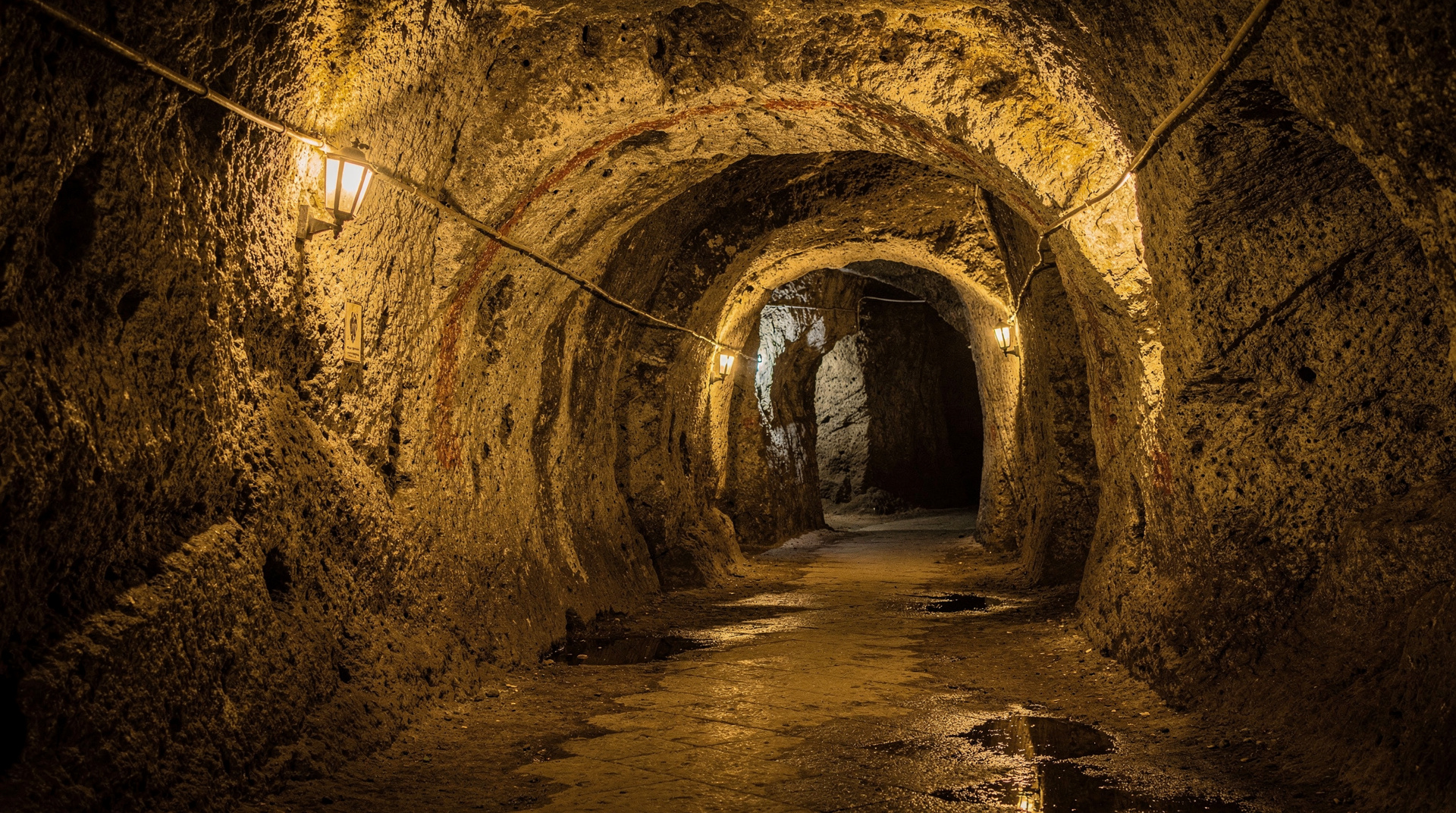
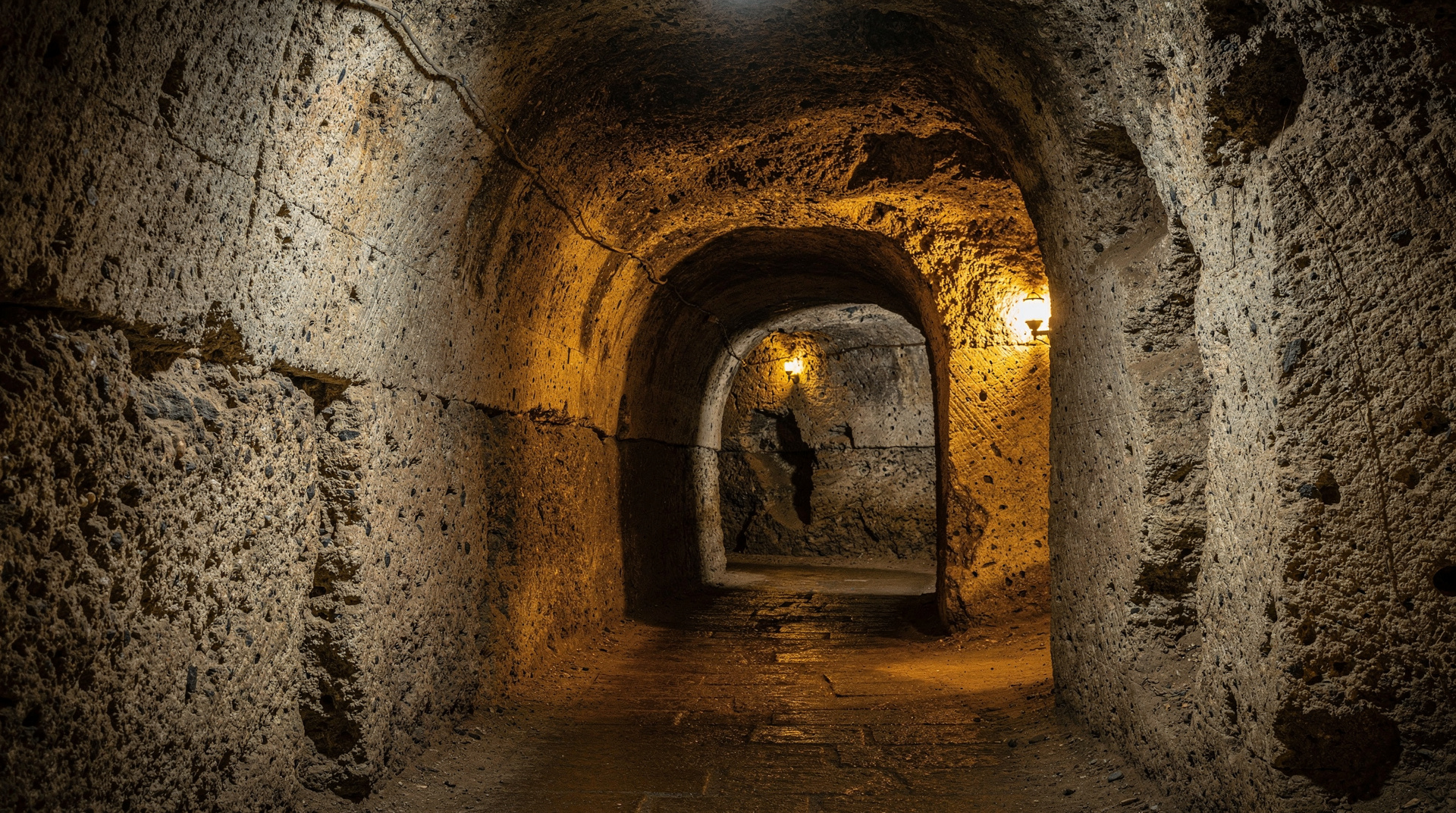
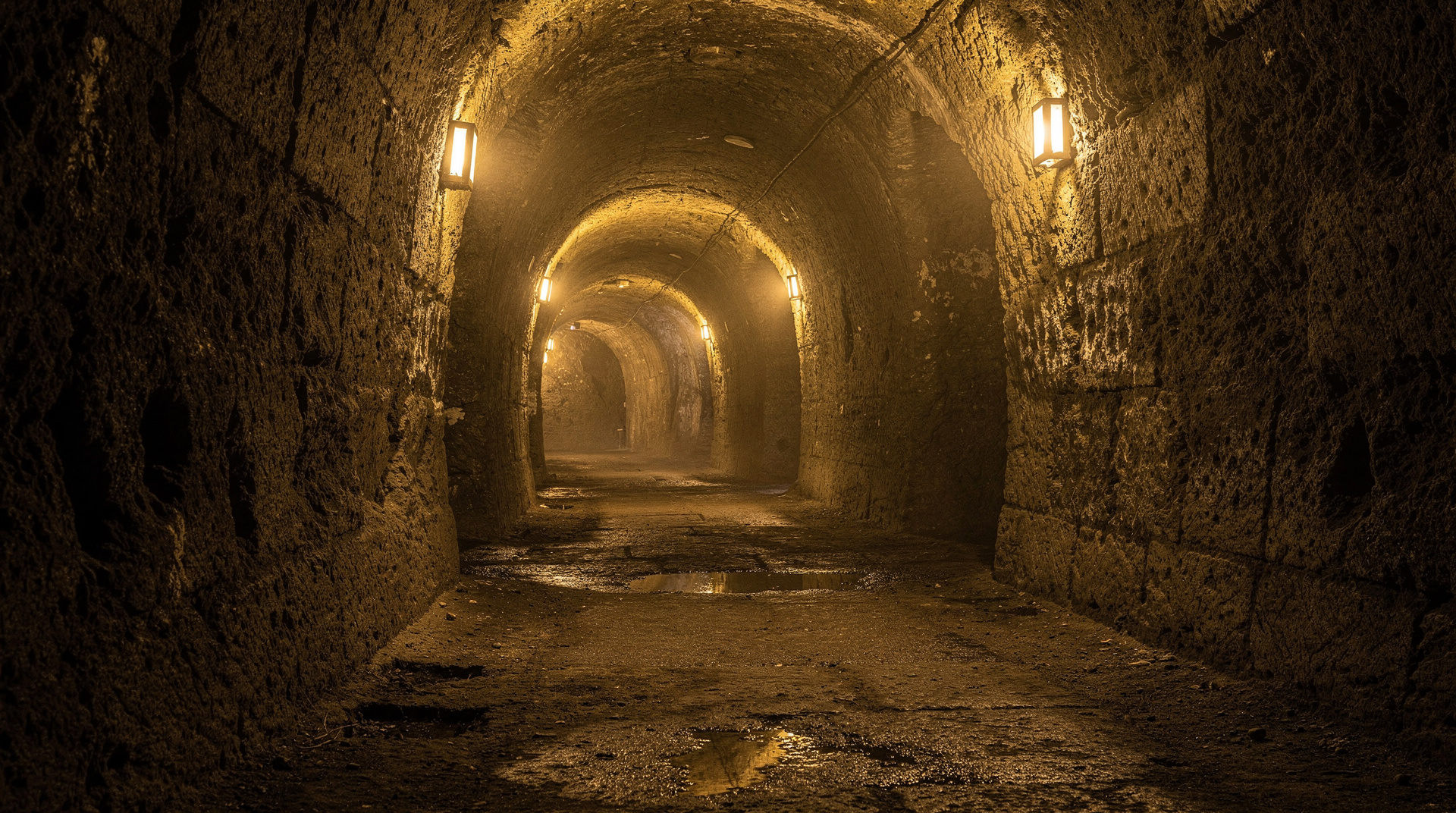
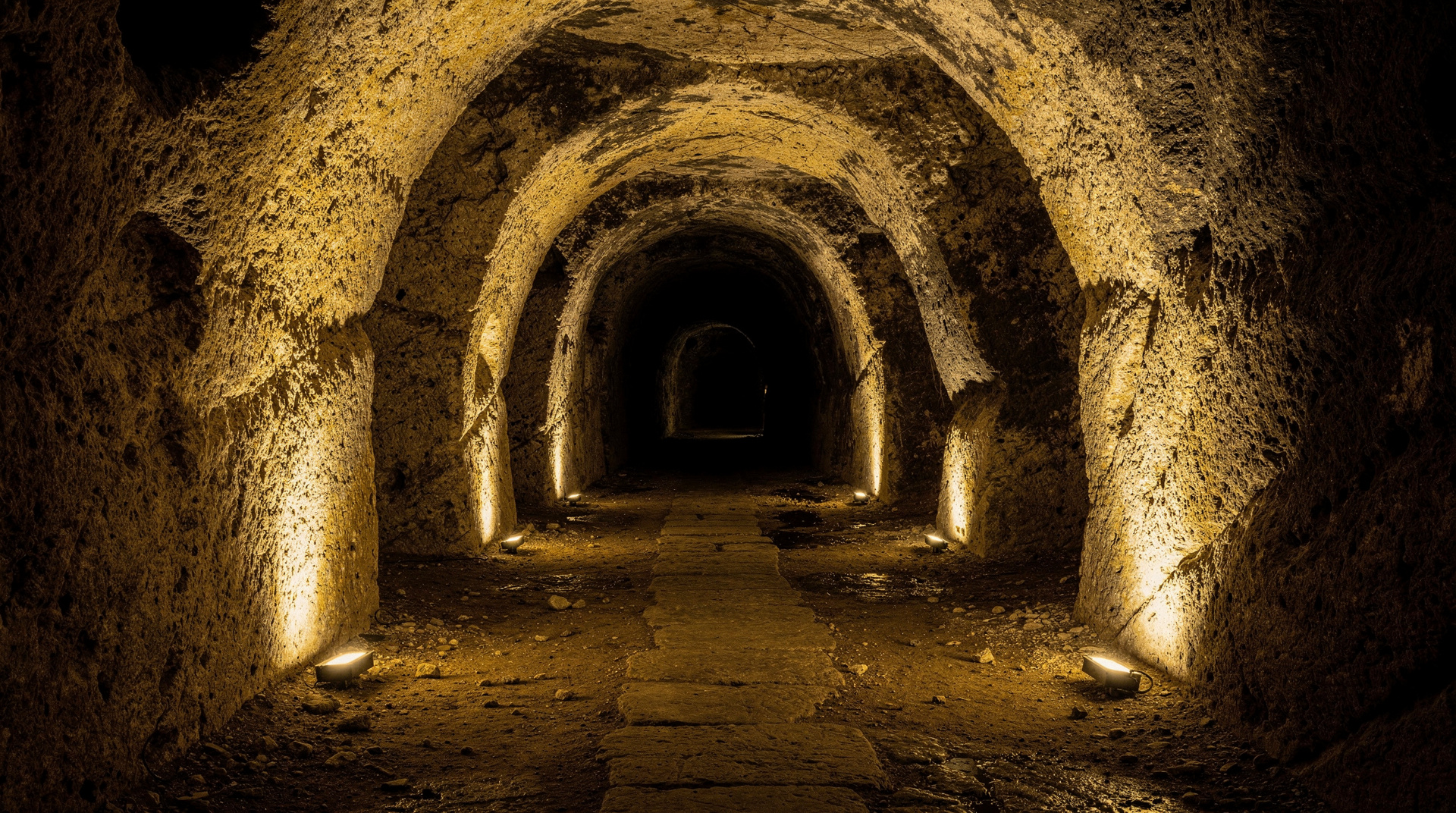
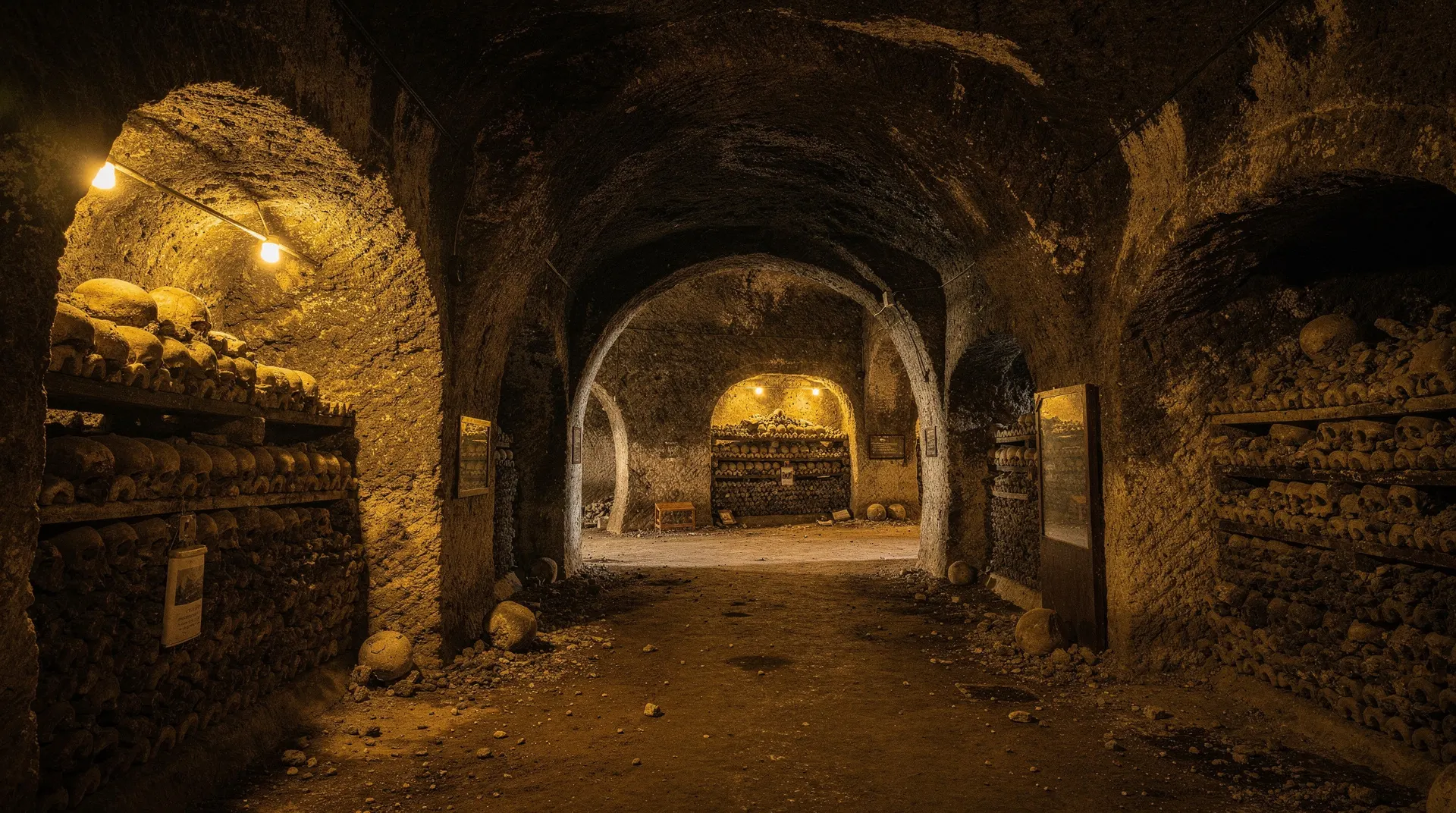
The Fontanelle cemetery occupies a natural tuff cavern in the upper edge of the Rione Sanità — a stretch of volcanic rock quarried since ancient times, the same tufa that fills the tunnels of Napoli Sotterranea two kilometres south. The cavern is large: roughly 3,000 square metres of accessible interior space, with a vaulted ceiling 8–10 metres high in the central section. It holds approximately 40,000 sets of human remains — skulls arranged in rows, long bones stacked against walls, the accumulated dead of multiple catastrophes deposited over three centuries.
Visiting is free. There are no actors, no theatrical lighting changes, no soundtrack. The bones are simply there, in quantity, in an ancient rock cavern that the city manages as a public monument. The experience is singular.
| Cost | Free (small fee for optional guided tour) |
| Time needed | 45 minutes to 1.5 hours |
| Getting there | Metro Line 1 to Materdei, then 15-minute walk |
| Best time | Weekday mornings, or early autumn/winter |
| Suitable for | Most visitors; use judgment with young or anxious children |
How 40,000 people ended up here
The accumulation of remains at Fontanelle spans roughly three centuries, beginning with the greatest demographic catastrophe in Naples’ recorded history.
The plague of 1656. In the spring of 1656, bubonic plague arrived in Naples — most probably from a ship from Sardinia. Within six months, it had killed between 100,000 and 150,000 people in a city of approximately 300,000. The death rate exceeded the capacity of every cemetery in the city. Bodies were buried in mass graves, thrown into abandoned cisterns, and deposited wherever space existed. The Fontanelle cavern, already in use as an unofficial disposal site for bones displaced from overcrowded churchyards, became a major receiving point for plague dead. The scale of 1656 explains the core of what you see: this was emergency management of an apocalyptic mortality event.
Flood displacement. Naples’ churchyard cemeteries, many of which were below street level in the low-lying parts of the city, were periodically flooded by heavy rainfall and the poor drainage of the urban basin. When floodwaters receded, displaced bones were collected and moved to Fontanelle — a higher, drier location. This process continued through the 17th, 18th, and into the 19th century.
Cholera. The cholera epidemics of 1836–37 and especially 1884 (which killed around 7,000 people in Naples) added more remains to the cavern. By the time the comune began formal management of the site in the late 19th century, it contained a multi-generational deposit that was effectively impossible to attribute individually.
The anime pezzentelle: adopting the dead
The response of the local population to this mass of anonymous dead produced one of the most unusual folk religious practices in European Catholicism.
Beginning in the 17th century and intensifying in the 18th and 19th centuries, residents of the Rione Sanità and surrounding neighbourhoods adopted individual skulls from the Fontanelle cavern — cleaning them, placing them on small altars, maintaining candles, and praying to the anonymous person whose skull they had adopted.
The adopted skull was called the capuzzella (little head), and the relationship between the living adopter and the dead soul was understood as reciprocal: the living provided prayers and memorial care; the soul in purgatory interceded for the living’s petitions. Dreams were the primary channel of communication — if the skull appeared in a dream and provided information or guidance, the relationship was confirmed. If no dream came, the skull might be abandoned and another chosen.
The practice was theologically irregular — the Catholic Church officially discourages prayer to uncanonised souls and prohibits what it terms “superstition.” The Church hierarchy in Naples periodically intervened against the anime pezzentelle tradition without success for nearly three centuries. In 1969, Cardinal Corrado Ursi finally ordered the Fontanelle closed to the cult entirely, removed the altars and candles that had accumulated around popular skulls, and sealed the entrance. The closure lasted until 1981, when the comune took over management and reopened it as a public monument.
A few practising adherents to the old tradition have returned to the cavern since reopening, maintaining small private devotions at particular locations. The Church no longer actively suppresses the practice, though it does not endorse it.
What you see inside
The main entrance on Via Fontanelle leads into the first hall — a wide, high-ceilinged space where the organisation of the remains is immediately apparent. The bones were arranged in the 19th century under the management of a local priest, Father Gaetano Barbati, who recruited teams of local women to sort, clean, and organise what had been a chaotic deposit. The skulls were separated from long bones, sorted into rows, and arranged as systematically as the sheer volume allowed.
The main halls. Three interconnected chambers of varying height form the core of the accessible area. The ceiling is natural tuff, unworked except where it was quarried. The walls are lined with bone stacks. The central chamber, the largest, has a stone aisle down the centre. The effect is not dramatic — there is no theatrical staging — but the sheer quantity is overwhelming: skulls in every direction, stacked to shoulder height in places, receding into the semi-lit distance.
The chapel. At the far end of the main chamber, a small chapel was constructed inside the cavern in the 18th century. It contains an altar, a crucifix, and stone benches. The chapel was the formal liturgical centre of the site during the period when the Church maintained an official relationship with it. It is still intact and still visibly maintained.
The skull altars. Several locations in the cavern retain small platforms and stone surfaces where adopted skulls were placed and their devotional objects arranged. The candles, photographs, and personal petitions that once accumulated here have been largely removed since 1969, but the physical infrastructure of the altars — stone shelves, carved niches — remains.
The Capitano skull. Among the many skulls, one has a specific legendary identity: the Capitano, a skull in a glass case with a military hat placed on it. According to local narrative, this was the skull of a military officer — variously identified over the centuries as a Spanish soldier, an unnamed general, a Bourbon officer — who became one of the most actively petitioned capuzzelle in the cavern. The Capitano’s altar became elaborate over the 19th century; the glass case was added to protect a skull that had been adopted by so many people that its surface was deteriorating from handling. Whatever its actual origin, the Capitano is now the most photographed single object in the cavern.
The practical visit
Entry: Free. The cavern is maintained by the comune di Napoli.
Guided tours: Available for a small fee at the entrance. Guides provide context on the history, the anatomy of the bone arrangements, and the anime pezzentelle tradition. Tours run in Italian with English available at selected times. Independent visits are entirely possible — the cavern is navigable without guidance, and most of the notable elements are self-evident.
Lighting: The interior is lit at a low level — enough to see clearly but not brightly illuminated. A phone torch is useful for examining details in darker corners.
Duration: 45 minutes to 1.5 hours depending on how thoroughly you explore. The main halls can be covered in 30 minutes; extended exploration of the side sections and chapel adds time.
Photography: Permitted throughout. No flash restrictions are posted, though using flash near fragile bones is discouraged by guides.
Fontanelle in the context of Rione Sanità
The Fontanelle cemetery is at the upper (hill-facing) edge of the Rione Sanità basin, on Via Fontanelle. This positioning — in a street that runs along the base of the Capodimonte slope — reflects the geography: the cavern opens directly into the tufa hillside that forms the north wall of the Sanità bowl.
A half-day in Rione Sanità that includes Fontanelle can also include the Catacombs of San Gennaro and the Catacombs of San Gaudioso — giving a complete sequence of the neighbourhood’s underground heritage. Fontanelle is the most different of the three: larger in scale, free, less formally structured, and more directly confrontational in its presentation of mass death. It is best visited last in the sequence — the catacombs provide historical context that makes the Fontanelle experience richer.
Combining Fontanelle with the rest of Rione Sanità
Fontanelle sits within a neighbourhood that rewards a slower visit than a single stop. The Rione Sanità guide covers the wider area — its Baroque churches, its street art, and the social-enterprise cooperatives that now run several of the neighbourhood’s cultural sites, including guided tours of the catacombs.
Combining Fontanelle with the Catacombs of San Gennaro and San Gaudioso in one day gives a full picture of how Naples has handled mass death across different eras — plague pit, early-Christian catacomb, and formal ossuary — and the underground Naples compared guide sets out how these sites differ from the tunnels and cisterns covered by the general Naples underground guide.
Guided Sanità catacombs and local folklore tourEtiquette and practical tips beyond the basics
Because Fontanelle contains actual human remains rather than replicas, the etiquette expectations are slightly different from a typical museum visit. Speak quietly inside the main halls, particularly near the chapel and the Capitano’s altar, where a handful of visitors still come to pray or leave small offerings. Wear layers — the cavern stays cool year-round regardless of the temperature outside, which is a welcome relief in summer but can feel chilly in winter if you’re not prepared. There is minimal seating inside, so this is a standing, walking visit rather than one where you can rest partway through; if mobility is a concern, note that the main halls are reasonably flat but the entrance involves some uneven stone underfoot.
Understanding the site within Naples’ history
Fontanelle is easiest to appreciate with some grounding in the broader arc of Neapolitan history — a city that has absorbed plague, cholera, earthquakes, and war within living memory of its oldest residents.
The Naples history guide gives the wider context for the 1656 plague and the repeated catastrophes that filled the cavern, while the Neapolitan culture and traditions guide explains how practices like the anime pezzentelle fit into the city’s broader relationship with death, religion, and folk belief — a relationship that is distinctly different from the rest of Italy. If you’re planning a single day in the city and wondering whether Fontanelle fits, the Naples in one day guide has a realistic take on what a tight schedule can include.
Frequently asked questions about Fontanelle cemetery
Is Fontanelle a genuine cemetery or a tourist attraction?
Both, but the distinction matters. Fontanelle contains the actual remains of approximately 40,000 real people, most of them anonymous. It is managed as a public monument. There is no performance element. Visitors who treat it as a morbid spectacle are sometimes uncomfortable when they realise the bones they are looking at are not props.
Why is it called Fontanelle?
The name refers to small springs (fontanelle, literally “little fountains”) that emerge from the tuff hillside in this area. The groundwater seeping through the volcanic rock made this part of the slope unsuitable for conventional construction but contributed to the preservation conditions of the cavern.
Can I touch the skulls?
Technically possible, but not permitted. The site management requests that visitors do not touch or move the remains. This is both a preservation request and a matter of basic respect.
Is Fontanelle open year-round?
Generally yes, but hours can change and the site has been closed for maintenance periods. Checking current opening information via the comune website (comune.napoli.it) or the tourism office is advisable.
What is the best time to visit?
Weekday mornings are least crowded. The site has become more visited in recent years following media coverage and travel articles — weekend afternoons can have a steady stream of visitors. The experience is more contemplative when not crowded. Early morning in autumn or winter offers the most reflective conditions.