Naples underground guide: tunnels, catacombs and hidden city
Naples: Naples Underground Entry Ticket and Guided Tour
Duration: 1.5-2h
What are the best underground sites in Naples?
Naples has four main underground experiences: Napoli Sotterranea (Greek-Roman tunnels under Spaccanapoli), the Galleria Borbonica (Bourbon-era escape tunnel), the Catacombs of San Gennaro (early Christian burial chambers), and the Catacombs of San Gaudioso. Each lasts 45–90 minutes and charges €10–13. The Fontanelle ossuary is free and unlike any of them.
Naples sits on top of roughly 2,500 years of its own history. The city was built, demolished, rebuilt, and expanded layer by layer on a bed of soft yellow tufa — a volcanic stone easy to cut but structurally solid enough to hold cathedral foundations for centuries. What that left behind is one of the most extensive urban undergrounds in Europe: a labyrinth of Greek cisterns, Roman aqueduct tunnels, early Christian catacombs, wartime shelters, Bourbon-era escape routes, and a bone repository that occupies a volcanic tuff cavern the size of a warehouse.
This guide covers what exists, what it costs, how long each site takes, and which visitors are likely to find each experience worthwhile.
| Where | Centro storico (Piazza San Gaetano), Chiaia, Rione Sanità/Capodimonte |
| Cost | Around €9–13 per site; combined catacombs ticket ~€15 |
| Time needed | 45–90 min per site; half-day for two, full day for a Sanità cluster |
| Getting there | Metro Linea 1 to Dante/Museo, then walk or bus C63 |
| Best time | Any season — underground stays 12–15°C year-round |
Comparing the main underground sites
| Site | Best for | Duration | Cost | Notes |
|---|---|---|---|---|
| Napoli Sotterranea | First-timers, WWII shelter | ~80 min | €12 | Narrowest passages (45 cm) |
| Galleria Borbonica | Cars, wartime relics | ~75 min | €10 | Boat/adventure options exist |
| Catacombs of San Gennaro | Early Christian art | ~60 min | €9 | Combine with San Gaudioso |
| Catacombs of San Gaudioso | Smaller, less crowded | ~45 min | €9 | Skull-and-portrait tombs |
| Fontanelle ossuary | Free, self-guided | Self-paced | Free | Not for young children |
| Decumanus underground | Roman street level | ~60 min | Varies | Via Napoli Sotterranea circuit |
Why there is so much underground in Naples
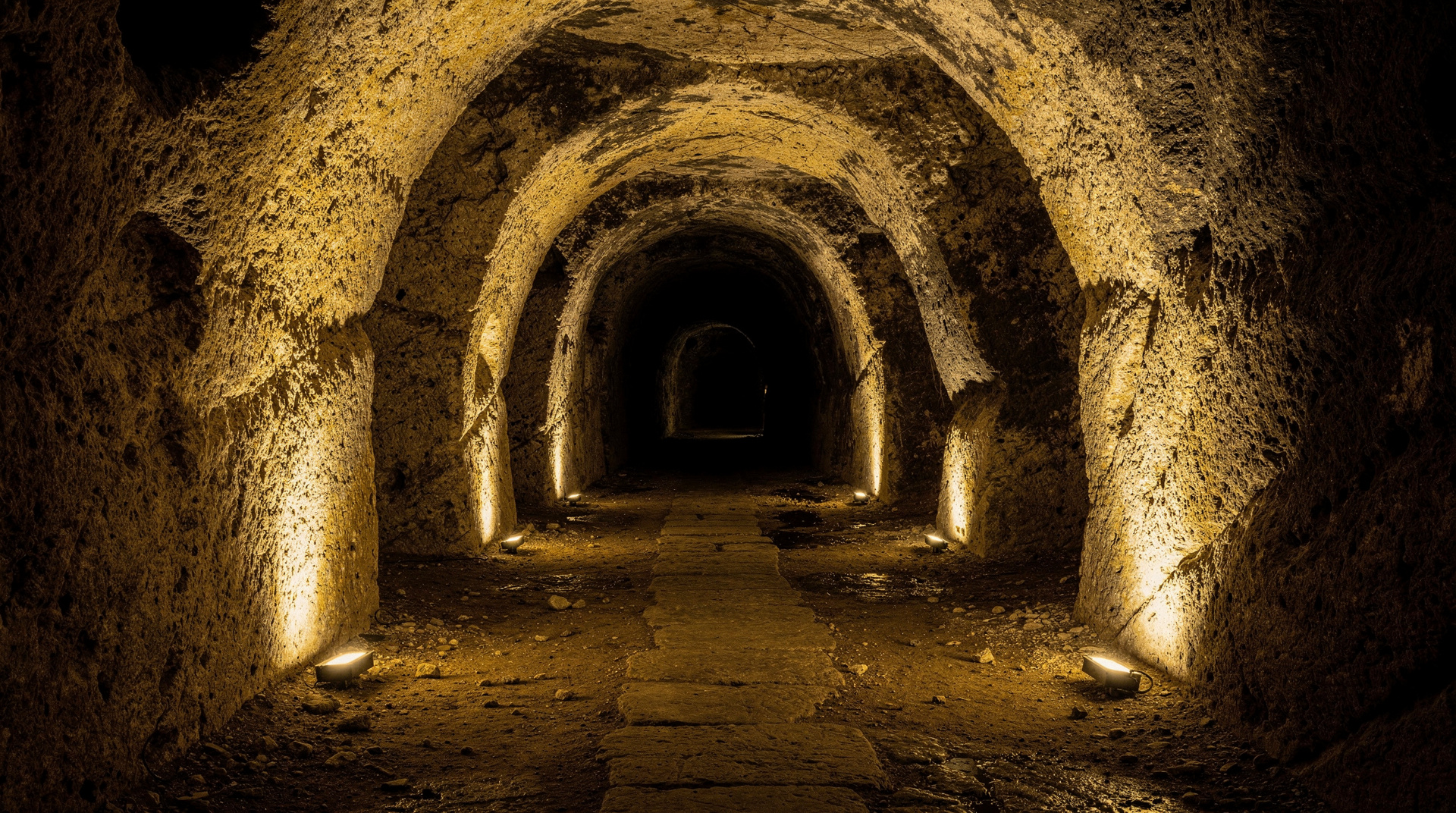
The geology explains the archaeology. The Campi Flegrei volcanic field underlies the entire Naples area, producing tufa — compacted volcanic ash — that the Greeks quarried starting in the 4th century BC to build the walls and cisterns of Neapolis. Digging downward was easier and safer than hauling stone from a distance; you quarried and built simultaneously.
By the Roman period, the cisterns had multiplied into a vast interconnected network supplying water to a city of several hundred thousand. The network fell into disuse when the Roman aqueduct collapsed in the 6th century and was not substantially replaced until 1885. For over a thousand years, the cavern space was repurposed: workshops, storage, dumping. In the 1940s, the shallower tunnels served as air-raid shelters. Much of this accumulation is still there — abandoned objects, wartime graffiti, the debris of multiple civilisations compacted in layers underground.
Napoli Sotterranea: the main Greek-Roman tunnel complex
The most visited underground site in Naples sits directly under Piazza San Gaetano, in the heart of the centro storico. Napoli Sotterranea occupies a section of the ancient cistern network — tunnels originally cut by Greek colonists in the 4th–3rd centuries BC and expanded by the Romans to supply the city’s bath complexes, fountains, and private households.
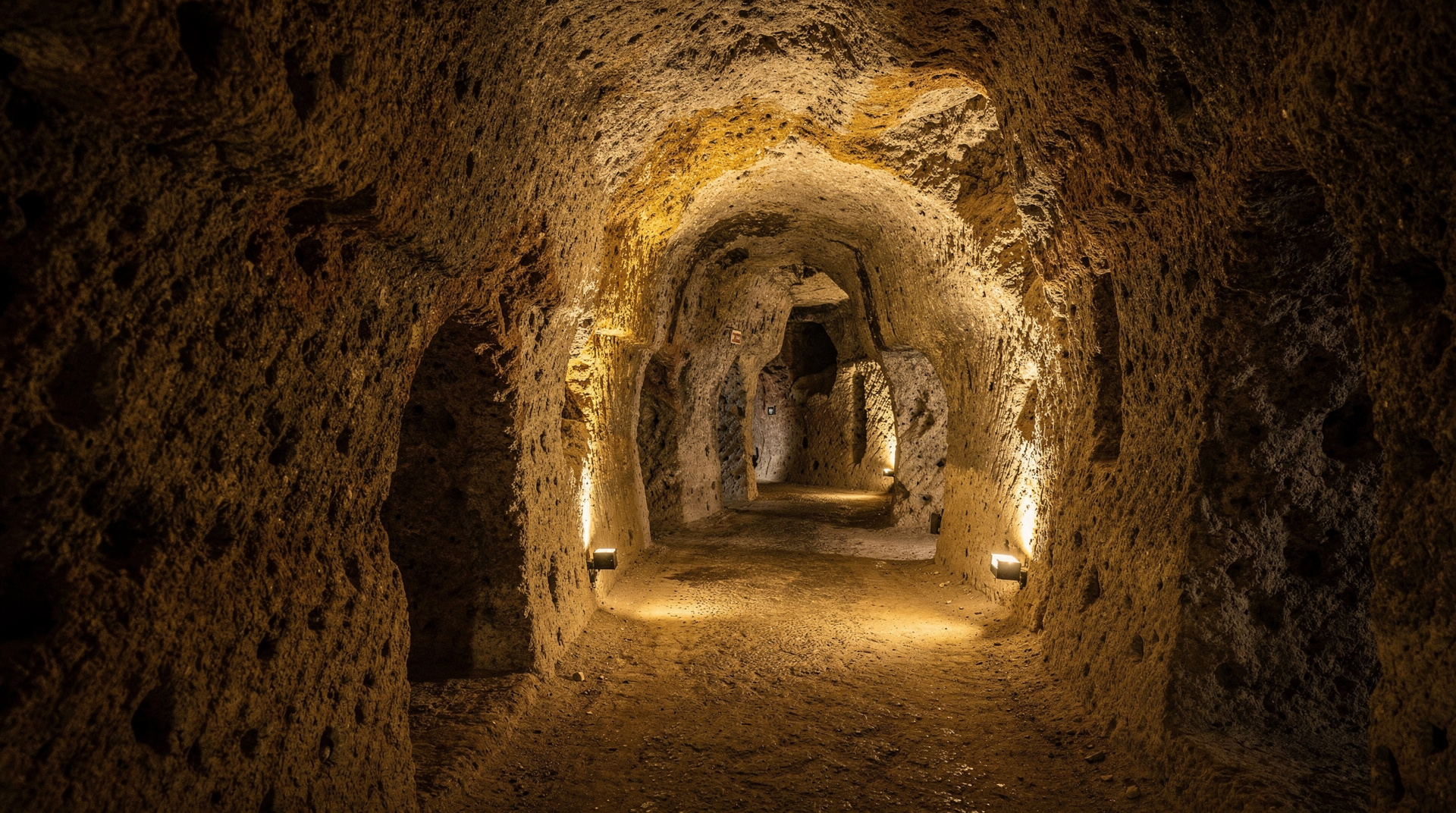
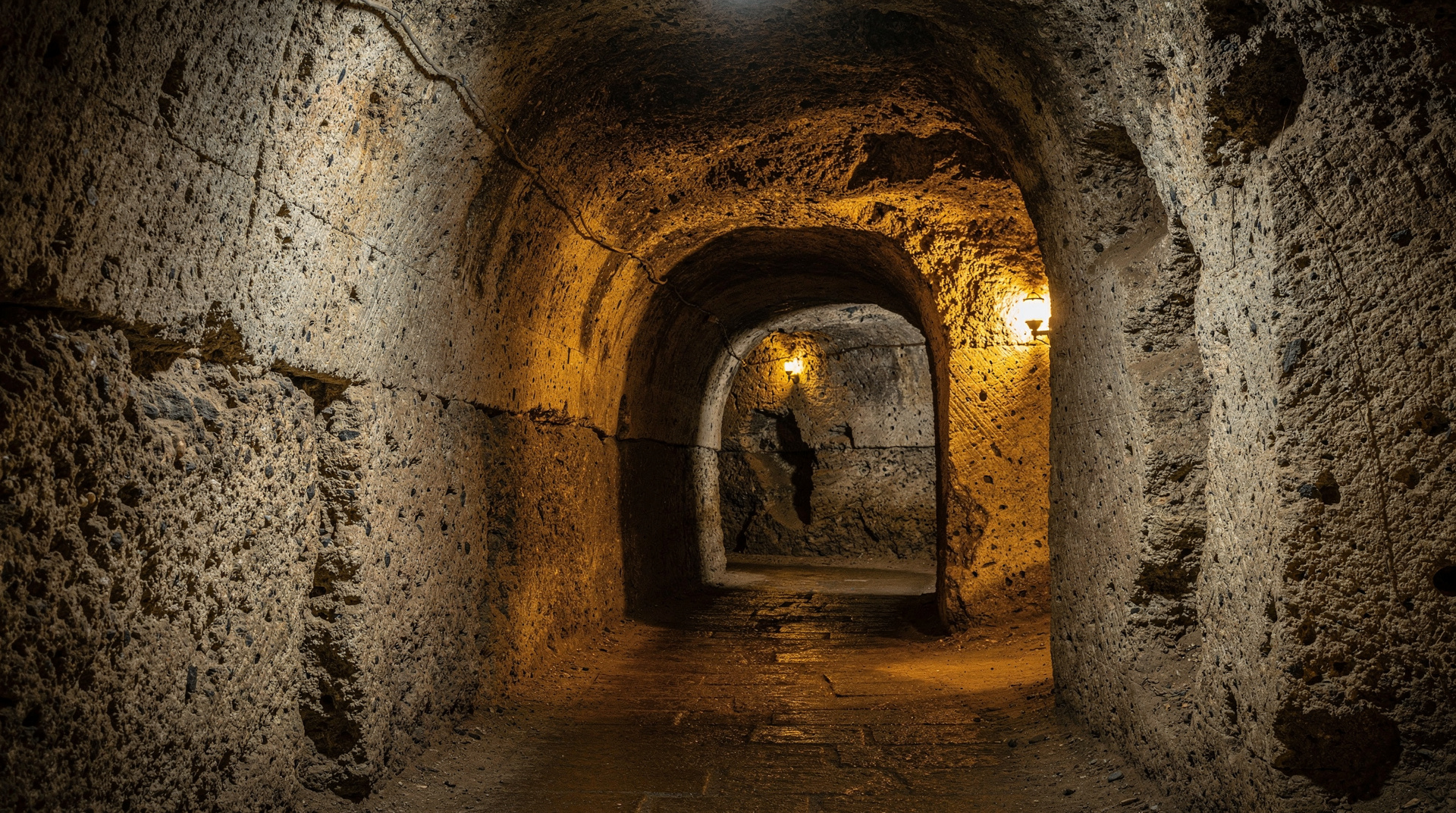
The guided tour descends about 40 metres below street level via a narrow staircase, then passes through a sequence of cistern channels carved through tufa. The narrowest passages are around 45 cm wide — genuinely tight for larger visitors. The tour includes sections where visitors carry oil lamps through passages too narrow for electric lighting, which either reads as atmospheric or uncomfortable depending on your tolerance. An WWII-era shelter occupies one of the larger chambers: families lived here for months during Allied bombing campaigns, and the personal objects left behind — children’s shoes, handwritten calendars marking air-raid nights — are more affecting than the Roman archaeology for many visitors.
The tour runs every 30–60 minutes, lasts around 80 minutes, and costs €12 adults (reduced rates for students and children). The site is managed by a non-profit and has been operating public tours since the 1990s.
Napoli Sotterranea: guided underground tourThe Galleria Borbonica: the Bourbon escape tunnel
The Galleria Borbonica is a different kind of underground entirely. Ferdinand II of Bourbon commissioned it in 1853 as an escape route connecting the Royal Palace to military barracks — a private underground carriage road so the royal family could flee the city if revolt broke out. Construction took seven years. The tunnel was never used for its intended purpose; it was completed just before the Bourbon dynasty collapsed in 1861 with the unification of Italy.
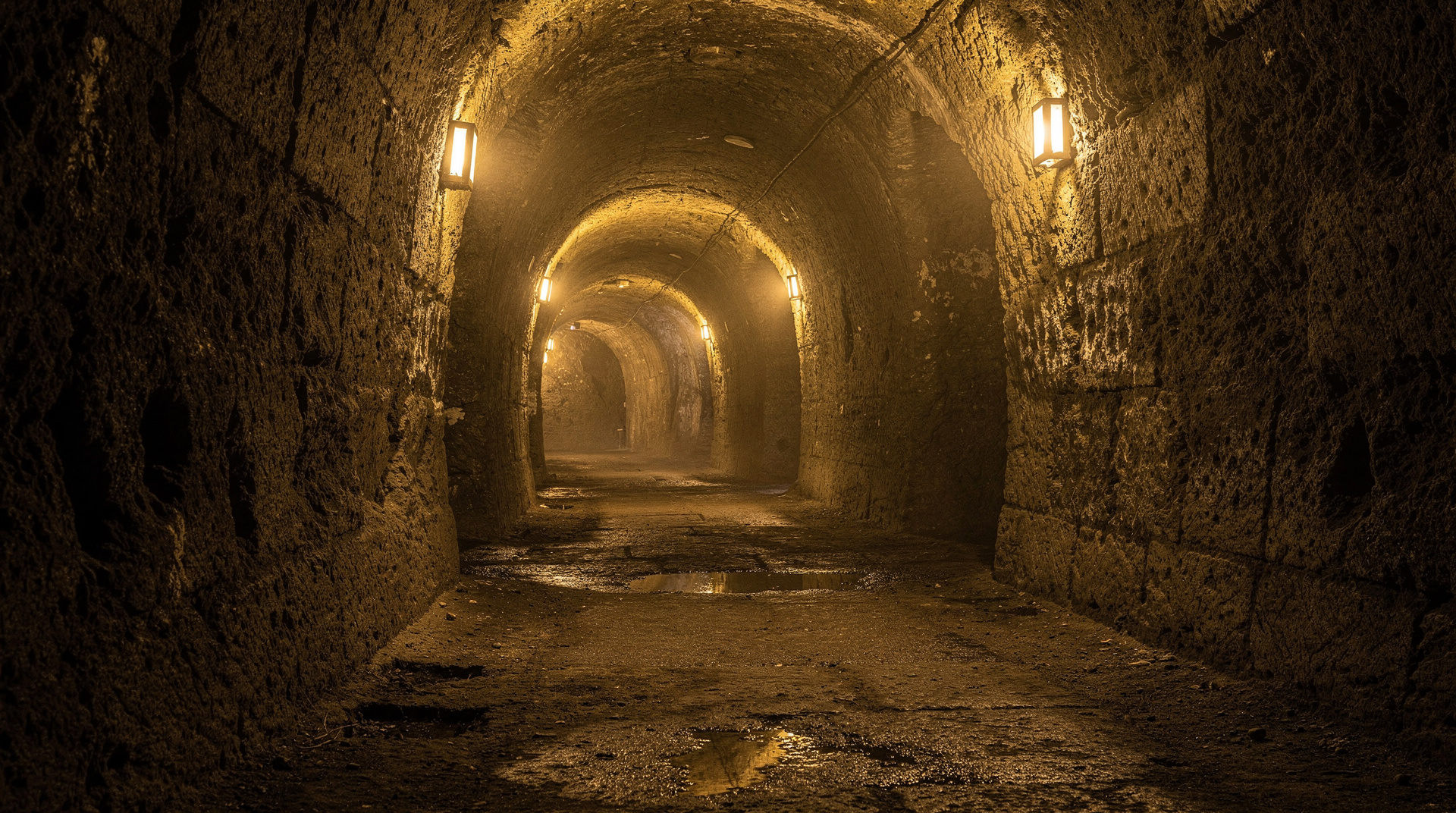
The gallery was later used as a car depository in the early 20th century, then converted to a wartime shelter in 1942. The result is a single large tunnel packed with period objects: dozens of abandoned automobiles from the 1920s–1940s, a Fiat 1100 and a Lancia buried under tufa debris, wartime medical equipment, and — strangest of all — sculpture fragments pulled from bombed buildings stored here for safekeeping and never reclaimed.
Several tour formats are available, including a standard walking tour, a boat tour through flooded lower sections, and an adventure tour involving wading. The standard tour lasts about 75 minutes and costs €10. The location is in the Chiaia district, accessible from Via Morelli or through the courtyard of a residential building — the entrance is easy to miss without a map.
The Catacombs of San Gennaro: the most important Christian site underground
The Catacombs of San Gennaro predate the conversion of the Roman Empire to Christianity. The earliest burials here date to the 2nd century AD, making this one of the oldest intact Christian burial complexes in the Mediterranean world. It is also one of the largest: two levels of chambers, arcosolia (arched burial niches), and decorated crypts extend through the hillside of Capodimonte.
The upper catacomb level was repurposed as a place of Christian pilgrimage after the relics of Naples’ patron saint, Januarius (Gennaro), were brought here in the 5th century. The frescoes that survive — some dating to the 4th and 5th centuries — are genuinely significant artistically, not just archaeologically. The earliest known portrait of San Gennaro is here, painted within decades of his martyrdom.
The catacombs are managed by the Cooperative Sociale La Paranza, a community enterprise based in the Rione Sanità, the working-class neighbourhood above. The cooperative runs tours in English and Italian. The standard tour lasts about 1 hour and costs €9. Entry is through the Basilica di San Gennaro extra Moenia at Via Capodimonte 13.
Catacombs of San Gennaro: guided visitThe Catacombs of San Gaudioso: smaller and less crowded
Three hundred metres from San Gennaro, the Catacombs of San Gaudioso occupy the basement of the Basilica Santa Maria della Sanità. San Gaudioso was a 5th-century African bishop who died in Naples and was buried here — the catacomb grew around his tomb. The site is smaller than San Gennaro but in some ways more immediate: the decoration is more unusual, featuring 17th-century noble tombs in the upper church with painted portraits set above skull niches — the skeletons installed directly in the wall below portraits of the deceased, which is either grotesque or fascinatingly honest about death depending on your perspective.
Tours run every 30 minutes, last about 45 minutes, and cost €9. The same La Paranza cooperative manages both San Gennaro and San Gaudioso; a combined ticket (€15) covers both sites and makes sense if you want the full Rione Sanità underground experience in one day.
The Fontanelle ossuary: the most unsettling site
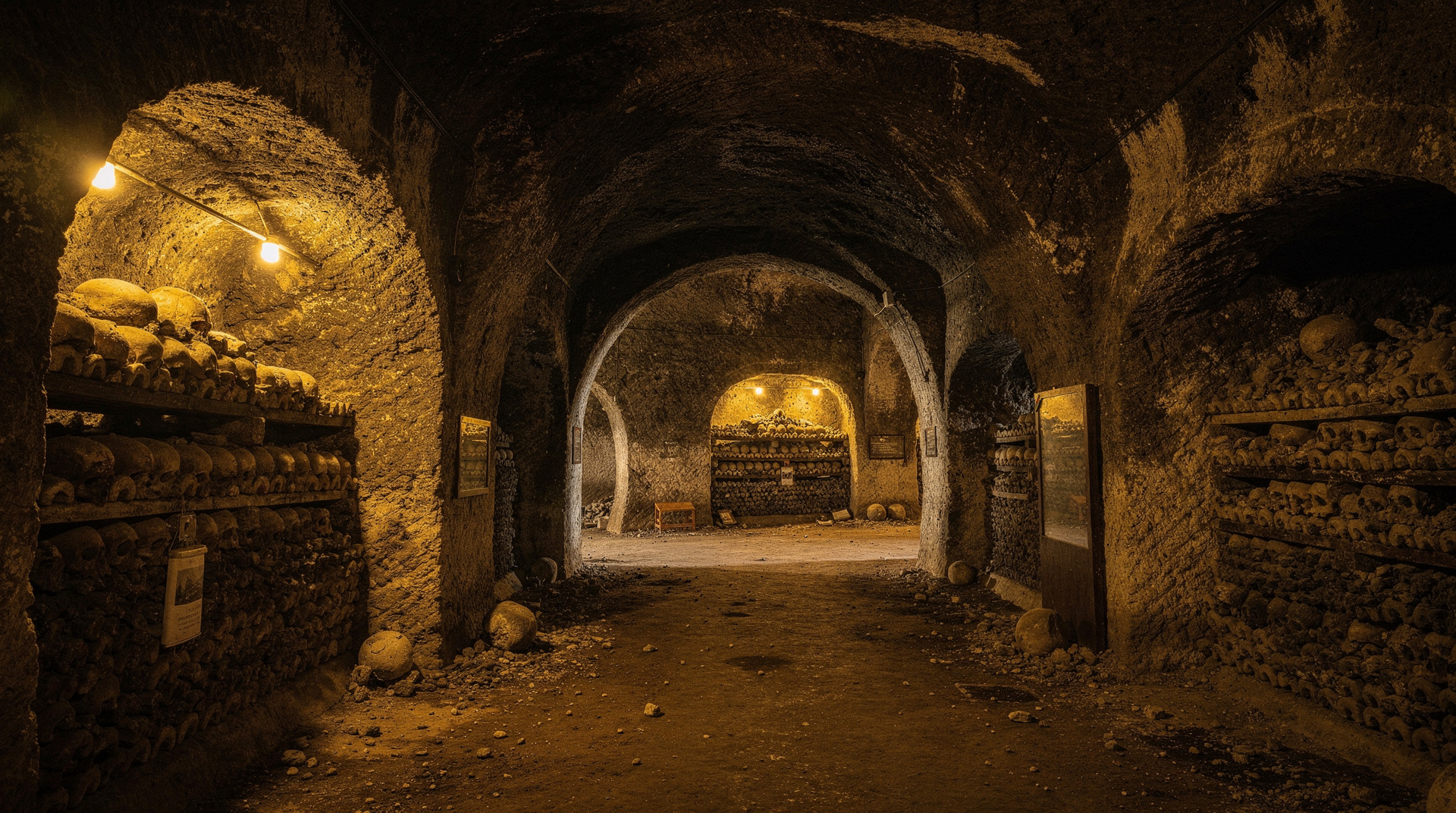
The Fontanelle cemetery is not a catacomb and not a guided tour site in the formal sense. It is an ossuary: a large natural tuff cavern at the top of the Rione Sanità that contains the skeletal remains of approximately 40,000 people — the bones of plague victims from the 1656 epidemic, unclaimed remains from the 17th-century city cemeteries, and bones displaced by floods. The bones are stacked and arranged in rows, skulls separated into displays that are part of a cult practice unique to Naples: the anime pezzentelle (abandoned souls) tradition, in which local residents adopted anonymous skulls, cared for them, and petitioned them for favours.
The city closed the Fontanelle to this cult practice in the 1960s and declared the space a public monument. It is now managed by the comune and open free of charge. Entry is from Via Fontanelle 80, in a narrow street above the Sanità basin. A 90-minute guided tour is available for a small fee, but the site is navigable independently. It is genuinely unlike any other attraction in Naples — unsettling in a way that is not theatrical but simply factual.
Decumanus underground: the Roman street beneath Spaccanapoli
A separate and less-publicised underground circuit runs beneath the decumanus major — the main east-west Roman street that underlies modern Via dei Tribunali. Several properties along this axis have preserved sections of the original Greek and Roman road surface, private cisterns, and in some cases shop fronts at a level 4–6 metres below the current street.
The longest accessible stretch runs from Piazza San Gaetano eastward and is accessible via the Napoli Sotterranea circuit. A separate tour specifically of the decumanus underground offers a different routing through these spaces.
Naples: decumans underground guided tourThe Spanish quarter underground: lesser-known option
The Spanish Quarter — the densely populated grid of streets west of Via Toledo built for Spanish garrison troops in the 16th century — also sits on top of earlier cistern infrastructure. A tour specifically of this district combines above-ground centro storico history with descent into the cistern network beneath the Spanish Quarter grid. It is a less standard routing than Napoli Sotterranea and tends to attract smaller group sizes.
Practical tips for photography and comfort
Bring a phone or camera with a fast lens or good low-light performance — most underground sites are dimly lit, and flash is banned everywhere to protect fragile frescoes and preserved surfaces. A small headlamp or phone torch is useful at the Galleria Borbonica’s darker sections, though guides usually provide adequate lighting. Wear layers you can add rather than remove — a light jacket packed into a day bag on a 35°C August day feels excessive until you are 40 metres underground. Finally, some sites involve stooping through low passages; taller visitors should expect the odd bumped head, especially at Napoli Sotterranea’s narrowest points.
Choosing between a guided visit and a self-guided audio option
Only Fontanelle can be visited entirely independently; every other site requires a guide, either live or via a fixed-route audio system at some operators. A live guide is worth the modest price difference at Napoli Sotterranea and the catacombs — the sites are genuinely hard to interpret without context, since there is little on-site signage and the historical layers (Greek, Roman, medieval, wartime) are easy to conflate without someone pointing out which is which. Groups are usually capped at 20–25 people, and English-language tours run less frequently than Italian ones, so build in some flexibility if you have a tight schedule and want a specific language slot.
What surprises first-time visitors
The scale is the most common surprise — Napoli Sotterranea alone extends for kilometres, and what tourists see is a fraction of the full network, much of which remains unexplored or inaccessible for safety reasons. The temperature drop is another: even seasoned Naples visitors underestimate how cold 12–15°C feels after a hot street, and the lack of natural light disorients some visitors’ sense of time — an 80-minute tour can feel much shorter or much longer than expected.
Finally, several sites are genuinely still in use or recently vacated: WWII shelter graffiti at Napoli Sotterranea, cars abandoned mid-last-century in the Galleria Borbonica, and skulls tended by local families at Fontanelle until the 1960s — this is not staged history but recently lived space.
How to plan a day of underground Naples
The underground sites are distributed across different parts of the city:
Cluster 1 — Centro Storico (Spaccanapoli axis): Napoli Sotterranea, decumans underground. These two share a geographic zone and can logically be visited on the same day, though not back-to-back (both are 80-minute tours and underground fatigue is real).
Cluster 2 — Rione Sanità / Capodimonte: Catacombs of San Gennaro, Catacombs of San Gaudioso, Fontanelle. These three are within 15 minutes’ walk of each other on foot. A full day in Rione Sanità — including the two catacombs, Fontanelle, and lunch in the neighbourhood — is one of the most interesting days you can spend in Naples without touching the main tourist circuit.
Cluster 3 — Chiaia: Galleria Borbonica. This stands alone in a different neighbourhood and is best combined with a walk along the Lungomare Mergellina or a visit to Castel dell’Ovo.
For a curated overview of what distinguishes each site, see underground Naples compared.
What you need to know before going
Temperature: All underground sites hold at 12–15°C regardless of surface heat. In July and August, descending underground is genuinely refreshing — the temperature difference between 35°C on the street and 13°C below ground is immediate.
Photography: Permitted at all sites without flash at Fontanelle; check each site’s policy for the catacombs (no flash is universal).
Booking: Napoli Sotterranea generally does not require advance booking, though July weekends can have waiting times. Catacombs of San Gennaro benefits from advance booking at weekends. Galleria Borbonica requires a reserved slot.
Language: English tours run at all major sites. Tour frequency in English is lower than in Italian — usually every 1–2 hours. If timing is important, confirm English schedules directly with each site.
Guided vs independent: Fontanelle is the only site accessible independently for free. All others require a guided tour; the underground spaces are not safe to navigate alone.
Combining with above-ground sights: The Sanità cluster sits directly beneath the neighbourhood covered in the rione-sanita-guide — pairing the catacombs with a walk through the district’s murals and markets makes for a fuller day than the underground alone. Likewise, Napoli Sotterranea sits a few minutes from the rest of the centro-storico-guide circuit, so it slots naturally into a self-guided walking tour of the old town.
Frequently asked questions about Naples underground
Is underground Naples safe?
Yes. All commercial sites are maintained, lit, and guided. The surfaces are uneven tufa and limestone, which requires sensible footwear. The main practical risk is loose footing, not structural safety.
Can I visit multiple underground sites in one day?
Two sites in one day is realistic. Three in one day risks saturation — the experience becomes less interesting after several hours underground. Spreading visits across two days is more rewarding.
Is the underground better to visit in summer or winter?
The underground experience itself is identical year-round. In summer, the 12°C temperature makes underground visits a pleasant break from heat. In winter, the contrast is less dramatic but the sites are less crowded, particularly at weekends.
How do I get to the Catacombs of San Gennaro from the centre?
From Piazza Garibaldi: bus 168 or 178 to Via Capodimonte. From Piazza Dante: uphill walk of about 25 minutes via Via Sanità, or bus C63. From the centro storico: the Rione Sanità is about 20–30 minutes’ walk north through the historic district.
Are photography and video allowed?
Photography without flash is permitted at all sites. Video filming for personal use is generally allowed. Commercial filming requires prior permission from each site’s management. Fontanelle is the most permissive; the catacombs have stricter policies on tripods and professional equipment.
What is the best underground tour for first-time visitors?
Napoli Sotterranea is the most complete introduction: it combines Greek, Roman, and WWII layers in a single visit, the tour is well-organised, and the narrow-passage section is genuinely memorable. The Catacombs of San Gennaro is the choice if early Christian art and social history are your primary interest.
Naples top sights and underground: combined guided tourFrequently asked questions about Naples underground guide: tunnels, catacombs and hidden city
How long does Naples underground take to visit?
Is Naples underground suitable for claustrophobic visitors?
Are the underground sites accessible with a wheelchair or pushchair?
Do I need to book in advance?
Is there a combined ticket for the underground sites?
What should I wear underground?
Which underground site is best for children?
Top experiences
Bookable activities with verified prices and instant confirmation on GetYourGuide.