Centro storico Naples guide: navigating the UNESCO historic core
Naples: Walking Tour of the Historical Center
What is the centro storico of Naples and is it worth spending time there?
Naples centro storico (UNESCO World Heritage since 1995) is the largest intact ancient city center in Europe — 2,500 years of continuous urban occupation on a Greek grid. It encompasses Spaccanapoli, Via dei Tribunali, the Decumani, and dozens of historic churches and palazzi. It is absolutely worth spending time here: this is the core of what makes Naples unique. Plan at least a full day minimum.
The essential point: Naples centro storico is one of the most layered and remarkable urban environments in Europe — 2,500 years of occupation visible in every block. It is noisy, occasionally chaotic, and sometimes overwhelming. It is also irreplaceable.
| Where | Between Piazza del Gesù Nuovo and Via Duomo |
| Cost | Free to walk; museum entries €6–20 |
| Time needed | Full day minimum, 2 days for depth |
| Getting there | Dante or Museo metro (Line 1), fully walkable once there |
| Best time | 08:00–10:00 for quiet streets, evenings for atmosphere |
The geography of the ancient center
The centro storico of Naples follows a plan laid down by Greek colonists in the 5th century BC — a rigid orthogonal grid of streets that has never been entirely erased, despite Roman, medieval, Norman, Angevin, Aragonese, Spanish, and Bourbon occupation over 25 centuries.
The basic structure: three parallel east-west streets (decumani) crossed by narrow north-south alleys (cardines). The decumani are still there, still in daily use:
- Decumano Superiore (northern): Via dell’Anticaglia, now partly buried under buildings
- Decumano Maggiore (central): Via dei Tribunali — the main tourist-and-pizza street
- Decumano Inferiore (southern): Spaccanapoli (Via Benedetto Croce / Via San Biagio dei Librai)
Between and below these ancient streets lies everything else: Roman ruins visible through glass floors in metro stations, medieval churches built on top of Greek temples, Baroque chapels jammed into spaces the Greek planners left as public squares. The density of significant architecture per square meter is extraordinary.
In 1995 UNESCO designated the entire centro storico a World Heritage Site — one of the largest urban World Heritage zones in Europe, covering 1,700 hectares.
A guided centro storico walking tour makes the layering comprehensible — essential for a first visit.
Spaccanapoli: the city’s spine
Starting at Piazza del Gesù Nuovo (western end, near the metro station at Dante), Spaccanapoli is the most concentrated cultural experience Naples offers.
Piazza del Gesù Nuovo: The obelisk in the center (Guglia dell’Immacolata, 1747) is a prime Baroque extravagance — coated with angels, reliefs, and portraits of saints. The church of Gesù Nuovo has a rusticated stone facade that looks more like a fortress than a church. Inside: Baroque excess, including the room of Francesco Saverio Caracciolo still decorated with thousands of his ex votos (many are hospital thank-you notes for surgical successes, in extraordinary and occasionally gruesome detail).
Santa Chiara: Directly across the piazza, this 14th-century Gothic church was bombed in 1943, rebuilt, and partially restored. The adjacent cloister (separate entry, €6) with its majolica-tiled columns is one of the most photographed interiors in Naples — worth it, though often crowded by 10:00.
Via Benedetto Croce → Via San Biagio dei Librai: Walking east, the street passes the Cappella Sansevero (one of the most important museum experiences in Naples, see the guide), the church of San Domenico Maggiore, and dozens of artisan shops: nativity figure makers (presepe), bookshops, tailors, and latterie.
Piazza San Domenico Maggiore: A good rest stop and landmark — the 1737 obelisk, outdoor cafés, and direct access to the Spaccanapoli street performers who gather here in the evening.
Via dei Tribunali: the pizza street
Via dei Tribunali runs parallel to Spaccanapoli, 500 meters to the north. It is the main pizza street of Naples and consequently one of the most crowded tourist zones in the city.
The pizza: Gino Sorbillo (no. 32) and Sorbillo Lievito Madre al Duomo (Via Duomo branch) are the most famous. Expect 45–60 minute queues at peak times (12:30–14:00, 19:30–21:00). Di Matteo (no. 94) has shorter queues and is equally good by most local assessments. For pizza al portafoglio (folded street pizza), 2–3 € per piece, the small stands between the sit-down restaurants are faster and less theatrical.
Non-pizza on Via dei Tribunali: The Duomo (Cathedral) is on Via Duomo, the north-south cross-street — a 5-minute detour east from Tribunali leads there. See the Naples cathedral guide for what to see inside.
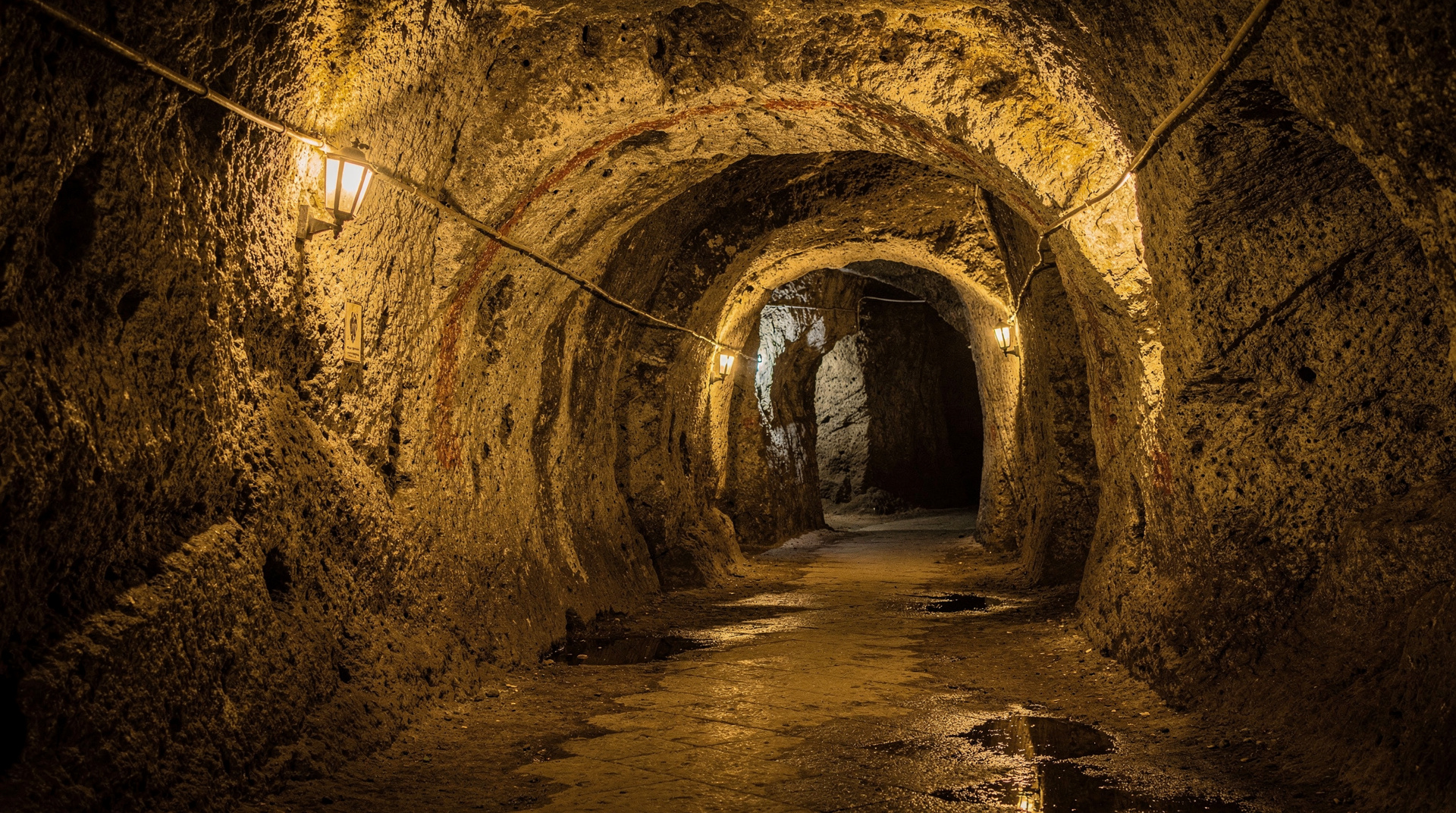
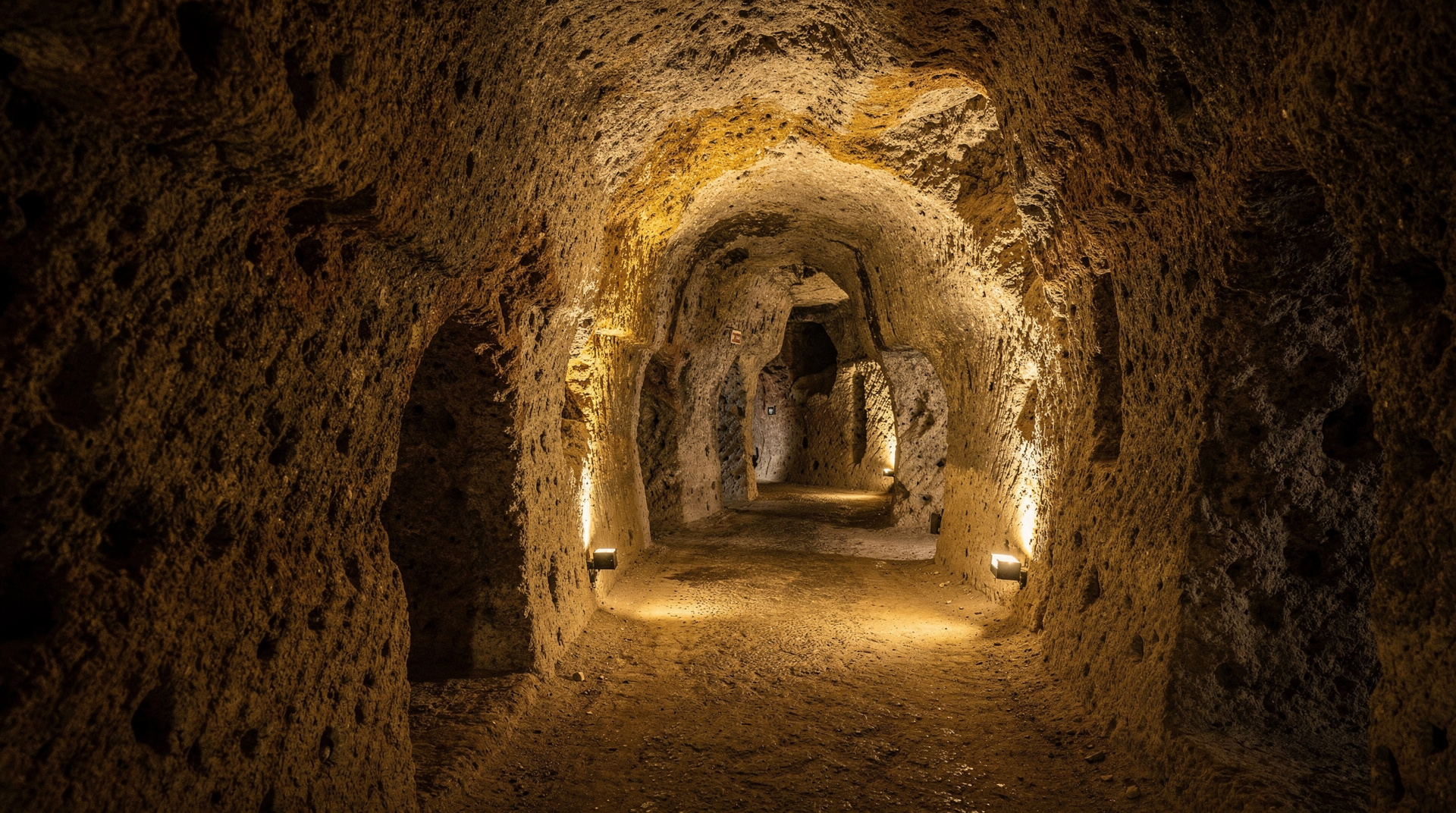
The Naples underground tunnels entrance at Piazza San Gaetano (midway along Via dei Tribunali) leads into the Roman cistern system below the street — one of the best underground experiences in Europe.
The Quartieri Spagnoli: the Spanish Quarter
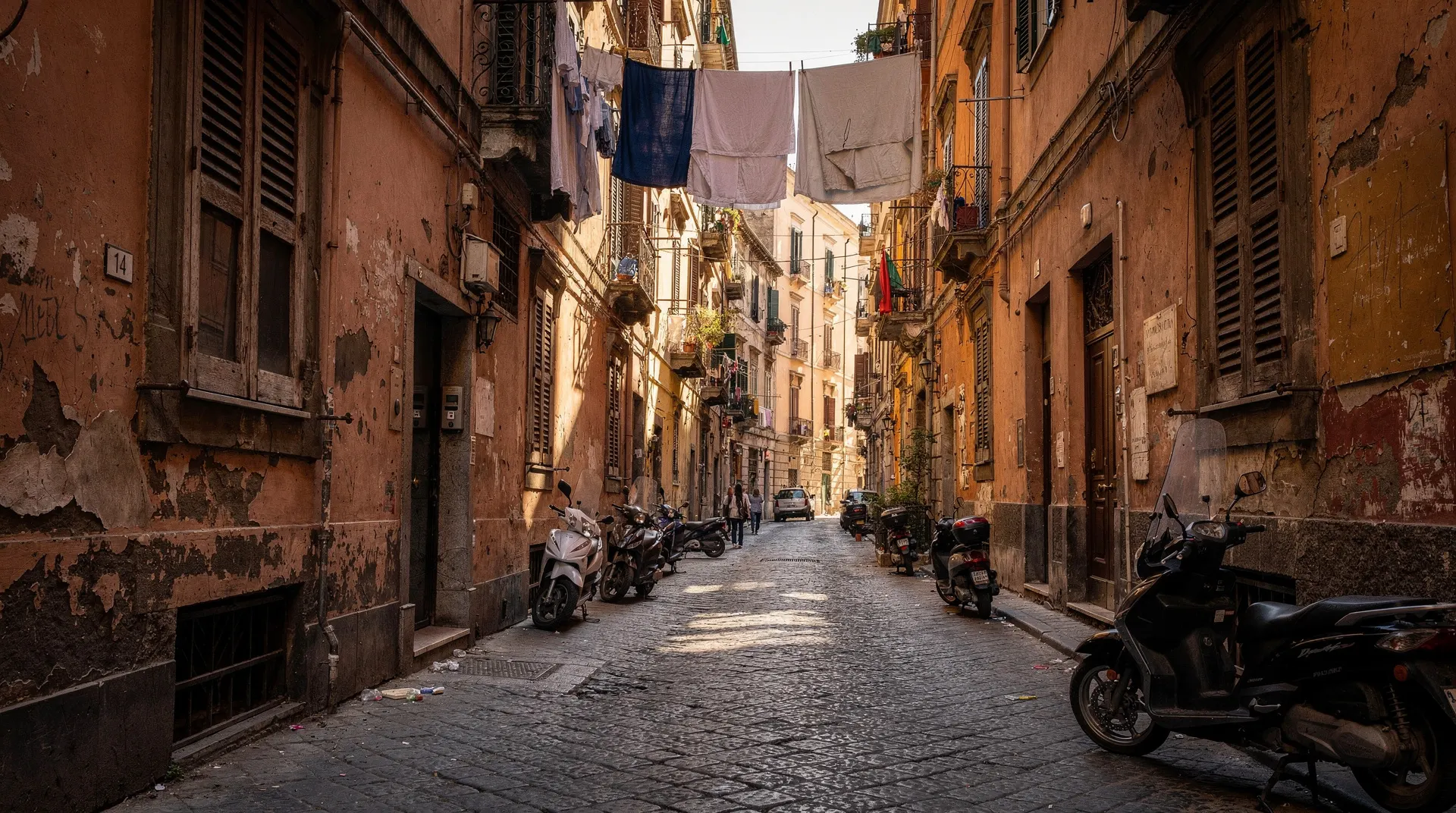
West of Via Toledo, the Spanish Quarter climbs the hillside in a tight grid of alleys. Built in the 16th century to house Spanish troops (hence the name), it remains one of the most authentic residential neighborhoods in central Naples — bassi (ground-floor street-opening rooms) still inhabited, laundry across alleys, murals of Maradona on corners.
Navigation: The alleys run steeply uphill. The neighborhood is easily entered from Via Toledo (the main shopping street) by walking west through any of the cross-streets. It is not threatening in daylight — but disorienting if you don’t maintain a sense of direction.
Eating: Trattoria da Nennella (Vico Lungo Teatro Nuovo 105) is the most famous local trattoria — three courses for €15–20, theatrical service, reservations advisable. Many similar places exist in the alleys.
Maradona shrines: Several street corners and bassi interiors have elaborate Diego Maradona shrines — the footballer played for Napoli from 1984–1991 and is treated as a secular saint in Naples. The most visited shrine is on Vico San Domenico.
Key monuments not to miss
Cappella Sansevero: The most important museum visit in the centro storico — the Veiled Christ sculpture is one of the most technically astonishing works in European art. Entry €8, strictly timed. Book online ahead. No photography inside. See the Cappella Sansevero guide.
MANN (Museo Archeologico Nazionale): Technically at the northern edge of the centro storico, near the Piazza Cavour/Museo metro station. The world’s most important collection of Roman and Greek antiquities from the Vesuvian sites — the Farnese Hercules, the secret erotic room, the Alexander mosaic, the Pompeii bronzes. Allow 3–4 hours minimum. Entry €20. See the MANN guide.
Napoli Sotterranea: The most-visited underground Naples tour, departing from Piazza San Gaetano. Roman cistern system, wartime shelter, ancient theatre visible under a private residence. 1.5 hours, €12. See the full underground comparison guide for the different options.
Catacombs of San Gennaro: North of the centro (Rione Sanità), the largest Christian catacombs in southern Italy. Guided tours only, hourly 10:00–17:00, €9.
The Naples underground 1.5-hour tour enters the Roman cistern system under Via dei Tribunali.
Street food in the centro storico
The centro storico has the highest concentration of street food in Naples. The honest itinerary:
Morning: Sfogliatella (shell-shaped pastry with ricotta, €2–2.50) from Sfogliatella Mary (Galleria Umberto I) or Pintauro (Via Toledo). Espresso standing at the bar counter: €1–1.20.
Mid-morning: Pizza fritta (fried pizza, stuffed with ricotta, salami, and lard, €2.50–4) from any dedicated friggitoria on Via dei Tribunali. Also cuoppo (fried seafood or vegetables in a paper cone, €4–6).
Lunch: Pizza Margherita at one of the sit-down pizzerias (€5–7) or a full meal at a trattoria (€12–18 for two courses).
Afternoon: Taralli (hard pretzel-like rings with lard and black pepper, €0.50 each) and a granita from the pasticcerie on Spaccanapoli.
For the full guide to what and where to eat, see the Naples street food guide and the pizza guide.
Staying in the centro storico: practical notes
Which part to choose: The best accommodation is on or near Spaccanapoli, Via dei Tribunali, or in the zone between the two (Via Santa Maria di Costantinopoli). Avoid the area immediately around Piazza Garibaldi (the main train station) — fine for transit, uncomfortable for evenings.
Noise: Genuine and unavoidable. Scooters, garbage trucks (from 06:00), bar noise until midnight. Rear-facing rooms and upper floors reduce but don’t eliminate this.
Prices: €40–200 per room. The range is enormous. A renovated palazzo apartment might be €150; a basement B&B on the same street €45.
Arriving by car: Do not. ZTL restrictions, no parking, scooter traffic. If you must bring a car, pre-arrange a garage with your hotel. See the Naples ZTL guide.
Frequently asked questions about Naples centro storico
Is the centro storico walkable?
Yes — this is fundamentally a pedestrian city. The centro storico is almost entirely flat, and distances between the key sites are short: Cappella Sansevero to MANN is about 15 minutes on foot. The main streets are all walkable. Some alleys have irregular cobblestones (the ancient basalt grid) that can be awkward with wheeled luggage or mobility limitations.
What is the best way to explore the centro storico independently?
Walk Spaccanapoli end-to-end first (west from Piazza del Gesù to east), then Via dei Tribunali. This covers both main axes and most key monuments. Start early (08:30–09:00) before the tourist groups arrive. The self-guided walking tour provides a detailed route.
Are the churches in centro storico free to enter?
Many are — in Italy most churches are free or ask for a small donation (€1–2). The major exceptions with entry fees: Cappella Sansevero (€8, timed entry), the Certosa di San Martino (€6, in Vomero). Most of the historic churches on Spaccanapoli and Via dei Tribunali are free. Check the notice board at the entrance.
When is the centro storico most crowded?
Easter week, August, and December (Christmas markets, presepe shopping) are the peak periods. Summer weekends (June–September) see large crowds on Via dei Tribunali from 11:00 onwards. The best time to walk the historic streets is 08:00–10:00 any day of the week.
What hidden gems are in the centro storico?
The church of San Lorenzo Maggiore has an archaeological excavation below that exposes the original Greek market street. The Pio Monte della Misericordia (Via dei Tribunali 253) houses a Caravaggio altarpiece in its small chapel (€7). The Basilica di San Paolo Maggiore stands on top of a Roman temple, its Corinthian columns still visible. For a full list, see the hidden gems Naples guide.
One day vs two days in the centro storico
With a single day, walk Spaccanapoli end-to-end in the morning, stop at Cappella Sansevero, have lunch on Via dei Tribunali, then spend the afternoon at MANN or a short underground tour — that combination covers the highest-value sights without over-scheduling. With two days, split it deliberately: day one for the two decumani and their churches and food, day two for MANN in the morning, a Rione Sanità catacomb visit in the afternoon, and an evening at Piazza Bellini. Trying to compress everything into one rushed day is the single most common mistake first-time visitors make here.
Frequently asked questions about Centro storico Naples guide: navigating the UNESCO historic core
What is Spaccanapoli and where is it?
What is the difference between Spaccanapoli and Via dei Tribunali?
How safe is the Naples centro storico?
Where should I eat in centro storico Naples?
Can you walk the whole centro storico in a day?
What is the ZTL and does it affect tourists on foot?
Is the centro storico good for nightlife?
Top experiences
Bookable activities with verified prices and instant confirmation on GetYourGuide.