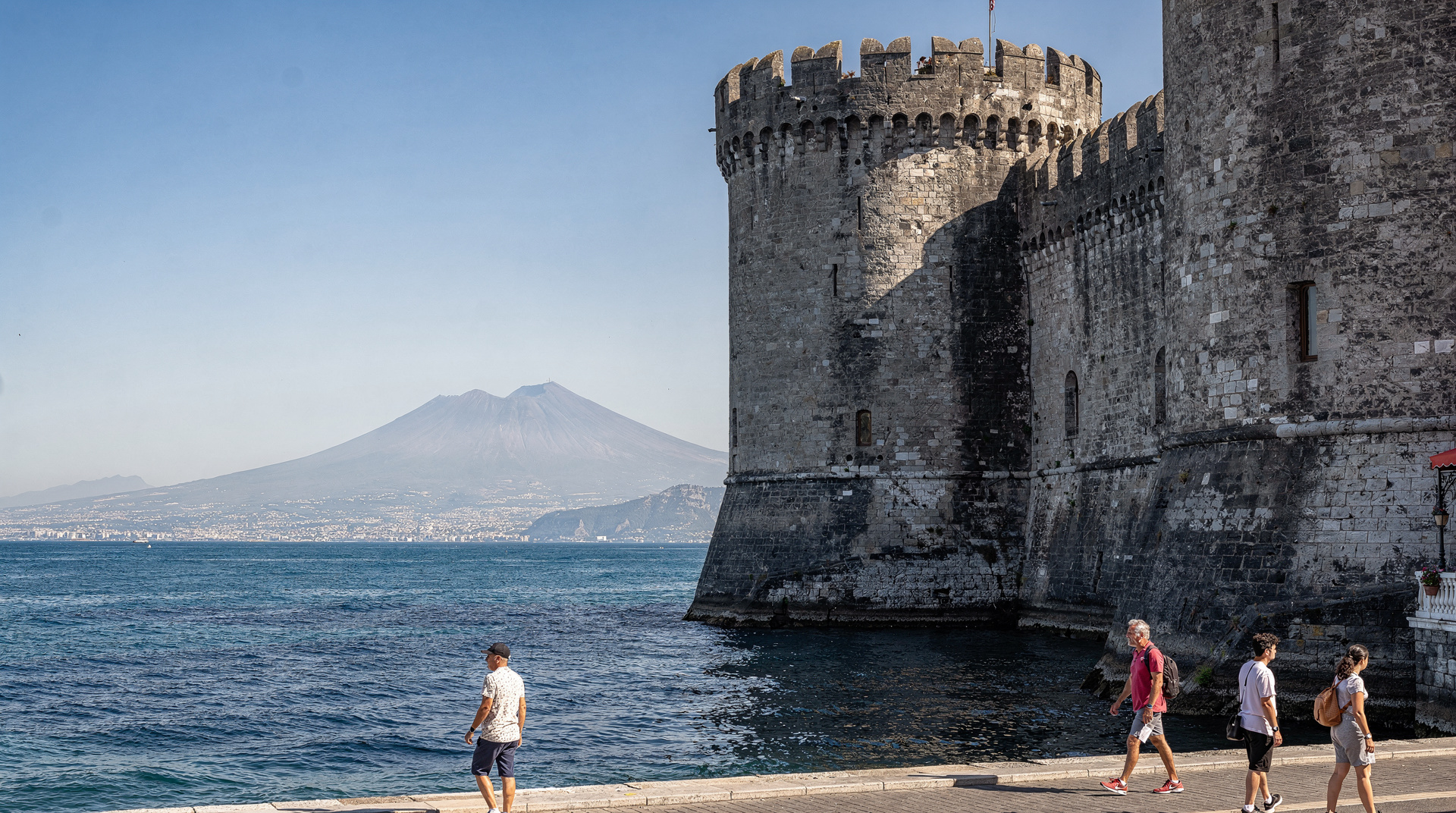
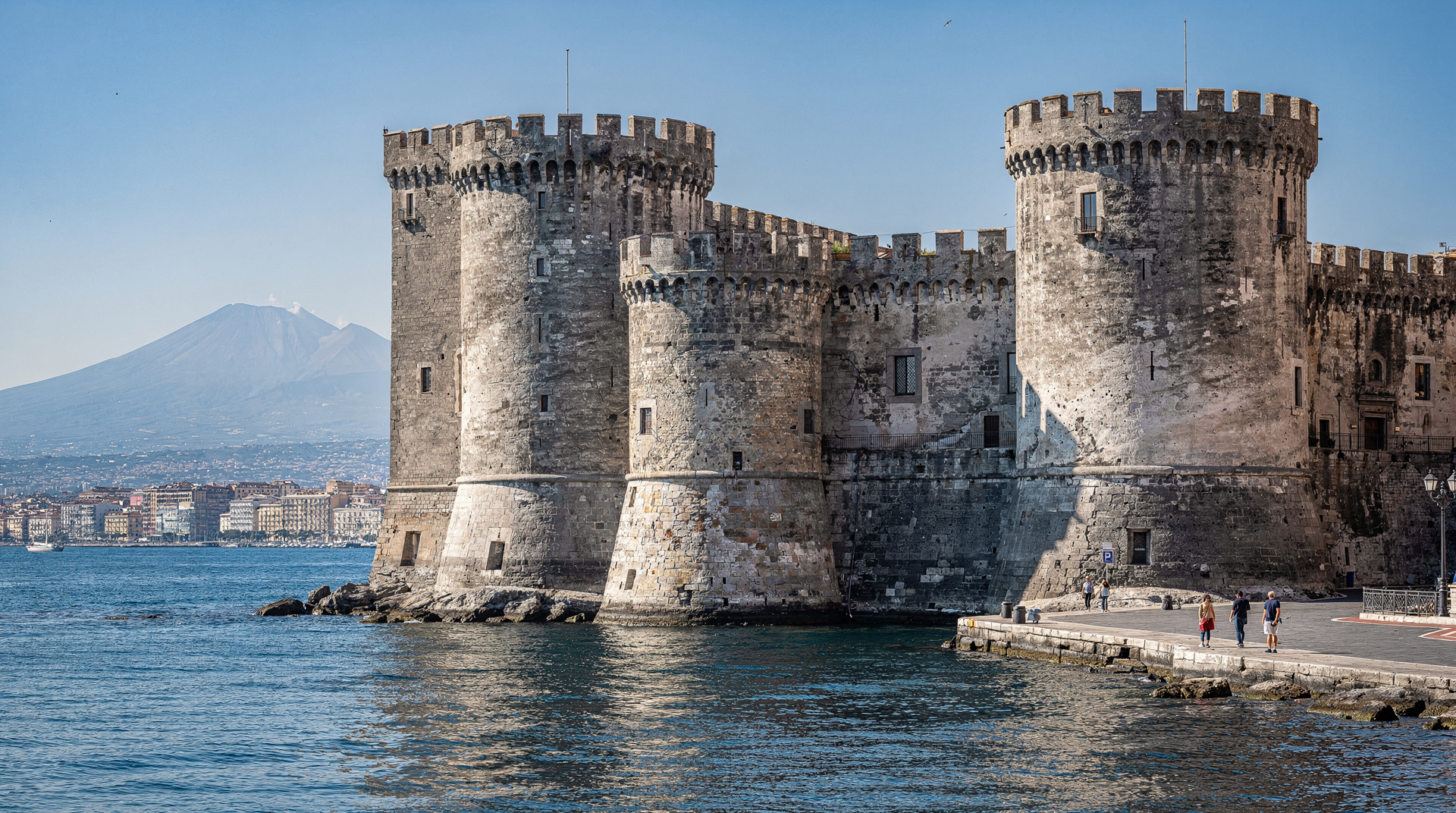
Castel dell'Ovo Naples — the seafront castle
Naples: Castel dell'Ovo Boat Tour with Snorkeling & Aperitif
Duration: 3h
Can you visit Castel dell'Ovo in Naples right now?
Not at the moment. Castel dell'Ovo is currently closed to the public for renovation works, until a date not yet set (check the City of Naples website before going). The exterior, the causeway to Borgo Marinaro and the views from the Lungomare are not affected and remain free.
Quick answer: Castel dell’Ovo is currently closed to the public for renovation works, until a date not yet set — check the City of Naples website before going. The main appeal is the exterior silhouette from the Lungomare and the causeway to Borgo Marinaro, which are not affected.
| Where | Borgo Marinaro, Via Eldorado 3 |
| Cost | Interior currently closed for renovation (check the City of Naples website); exterior and causeway free |
| Time needed | 30–45 minutes for the causeway and Borgo Marinaro; add the Lungomare walk for a half-day |
| Getting there | 15-min walk from Piazza del Plebiscito, or taxi €8–12 |
| Best time | Late afternoon for photography, quieter on weekday mornings |
The oldest castle in Naples
Castel dell’Ovo sits on the islet of Megaride — a small promontory in the Tyrrhenian Sea connected to the mainland by a short causeway. It is one of the oldest standing structures in Naples and has been continuously occupied and modified since the 6th century BCE.
The history layers are complex: Greek colonists from Cumae established a settlement here in the early centuries of Greek Naples. By the 1st century BCE, the Roman nobleman Lucullus (famous for his extravagant banquets) built a luxurious villa on the island — the Villa Luculli. Fragments of Roman construction are still visible in the castle’s lower sections.
After the fall of Rome, the island passed through Byzantine, Norman, Swabian, Angevin, and Aragonese hands. Each era added or modified the fortifications. The castle was used as a royal residence, a prison (including for the poet Virgil, according to one tradition), and a military garrison. The current structure is largely medieval and Norman in its bones, with significant baroque-era modifications.
The Egg legend
The castle owes its name to a medieval story (documented from the 12th century) that Virgil — who was considered a magician and necromancer throughout the medieval period — buried a magical egg in a jar inside the foundations of the original Roman villa. As long as the egg remains intact, the castle will stand and Naples will be safe. If the egg breaks, both the castle and the city will be destroyed.
The legend has no historical basis. It is one of the many accretions of magical significance that attached themselves to Virgil’s memory in medieval Naples. Virgil (70–19 BCE) did own a house near Naples (on the Posillipo hill, not here), which added to the tradition. The legend persists and the castle’s name remains.
Getting there
Address: Via Eldorado 3 (Borgo Marinaro), Naples On foot from Piazza del Plebiscito: 15 minutes west along the Lungomare (Via Partenope) On foot from Chiaia: 10 minutes south through the residential streets Metro: Nearest is Piazza Amedeo (Line 2) — 15 minutes’ walk Bus: Lines 151, 140 stop near the castle Taxi from the historic centre: €8–12 (fixed rate to the seafront)
Visiting hours and entry
Entry: Currently closed to the public for renovation works, until a date not yet set. Check the City of Naples website before going.
The exterior, the causeway to Borgo Marinaro, the views from the Lungomare and the Borgo Marinaro restaurants are not affected by the closure. The sections below describe the castle as it is when open.
What to see inside
Ground and intermediate levels: Exhibition spaces used for temporary art shows — usually photography exhibitions, local artist shows, or cultural events. Quality varies. There is usually something on the walls but it is rarely exceptional. The cisterns and stone vaulting visible at ground level are genuinely old.
The chapel: A small medieval chapel within the castle precinct is usually accessible. Modest.
The upper battlements: The best reason to enter. From the highest accessible terrace, the 360-degree view takes in:
- East: Vesuvius, the Naples waterfront, Piazza del Plebiscito
- West: the Lungomare, Mergellina, Posillipo headland, and the distant Phlegraean Fields
- South: open sea, Capri visible on clear days, Ischia in the northwest
The battlements are the best viewpoint in central Naples (closed at present). Allow 20–30 minutes here. For a fuller ranked list of the city’s panoramic spots, including higher and further-out options, see Naples viewpoints.
Roman and medieval foundations: Partially visible in the lower sections of the castle. Placards explain what’s Roman vs Norman vs later.
For a different perspective on the castle and coastline, a short boat trip from the causeway area offers swimming and snorkelling right beneath the fortress walls — a genuinely unusual way to see it that most visitors never consider.
Castel dell’Ovo boat trip with swimming and snorkellingThe Borgo Marinaro
The narrow strip of former fishing village at the castle’s base (connected to the mainland by the causeway) is now occupied by seafood restaurants, small bars, and a tiny marina with moored fishing boats.
The restaurants here have one advantage: the location. A table on the waterfront with Castel dell’Ovo behind you and the bay in front is genuinely atmospheric. The food quality and value are below average for Naples — you are paying for the setting. If you want a casual lunch with a view, this is acceptable. If you want the best seafood in Naples, the Rione Borgese or Quartieri Spagnoli areas offer better value.
For an evening drink with the castle illuminated, the bar at the end of the Borgo Marinaro jetty is a reasonable option (€6–9 for a Spritz or Negroni).
Best views of Castel dell’Ovo
From the Lungomare: Walking east from Mergellina toward the castle, the classic postcard view — castle on its promontory, Vesuvius in the background, the bay in the foreground. The best photographic light is afternoon (castle faces south-southwest; morning light is backlit).
From the water: Any boat excursion around the bay shows the castle from angles not visible from land. Even the Capri ferry passes reasonably close.
From the castle battlements: Looking back at the city, the view is exceptional (closed at present).
From the Castel Nuovo terrace: The medieval castle on the port end of Piazza del Plebiscito is 1 km east and gives a different angle on the dell’Ovo promontory.
Practical considerations
Parking: The seafront road (Via Partenope) has limited metered parking; it fills up quickly. Walking or taxi is more reliable.
Crowds: The Lungomare near the castle is busy on weekend evenings (the standard Neapolitan evening walk). The castle interior itself is rarely crowded — mostly tourists who stop in from the Lungomare.
Safety: The Lungomare and Borgo Marinaro are among the safest areas in Naples. No special precautions needed.
Combining with the Lungomare walk
The most satisfying way to see Castel dell’Ovo is as part of the full Lungomare evening walk — starting at Piazza del Plebiscito, walking west past the castle to Mergellina. The return journey (or taxi back) completes the circuit.
See also best photo spots in Naples for the most productive shooting positions.
Who gets the most out of the castle
Castel dell’Ovo rewards a particular kind of visitor: someone who likes to wander without a strict plan and treats a landmark as a pause between other things. If you arrive expecting a set of must-see rooms, you will probably leave underwhelmed. If you arrive expecting a stone terrace over the water, a good excuse to slow down and a place to understand how the bay is laid out, you will leave happy.
First-time visitors benefit most from using the castle as an orientation point. From the battlements you can name what you will see over the coming days: the volcano to the east, the headland of Posillipo to the west, the islands out to sea. If you are still deciding how to spend your days, the first-time Naples guide and the Naples bucket list help you place the castle in a wider plan, while how many days in Naples helps you decide how much time to give the waterfront.
Couples tend to like the place at the end of the day, when the light softens and the Lungomare fills with strollers. The Naples for couples guide suggests how to build an evening around the seafront. Families will find the causeway easy and open, though the castle’s stairs and uneven stone are worth keeping in mind with small children; the Naples with kids guide covers what else works for younger travellers nearby. Anyone with limited mobility should read the accessible Naples guide before planning the climb, since the upper terraces involve steps.
A relaxed way to spend an hour here
There is no need to rush. A comfortable rhythm is to cross the causeway slowly, pause to watch the small boats in the marina, then go up to the battlements and give the view a few unhurried minutes before you look at anything else. Come back down through the lower levels, where the old stone vaulting and the information placards reward a slower look, and finish with a coffee or a walk along the jetty.
If you like to take photographs, plan your visit around the light rather than the opening hours alone. The best photo spots in Naples and the wider Naples viewpoints guide pair well with this stop, and you can compare the castle’s perspective with other vantage points before deciding where to spend your golden hour. If you prefer to sit rather than shoot, the Borgo Marinaro gives you a place to watch the light change over the water.
On the way, you pass through Chiaia, one of the more elegant parts of the city. The Chiaia neighbourhood guide and the Chiaia destination page describe the streets, cafés and shops you can fold into the same outing. For something sweet after the walk, the sfogliatella and pastries guide and the Naples coffee culture guide point you towards the local habits worth trying.
Pairing the castle with other sights
The castle sits in the middle of a stretch of coast that is easy to explore on foot. To the east, the historic waterfront leads towards Castel Nuovo and the Royal Palace; the Bourbon Naples guide explains the dynasty that shaped much of this part of the city. To the west, the shoreline continues towards Mergellina and the hill of Posillipo, where the Posillipo guide describes the quieter, residential side of the bay.
If you would rather link several landmarks in one go, the self-guided walking tour and the one-day itinerary show how the castle fits into a full day, while the two-day itinerary leaves more room for a slow seafront afternoon. For the history behind the layers you can see in the walls, the Naples history guide and the Greco-Roman Naples guide give useful context before or after your visit.
If you would rather have someone explain the streets between the castle and the old centre, a private walking tour of the city’s highlights lets you set the pace and ask questions along the way. For a lighter, flexible option, a self-guided audio walk through the main sights lets you stop wherever the view or the light calls for it.
Evenings are a good time to return. The seafront changes character after sunset, and the Naples at night guide and the best rooftop bars in Naples offer ideas for what to do once the castle is lit up. For more places to eat, the best restaurants in Naples page and the restaurant traps guide help you choose well, particularly if you are tempted by the waterfront cluster.
Frequently asked questions about Castel dell’Ovo
Is Castel dell’Ovo worth visiting if I only have one day in Naples?
It is worth walking past on the Lungomare walk. The castle is currently closed to the public for renovation, so the walk to the castle and the exterior viewpoints are what is available. Do not prioritise it over the MANN or Cappella Sansevero; the walk is free and conveniently located.
Can I visit Castel dell’Ovo at night?
The castle interior is currently closed to the public for renovation. The causeway is usually accessible later. The exterior is illuminated at night and the Borgo Marinaro restaurants are open until 22:00–23:00.
What is the difference between the three Naples castles?
Castel dell’Ovo: Seafront, primarily views and exterior (currently closed to the public for renovation). Castel Nuovo (Maschio Angioino): €10, civic museum, best Renaissance arch — see Castel Nuovo (Maschio Angioino) Naples for the full guide. Castel Sant’Elmo: €5, Vomero hill, best panoramic views of the city. All three are worth visiting in a 3–4 day stay, alongside the wider top attractions in Naples.
Is there a legend connecting the castle to Virgil?
Yes — the Egg legend described above. In addition, tradition holds that Virgil was briefly imprisoned on the island (no historical evidence). The tomb attributed to Virgil is actually on the Posillipo hill at Piedigrotta, not here.
Are the restaurants at Borgo Marinaro good?
Acceptable for the setting; not the best value in Naples. For better seafood, seek out restaurants in Chiaia or the Pignasecca area rather than the tourist-facing waterfront cluster.
How Castel dell’Ovo fits a wider Naples itinerary
Even with the interior closed, Castel dell’Ovo’s exterior and causeway are one of the easiest wins in a free things to do in Naples itinerary — pair it with the Lungomare walk and a stop at the Royal Palace exterior on Piazza del Plebiscito for a car-free, cost-free half-day that still covers three of the city’s most photographed landmarks. Visitors who enjoy hilltop panoramas more than seafront ones should compare this castle’s view with the one from Certosa di San Martino on the Vomero hill, widely considered the single best view over the whole bay.
Top experiences
Bookable activities with verified prices and instant confirmation on GetYourGuide.