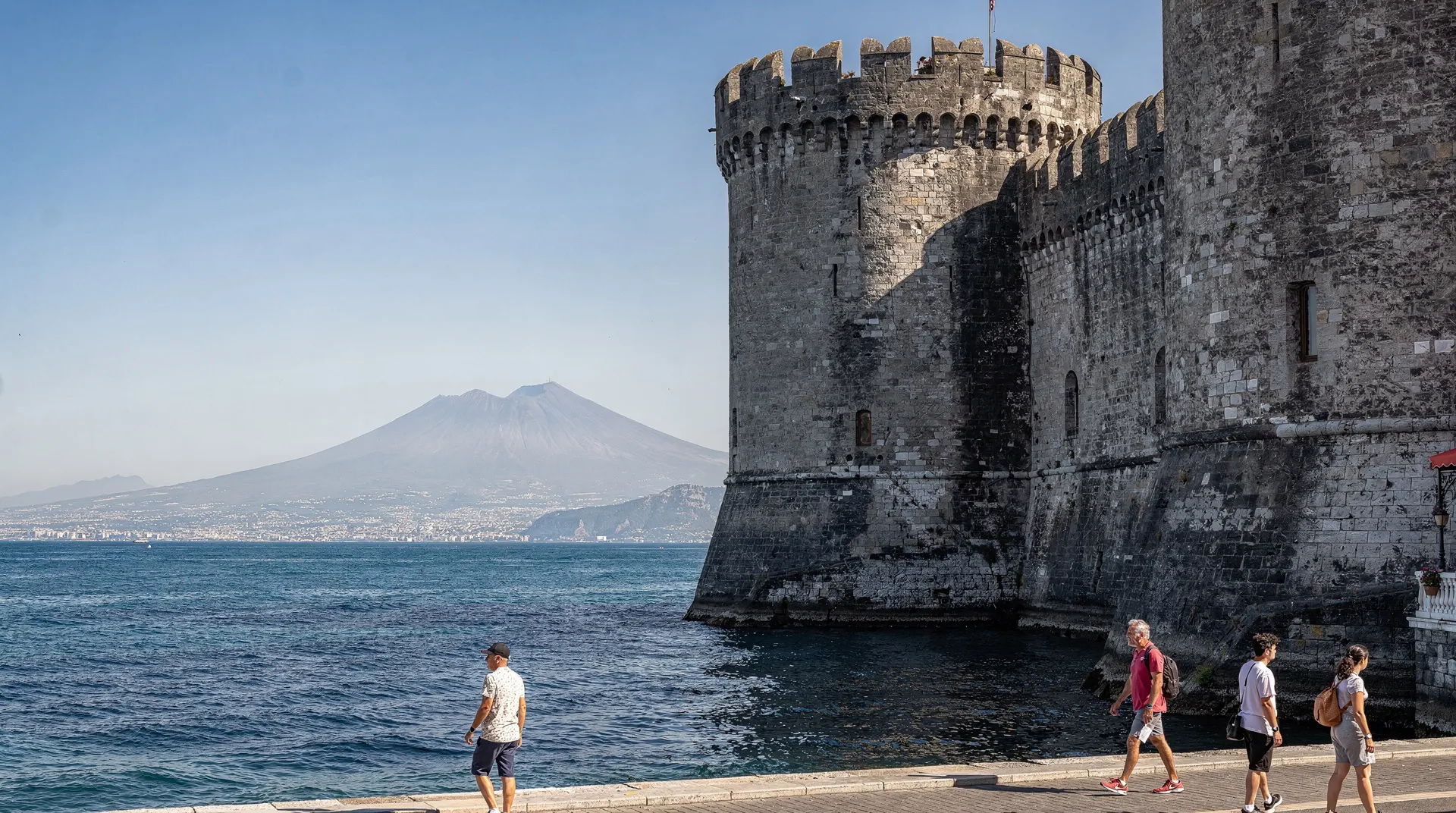
Castel Nuovo (Maschio Angioino) Naples — visitor guide
Naples: Walking Tour of the Historical Center
Is Castel Nuovo (Maschio Angioino) worth visiting in Naples?
Yes for the triumphal arch — the Arco di Trionfo (1443–1467) is one of the finest pieces of early Renaissance relief sculpture in Italy. The civic museum inside is secondary but includes medieval Neapolitan paintings and the original bronze doors with an embedded cannonball. Entry €10.
Quick answer: Castel Nuovo’s main attraction is the Arco di Trionfo — an outstanding early Renaissance triumphal arch that most visitors walk past without realising its significance. Entry €10. Allow 60–75 minutes for arch and museum.
| Where | Piazza Municipio, next to the port |
| Cost | €10 (exterior arch is free to view) |
| Time needed | 60–75 minutes |
| Getting there | Municipio metro (Line 1) or 5-min walk from Molo Beverello |
| Best time | Weekday morning, closed Sundays |
History: the new castle
“Maschio Angioino” (Angevin keep) and “Castel Nuovo” (new castle) refer to the same fortification — “new” relative to Castel dell’Ovo, which had already been standing for centuries when construction began in 1279.
Charles I of Anjou ordered the new castle built after wresting control of the Kingdom of Sicily from the Hohenstaufen dynasty. The original construction (1279–1282) was rapid: Parisian architects brought French Gothic forms to Naples. A church, the Cappella Palatina, was built within the castle and decorated with works by Giotto and Pietro Cavallini (surviving only in fragments).
The castle was captured, damaged, and modified repeatedly over the next century. It passed to the Aragonese in 1443 when Alfonso I of Aragon conquered Naples — and it is the Aragonese period that gave the castle its most significant architectural element: the triumphal arch.
The Arco di Trionfo — why it matters
Inserted between the two round Angevin towers flanking the main entrance, the Arco di Trionfo commemorates Alfonso I’s triumphal entry into Naples on February 26, 1443. The arch was commissioned by Alfonso’s son Ferdinand I and built over a period from approximately 1453 to 1467.
The design is attributed primarily to Francesco Laurana, with contributions from Domenico Gagini, Isaia da Pisa, and others. The commission was explicitly modelled on Roman triumphal arches — a deliberate claim to the same imperial heritage that Rome’s arches commemorated.
What the arch shows:
- Lower arch: Alfonso’s actual triumphal procession — a relief frieze showing the king in a chariot surrounded by courtiers, knights, and symbolic figures. The realism of individual portraits in the crowd is striking.
- Upper arch: Allegorical figures — four river gods (the Tagus, the Ebro, the Danube, the Tiber) symbolising the extent of Aragonese rule; the Cardinal Virtues.
- Crowning lunette: Alfonso I enthroned, flanked by allegories.
- Side niches: Significant sculptural figures.
The whole is approximately 15 metres high and 8 metres wide. It reads as a political manifesto in stone: Alfonso I as Roman emperor, legitimate heir to the ancient tradition of Naples, conqueror and patron.
Study the arch slowly from the outside — the narrative detail in the procession frieze is only legible at close range.
Getting to Castel Nuovo
Address: Piazza Municipio, Naples Metro: Municipio (Line 1) — 5 minutes’ walk (the station has its own archaeological significance; Roman and medieval remains are visible through the floor glass) From Piazza del Plebiscito: 8 minutes on foot, north along Via Toledo then right toward the port From the port (Molo Beverello ferry terminal): 5 minutes on foot — the castle is directly visible
The castle sits at the edge of the port. If you arrive by ferry from Capri or Ischia, you will see it immediately.
Visiting hours and tickets
Hours: Monday–Saturday 9:00–19:00 (last entry 18:30). Closed Sunday. Entry: €10 adults. Reduced rates for seniors (over 65) and youth. Photography: Permitted inside (no flash).
The exterior and the arch are visible from the street at all hours. A full visit of the exterior architecture before buying a ticket is reasonable — if the arch satisfies you, you may decide to skip the museum.
Inside the museum: what to expect
The Museo Civico di Castel Nuovo occupies several levels of the castle.
Ground floor — Cappella Palatina: The original palace chapel is the most significant interior space. Fragments of fresco from the original 14th-century decoration survive — attributed to the school of Giotto (Giotto himself worked in Naples, 1328–1333, on frescoes now lost) and to Pietro Cavallini. The surviving fragments are modest in extent but historically important as evidence of the Gothic pictorial tradition in Naples.
First floor — painting gallery: Medieval and early Renaissance Neapolitan panel paintings. The collection includes Colantonio’s work (the teacher of Antonello da Messina, Naples’ most significant 15th-century painter) and several large altarpieces from demolished churches. The quality is uneven but the best pieces are genuinely significant.
The original bronze doors (1474): The doors cast by Guillermo Sagrera are displayed in the museum. They show scenes from Ferdinand I’s wars against the Angevin pretenders in eight panels, with extraordinary detail including battle scenes, negotiation scenes, and the famous cannonball incident: in 1494, during the French siege by Charles VIII, a French cannonball struck one of the door panels. The cannonball remains embedded in the metal, left in place as a kind of historical souvenir. Replicas stand at the entrance.
Upper floors and tower access: The upper floors contain additional museum material and access to the battlements, with views over the port and the bay.
The castle’s hidden Roman layer
The Municipio metro station below Piazza Municipio, accessed during construction work for Line 1, revealed Roman-era remains — harbour structures, wooden piles from an ancient dock, and a substantial medieval layer. The station was designed to incorporate these finds as a visible underground museum: glass floors allow visitors to see the Roman and medieval strata below the platform level.
This is not part of the castle visit itself, but it is 5 minutes away and free to view with a metro ticket. One of the more unusual junctions of ancient archaeology and modern infrastructure in Europe. For the broader story of how Greek and Roman Naples underlies the modern city, see greco-roman-naples.
Where Castel Nuovo fits in a Naples art itinerary
Castel Nuovo’s painting collection is a useful, often-skipped complement to the city’s bigger art institutions. If you are building a Naples art day around the Royal Palace and the wider best museums in Naples list, Castel Nuovo’s Colantonio and Cavallini works add the missing medieval-to-early-Renaissance link between the classical antiquities elsewhere in the city and the later Baroque collections.
It also pairs naturally with a self-guided walking route through the historic centre, since the castle sits right at the port end of the old city and the history-focused overview of Naples provides useful context on the Angevin and Aragonese periods covered here.
What to spend time on (and what to skip)
Spend time on:
- The Arco di Trionfo exterior — 15–20 minutes, slow and close
- The bronze doors (in the museum) — 15 minutes
- The Cappella Palatina fresco fragments — 10 minutes
- The castle battlements view — 10 minutes
Skip or skim:
- The later sections of the civic museum collection (16th–19th century material is less significant)
- The armaments room (unless specifically interested)
A focused 60-minute visit covers everything worth seeing.
If you’d rather have a guide explain the arch’s imagery and the museum highlights on the spot, Castel Nuovo is usually included as a stop on wider historic-centre walking tours from the port area.
Naples historic centre guided walking tourComparing Naples’ three main castles
| Castle | Cost | Best for | Sunday hours |
|---|---|---|---|
| Castel dell’Ovo | Free | Seafront views, exterior, photography | Open |
| Castel Nuovo (Maschio Angioino) | €10 | Renaissance arch, medieval art collection | Closed |
| Castel Sant’Elmo | €5 | Best panoramic view of the whole city | Check ahead |
Castel dell’Ovo: Free, seafront, primarily external views and battlements. The most photogenic but the least museum content.
Castel Nuovo (Maschio Angioino): €10, best Renaissance architecture (the arch), best medieval art collection (the bronze doors, Cavallini fragments). Worth paying for.
Castel Sant’Elmo: €5, Vomero hill, best panoramic views of the entire city and bay — nearby, Certosa di San Martino shares the same hilltop and is worth combining on the same visit. No medieval art collection but the views are the best of the three.
For a visitor with 3 days in Naples, all three are achievable, alongside the wider top attractions in Naples. For a visitor with 1 day, the arch exterior of Castel Nuovo is visible for free; the museum requires purchasing a ticket.
Frequently asked questions about Castel Nuovo
Is Castel Nuovo open on Sundays?
No. The museum is closed Sunday. The exterior (including the arch) is visible from the piazza at any time.
Is the Castel Nuovo viewpoint better than Castel Dell’Ovo?
Different. Castel Nuovo’s best views are from the battlements toward the bay and Castel dell’Ovo — good but not Naples’ best. Castel Sant’Elmo on the Vomero has the best full-city panorama.
Who built Castel Nuovo?
Originally commissioned by Charles I of Anjou (1279) and built by French architects. The triumphal arch was added under Ferdinand I of Aragon (1453–1467). Subsequent modifications were made under the Spanish viceroys in the 16th–17th centuries.
Is the Arco di Trionfo the best Renaissance arch in southern Italy?
It is among the best. Its main competitors are the Arco d’Alfonso in Benevento and various Roman-influenced arches in Sicily. The Castel Nuovo arch is considered the finest example of early Renaissance triumphal architecture in the south, comparable in quality (though not scale) to the better-known arches of central Italy.
What is the cannonball in the bronze doors?
A French cannonball fired during Charles VIII of France’s siege in 1494. It struck one of the door panels and was left embedded rather than removed — either as a historical curiosity or because removal was technically difficult. It is still visible in the relevant panel, marked on the museum interpretation.
Frequently asked questions about Castel Nuovo (Maschio Angioino) Naples — visitor
What is the Arco di Trionfo at Castel Nuovo?
What are the bronze doors of Castel Nuovo?
What is inside the civic museum at Castel Nuovo?
How long does Castel Nuovo take to visit?
Is Castel Nuovo included in the ArteCard?
What is the difference between Castel Nuovo and Castel dell'Ovo?
Top experiences
Bookable activities with verified prices and instant confirmation on GetYourGuide.