Royal Palace of Naples — Palazzo Reale visitor guide
Naples: Royal Palace and Monumental Area Small Group Tour
Duration: 2.5h
Is the Royal Palace of Naples worth visiting?
Yes, particularly for the furnished Bourbon royal apartments and the historic court theatre (Teatro di Corte). The palace gives the best insight into Bourbon Naples available in the city. Entry €10. Allow 60–90 minutes. Open daily except Wednesday.
Quick answer: Palazzo Reale offers the best insight into the Bourbon kingdom — furnished royal apartments, a beautiful court theatre, and the facade overlooking Piazza del Plebiscito. Entry €10. Allow 60–90 minutes. Closed Wednesday.
| Where | Piazza del Plebiscito, central Naples |
| Cost | Around €10 entry, audio guide around €5 extra |
| Time needed | 60–90 minutes |
| Getting there | 10–15min walk from historic center, or Metro Line 1 Municipio |
| Best time | Closed Wednesday; mornings for facade light, afternoons for fewer crowds |
The palace and its place in Neapolitan history
Palazzo Reale occupies the entire eastern side of Piazza del Plebiscito, Naples’ principal civic square. Its 169-metre facade defines the space on one side; the neoclassical Church of San Francesco di Paola closes it on the other.
The palace’s history spans four centuries and six dynastic regimes:
Spanish viceroys (1600–1734): The original commission came from the Spanish viceroy Fernando Ruiz de Castro in 1600. The architect Domenico Fontana designed a structure intended to receive Philip III of Spain — who never came. The palace was progressively expanded throughout the Spanish period.
Bourbon kingdom (1734–1806, 1815–1861): When Charles of Bourbon established the independent Kingdom of the Two Sicilies, Palazzo Reale became the primary royal residence. The most significant interior decoration and furnishing dates to this period, particularly under Ferdinand IV (the longest-ruling Bourbon, 1751–1825). The palace was lavishly furnished with Capodimonte porcelain, Flemish tapestries, mirrors from Murano, and paintings from the royal collection.
Napoleonic interlude (1806–1815): Under Joseph Bonaparte and then Joachim Murat, the palace was again a royal residence with significant redecoration in the Empire style.
Unified Italy (from 1861): The palace became one of several royal residences of the House of Savoy. Victor Emmanuel II is represented in the facade niches. After the fall of the monarchy in 1946, the palace became a state museum.
The eight dynastic statues
Before entering, study the eight niches on the facade — these statues tell the entire dynastic history of Naples:
- Roger II (1095–1154): Norman king who unified Sicily and southern Italy
- Frederick II (1194–1250): Hohenstaufen emperor, born in Apulia, one of the greatest medieval rulers and intellectuals
- Charles I of Anjou (1226–1285): French prince who conquered Naples from the Hohenstaufens
- Alfonso I of Aragon (1396–1458): Spanish Aragonese king; subject of the Castel Nuovo arch
- Charles V (1500–1558): Holy Roman Emperor and King of Spain; greatest Habsburg
- Charles III of Bourbon (1716–1788): Founder of the Bourbon Kingdom of Naples; built Capodimonte and Caserta
- Joachim Murat (1767–1815): Napoleon’s brother-in-law, King of Naples 1808–1815
- Victor Emmanuel II (1820–1878): First king of unified Italy
The sequence from Norman to Italian unification — 900 years of Neapolitan political history — is compressed into one façade.
Opening hours and tickets
Hours: 9:00–20:00 Thursday–Tuesday; closed Wednesday. Last entry 19:00. Entry: €10 adults; reduced rates for EU students and seniors. Under 18 EU free. ArteCard: Included in the Campania ArteCard (3-day Naples card €25).
Palazzo Reale entry with audio guide includedWhat to see inside
The Monumental Staircase
The approach to the piano nobile (main floor) is through a grand double staircase — one of the architectural set-pieces of the palace, designed to impress. The scale is explicitly royal.
The Royal Apartments (piano nobile)
The main floor apartments were used by the Bourbon royal family from the 18th century until 1861. Approximately 30 rooms are open to visitors, with varying levels of original furnishing and decoration.
The Diplomatic Hall (Sala degli Ambasciatori): The room where foreign ambassadors were received. Eighteenth-century Flemish tapestries showing the history of Troy (originally woven for Louis XIV) line the walls — an extraordinary survival.
The Throne Room: The ceremonial throne remains in position. The decoration is an accumulation of Bourbon, Napoleonic, and Savoy elements.
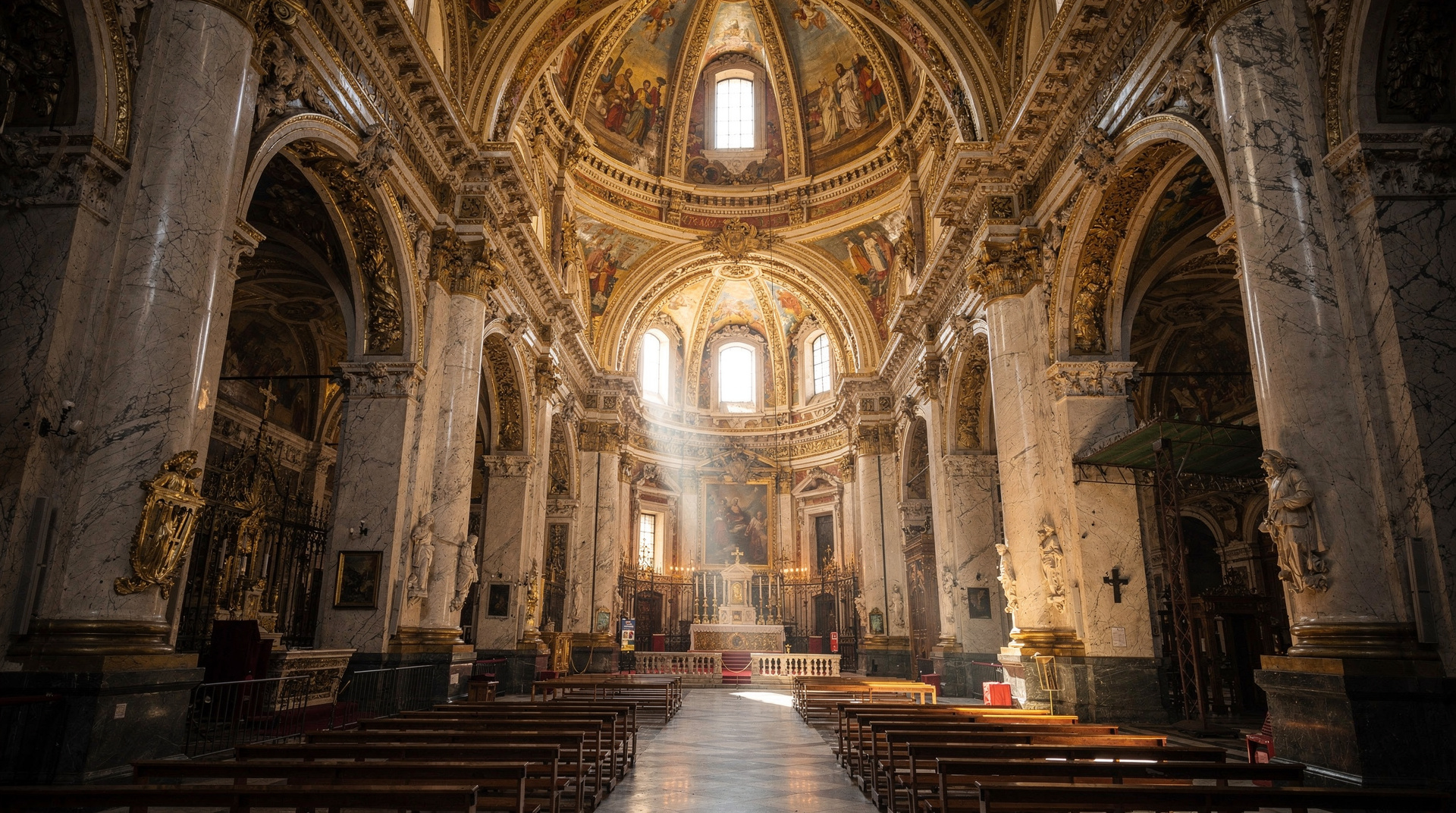
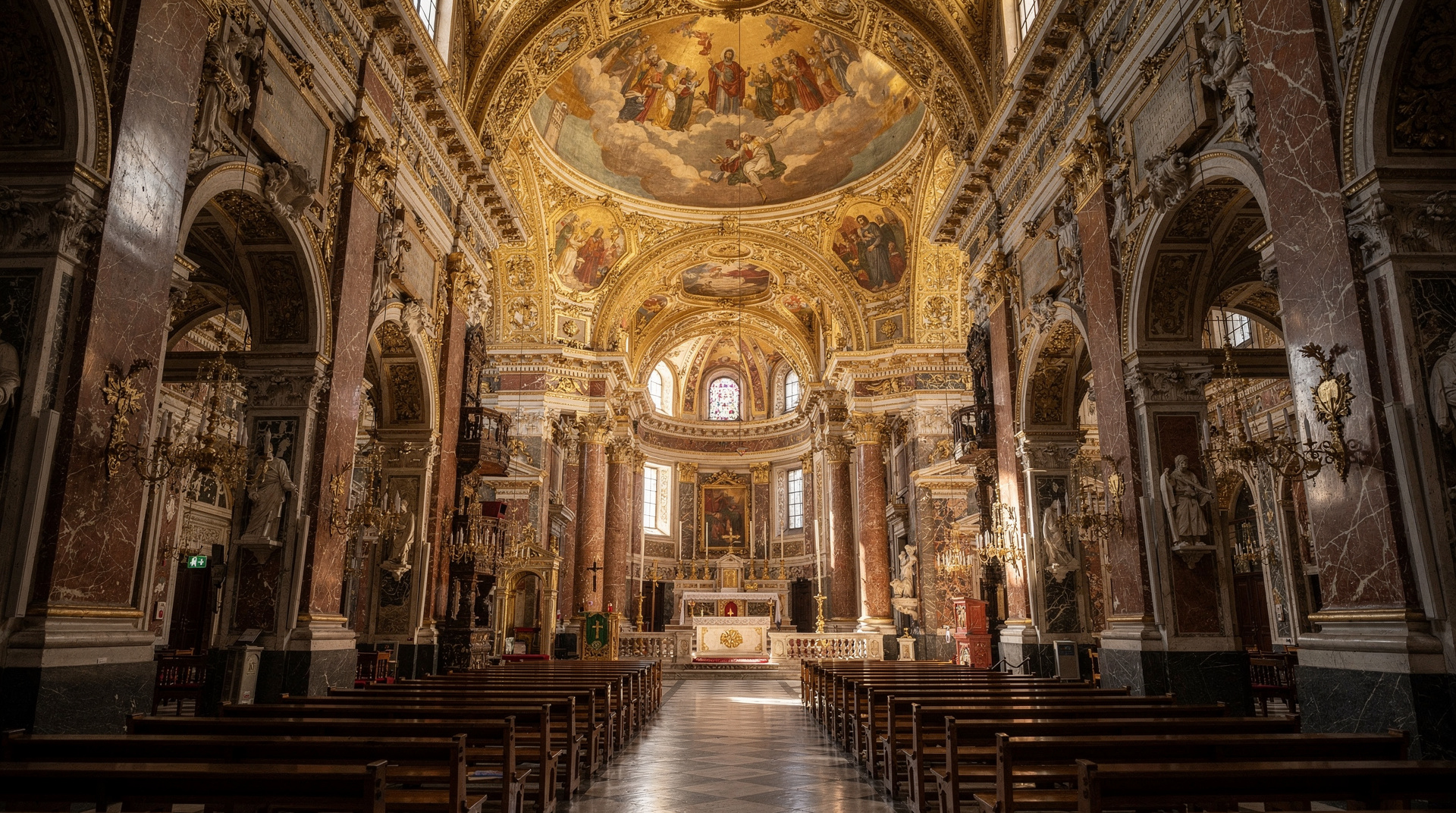
The Chapel: The palace’s private chapel retains its 18th-century marble and gilded decoration. The altarpiece is by Luca Giordano.
The King’s Bedroom: Furnished with period pieces; the bed and the furniture are genuinely from the royal period.
Porcelain collections: Scattered through the apartments are pieces from the Capodimonte manufactory — the royal porcelain factory founded by Charles of Bourbon in 1743. Compare these with the larger collection at Capodimonte museum.
Paintings: The apartment walls display a mix of royal portraits, historical paintings, and decorative works. Not the highest quality in Naples (the best painting collections are at the MANN and Capodimonte) but contextually important.
The Teatrino di Corte (Court Theatre)
One of the best reasons to visit. The private court theatre was built in 1768 for performances for the royal family — operas, plays, and private concerts. The theatre is small (it was not for public performances) and exquisitely decorated in the rococo style: gilded boxes, painted ceiling, red velvet.
The main public opera house (Teatro di San Carlo) is directly adjacent to the palace — it was built by Charles of Bourbon in 1737 specifically because he wanted a royal opera house within walking distance of his apartments. The Teatrino is the private complement.
Small-group monumental tour of Palazzo Reale (includes court theatre)The Herculaneum Papyri (National Library)
The Biblioteca Nazionale occupies a wing of the palace. Its most extraordinary holding is the collection of papyrus scrolls from the Villa of the Papyri at Herculaneum — the only substantial ancient library to survive (though in carbonised form, buried by Vesuvius in 79 CE).
Of approximately 1,800 scrolls excavated in the 18th century, about 1,100 survive. Most are works of the Epicurean philosopher Philodemus of Gadara; several are previously unknown ancient texts. Technology (multispectral imaging, tomographic reconstruction) is gradually decoding the carbonised texts.
The library is not a casual visitor destination — it is a working research institution. Occasional exhibitions display papyri. Check the official website for current temporary exhibitions.
Piazza del Plebiscito — worth exploring
Palazzo Reale faces what is arguably Naples’ finest public space. The neoclassical Church of San Francesco di Paola (free entry) across the piazza is a deliberate copy of the Pantheon in Rome, completed 1846.
The equestrian statues in the piazza centre show Charles III of Bourbon (left) and Ferdinand I (right). A Neapolitan tradition involves walking blindfolded between the statues — if you can navigate the gap without looking, the next year will be lucky. The probability of success is discussed at length by locals.
In the evening, the square is illuminated and less tourist-heavy than during the day — one of the better evening ambient spaces in the city.
Practical notes
Duration: 60–90 minutes for a thorough visit. The royal apartments alone take 45 minutes. Adding the court theatre extends this.
Audio guide: Available at the entrance (€5) or via the official app. The audio guide for the tapestry room is particularly informative.
Photography: Permitted without flash throughout.
Café: No café inside the palace; the nearby Galleria Umberto I has multiple café options.
Combination with San Carlo: The Teatro di San Carlo is directly adjacent — guided tours of the opera house (€10) can be combined with a Palazzo Reale visit in the same half-day.
Frequently asked questions about the Royal Palace Naples
Is Palazzo Reale better before or after lunch?
No strong preference. Morning light is better for the facade photographs (south-facing piazza is bright in the morning). Afternoon visits are slightly less crowded. The interior lighting is artificial throughout.
Can I visit the National Library’s papyrus collection?
Only during specific exhibitions or with advance research registration. The library is not a public museum. Check the Biblioteca Nazionale website for upcoming exhibitions.
What is the difference between Palazzo Reale and Caserta?
Both are Bourbon royal palaces. Palazzo Reale in Naples was the in-city working palace; Caserta (45 km north) was the grand ceremonial palace — larger than Versailles. Both are open to visitors. Caserta requires a half-day or full day; it is a popular day trip from Naples. See Caserta Royal Palace day trip.
Is the Palazzo Reale decorated differently in the Spanish and Bourbon periods?
Yes, substantially. The Spanish period decoration was largely destroyed or covered during the Bourbon redecoration in the 18th century. What visitors see today is primarily 18th-century Bourbon work, with some Napoleonic Empire-style overlays in specific rooms.
Are the Flemish tapestries in Palazzo Reale original?
Yes. The tapestries in the Diplomatic Hall were woven in Brussels in the early 18th century — the series on the history of Troy. They were purchased by the Bourbon royal family and have been in Naples since the 18th century. They are approximately 4–5 metres high and cover the complete walls of the room.
Pairing Palazzo Reale with the rest of Piazza del Plebiscito
The palace works best as part of a single circuit around Naples’ royal core rather than as an isolated visit. Castel Nuovo (Maschio Angioino) is a five-minute walk toward the port and covers the earlier Angevin period the palace’s facade statues only summarise. Castel dell’Ovo, a further ten minutes along the waterfront, adds the oldest fortress in the city and a genuinely different architectural register — medieval rather than Bourbon baroque.
Together with the Teatro di San Carlo next door, these four stops form a natural half-day royal-and-medieval Naples itinerary; the top attractions Naples guide sequences them alongside the rest of the city’s essentials, and the self-guided walking tour folds Piazza del Plebiscito into a broader route through the centre.
For visitors comparing museum options rather than trying to see everything, best museums in Naples ranks Palazzo Reale against MANN and Capodimonte — the short version is that Palazzo Reale wins on atmosphere and royal context, while the other two win on art and archaeology.
Frequently asked questions about Royal Palace of Naples — Palazzo Reale visitor
What is the Royal Palace of Naples?
What is in the Palazzo Reale today?
Is the National Library inside Palazzo Reale?
What are the eight statues outside Palazzo Reale?
Is the Palazzo Reale included in the ArteCard?
How do I get to Palazzo Reale in Naples?
Top experiences
Bookable activities with verified prices and instant confirmation on GetYourGuide.