Lungomare and Mergellina
Naples' seafront promenade runs from Castel dell'Ovo past Villa Comunale to Mergellina port — the city's living room, ferry departure point, and evening walk.
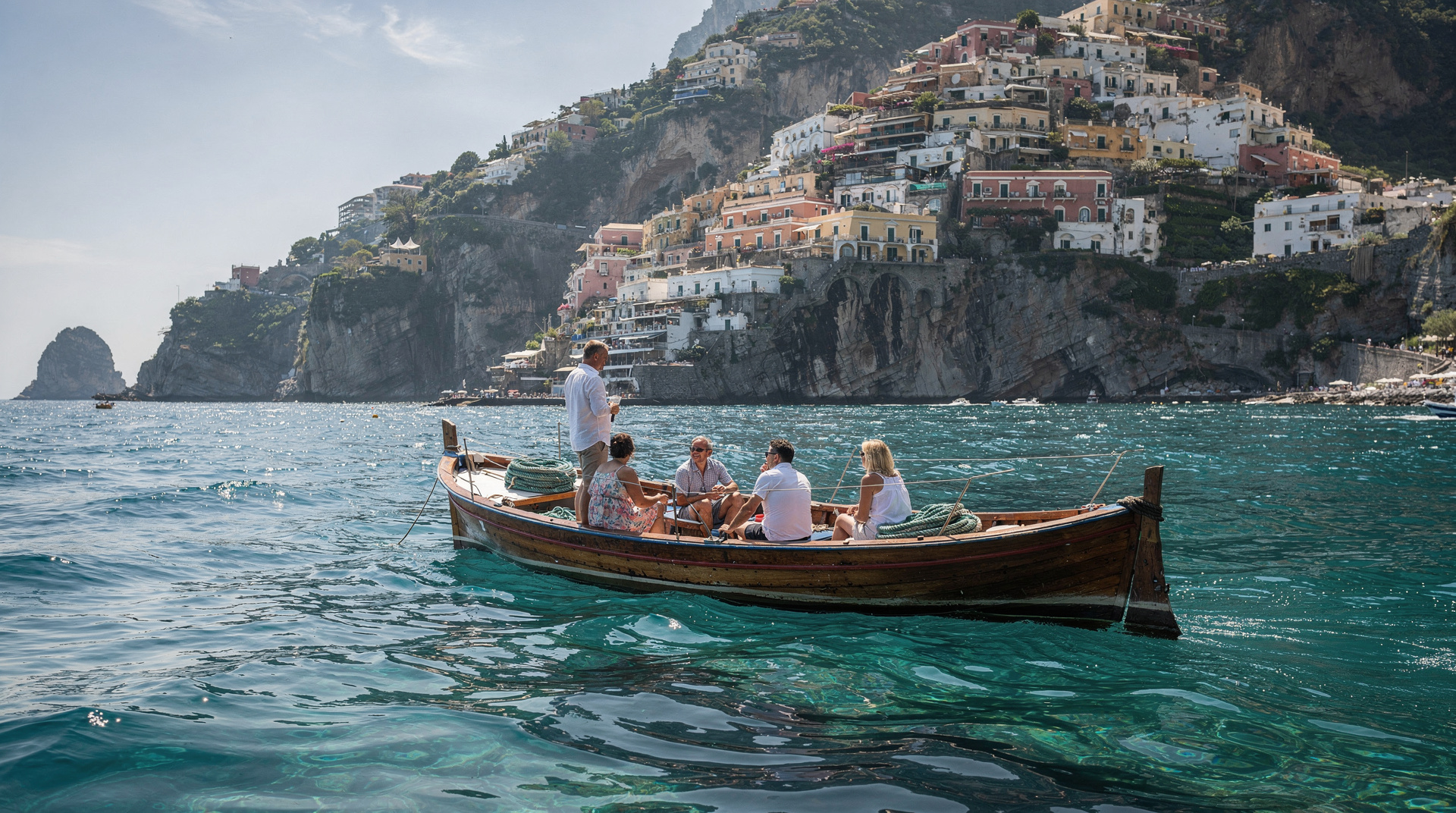
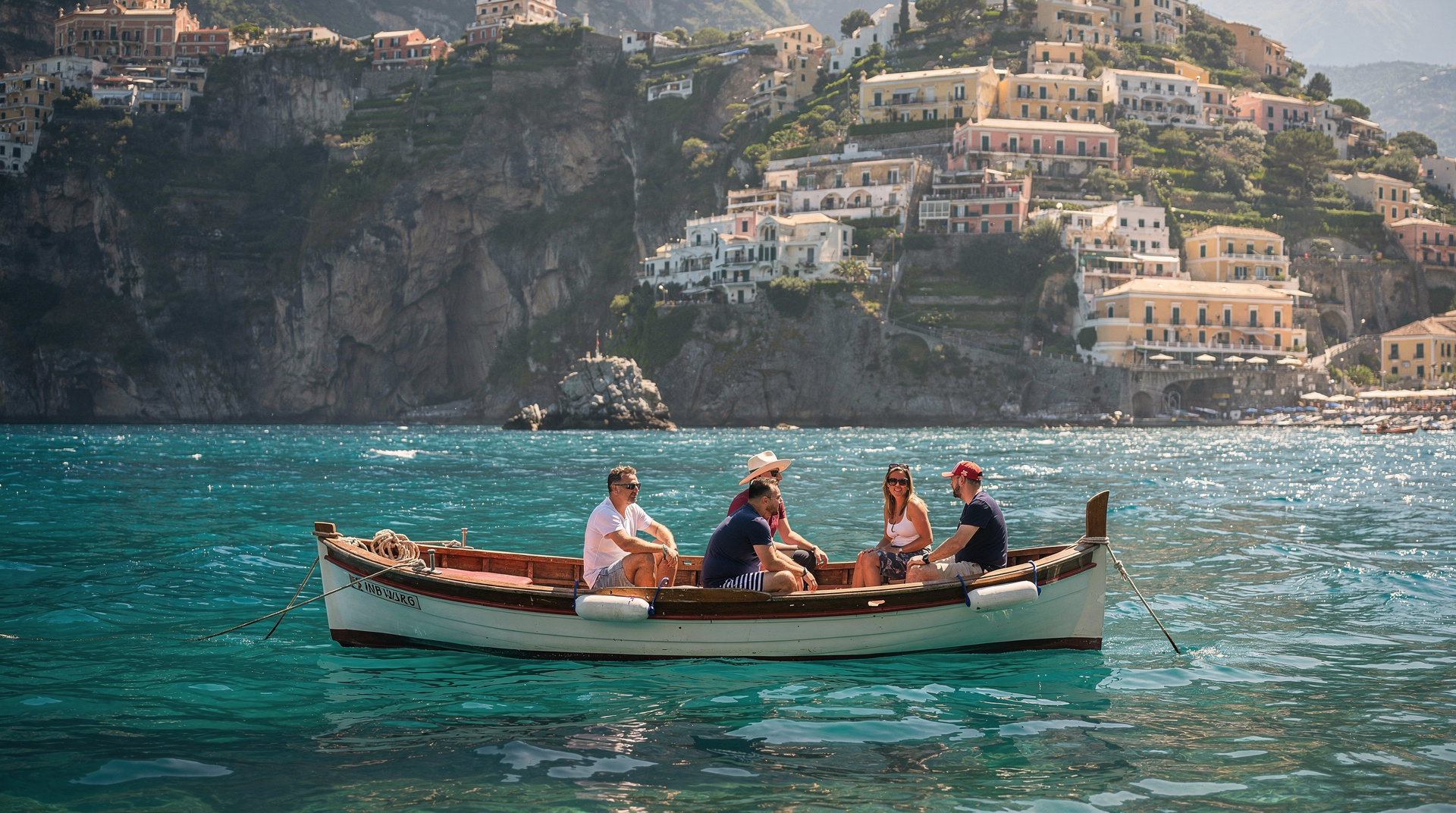
Naples: Castel dell'Ovo Boat Tour with Snorkeling & Aperitif
Duration: 3h
Quick facts
- Length
- ~2.5 km from Castel dell'Ovo to Mergellina port
- Key landmarks
- Castel dell'Ovo, Villa Comunale, Piazza Vittoria, Mergellina ferry port
- Ferries from Mergellina
- Hydrofoils to Capri (~50 min) and Ischia (~55 min)
- Character
- Pedestrianised promenade, seafront bars and restaurants, evening walk
- Metro access
- Mergellina station (Line 2); Piazza Vittoria (Line 1, under construction)
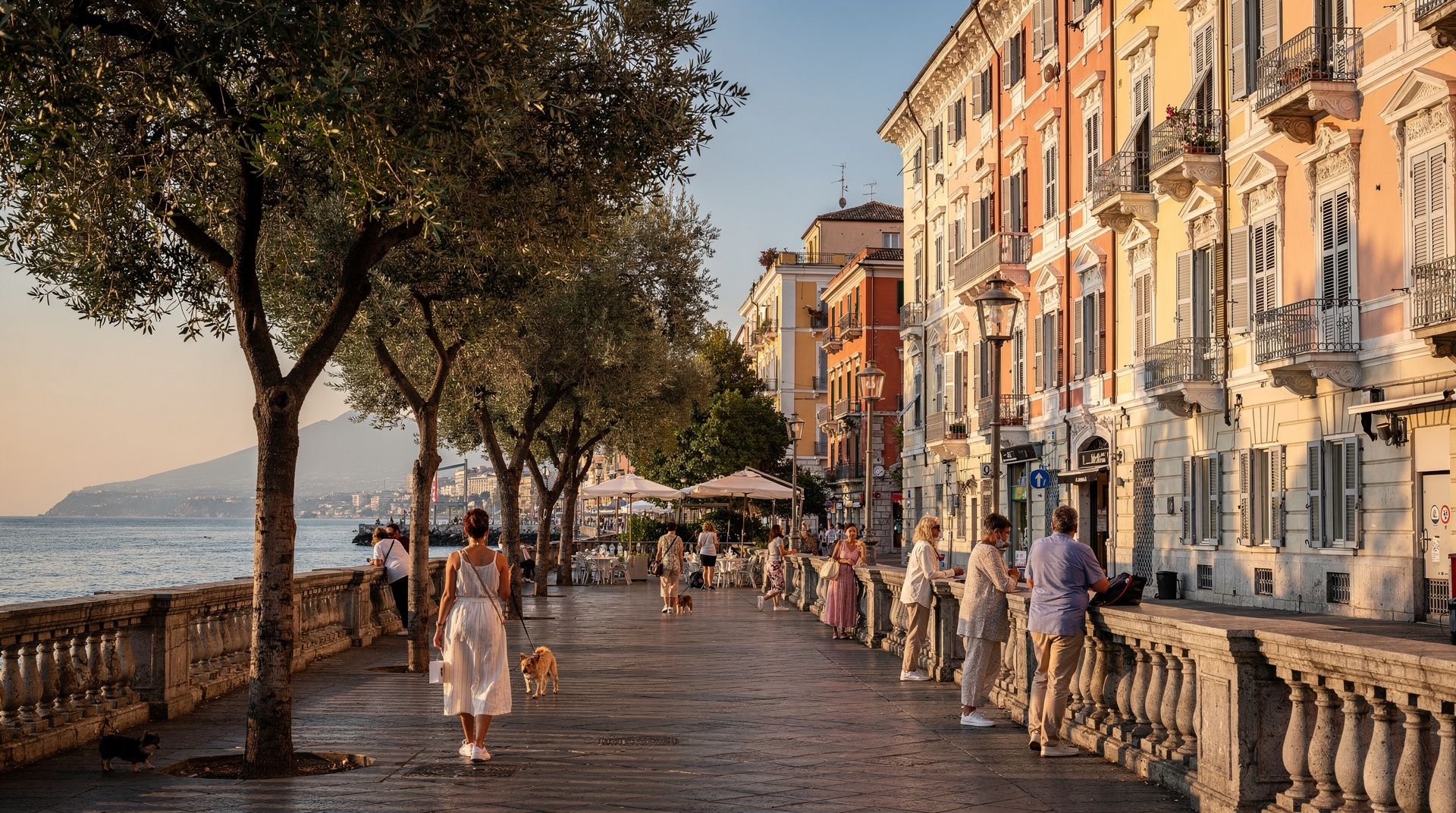
The Lungomare Caracciolo is the long seafront promenade that runs along the southern edge of Naples from Castel dell’Ovo to the Mergellina port, a distance of roughly 2.5 kilometres. It is the city’s most used public space — the place where Neapolitans walk in the evenings, where families occupy benches on Sunday mornings, where teenagers on scooters make passes after dark. Tourists walk it too, but it never feels like a tourist attraction in the way that Spaccanapoli or the centro storico does.
| Where | Naples seafront, Castel dell’Ovo to Mergellina, ~2.5 km |
| Cost | Free to walk; Aquarium ~2–3 €; gelato ~2,50–3,50 € |
| Time needed | Half-day for the walk; evening 18:00–21:00 for the full ritual |
| Getting there | Metro Line 2 to Mergellina, or 20-min walk from Piazza Plebiscito |
| Best time | Year-round for the walk; April–October for evening dining |
Castel dell’Ovo
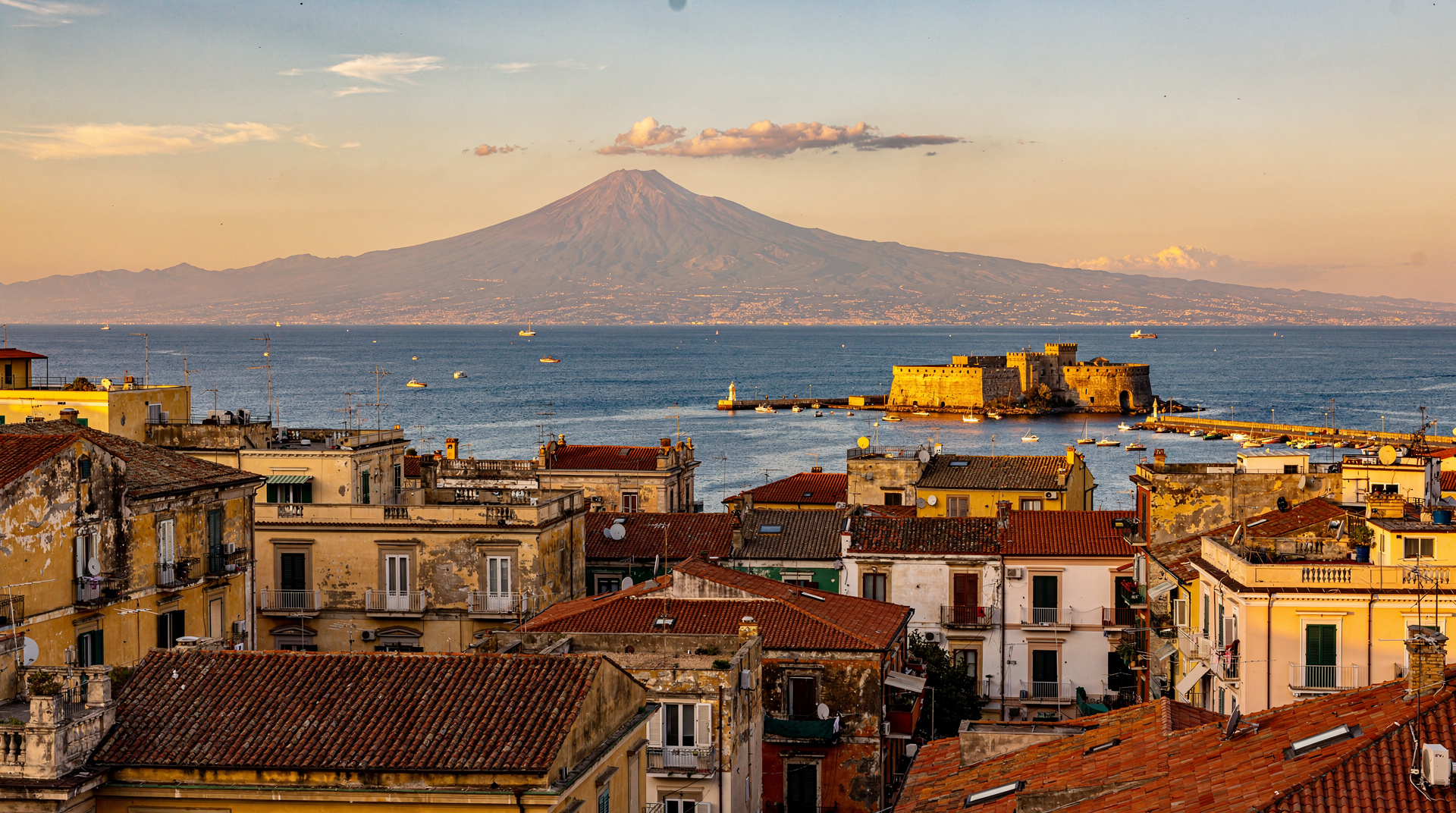
The castle on the small island of Megaride — connected to the mainland by a causeway — is the oldest standing castle in Naples, built on the site of the original Greek settlement (6th century BC) and later the location of a Roman villa. The current structure is medieval, built by the Normans, extended by the Hohenstaufen and Angevin dynasties.
The name “Egg Castle” comes from a legend attributed to the poet Virgil, who was believed (in medieval tradition) to have been a magician. He supposedly concealed a magical egg in the castle’s foundations; if the egg were ever broken, the castle and the city would be destroyed. This is obviously not literally true, but it is the kind of story that reveals how seriously medieval Naples took its relationship with magic.
The castle interior is open to visitors (free, but check current access as parts are closed for restoration at different times). The upper terraces give good views of the bay, the Lungomare, and Vesuvius. The castle hosts occasional cultural events and temporary exhibitions.
The Borgo Marinaro below the castle walls is a small harbour with several seafood restaurants. Prices are elevated relative to the quality — you are paying for the view and the postcard setting. Walk north for better value.
Castel dell’Ovo boat and snorkel excursion from the Naples waterfrontThe Lungomare walk
The pedestrianised section of Via Caracciolo runs from Castel dell’Ovo to Villa Comunale with the sea on one side and a row of upscale hotels, restaurants, and residential buildings on the other. The walk is flat, wide, and well-lit — genuinely pleasant in a way that not all urban promenades manage.
Via Partenope (the section immediately adjacent to Castel dell’Ovo) is lined with restaurants — some with outdoor terraces directly overlooking the bay. These restaurants are considerably more expensive than equivalents a few streets back; budget 40–60 €/person for dinner. The setting is undeniably good.
The promenade passes the Fontana del Carciofo (Artichoke Fountain, a 17th-century baroque fountain relocated here) and reaches Villa Comunale — the public gardens running parallel to the sea, with the Anton Dohrn Aquarium inside (the oldest public aquarium in Europe, founded 1872).
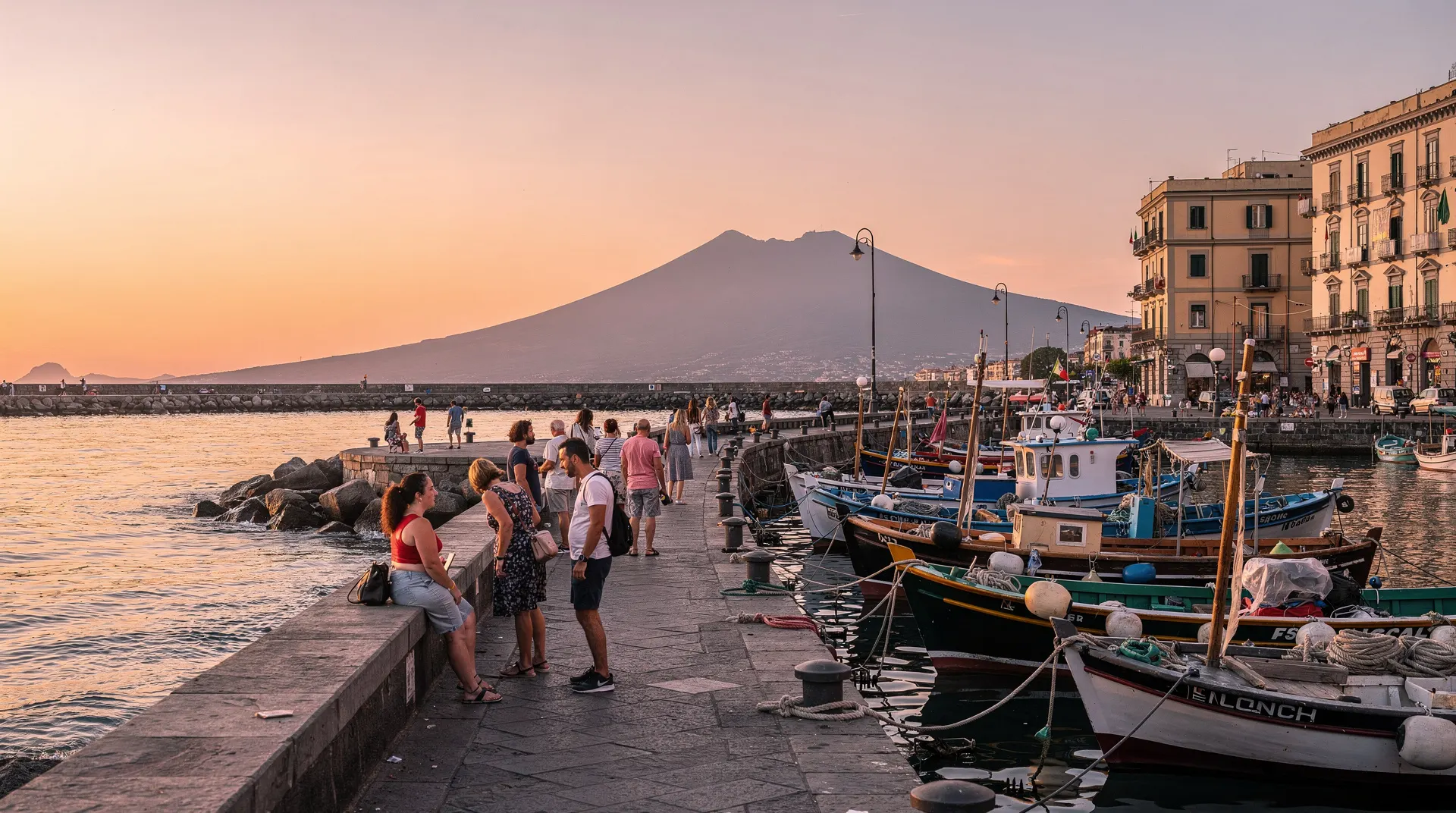
Evening on the Lungomare. In spring and summer, the promenade fills from about 18h onwards. Gelato, lemon granita, and fried pizza are sold from kiosks. The light over Vesuvius at dusk is consistently good. For the full evening guide, see Lungomare evening walk and Naples at night.
Mergellina
Mergellina, at the western end of the Lungomare, is a small harbour (porto) that serves as the second-most-important ferry port in Naples. From here, SNAV and Caremar hydrofoils depart to Capri (approximately 50 min, around 21 €) and Ischia (around 55 min). These are passenger-only fast ferries; car ferries depart from the main Porta di Massa port further east.
Mergellina is a useful departure point for day trips to the islands — particularly for visitors staying in Chiaia, since it avoids the longer transit to Molo Beverello. However, frequency is lower than from Molo Beverello, and some seasonal routes only run from the main port. Always verify your departure point when booking. See the ferries guide for all options and the Beverello vs Porta di Massa comparison.
The harbour area has a small fish market in the early mornings, several iced seafood counters selling portions of raw clams (tartufo di mare) directly on the dock, and numerous gelaterias — Mergellina has a reputation for good gelato, particularly at Chalet Ciro a Mergellina (founded 1933).
Running, cycling, and exercising on the Lungomare
The Lungomare is the default fitness route for anyone staying near the seafront, and it works well for visitors too. The flat 2.5 km stretch between Castel dell’Ovo and Mergellina is fully paved and mostly free of the scooter traffic that makes running elsewhere in Naples stressful — Via Caracciolo is pedestrianised on weekends and holidays, and even on weekdays the promenade itself (as opposed to the parallel road) is walkers-and-runners only.
Early morning (before 8h) is the best window: the light over the bay is good, the temperature is manageable even in summer, and the promenade is shared mostly with other runners and dog walkers rather than the evening crowds. A there-and-back run from Castel dell’Ovo to Mergellina and back covers exactly 5 km — a convenient benchmark distance.
Bike rental is available seasonally from a few kiosks near Piazza Vittoria and Mergellina, typically 5–8 €/hour. Combined with the flat profile, this makes the Lungomare one of the very few places in Naples where casual cycling is genuinely pleasant rather than an exercise in dodging traffic. For a guided version that also covers Posillipo’s hillier roads, see the panoramic e-bike tour.
Villa Comunale in detail: gardens, aquarium, and the carousel
Villa Comunale deserves more than a passing mention. Laid out in the late 18th century under the Bourbons as a royal promenade, it now functions as Naples’ most-used central park — a strip of gardens roughly 1 km long, running parallel to Via Caracciolo, planted with palms, magnolias, and century-old plane trees.
The Stazione Zoologica Anton Dohrn (the aquarium inside the park) opened in 1874 and is the oldest public aquarium in Europe still operating in its original building. It is small by modern aquarium standards — nine tanks showing Mediterranean marine life native to the Bay of Naples rather than an exotic global collection — but the building itself, with its 19th-century ironwork and the attached marine biology research station (still active), is part of the appeal. Entry costs around 2–3 €, among the cheapest paid attractions in the city; visits take 30–45 minutes.
The park also has a traditional carousel (giostra) near the Piazza della Repubblica end, playgrounds used by local families, and several drinking-water fountains (the nasoni, Naples’ cast-iron public taps) along the central path. Benches under the plane trees are a genuinely pleasant place to eat gelato away from the more exposed seafront.
Piazza Vittoria and the city connection
Piazza Vittoria is a wide open square at roughly the midpoint of the Lungomare, where the promenade connects to the uphill streets of Chiaia. The square marks the end of the main hotel strip along Via Partenope and the beginning of the more residential sections of the waterfront. Villa Pignatelli (a 19th-century neoclassical villa converted to a museum) is on the north side.
The Metro Line 1 extension will eventually add a station here; as of 2026, the nearest metro is Amedeo (Chiaia, ~10 min walk north) or the future Piazza Vittoria station.
Via Santa Lucia and the hotel strip
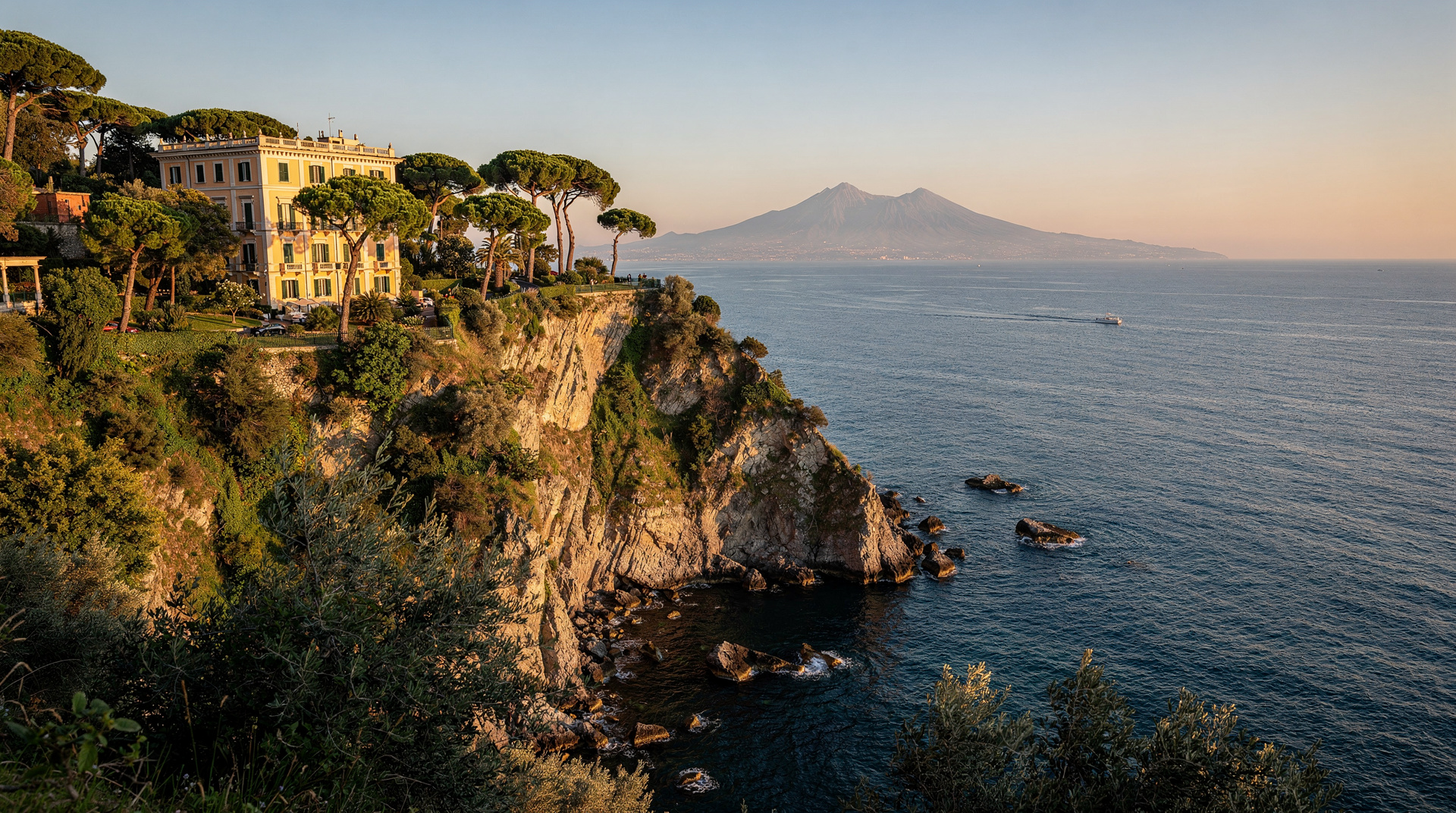
Between Castel dell’Ovo and Piazza Plebiscito runs Via Santa Lucia, Naples’ most prestigious hotel street. The grand 19th-century and early-20th-century hotels here — Grand Hotel Santa Lucia, Hotel Vesuvio, Hotel Royal — face the bay with Vesuvius in the background. This is the Naples of 19th-century grand tour literature: Goethe and Shelley wrote about the view from this strip. The hotels are expensive; the views are extraordinary.
The street connects the waterfront to Piazza del Plebiscito, making it a natural pedestrian link between the historic centre and the seafront.
Seafront dining: what to expect
The restaurants along Via Partenope and Via Santa Lucia occupy the most expensive real estate in Naples and price accordingly. Expect to pay:
- First course (pasta, risotto): 16–24 €
- Fish main: 22–35 €
- Coperto (cover charge): 2–4 € per person
- House wine (carafe): 10–18 €
The fish is genuinely fresh — the proximity to the harbour is real. The cooking is reliable Neapolitan, not spectacular. You are paying significantly for the view and the address. If your budget doesn’t accommodate this, the Lungomare is equally enjoyable as a walk and for gelato, and you eat elsewhere.
A functional mid-range alternative: restaurants on Via Santa Lucia slightly back from the water, or the streets immediately behind the waterfront strip, charge 20–30 % less for the same standard.
Ferries from Molo Beverello — the main island port
A note for clarity: the main ferry port for islands (Capri, Ischia, Procida) is Molo Beverello, which is east of Castel dell’Ovo — a 20-min walk from the Castel along the waterfront, or a short taxi. This is where the majority of hydrofoil services depart, with more frequency and more routes than Mergellina.
Calata Porta di Massa is immediately adjacent to Molo Beverello (300 metres) and handles the slower car ferries. If you are arriving by car ferry, this is where you disembark; the two ports serve different services and are not interchangeable. See ferries guide and the Beverello vs Porta di Massa comparison.
The Pignasecca market
Walking north from the Lungomare into the neighbourhood between Chiaia and the historic centre, you reach the Pignasecca market — an outdoor food market that has operated continuously in this location since the 17th century. Stalls sell fish, vegetables, fruit, and street food. The market runs mornings (typically 7h–14h) Monday–Saturday and is one of the most photogenic and authentic food spaces in Naples. Prices are lower than tourist-facing shops. The area directly around it is busy and somewhat scruffy; keep bags secure.
Piazza del Plebiscito in context
The great neoclassical square adjacent to the Royal Palace is technically the hinge between Chiaia and the historic centre, but it is accessed from the Lungomare via Via Santa Lucia. The square was restored in the 1990s and is now fully pedestrianised. The church of San Francesco di Paola (modelled on the Pantheon in Rome) closes the western end. At night, the square is lit and used for events; in winter, a large Christmas market operates here.
Practical information
Getting there. From the historic centre, the Lungomare is a 20-min walk south via Piazza Plebiscito and Via Santa Lucia. From Chiaia, Via Partenope is a 10-min walk south from Piazza Amedeo. Metro Line 2 to Mergellina station connects from Napoli Centrale (Piazza Garibaldi).
Ferry access. For Molo Beverello (main hydrofoil port for Capri, Ischia, Procida), allow 20-min walk east from Castel dell’Ovo, or a short taxi. Do not confuse Molo Beverello with Calata Porta di Massa — they are adjacent but serve different routes. See ferries guide.
Parking. Street parking along the Lungomare is limited and monitored. If you must drive, the Parcheggio Via Caracciolo is available but fills quickly on weekends.
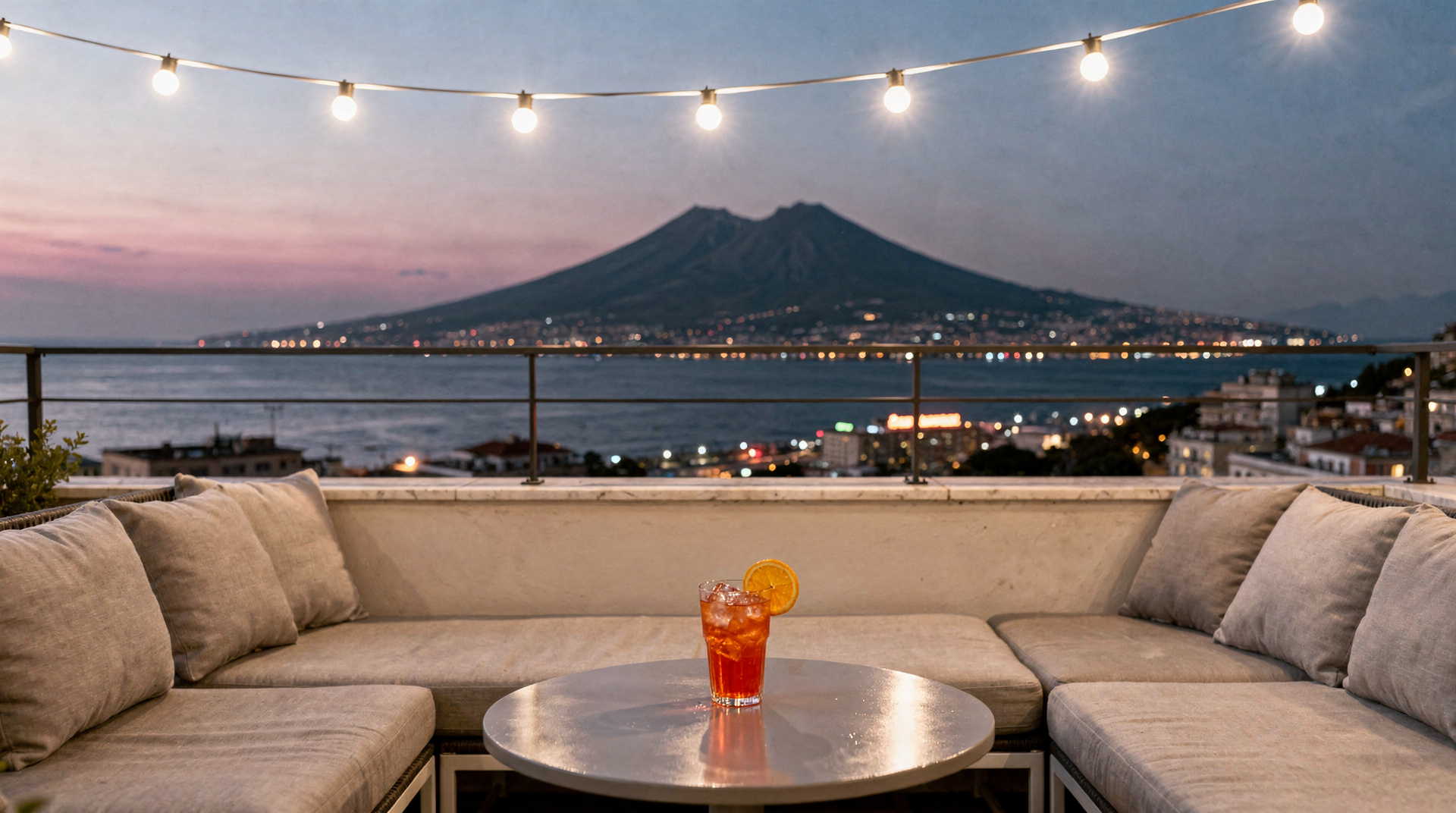
Naples by night — evening food and wine tour along the waterfrontConnecting the waterfront to day trips
For visitors planning island day trips, the logistics of the waterfront are important to understand:
Capri by hydrofoil: fastest from Molo Beverello (20 min walk east of Castel dell’Ovo). Journey ~45–50 min; tickets ~21–24 € one way. Departures start around 7h. Book in advance in July–August. See Capri day trip guide.
Ischia: similarly from Molo Beverello (hydrofoil ~50 min, ~17 €) or Mergellina (~55 min, similar price). The choice of port depends on where you are staying. See Ischia day trip.
Procida: Molo Beverello only, hydrofoil ~35 min. See Procida day trip.
Timing for early departures: if you are staying in Chiaia and have a 7h30 ferry, allow 25–30 min walk to Molo Beverello (not difficult; the waterfront walk is pleasant). Or a 5-min taxi. Do not assume Mergellina has the same service as Beverello — check your specific tickets.
The evening promenade ritual
The Lungomare between 18h and 21h in spring and summer is Naples at its most sociable. The mechanism: Neapolitans finish work, collect children from school or sports, and head for the waterfront. Grandparents push prams. Teenagers cycle in groups. Couples walk slowly. The gelato kiosks have queues. Street vendors sell roasted nuts, corn, and — in summer — sliced coconut and fresh figs.
The ritual is not performed for tourists, which makes observing it more interesting. There is nothing to buy and nothing to do except walk and watch. The light over the bay in late afternoon (the sun sets behind Posillipo to the west) creates long reflections on the water.
A practical note: the waterfront gelato kiosks charge tourist prices (2,50–3,50 € for a medium cone). The gelaterias one street back into Chiaia or Mergellina charge 1,80–2,50 € for the same. Quality is comparable.
Castel Nuovo from the waterfront perspective
Looking east from the promenade, the square outline of Castel Nuovo (Maschio Angioino) is visible above the port area. Built in 1279 for Charles I of Anjou, the castle anchors the eastern end of the waterfront district. The Renaissance triumphal arch in the entrance — added 1470s — is one of the finest examples of early Renaissance sculpture in southern Italy. Entry around 6 €; the view from the waterfront is free and gives the exterior well. See Castel Nuovo guide.
Budget breakdown for a Lungomare day
The Lungomare is one of the few tourist-facing areas in Naples where free activity dominates:
- Walking the 2.5 km promenade: free
- Castel dell’Ovo exterior: free
- Villa Comunale garden entry: free
- Anton Dohrn Aquarium: ~2–3 €
- Gelato from a kiosk: 2,50–3,50 €
- Coffee at a Mergellina bar: 1–1,20 €
Spending money becomes necessary only if you eat at the waterfront restaurants (30–50 €/person minimum) or take a boat excursion. The promenade itself costs nothing, which makes it particularly useful for a budget Naples visit. See Naples on a budget.
Accessibility
The Lungomare is almost entirely flat and on smooth paving — one of the most accessible routes in Naples for mobility impairment. The Castel dell’Ovo exterior is accessible; the upper terraces have steps. The Anton Dohrn Aquarium has limited internal accessibility. For specific accessibility information across Naples, see accessible Naples.
Frequently asked questions about the Lungomare and Mergellina
Is the Lungomare pedestrianised?
Part of it, yes. Via Caracciolo between Piazza Vittoria and Castel dell’Ovo is closed to private vehicles on weekends and public holidays; during weekdays it has traffic in one direction. Via Partenope (the stretch directly by the castle) is always accessible by car. The experience is pleasanter on weekends when Via Caracciolo is fully pedestrianised.
Can I ferry to Capri from Mergellina?
Yes. SNAV and Caremar hydrofoils depart from Mergellina to Capri and Ischia. Frequency is lower than from Molo Beverello; confirm your route before booking. In winter some Mergellina routes are suspended.
Is Castel dell’Ovo free to enter?
Yes, the exterior and some interior areas are free. Check current access as restoration work periodically closes sections.
What is the best gelato near the Lungomare?
Chalet Ciro a Mergellina (at the Mergellina harbour) has been operating since 1933 and maintains a strong local reputation. Expect to pay 2,50–3,50 € for a cone. Avoid gelaterias with brightly coloured piled gelato (a sign of chemical colourants); look for gelato stored in covered metal containers.
Is it safe to walk the Lungomare at night?
Yes. The Lungomare is well-lit, well-frequented, and considered one of the safest evening spaces in Naples. The Via Partenope strip (hotels and restaurants) is busy until late in season.
Are the Lungomare restaurants good value?
No, not relative to their prices. You are paying for location. The food at a mid-range restaurant in Chiaia or the centro storico costs 20–30 % less for comparable quality. If you want to eat on the waterfront, budget for it as an experience rather than a gastronomy decision.
Can I run or cycle the Lungomare?
Yes — it is Naples’ best route for both. The paved 2.5 km promenade is flat and largely free of scooter traffic, especially before 8h. Seasonal bike rental is available near Piazza Vittoria and Mergellina from roughly 5–8 €/hour.
Is the Anton Dohrn Aquarium worth visiting?
For a short, inexpensive stop, yes. It’s small and focused on Mediterranean species rather than an exotic global collection, but the 1874 building and working marine-research station give it a character larger aquariums lack. Entry is around 2–3 €; budget 30–45 minutes.
Top experiences
Bookable activities with verified prices and instant confirmation on GetYourGuide.