Posillipo
Posillipo is Naples' most scenic coastal promontory — rocky coves at Gaiola, Parco Virgiliano panoramas, and the finest sunsets in the city.
Naples: Electric Bike Tour of Pausilypon Archaeological Park
Quick facts
- Character
- Exclusive residential coastal promontory, villas, rocky coves
- Access
- Bus from Piazza Amedeo or Mergellina; Posillipo funicular (limited); taxi
- Key sites
- Parco Virgiliano, Gaiola underwater park, Capo Posillipo, Palazzo Donn'Anna
- Best for
- Sunset views, coastal walking, snorkelling at Gaiola
- Water access
- Rocky entry points at Gaiola; no sandy beach
The Greek name Pausilypon — “relief from pain” — tells you what ancient Neapolitans thought of this promontory. Posillipo curves westward from Mergellina, dropping steeply to the sea in a series of rocky cliffs, coves, and villas with a commanding view across the Bay of Naples. The neighbourhood today is one of the most expensive residential areas in the city — the kind of place where old families, professionals, and occasional celebrities keep apartments — but most of it is accessible to anyone willing to take a bus.
| Where | Naples’ western coastal promontory, past Mergellina |
| Cost | Free (Parco Virgiliano); Gaiola day permit ~3–5 € |
| Time needed | Half-day; combine with Chiaia or Mergellina |
| Getting there | Bus C16 from Piazza Amedeo, or taxi |
| Best time | Late afternoon for sunsets; April–October for outdoor time |
Parco Virgiliano
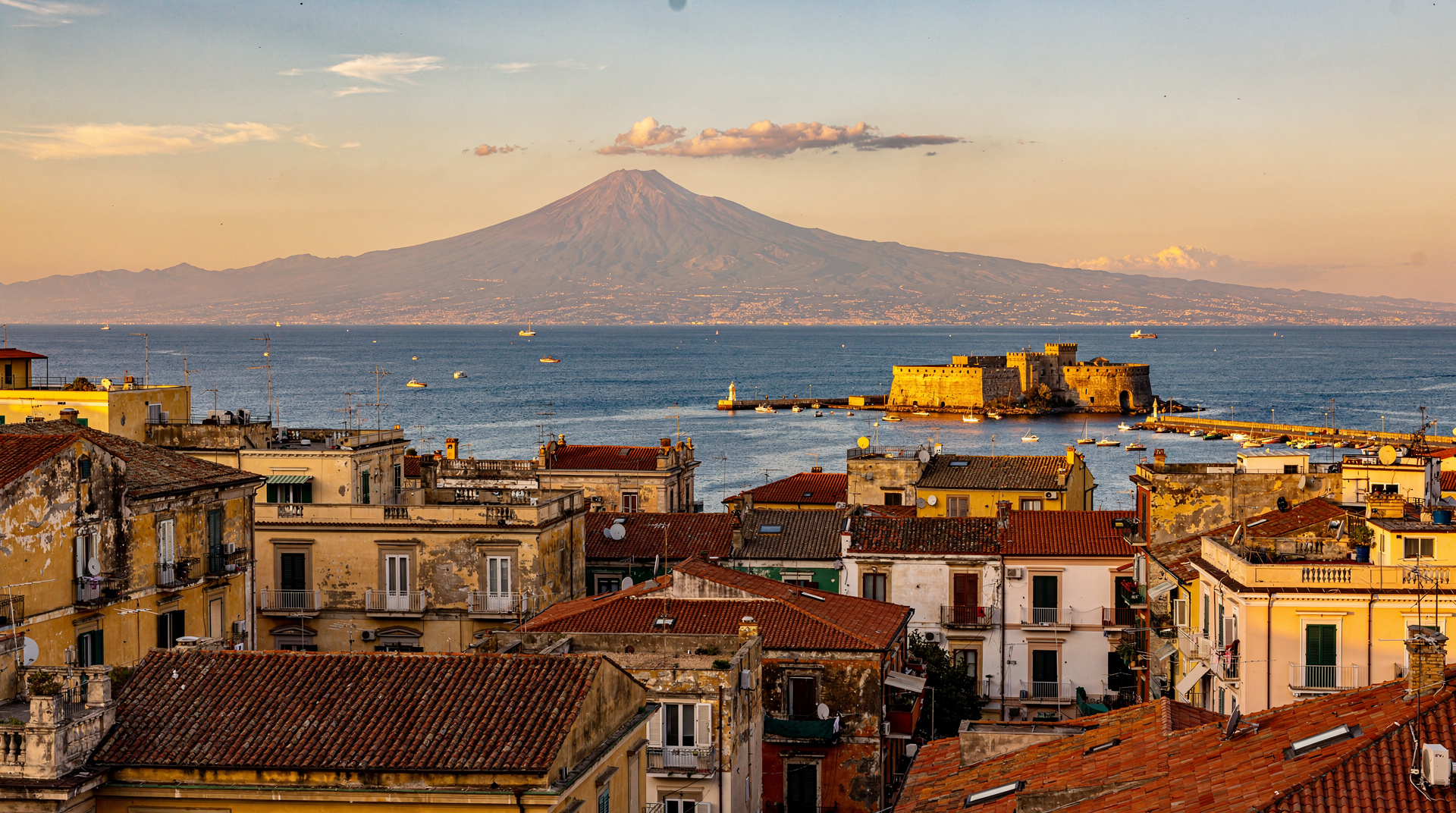
The main public viewpoint in Posillipo is the Parco Virgiliano (also called Parco della Rimembranza), a public park on the highest point of the promontory. The views from the park encompass:
- The Bay of Naples spread east and south
- Mount Vesuvius on the left (east)
- Capri visible on the southern horizon on clear days
- Ischia and Procida to the north-west
- The Campi Flegrei and the Phlegraean coast to the north
This is arguably the most complete panoramic view available in the Naples area. The best light is morning and late afternoon; the park is also used by locals for evening walks and is generally calm.
Entry is free. The park has benches, paths, and a small belvedere structure. Bring water; there are no refreshment facilities inside.
For more viewpoints across the city, see Naples viewpoints.
Gaiola underwater archaeological park
The Area Marina Protetta Parco Sommerso di Gaiola is a small marine protected area centred on two tiny islets connected by a causeway, about 100 metres off the Posillipo coast. The shallow water (3–10 metres) over a Roman villa that partially sank into the sea makes this one of the most accessible underwater archaeological sites in the Mediterranean.
Day use permits allow swimming and snorkelling in the protected zone — apply through the park authority (Centre Sub Posillipo or the Gaiola foundation). Boat access can also be arranged. The ruins are visible without diving equipment in calm conditions.
The site has a persistent reputation for being “cursed” — a string of wealthy 20th-century owners of the adjacent Villa Gaiola (now abandoned) experienced various misfortunes. This is a local legend; the archaeology is real and the snorkelling is exceptional.
Water entry is rocky; water shoes are essential. The site is not suitable for young children.
Palazzo Donn’Anna
The semi-ruined palazzo on the water’s edge at the base of the Posillipo cliffs is one of the most photographed buildings in Naples. Built in the 17th century for Donn’Anna Carafa (according to legend, begun for her marriage to the Viceroy of Naples but she died before it was completed), the palazzo now appears as a romantic ruin with arches opening directly onto the sea. It is privately owned and not open to the public, but visible from the Lungomare and from boats.
The palazzo features in several novels and films set in Naples; it is a useful shorthand for the city’s particular combination of grandeur and dilapidation.
Capo Posillipo
The point where the promontory meets the sea is accessible by a steep path or road descent. There are small private beach clubs (lidi) on the rocks — seasonal access, around 10–15 € for a lounger and umbrella — and free rocky entry points for those who prefer not to pay. The water here is among the cleanest in the greater Naples area.
The road along the coast, Via Posillipo, has traffic but also extraordinary views at every turn.
E-bike tour to Posillipo — Pausilypon, coastal road, panoramic descentGetting to Posillipo
Posillipo is less straightforward to reach than other Naples neighbourhoods. Options:
- Bus: Line C16 from Piazza Amedeo (Chiaia) runs along Via Posillipo past the main access points to Parco Virgiliano and Gaiola. Frequency: approximately every 20–30 min. The journey takes 20–30 min depending on traffic.
- Posillipo funicular: runs from Mergellina to a midpoint on the Posillipo hill. Limited hours; useful for reaching the upper residential area but not the park directly.
- Taxi or rideshare: the most straightforward option. A taxi from Chiaia costs 10–15 €. The road along Posillipo can be slow in summer traffic.
- E-bike tour: commercially organised tours (see above) are a good solution — they handle the navigation and include the best stopping points.
For general getting-around information, see getting around Naples.
The Villa Pausilypon archaeological area
On the northern slope of the Posillipo hill, accessible by a path down from the main road (or by boat from Gaiola), is the excavated site of the ancient Roman villa of Publius Vedius Pollio — the Villa Pausilypon that gives the neighbourhood its ancient name. The site includes a small Roman theatre (the Teatrino di Pausilypon) carved into the tufa cliff, a larger theatre (the Odeon) with remains of seating, and the tunnels and passages of the villa complex.
Augustus inherited the property after Vedius Pollio’s death and used it as a summer retreat. The site passed through various hands and eventually became neglected. Archaeological work in the 20th century revealed the extent of the complex.
The site is managed by the Parco Sommerso di Gaiola and access requires advance booking through the park authority. Visits are guided and numbers are small. The combination of the Roman theatre, the sea view, and the connection to the submerged portions of the villa visible at Gaiola makes this one of the most unusual archaeological experiences in the Naples area.
The road itself: Via Posillipo
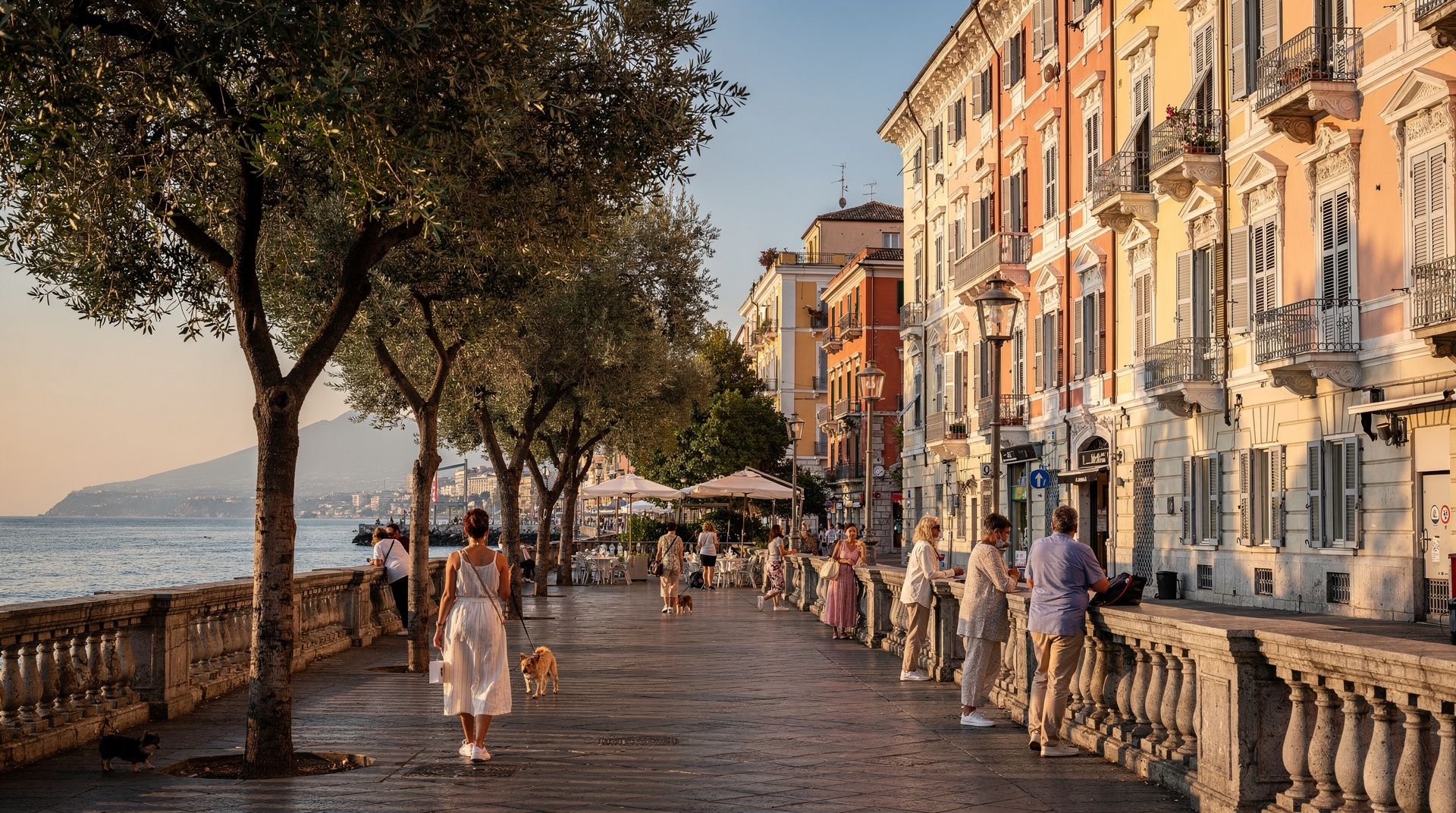
Via Posillipo, the road that runs along the promontory from Mergellina westward, is worth knowing as a driving or cycling route — the views from it are continuous. Every curve reveals a new angle on the bay. Several belvedere pull-offs exist; the most used is the Belvedere di Posillipo near Villa Lauro, with a fenced terrace and a telescope installation.
The road is two-way and narrow in places; it carries local traffic, delivery vehicles, and through-traffic to the outer Posillipo residential areas. In summer (July–August), congestion is significant from about 17h as people come for the sunset. Timing your visit for late morning avoids most of the traffic.
By bicycle or e-bike, Via Posillipo is manageable and considerably more pleasant than by car. Organised tours (see above) handle the direction-finding and the best stopping points.
Swimming and beach access
Posillipo has no sand beaches. The coast is rocky, with small coves and ledges accessible by descending paths or small sets of steps built into the cliffs. Several private lidi (beach clubs) operate on the rocks — seasonal, approximately 15–25 € for a sun lounger and umbrella, with a bar. This is not a cheap-holiday beach; it is an expensive-postcard beach.
The free option is the rocks below the Gaiola islets (access from the park area, rocky entry, water shoes essential) or scattered informal access points along Via Posillipo where paths lead down to the water. The water is clean — cleaner than near the port — because Posillipo is west of the main city drainage outflows.
For actual sandy beaches within reasonable distance of Naples, Ischia and Procida are the best options. See best beaches near Naples.
Sunsets at Posillipo
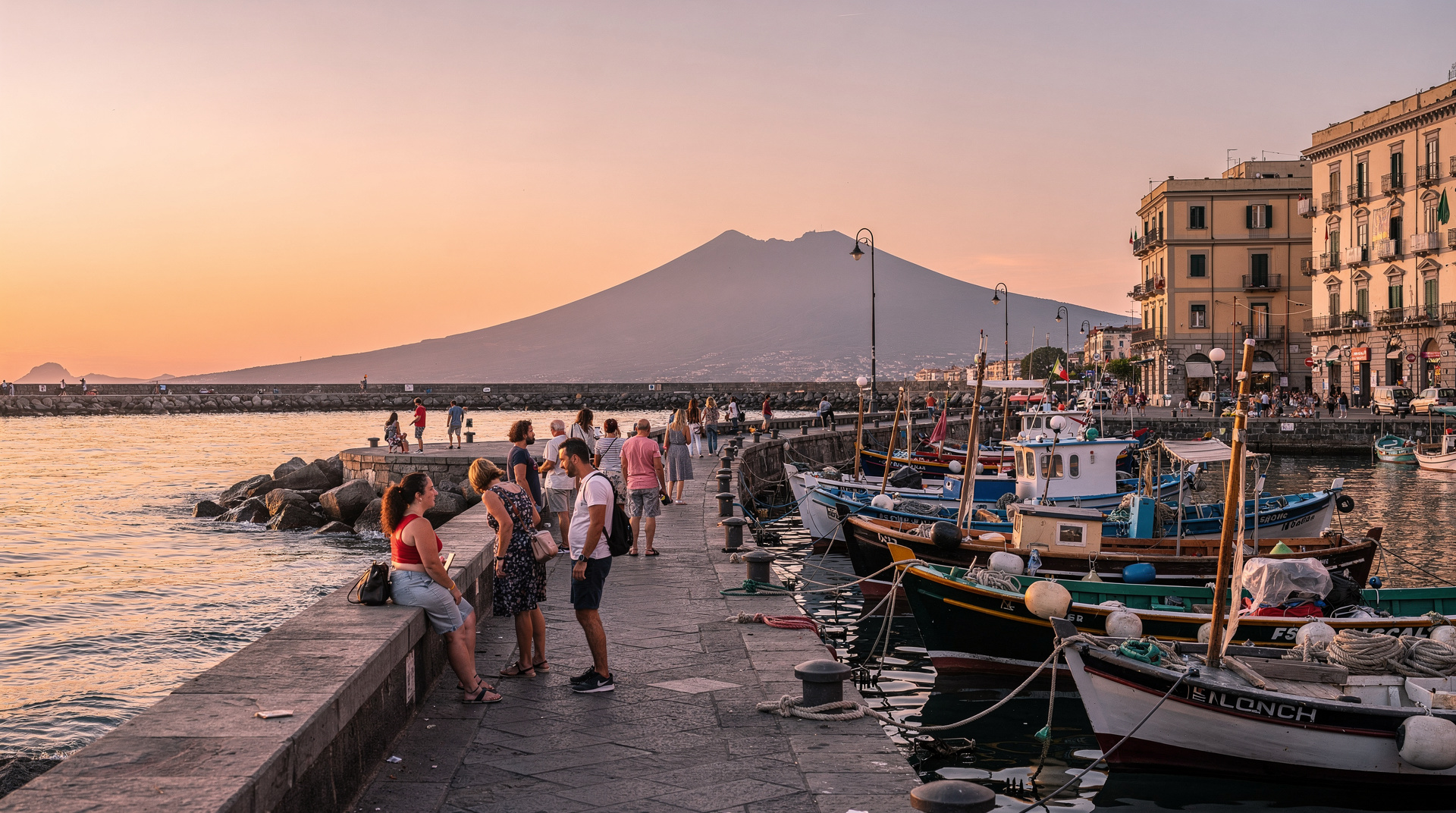
Posillipo faces west and south-west, which makes it the prime sunset-watching location in Naples. The Parco Virgiliano and the various balconies and terraces along Via Posillipo fill with locals and visitors from about an hour before sunset in spring and autumn. In summer, this becomes a ritual — people arrive by car, scooter, and bus, and the road becomes congested. Walking is sometimes faster.
The best dedicated sunset spots: the Belvedere di Posillipo (a terrace off Via Posillipo), the upper section of Parco Virgiliano, and any of the waterfront restaurants with west-facing terraces.
Panoramic e-bike tour — seafront, Posillipo coast, and city highlightsPosillipo in literature and film
The promontory has a long literary trail. Virgil’s tomb is traditionally located at Piedigrotta, at the eastern edge of Posillipo — the Crypta Neapolitana tunnel, carved through the hill in Roman times, passes near the alleged burial site. The attribution is medieval legend rather than fact, but it established the area’s literary mystique.
In the 20th century, Posillipo appears in the novels of Curzio Malaparte (La pelle, 1949), which describes Naples during the Allied occupation of 1943–44. More recently, it features in Elena Ferrante’s Neapolitan novels as the zone of wealthy Naples — the social geography that the working-class protagonists observe from across the city.
Film: several Italian films and international productions have used the Posillipo coastline for its combination of dramatic scenery and accessibility. The Palazzo Donn’Anna, in particular, has appeared in numerous productions as a symbol of noble decline.
Alternative access: by boat
The Posillipo coast is best seen from the water. Several tour operators offer boat tours from the Naples waterfront (Castel dell’Ovo or Mergellina) that pass the Gaiola islets, Palazzo Donn’Anna, and the Pausilypon villa ruins. This is especially useful for visitors who want to see the underwater archaeological elements without obtaining a Gaiola permit in advance. The best boat tours Naples guide covers the options.
Dining at Posillipo
The restaurants on Via Posillipo and at Capo Posillipo are among the most expensive in Naples, with the most spectacular settings. Several occupy converted villas or terraced positions directly above the water.
What to expect: seafood-focused menus (riccio di mare / sea urchin pasta is a regional speciality; fresh catch varies daily), service that skews attentive, and prices that reflect the address (first courses 18–28 €; mains 25–45 €). These are not trap restaurants — the quality is generally legitimate. They are, however, a commitment of both money and time (dinner here is a 2–3 hour event).
For a more casual option, the fish restaurants at the Mergellina harbour (20 min east) offer comparable fresh seafood at 30–40 % less. For a budget option, the Lungomare along the way has street food kiosks.
A specific name: Ristorante Lo Scoglio di Frisio at Capo Posillipo is one of the established names — long history, solid seafood, known to Italian rather than tourist audiences. Reserve in advance; parking is limited.
Neapolitan villas at Posillipo
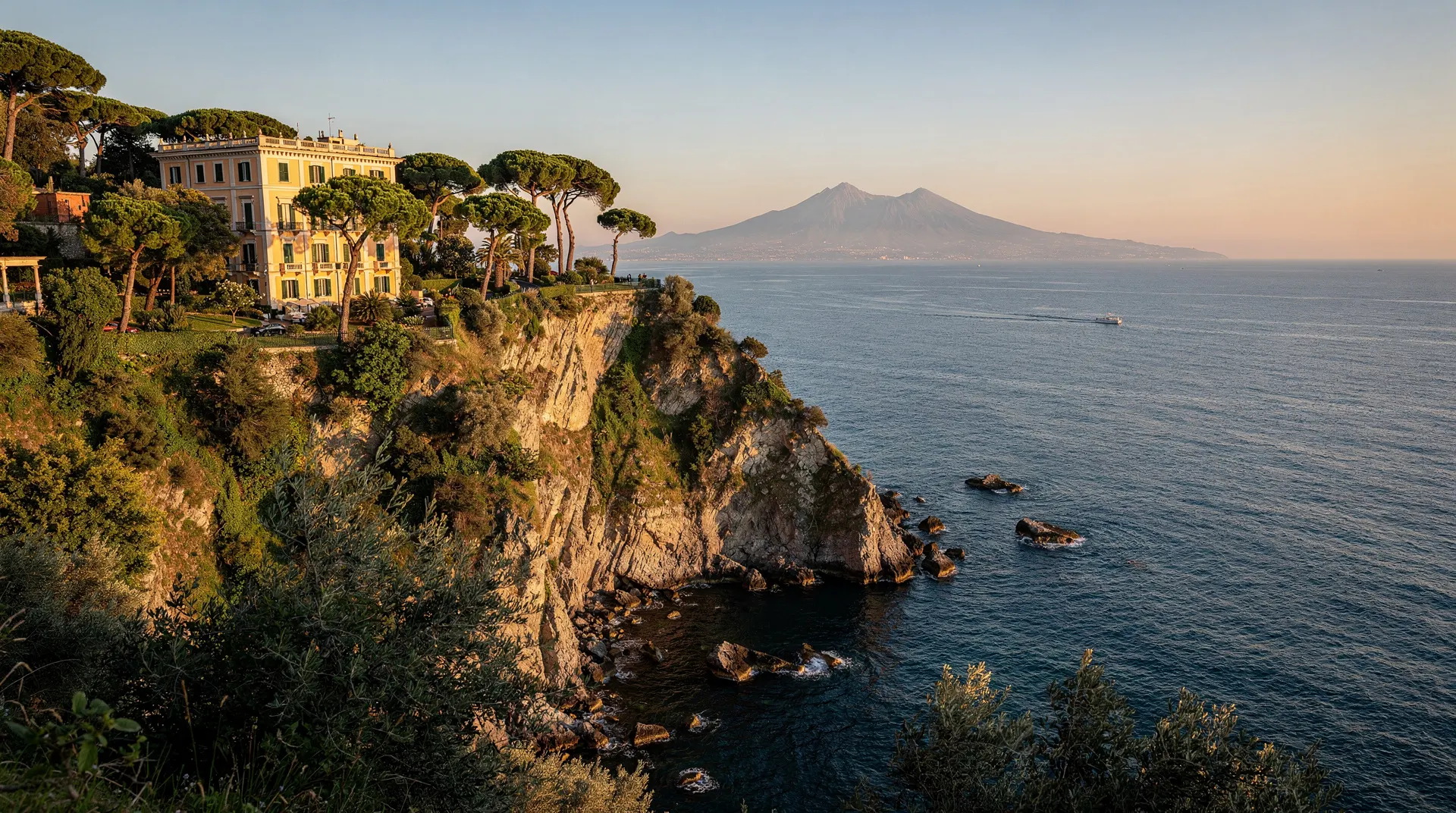
Beyond the Villa Pausilypon archaeological complex, the promontory is lined with historic private villas visible from the road and from the sea. Most are not open to the public:
Villa Rosebery is the official Neapolitan residence of the Italian President, used for official functions and periodic public openings. It occupies a prime position on the promontory with its own waterfront access.
Villa Volpicelli is occasionally photographed from the sea — a coastal villa with a small private harbour that has been used as a film location.
These villas represent the historic use of Posillipo by Naples’ wealthy and aristocratic families, a pattern established in the Roman period and maintained through the Bourbon era and into the present.
Hiking and coastal paths around Posillipo
Beyond the main road and the park, Posillipo has a handful of lesser-known paths that descend from the ridge toward the water, connecting the residential upper slopes to small coves and the Pausilypon archaeological area. These paths are unofficial and unmarked in places, used mainly by locals accessing private stretches of coast, but a few — particularly the descent from near Parco Virgiliano toward the Marechiaro fishing hamlet — are walkable by visitors with reasonable fitness and appropriate shoes.
Marechiaro, at the far western end of Posillipo, is a small former fishing village now absorbed into the neighbourhood’s edge, known for the traditional Neapolitan song “Marechiare” (by Salvatore Di Giacomo) celebrating its window with a view of the sea. The hamlet retains a handful of seafood restaurants at the water’s edge and a small rocky swimming area, considerably less visited than Capo Posillipo. Reaching it requires either the C16 bus to its final stretch or a taxi, as it sits beyond the main tourist-facing section of Via Posillipo.
Posillipo compared with Naples’ other coastal viewpoints
| Viewpoint | Access | Character |
|---|---|---|
| Posillipo (Parco Virgiliano) | Bus/taxi, 20–30 min | Widest panorama, quietest, sunset-focused |
| Castel Sant’Elmo (Vomero) | Funicular | 360° city view, museum inside |
| Lungomare / Castel dell’Ovo | Walking from centre | Sea-level, most accessible, busiest |
| Certosa di San Martino | Funicular + walk | Elevated, museum and gardens combined |
Posillipo wins on the width and drama of its sea panorama and its relative quiet outside sunset hours; the Vomero viewpoints win on ease of access from the historic centre. Combining a Vomero visit in the morning with Posillipo for sunset is a logical way to see both without duplicating transport.
Local weekly markets and neighbourhood rhythm
Posillipo’s commercial life is on Via Posillipo itself — small shops, a supermarket, pharmacies serving the residential population. The neighbourhood has no tourist market; what you find is ordinary Neapolitan daily life at a higher economic register. A neighbourhood food market operates on Via Posillipo near Capo Posillipo on certain mornings (times vary; check locally).
The pace is slower than the city below. Residents have largely opted for Posillipo specifically to be away from the urban intensity; the neighbourhood reflects that choice.
Posillipo for families
The neighbourhood has limited appeal for families with young children as a day excursion — there are no sandy beaches, no dedicated family attractions, and the road access is by bus or taxi rather than walking from the city centre. Parco Virgiliano is pleasant for an hour of outdoor time, but children requiring structured activity will get more from the MANN, Napoli Sotterranea, or the islands.
For families, Naples with kids and family day trips Campania cover options that work better with children in tow.
Photography at Posillipo
For photographers, Posillipo offers a genuinely different register from the crowded viewpoints of the historic centre. The wide, uninterrupted sweep from Parco Virgiliano works well with a standard lens in the golden hour before sunset, when Vesuvius and the bay pick up warm light with none of the haze that often affects midday shots from lower vantage points. The Belvedere di Posillipo, slightly lower and closer to the water, gives a tighter composition with Palazzo Donn’Anna or the Gaiola islets in the foreground.
Blue hour (the 20–30 minutes after sunset) is arguably better for photographs than the sunset itself, since the sky retains colour while the city lights along the bay begin to switch on — a combination the more famous Naples viewpoints (Castel Sant’Elmo, San Martino) can’t quite replicate given their different orientation. Bring a tripod if serious about long exposures; the park benches offer a stable alternative in a pinch. For more angles across the city, the best photo spots in Naples guide has a fuller list.
Budget and realistic cost
A half-day at Posillipo costs:
- Bus ticket: 1,20 € each way
- Parco Virgiliano entry: free
- Gaiola day permit: around 3–5 € per person (plus water shoes if you don’t have them)
- Gelato / snacks: 3–5 €
- Lunch (if eating in the neighbourhood): 18–35 €/person depending on whether you eat at a waterfront restaurant or a simpler option
If you avoid the waterfront restaurants, the excursion is very low-cost. If you eat at one of the terrace restaurants over the sea, budget 35–50 €/person for a proper lunch. There is no middle ground in Posillipo’s restaurant offer.
Frequently asked questions about Posillipo
Is Posillipo worth visiting on a short trip to Naples?
On a 2-day visit, probably not — the centro storico, MANN, and Spaccanapoli are higher priority. On a 3+ day visit, a half-day at Parco Virgiliano and Gaiola adds a dimension — sea air, coastal views, a different pace — that is genuinely different from the urban sightseeing elsewhere.
Can I swim at Gaiola?
Yes, with a day permit from the park authority. The entry is rocky and requires water shoes. The site is not guarded as a lifeguard beach; it is a marine reserve with some visitor management.
Is Posillipo safe?
Yes, it is one of the most comfortable and low-crime areas in the greater Naples area. The residential character and the presence of well-off locals keeps the general atmosphere calm.
How do I get the best sunset views?
Go to Parco Virgiliano (free, open to dusk) or take a bus along Via Posillipo toward Capo Posillipo. Arrive at least 30 min before sunset for a good position. In summer, the road can be slow by car — the bus or a walk from lower Posillipo is more reliable.
Are there restaurants in Posillipo?
Several, mostly upscale, some with spectacular terraces over the water. Prices reflect the location. For a special dinner with a view, this is one of the best options in Naples — but budget accordingly and book ahead.
What is the Pausilypon archaeological site?
The ancient Roman villa of Vedius Pollio (the Latin name survives in the neighbourhood’s Greek-derived name) is accessible as part of a guided visit to the Parco Sommerso di Gaiola or via separate cultural site access. The villa complex includes a small theatre. Tours must be booked through the park authority.
Is Marechiaro worth visiting?
Yes, if you have time beyond the main Posillipo sights — it’s a quieter, less commercial fishing hamlet at the far end of the promontory, known for a famous Neapolitan song and a small rocky swimming area. It requires a longer bus ride or taxi than the main Parco Virgiliano/Gaiola area.
How does Posillipo compare to the Vomero viewpoints?
Posillipo has the wider, more dramatic open-sea panorama and is quieter outside sunset hours; Vomero’s Castel Sant’Elmo gives a 360° city view and is easier to reach from the historic centre by funicular. Combining both — Vomero in the morning, Posillipo for sunset — covers Naples’ best viewpoints in a single day.
Top experiences
Bookable activities with verified prices and instant confirmation on GetYourGuide.