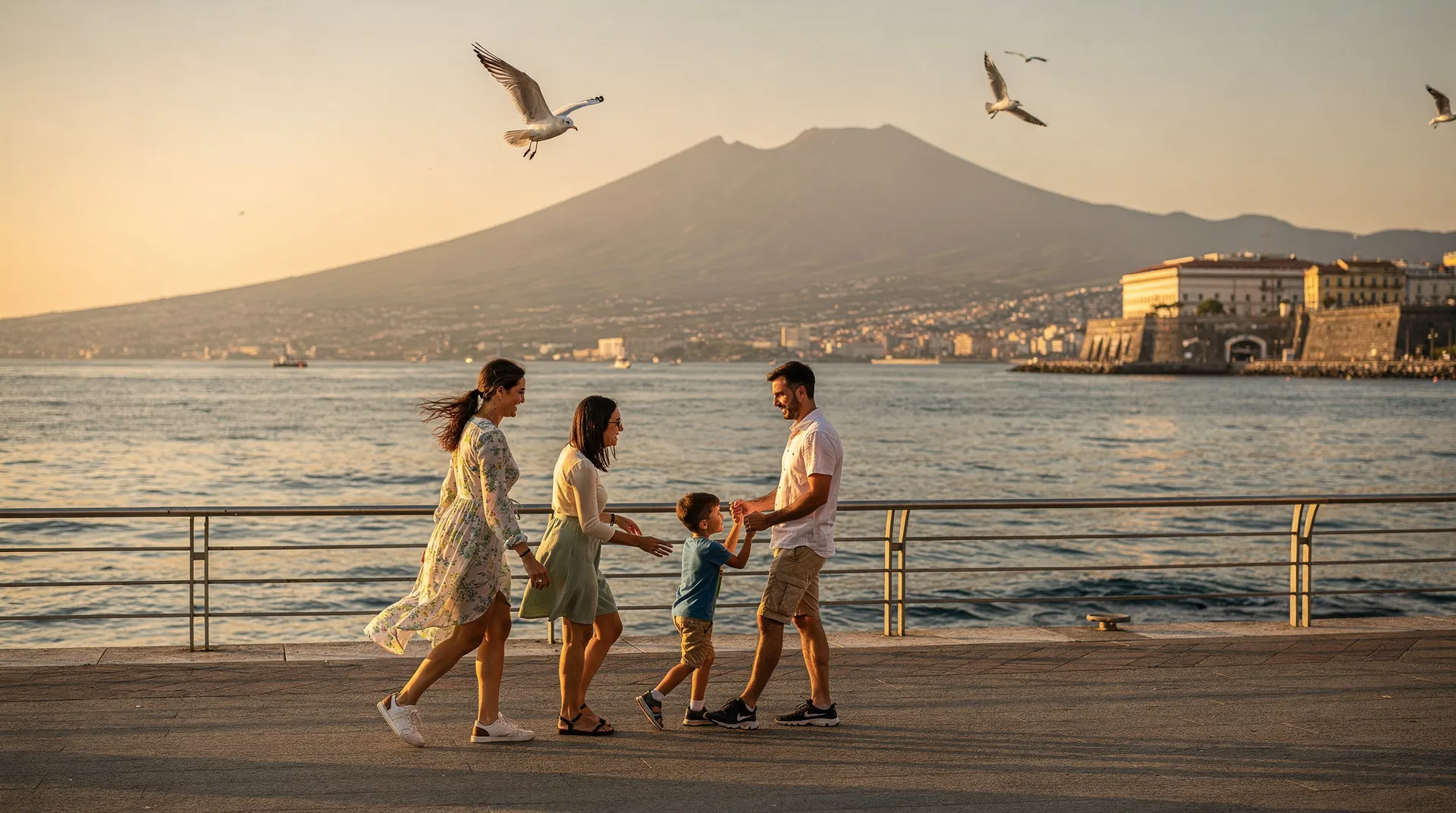
Naples with kids: honest guide for families visiting in 2026
Naples: Hop-on Hop-off Bus Tour 24-Hour Ticket
Duration: 24h
Is Naples a good destination for families with children?
Yes, for families with children aged roughly 6 and up. Naples itself is chaotic and stimulating — the street life, food culture, and underground heritage are genuinely engaging for older children. Younger children (under 4) are manageable but the cobblestones, heat, and scooter-heavy traffic make stroller logistics difficult. The surrounding attractions — Pompeii, Herculaneum, Vesuvius, Capri — are excellent family day trips with the right preparation.
Bottom line: Naples works for families. The chaos is part of the experience, the food is universally popular, and the day trips are world-class. Prepare for heat in summer, cobblestones everywhere, and trains that need to be navigated carefully.
| Best age | 6+ for the city; younger children manage with a carrier |
| Best base | Vomero or Chiaia — quieter, wider pavements |
| Daily budget | Around €200–250 for a family of four |
| Watch for | Summer heat, cobblestones, Circumvesuviana crowding |
| Top day trip | Procida — small, walkable, colourful, easy ferry |
Setting expectations honestly
Naples has a reputation that parents Google anxiously before booking. The reality is nuanced. The city is loud, traffic is assertive, scooters use pavements, and some areas are not comfortable. It is also genuinely thrilling for older children — the underground tunnels, the volcanic landscape, the street food, the archaeological sites.
The families who struggle with Naples are typically those with very young children (under 3) who need regular pram access and calm environments, or families who planned to cover the sights at a walking-tour pace without accounting for heat (in summer, above 30°C by 11:00) and distance.
The families who love Naples are those who treat it as a food-and-exploration adventure rather than a monument-checking exercise, who build in afternoon rest time in summer, and who choose day trips that match their children’s specific interests.
The best Naples experiences for children
The Naples underground
Napoli Sotterranea (Via dei Tribunali) takes visitors through the Roman cistern system below the historic center — a network of tunnels and caverns carved from volcanic tuff 2,500 years ago. The narrowest sections require turning sideways; the underground aqueducts have wartime graffiti from 1943. It is dark, cool, and slightly claustrophobic in places.
Children aged 8+ typically find this excellent. Under 8, it depends on the child’s comfort with enclosed spaces and darkness. The tour is 1.5 hours and the guides are generally good at adjusting the explanation level. Entry €12.
For a comparison of the different underground options and which suits families, see the underground Naples guide.
MANN: the archaeological museum
The National Archaeological Museum of Naples (MANN) holds the world’s best collection of objects from Pompeii and Herculaneum — mosaics, bronzes, everyday objects, wall paintings, the famous “secret room” of erotic art. For children with any interest in ancient civilizations, this is one of the best museums in Europe.
The objects are concrete and relatable: bakery equipment, a dog mosaic, a surgeon’s instruments, toys, a garden scene in fresco. The museum is also genuinely large — you do not need to see everything. Focus on the Pompeii collections and the Farnese sculptures.
Practical for families: Entry €20, free for EU under 18 (bring ID). No mandatory strollers (lifts exist but the building is uneven). Allow 2–3 hours for a child-focused visit. The MANN guide covers the key rooms.
Metro art stations
Naples Metro Line 1 has a series of architect-designed art stations. For children, the Toledo station is the most dramatic — a deep shaft with a mosaic-tiled funnel descending from the street, designed by Oscar Tusquets Blanca. The visual effect is genuinely extraordinary and requires no explanation of historical context.
Other good stations for the visual impact: Municipio (ongoing Bourbon-era archaeological finds excavated during construction, visible through glass panels), Università (geometric tile work), Dante. All accessible with a standard metro ticket (€1.60). See the metro art stations guide.
Street food
Naples has the most family-friendly street food culture in Italy. Pizza fritta (fried pizza, filled, €2.50–4), cuoppo (fried seafood or vegetables in a paper cone, €4–6), sfogliatella (ricotta pastry, €2), and pizza a portafoglio (folded pizza, €2–3) all work as quick, cheap, enthusiastically received family meals.
The street food circuit requires no sitting down, no menus, and no argument about who eats what. It is also significantly cheaper than restaurant meals — a family of four can eat lunch for €15–20.
A guided street food tour with 8 tastings lets an expert lead the family through the best street food spots while providing context.
Hop-on hop-off bus
The Naples hop-on hop-off bus covers Chiaia, the Lungomare, Posillipo viewpoints, and the historic center — useful for families who want a first-day overview without navigating the cobblestone streets on foot. Children under a certain height ride free on most hop-on services (check the specific operator’s age/height rules). The open-top deck is popular with children for the view, less suitable in July–August heat.
Day trips from Naples with children
Pompeii
Pompeii is excellent for children aged 7 and up who have had some preparation. The plaster casts of people and animals, the bakeries with bread still preserved in stone ovens, the painted shop signs, the Roman fast-food counter (thermopolium) with food jars still in place — all of these are concrete, tangible, and genuinely interesting.
See the detailed Pompeii with kids tips guide for specific routes, heat management, and logistics. Key practical points: bring water and hats (almost no shade at Pompeii), arrive at opening (09:00), use a child-focused guided tour.
Herculaneum
Herculaneum is often better than Pompeii for families with children under 10: smaller site (manageable in 1.5–2 hours), better preserved buildings with wooden structures and upper floors still visible, and the macabre but powerful sight of skeletal remains of victims at the beachfront arches. The emotional and physical scale is more manageable. See the Herculaneum guide for entry details.
Procida island
Procida is the most family-friendly island day trip. Small (4 km²), highly walkable, less traffic than Capri, genuinely colorful harbor architecture (the pastel-painted fishermen’s houses were the backdrop for the film “Il Postino”), good swimming. Ferry from Beverello: 35 minutes (€12–15 per person round trip). No need to pre-book. See the Procida day trip guide.
Capri
Capri works well for families interested in boat trips, swimming, and the Blue Grotto (though be aware the grotto is small and requires a very small boat — check if this is appropriate for your children). The chairlift to Monte Solaro is excellent for children of all ages. See the Capri day trip guide.
Ischia and its thermal gardens
Ischia’s Poseidon Gardens and other thermal parks offer a genuinely different family day: a network of pools at varying temperatures, water slides for older children, and gentle spa facilities that work well for parents too. The island is larger and more spread out than Procida, so a rental scooter or bus is more useful than walking. It suits families who want a beach-and-pool day rather than more history and archaeology after Pompeii or Herculaneum. See the ischia-thermal-gardens guide for which park suits which age group.
For the full range of family options, the family day trips Campania guide compares all the options systematically.
Practical logistics for families in Naples
Heat and timing
June–August: The city gets brutally hot by midday (28–38°C). Plan sightseeing for 08:00–11:30 and 16:30–20:00. The hours 12:00–16:00 in summer require shade, a/c, and rest. Book accommodation with air conditioning — do not compromise on this for an August visit.
May, September, October: Significantly more comfortable (18–25°C). Families can be active throughout the day.
Cobblestones
The historic center is paved with ancient basalt cobblestones — beautiful to look at, difficult to wheel things over. Wheeled luggage, strollers, and mobility aids all struggle. Pack as lightly as possible; if using a stroller, bring the lightest possible model.
Public transport with children
Metro Line 1 is air-conditioned, reliable, and good for families. The Circumvesuviana for Pompeii/Sorrento day trips is not air-conditioned, often crowded, and has a pickpocket problem — keep children close and bags visible at the front. The Campania Express (seasonal premium service on the same route) is significantly more comfortable and worth the extra cost (about €7 vs €3.30 one way to Pompeii). See the Campania Express vs Circumvesuviana comparison.
Managing screen time and downtime
Long train rides, hot afternoons, and multi-hour museum visits can wear children down faster than adults expect. Building in deliberate downtime — a gelato stop, a bench by the Lungomare, a playground break in Villa Floridiana — keeps the day sustainable rather than turning every outing into an endurance test. Many families find that alternating one intensive activity (a museum, an archaeological site) with one low-effort one (a beach, a park, a food stop) works better than back-to-back sightseeing, especially for children under 10.
Food logistics
Children eating at normal Neapolitan restaurant times (dinner 20:00–22:00) is fine from around age 8. Younger children often need earlier eating — street food and self-catering fill that gap. Most pizzerias open from 19:00; some tourist-area restaurants open from 18:30 for families.
Allergy note: Many traditional Neapolitan dishes contain gluten, shellfish, and dairy — the three most common allergies. Pizza gluten-free options exist in some restaurants. The street food is harder to modify.
What not to do with children in Naples
The Circumvesuviana in peak summer without Campania Express: Standing in a 35°C non-air-conditioned train for 30–70 minutes with tired children is a genuine endurance test. Worth upgrading.
Driving in the historic center: ZTL restrictions aside, the traffic is genuinely dangerous for pedestrians and incomprehensible for drivers unfamiliar with the city. Take public transport.
Fontanelle Cemetery with children under 8: The scale of 40,000 visible bones is disturbing for young children. Fine for older children and teenagers with appropriate context-setting.
Assuming the Amalfi Coast is easy with young children: The coastal buses are slow, winding, and hot; driving the SS163 with young children in the back can test everyone’s patience. Boat access to Positano is easier than road access. See the Amalfi Coast guide for realistic logistics.
Budget: what does Naples with kids actually cost?
Naples is one of southern Europe’s most affordable major destinations. Indicative daily costs for a family of 2 adults + 2 children:
- Accommodation (Vomero/Chiaia 3-star): €90–130 per night
- Food: €40–60 per day (street food + one sit-down meal)
- Naples sights: €20–40 (MANN is free for EU children under 18; underground tours ~€12 per adult)
- Day trip (Pompeii): ~€50 for the family (train + entry; Pompeii is free for EU under 18 with ID)
- Total daily spend: ~€200–250 for a family of four
For full budget breakdown, see the Naples trip cost guide.
Packing list specific to Naples with children
Beyond the usual family travel basics, a few Naples-specific items make a real difference: a lightweight, sturdy stroller or a structured carrier for toddlers (cobblestones defeat most standard strollers within a day), a portable fan or cooling towel for summer visits, refillable water bottles (Naples’ free public fountains, the nasoni, make refilling easy and cheap), and a small first-aid kit with children’s paracetamol/ibuprofen since not every pharmacy stocks familiar brands. A paper map or offline map download is worth having too — the historic centre’s narrow streets can confuse phone GPS between tall buildings.
Choosing accommodation type
Beyond neighbourhood choice, families often do better in an apartment or aparthotel than a standard hotel room — a kitchenette allows breakfast and snacks on the family’s schedule rather than restaurant hours, which matters more with young children. Vomero and Chiaia both have good apartment stock within walking distance of the funicular or metro. If choosing a hotel, confirm connecting or triple/quad rooms are available before booking, as many centro storico properties are historic buildings with genuinely small standard rooms. See where-to-stay-in-naples for the broader neighbourhood comparison beyond the family-specific picks above.
Frequently asked questions about Naples with kids
Do Naples restaurants have high chairs?
Most sit-down restaurants in tourist areas have at least one high chair. Family-focused pizzerias generally have several. Street food stalls obviously don’t — you eat standing or find a bench.
Is the heat in Naples in summer dangerous for children?
Heat exhaustion is a real risk for young children at Pompeii in July–August when temperatures exceed 38°C. This is manageable with early starts, appropriate clothing, plenty of water, and rest in shade or air conditioning during midday hours. September is significantly better for families with young children.
Are there playgrounds in Naples?
Public playgrounds exist in Parco Virgiliano (Posillipo), Villa Floridiana (Vomero), and some smaller parks in Chiaia and the centro. They are not the primary reason to visit but provide useful rest breaks.
Is breastfeeding accepted in Naples?
Yes — Italy is generally accepting of breastfeeding in cafés, restaurants, and public spaces. Naples is no different. Discretion is appreciated in churches.
What medical facilities are available if a child gets ill?
Naples has a major children’s hospital (Ospedale Santobono-Pausilipon) and several hospital emergency departments (pronto soccorso) accessible to tourists with EHIC (EU citizens) or travel insurance. Pharmacies (farmacie) are plentiful, recognizable by the green cross, and open during extended hours — most staff speak at least basic English and can advise on over-the-counter medications.
Frequently asked questions about Naples with kids: honest guide for families visiting in 2026
What age is Naples suitable for children?
Which neighborhoods are best for families in Naples?
Is the Circumvesuviana train safe for families?
Can you take a stroller to Pompeii?
What is the best family day trip from Naples?
What is child-friendly about Naples itself?
Are restaurants in Naples family-friendly?
Top experiences
Bookable activities with verified prices and instant confirmation on GetYourGuide.