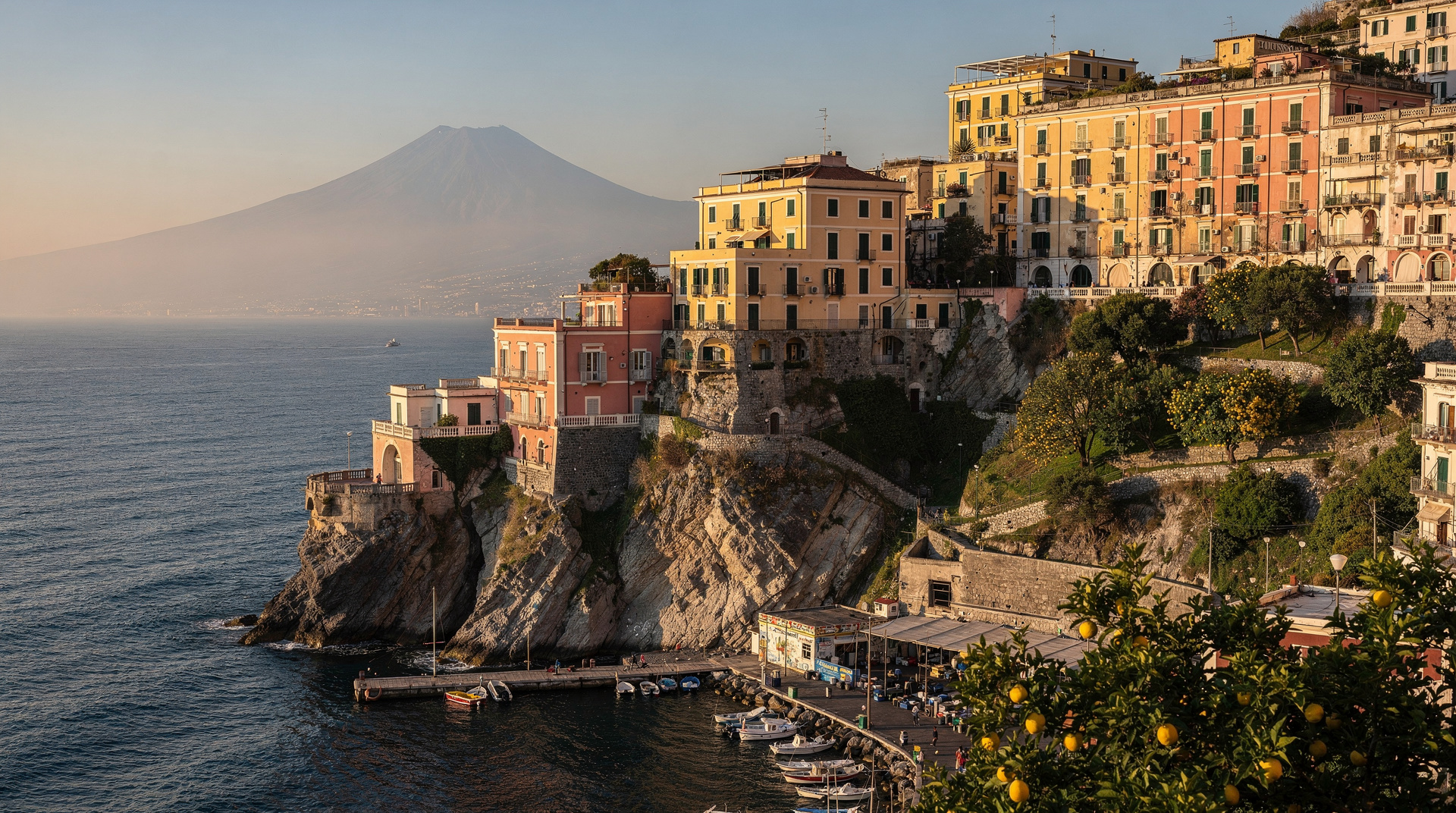
Naples vs Sorrento as a base — which is right for your trip?
Sorrento: Walking Tour with Local Guide
Duration: 2h
Is it better to base in Naples or Sorrento for a Campania trip?
Naples for a city-focused trip, budget accommodation, and multiple archaeological sites. Sorrento for convenient Capri and Amalfi Coast access, a quieter pace, and a resort-town feel. For trips of 5+ days, the split stay — 2–3 nights in Naples then 2–3 nights in Sorrento — is the most efficient way to cover the entire region without the limitations of a single base.
Naples or Sorrento as your base? Naples is cheaper, richer in city culture, and better for the archaeological sites north of Pompeii. Sorrento is quieter, closer to Capri, and better positioned for the Amalfi Coast. For 5+ days, split the stay. For shorter trips, choose based on your primary interest.
| Cheaper base | Naples — 25–40% less on accommodation |
| Best for Capri/Amalfi | Sorrento — shorter hydrofoil and bus times |
| Best for the city itself | Naples — MANN, Sansevero, centro storico |
| Getting between them | Circumvesuviana, 65 min, or Campania Express |
| 5+ day trips | Split stay: 2–3 nights each base |
The core difference
Naples and Sorrento are connected by the Circumvesuviana train in 65 minutes. The train runs every 30 minutes throughout the day. This close connection makes the choice between the two less absolute than it first appears — from either town, the other is effectively a day trip destination.
But where you sleep shapes the rhythm and cost of your trip, so the choice matters.
Naples is a city of one million people with all the complexity that implies. Its historic centre is UNESCO-listed and contains extraordinary density — the Cappella Sansevero, the MANN, Spaccanapoli, the underground city, Castel Nuovo, the Lungomare. The city has its own pull independent of day trips.
Sorrento is a resort town of 16,000 people, well-managed for tourism, with clean streets, good infrastructure, and a pleasant historic centre. It is not a significant city in its own right — its value is primarily as a transport hub for the coast and islands, and as a calmer base for visitors who want to sleep well between active day trips.
Day-trip access compared
The logistics matrix is the most important part of this decision.
| Destination | From Naples | From Sorrento |
|---|---|---|
| Naples city sights | — | 65 min (Circumvesuviana) |
| Herculaneum | 10–15 min (train) | 45 min (train) |
| Pompeii | 30 min (train) | 30 min (train) |
| Mount Vesuvius | 40–50 min (train + bus) | 45–50 min (train + bus) |
| Capri | 50 min (hydrofoil) | 20–25 min (hydrofoil) |
| Ischia | 50 min (hydrofoil) | 50–60 min (hydrofoil) |
| Procida | 35 min (hydrofoil) | 50 min (hydrofoil) |
| Positano | 2+ hours | 1 hour (bus) |
| Amalfi town | 2.5+ hours | 1.5 hours (bus) |
| Paestum | 1.5 hours | 2+ hours |
| Caserta | 45 min (train) | 2+ hours |
Sorrento wins for Capri and the Amalfi Coast. Naples wins for the city itself, Herculaneum, Caserta, and anything north of Pompeii. Pompeii and Vesuvius are essentially equal from either base.
Cost comparison
The accommodation cost difference between Naples and Sorrento is real and consistent.
| Category | Naples | Sorrento |
|---|---|---|
| Hostel dorm | €18–30 | €28–50 |
| Budget private double | €60–100 | €90–140 |
| Mid-range double | €100–160 | €140–220 |
| Good mid-range double | €150–200 | €200–300 |
Food prices are more similar, though Sorrento’s tourist-facing restaurants near the ferry terminal and on Corso Italia are noticeably more expensive than their Naples equivalents. The key advantage in Naples is the street food culture — pizza a portafoglio (€2–3), sfogliatella (€1.50), espresso at the bar (€1) — which has no Sorrento equivalent at those prices.
For a family of four over five nights, the accommodation saving in Naples typically runs €300–600 compared to Sorrento at equivalent quality levels.
Naples food walking tour — taste the city’s street food cultureThe transport question: Circumvesuviana realities
Both bases depend on the Circumvesuviana railway for archaeological site access and for the Naples-Sorrento connection itself. The train is the practical backbone of any Campania trip — understanding it is essential.
The Circumvesuviana runs from the lower level of Napoli Centrale (Garibaldi station) along the Bay to Sorrento. Trains run every 30 minutes approximately 6am–10pm. Single tickets cost €2.60–3.80 depending on the destination zone.
Honest assessment of the Circumvesuviana: The train is crowded, frequently late, not air-conditioned in many rolling stock units, and has no secure luggage space. It is also perfectly functional and costs less than a coffee. The pickpocket risk is real — busy summer trains between Naples and Pompeii attract opportunistic theft. Standard precautions: keep bag front-facing and zipped, avoid the spaces near doors where groups can create distractions, be aware of crowded entrances.
The Campania Express is a seasonal (approximately April–October) alternative that runs direct, air-conditioned services between Naples and Sorrento with tourist-focused stops. It is more expensive (approximately €12 vs €3.80 for the regular train) but significantly more comfortable. See campania-express-vs-circumvesuviana for the practical comparison.
Internet, connectivity, and working remotely
Both bases have reliable Wi-Fi in hotels and cafés, but Naples has the deeper bench of co-working-friendly cafés and longer opening hours if you need to work a few hours during a longer trip. Sorrento’s cafés lean more toward tourist turnover than laptop-friendly seating, though quieter side-street spots exist. Mobile data coverage is strong in both towns and along most of the Circumvesuviana route, with occasional dead spots in tunnels and some of the more rural stretches toward Sorrento. If uninterrupted connectivity matters for work calls, test your carrier’s coverage map for Campania before committing to a remote-work day trip schedule.
The safety question
Naples’ safety reputation is significantly worse than the statistical reality. For the purposes of base selection:
- The main tourist areas of Naples (Centro Storico, Chiaia, Vomero, Lungomare, Posillipo) are safe for day and evening use with normal urban awareness
- The Circumvesuviana is the highest-risk environment for tourists — bags and electronics should be secured
- Certain outer neighbourhoods (Scampia, Secondigliano, parts of Forcella late at night) are not tourist destinations and irrelevant to a normal trip
- Sorrento has essentially no street crime in its tourist areas
If safety concern is the deciding factor, Sorrento is the lower-stress option. But choosing Naples is also entirely reasonable with basic precautions. The elevated safety concern that some visitors have about Naples is disproportionate to the actual risk for well-oriented tourists.
Naples best-of walking tour — discover the city with confidenceWhat each base enables that the other doesn’t
Naples uniquely enables:
- Walking the best city centre in southern Italy without a transit commute
- Visiting Herculaneum efficiently (15 minutes instead of 45)
- Caserta Royal Palace as a half-day trip (45 minutes by regional train)
- Full evening culture — aperitivo in Chiaia, late-night street food on Via Toledo, opera at San Carlo (September–June)
- The MANN, Cappella Sansevero, and Naples Underground without travel time
- Budget accommodation that genuinely works at €50–80 per double
Sorrento uniquely enables:
- Capri by hydrofoil in 20 minutes (vs 50 from Naples) — meaningful if you visit twice
- Positano in 1 hour on a SITA bus (vs 2+ from Naples)
- Waking up in a resort town rather than a major city
- Easier early-morning departures for the Amalfi Coast before traffic builds
- A calmer environment for families with young children
- Better positioned for the Path of the Gods hike starting at Bomerano
Weather and seasonal fit
Sorrento’s cliff-top position catches sea breezes that make July and August noticeably more bearable than central Naples, where stone streets and less airflow trap heat into the evening. In shoulder season (April–May, September–October), the difference narrows considerably — both bases are pleasant, and Naples’ extra city-based indoor options (museums, underground sites) become a genuine advantage on the occasional rainy day. Winter favours Naples: more of Sorrento’s tourist infrastructure scales down or closes for the season, while Naples remains a fully functioning city year-round with its own winter charm, including the naples-at-christmas-presepi nativity scene tradition.
Getting to each base initially
If you are flying in, Naples Capodichino airport is close to the city (15–30 minutes by bus or taxi) and has no direct connection to Sorrento — reaching Sorrento from the airport means a taxi or transfer to Naples Centrale first, then the Circumvesuviana or Campania Express (about 1.5–2 hours door to door). Travellers arriving by train from Rome land at Naples Centrale, making Naples the more convenient first stop regardless of which base you eventually choose. The getting-to-sorrento guide covers every route in detail, including the seasonal ferry option from Naples’ port, which some travellers find more comfortable than the train with luggage.
Which base suits which travel style
Photographers and slow travellers often prefer Naples for its layered street life and constant visual interest — even a coffee-and-wander morning yields material. Sorrento suits travellers who want their base to be restful between active, sometimes long day trips — a quieter room, a shorter walk to dinner, less urban noise at night. Neither is objectively better; the choice depends on whether you want your base itself to be part of the adventure (Naples) or a calm platform to launch from (Sorrento). For a deeper look at Naples’ own neighbourhood options if you choose it, see best-areas-to-stay-naples.
The split-stay solution
For visits of 5 days or more, the most common recommendation from experienced Campania travellers is the split stay: 2–3 nights in Naples then 2–3 nights in Sorrento (or vice versa). This eliminates the main tradeoff entirely.
Suggested 7-day sequence:
- Day 1: Arrive Naples. Settle, explore Spaccanapoli, evening on the Lungomare.
- Day 2: MANN and Cappella Sansevero. Naples city day.
- Day 3: Pompeii or Herculaneum. Day trip from Naples.
- Day 4: Transfer to Sorrento mid-morning by Circumvesuviana. Sorrento afternoon.
- Day 5: Capri. Early hydrofoil from Sorrento.
- Day 6: Amalfi Coast by SITA bus — Positano and Amalfi.
- Day 7: Optional half-day (Ravello, Vesuvius, or another island) then return to Naples for departure.
Transferring by Circumvesuviana with luggage requires planning — the train can be standing-room-only on summer mornings. Use the Campania Express for this journey if available. Most Sorrento hotels accept bags before check-in.
Sorrento walking tour with local guideFrequently asked questions about choosing a Campania base
Can I visit the Amalfi Coast from Naples in a single day?
Yes, but it is a long day using public transport. Naples to Sorrento by Circumvesuviana (65 min), Sorrento to Positano by bus (1 hour), Positano to Amalfi by bus (40 min) — total one way is about 2.5–3 hours. Many visitors prefer a guided day trip that handles the logistics and takes a direct route, often by private vehicle or boat. See amalfi-coast-from-naples for all the options.
Is Sorrento worth visiting in its own right or just as a base?
Both. Sorrento has a genuinely pleasant historic centre — the Cathedral, the Via San Cesareo covered market lane, the Marina Grande fishing village below the cliff — and good limoncello and cooking class experiences. It is not a major cultural destination in the way Naples is, but a full day exploring it properly is rewarding rather than feeling like wasted base time.
What time should I arrive at Sorrento or Naples to start touring?
Arriving by early afternoon allows a first half-day of sightseeing and gives you time to get oriented. Arriving the night before your first active day is even better. Both cities have good late-arriving restaurant and street food options until midnight. For Naples arrivals, Alibus shuttle runs from the airport approximately 6am–midnight.
Which base is better for solo travellers?
Naples. The city has the most dynamic social infrastructure, the widest range of hostels and communal accommodation, and the best opportunities for spontaneous interaction with both locals and other travellers. Sorrento is quieter and more couple/family-oriented. Both are safe for solo travel. See solo-travel-naples for specific advice.
Is it possible to see Capri and the Amalfi Coast on the same day?
Technically possible, very rushed, and not recommended. Capri alone warrants 5–7 hours; Positano and Amalfi together warrant another full day. Attempting both in one day means doing neither properly and spending most of the day on ferries and buses. Allocate separate days for each.
Frequently asked questions about Naples vs Sorrento as a base — which is right for your trip?
Is Sorrento or Naples better for visiting Pompeii?
Is it safe to base in Naples as a tourist?
How much cheaper is Naples accommodation than Sorrento?
Can I do Capri from Naples easily?
Which base is better in July and August?
What is the Circumvesuviana and how do I use it?
Which base is better for visiting the Amalfi Coast?
Top experiences
Bookable activities with verified prices and instant confirmation on GetYourGuide.