Best areas to stay in Naples: a practical breakdown for 2026
Naples: Panoramic E-Bike Tour
What are the best areas to stay in Naples?
For most visitors, Chiaia and Centro Storico are the top two choices. Chiaia offers the safest, most comfortable residential experience near the seafront. Centro Storico puts you inside the UNESCO historic core — maximum atmosphere, more noise. Vomero works best for families wanting quiet and good transit links. Book before you arrive: quality hotels in the best locations fill fast.
Bottom line: Chiaia for comfort and safety. Centro Storico for immersion and walkability to sights. Vomero for quiet and family logistics. Posillipo for sea views and retreat.
| Best overall | Chiaia (comfort) or Centro Storico (atmosphere) |
| Best for families | Vomero — quiet, funicular-linked, safe |
| Best for views | Posillipo — sea-facing terraces, higher price |
| Best on a budget | Rione Sanità or vetted Centro Storico B&Bs |
| Typical price range | around €35–400+ per room depending on area |
| Book ahead by | 4–8 weeks for May–October, longer for Easter/August |
The geographic logic of Naples neighborhoods
Naples spreads along the Bay of Naples in an east-to-west arc. The flat coastal plain holds the historic center — the Greek-Roman grid, the medieval churches, the decumani. Behind it, hills rise to Vomero and Posillipo. The waterfront runs from the industrial port at the east to Mergellina and Posillipo at the west, with the elegant Lungomare promenade as the dividing line.
Understanding this geography explains why neighborhood choice matters. The Circumvesuviana (the train to Pompeii, Herculaneum, and Sorrento) leaves from Napoli Centrale at the eastern end of the flat zone. The port ferries for Capri, Ischia, and Procida depart from Beverello, on the waterfront roughly in the middle. The main art metro stations are threaded along Line 1 from Garibaldi to Vomero.
This means Centro Storico is best placed for train-based day trips. Chiaia is best placed for ferry-based island trips. Vomero is equidistant for both, via funicular and metro.
An e-bike tour covers Chiaia, Posillipo, and the Lungomare in a single morning — a fast way to compare neighborhoods and decide where you’d want to base yourself on a return trip.
Centro Storico: the full Naples experience
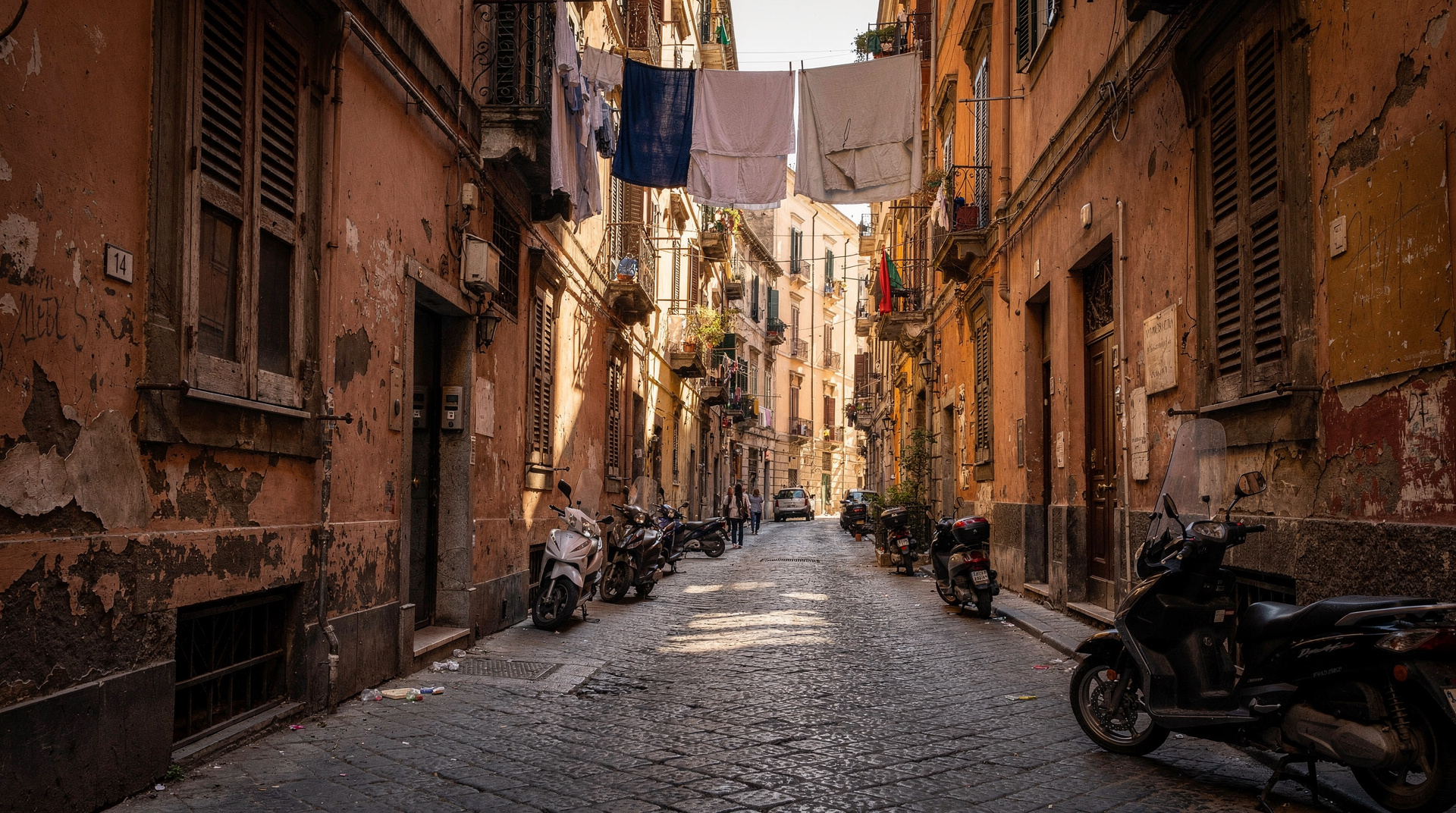
The Centro Storico is a UNESCO World Heritage Site, and staying here makes that designation tangible every morning. Step outside a typical B&B on Via dei Tribunali and you are standing inside a street that existed before Rome was an empire — the Greek plateia runs directly under it.
Accommodation range: €35–200 per room. The variation is enormous. A restored palazzo apartment might charge €150 for a beautifully frescoed double. A basement B&B on the same street might charge €45 for a room with minimal natural light. Both are “Centro Storico.”
Noise reality: Genuinely loud. Mopeds on narrow streets, bar noise, garbage trucks at 06:00. Rear-facing rooms in courtyard buildings are noticeably quieter. Double-glazing varies by building. If you are a light sleeper, Centro Storico in summer is a gamble.
Eating and drinking: The highest density of good-value food in Naples. Street food vendors, century-old pizzerias (L’Antica Pizzeria da Michele on Via Cesare Sersale: cash only, expect a queue), fried food stalls, pastry shops. Also the most tourist traps per square meter — read the restaurant traps guide before choosing where to eat.
Day-trip logistics: Best neighborhood for day trips. Napoli Centrale and Garibaldi metro hub are 10 minutes on foot. See getting to Pompeii from Naples and the Circumvesuviana guide for specific train logistics.
Chiaia: comfort and the waterfront
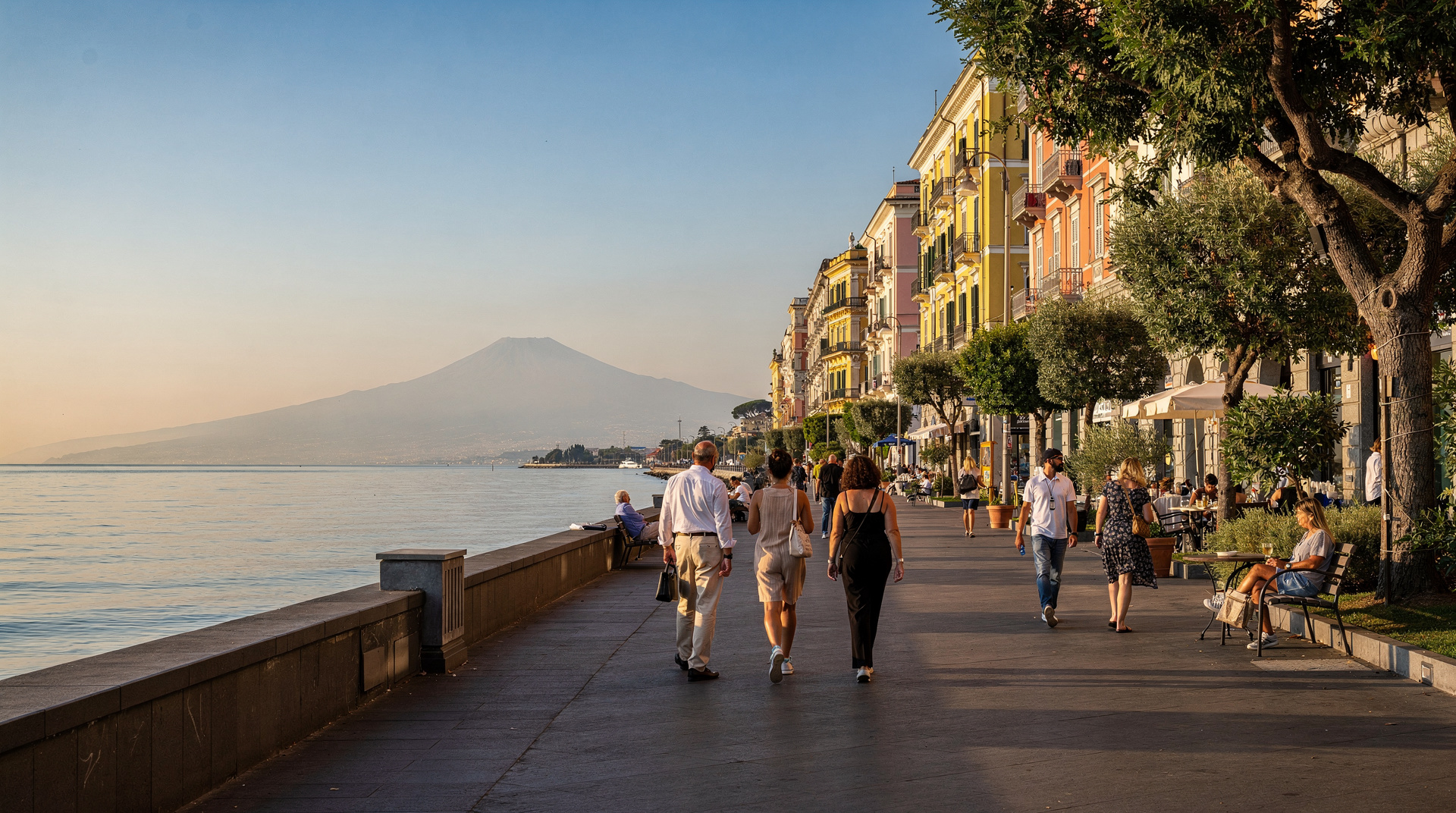
Chiaia runs from the seafront (Lungomare Caracciolo) up toward the base of the Vomero hill. The architectural character is 19th-century bourgeois — wide streets, ornate doorways, balconied buildings in warm ochre and terracotta. It is the neighborhood where upper-middle-class Neapolitans actually live.
Accommodation range: €90–300+ per room. You are unlikely to find genuinely bad accommodation here; the floor is higher than in the centro. The most interesting options are small boutique hotels in converted palazzi.
Why it works: The Lungomare is directly accessible — a 2 km waterfront walk with Vesuvius across the bay, best at sunset. Castel dell’Ovo sits at the east end. Good seafood restaurants and wine bars cluster around Piazza dei Martiri. The sense of being in a real city (not a tourist theme park) is stronger here than in the centro.
Connection to sights: Metro Line 2 from Piazza Amedeo to Napoli Centrale: 8 minutes. Walking to Piazza del Plebiscito: 15 minutes. See the lungomare evening walk guide for what to do in the immediate neighborhood.
Vomero: the quiet hilltop option
Vomero covers the hill above Chiaia and is served by three funicular lines. The neighborhood has a distinctly different character from the centro — quieter streets, lower tourist density, local cafés where Neapolitans argue about football rather than pose for Instagram.
Accommodation range: €65–140 per room. Generally good value for the quality level. The main street Via Scarlatti has some chain hotels; smaller independent options off the main thoroughfares offer better character.
Key sites in the neighborhood: Certosa di San Martino (the Carthusian monastery with city-wide views), Castel Sant’Elmo (the Spanish fortress), and the Belvedere Pasquale Scura (free viewpoint). These are worth a morning regardless of where you stay.
Practical note: Funiculars stop around 22:00 on most lines. After midnight, a taxi from the centro costs €8–12 and takes 10–15 minutes. This is not a significant inconvenience unless you plan to stay out very late regularly.
Posillipo: the luxury coastal option
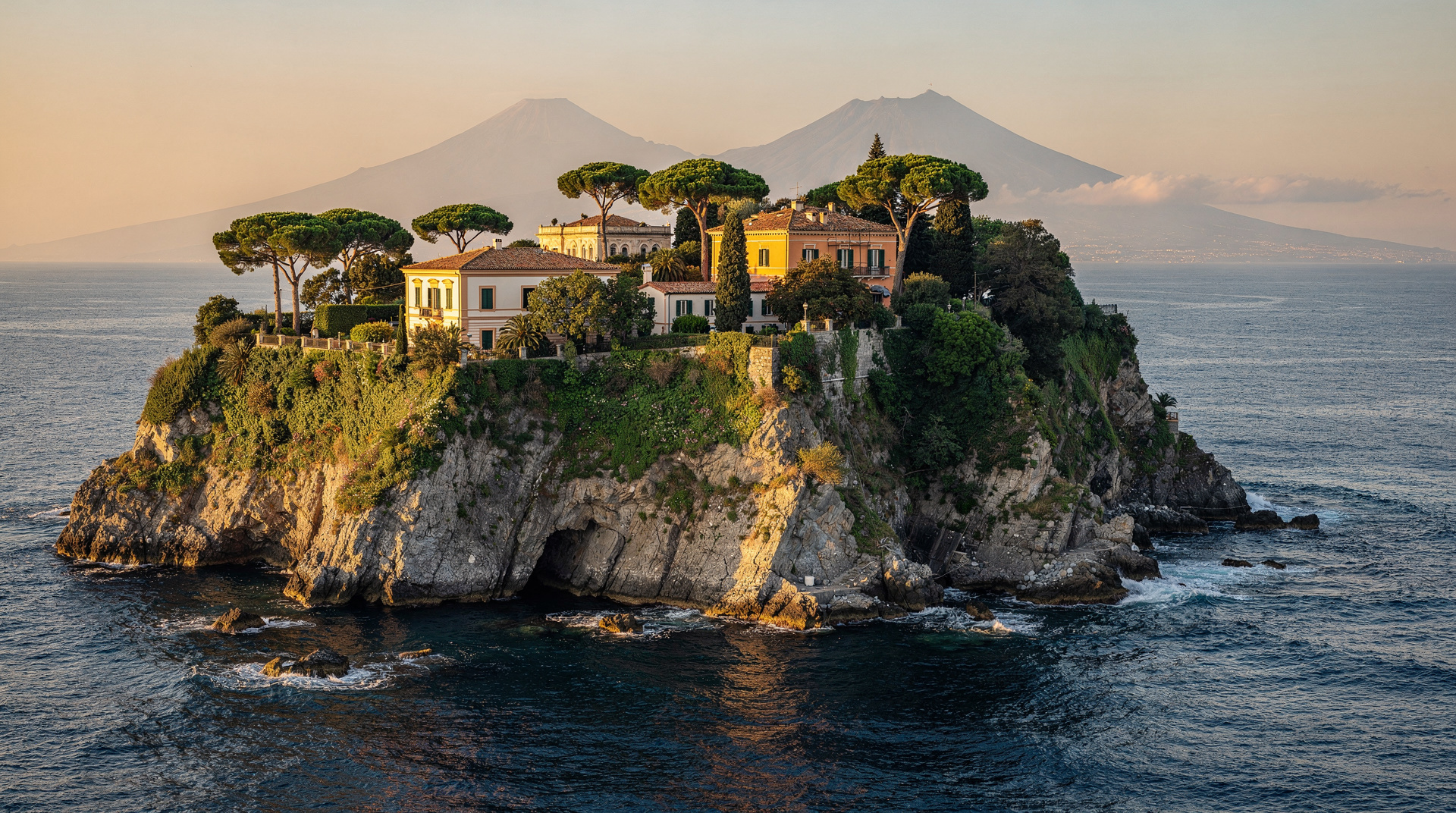
Posillipo occupies the promontory that juts into the bay west of Mergellina. It is technically a neighborhood of Naples but feels like a private coastal enclave — villa architecture, private bathing platforms, restaurants where the fish was swimming that morning.
Accommodation range: €180–400+ per room. At this price point, the options are genuine boutique hotels with sea-view terraces, not recycled B&Bs.
What it offers: Arguably the most beautiful setting in Naples for simply existing — drinking a coffee on a terrace with Vesuvius across the water. Private beach clubs (lidos) charge €15–30 for sunbed hire. The Posillipo neighborhood guide covers the options in detail.
Realistic limitation: Getting to the historic center requires 25–35 minutes each way. For a 3-day Naples trip focused on sightseeing, this is a significant daily overhead. For a week-long stay where you want a mix of beach, good food, and occasional city excursions, the calculus changes.
Rione Sanità: authentic and budget-friendly
Rione Sanità lies north of the centro storico, tucked between the historic center and the hill leading to Capodimonte. It is the oldest working-class neighborhood in Naples, home to the two main catacombs complexes, the Fontanelle Cemetery, and a thriving street art scene developed in cooperation with local youth organizations.
Accommodation range: €35–80 per room. Some very good-value small hotels and family-run B&Bs in historic buildings.
Visitor reality: Safe during daylight hours and fine for early evenings in the main streets. After dark on quieter streets, exercise more caution than in Chiaia. Not a neighborhood for walking back at 02:00 alone. It is also further from the mainstream sights — allow an extra 15–20 minutes to walk to MANN or Spaccanapoli.
Why choose it: If the catacombs are a priority, staying here eliminates commuting. The morning street life — vendors, local bars, scooter repair shops, schoolchildren — is a genuine off-tourist-circuit experience. Budget travelers who have already done the main sights on a first trip and want a different Naples will find Sanità compelling.
The Quartieri Spagnoli: historic grit, central location
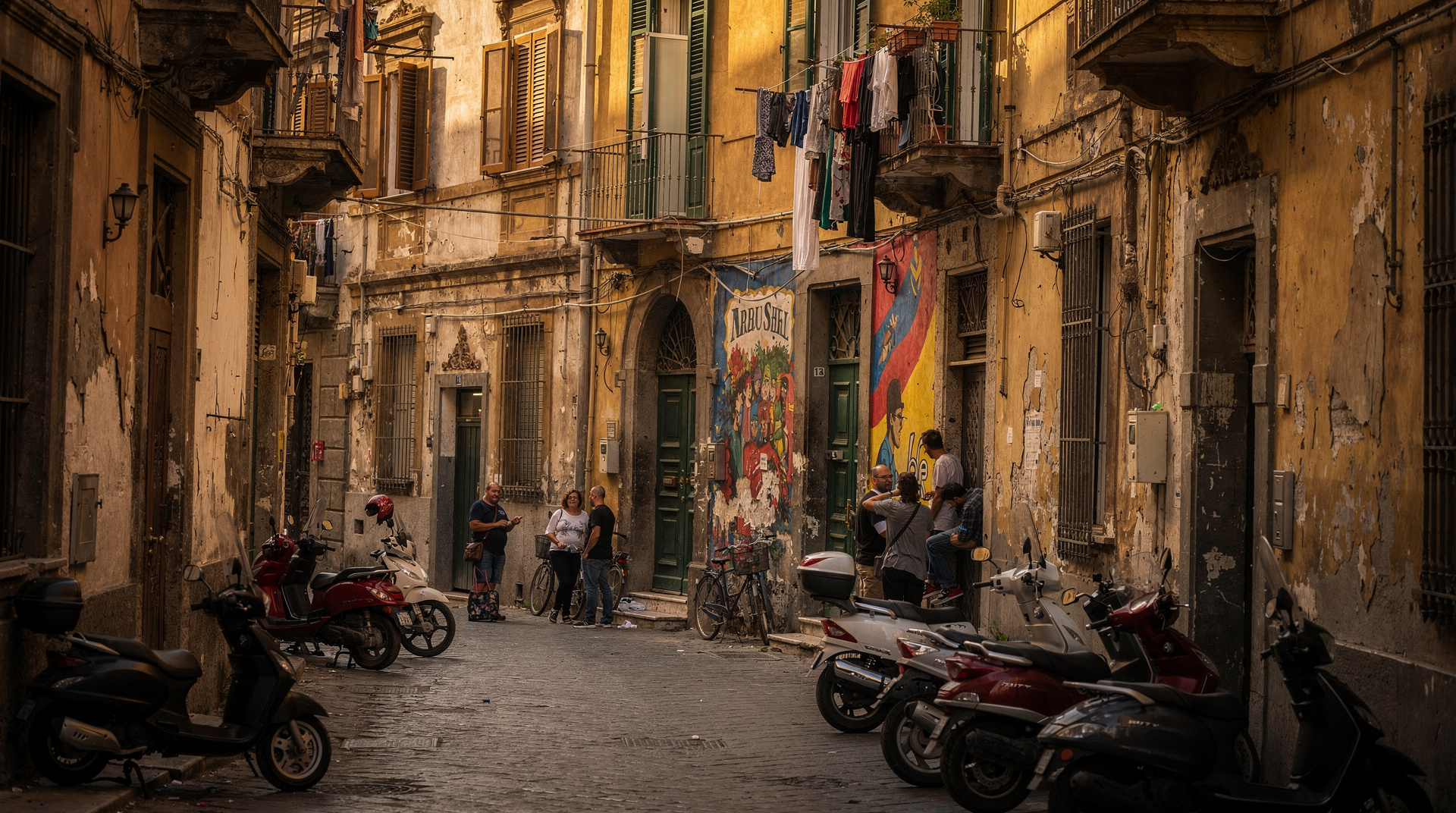
The Spanish Quarter sits west of Via Toledo, rising up the hillside toward Vomero. It is a grid of tight alleys — bassi (ground-floor rooms that open directly onto the street) stacked above each other, laundry across narrow streets, shrines at corners.
The atmosphere is more lived-in than touristy, but increasingly B&Bs and boutique accommodations have opened here. Prices: €50–120. Safety: fine during the day and early evening; taxis for late-night returns make sense.
It is worth a walk for anyone regardless of where they stay — see the Spaccanapoli guide for context.
Neighborhood comparison at a glance
| Neighborhood | Price range (per room) | Noise level | Best for |
|---|---|---|---|
| Centro Storico | around €35–200 | High | First-timers wanting maximum atmosphere |
| Chiaia | around €90–300+ | Moderate | Comfort, safety, waterfront evenings |
| Vomero | around €65–140 | Low | Families, quiet nights, good value |
| Posillipo | around €180–400+ | Very low | Views, seclusion, longer stays |
| Rione Sanità | around €35–80 | Low–moderate | Budget travelers, catacombs, authenticity |
| Quartieri Spagnoli | around €50–120 | High | Independent travelers, edgier atmosphere |
Where not to stay in Naples
A handful of areas look convenient on a map but disappoint in practice. The immediate zone around Napoli Centrale / Piazza Garibaldi, while transit-central, is scruffy, poorly lit at night, and has a noticeably higher density of scams and low-quality hotels than anywhere else in the city — fine for a transit night before an early train, not for a proper stay. The industrial port area east of Beverello has no accommodation worth booking and nothing to do on foot. Cheap rooms advertised as “Centro Storico” but actually located past Corso Umberto toward the station often oversell their location — check the exact address on a map, not just the neighborhood name, before booking.
Naples hop-on hop-off panoramic bus tour is a practical way to scout Chiaia, Vomero, and Posillipo from the top deck on your first day, before committing to a neighborhood for a return trip.
Booking tips: platforms, timing, and red flags
Most Naples accommodation books through the usual international platforms, but a few local quirks are worth knowing. Many Centro Storico B&Bs are small, family-run operations with no reception desk — check-in is often by prior arrangement, so confirm arrival time by message rather than assuming a front desk will be staffed. Read the most recent reviews (last 3–6 months) rather than the overall score: buildings change hands, renovations happen, and a property that was excellent two years ago can decline quickly under new management. A listing photographed with a wide-angle lens and no recent reviews is a mild red flag in the budget tier.
For families or groups of four or more, apartments in Chiaia or Vomero often work out cheaper per person than two hotel rooms, and give you a kitchen for breakfast — genuinely useful given how early some day trips to Pompeii or the islands start. See the Naples trip cost and budget guide for how accommodation fits into overall trip costs, and the Naples on a budget guide for stretching a tighter budget without ending up somewhere unpleasant.
Making the final decision
You are visiting for 2–3 days, first time: Centro Storico or Chiaia. Centre if you want maximum immersion. Chiaia if you want comfort and a quieter base.
You have 5–7 days including day trips: Chiaia or Vomero. The day-trip overhead from both is minimal and the base quality is higher.
You are travelling with children: Vomero is the most family-practical. Chiaia works well too.
You want sea access and are OK with less sightseeing: Posillipo.
You are on a tight budget: Rione Sanità or budget options in Centro Storico (carefully vetted).
The complete neighborhood-by-neighborhood guide goes deeper into each area. For day-trip logistics from each base, the getting around Naples guide covers transit in detail.
Frequently asked questions about the best areas to stay in Naples
What is the safest neighborhood in Naples for tourists?
Chiaia and Posillipo are consistently the safest for tourists. Vomero is also very safe. The Centro Storico tourist zones are safe with normal urban awareness. See the is Naples safe guide for crime statistics in context.
Is it better to stay in Naples or Sorrento?
Naples gives more cultural depth, more food variety, and better access to Pompeii and Herculaneum. Sorrento gives easier access to the Amalfi Coast and feels calmer. For a single trip covering both, many visitors do 2–3 nights Naples then switch to Sorrento as a base for the coast. See the Naples vs Sorrento base guide for a detailed comparison.
Can I stay in Naples without a car?
Easily. Naples has a metro, funiculars, buses, and the Circumvesuviana train network covering the main destinations. Renting a car in Naples is not recommended — ZTL zones, chaotic traffic, and limited parking make it more trouble than it saves. Rent a car only if you specifically plan to drive the Amalfi Coast SS163 or explore rural Campania.
How far in advance should I book Naples accommodation?
Easter and August: 3–4 months in advance for quality hotels. May, June, September, October: 4–8 weeks ahead. November–March (excluding Christmas/New Year): often fine to book 1–2 weeks out. The best boutique properties in Chiaia fill regardless of season.
What part of Naples is near the cruise port?
Most cruise ships dock at the Stazione Marittima (Beverello area) or the container port nearby. The Beverello terminal is a 15-minute walk from the historic center and connects directly to metro Line 1. If arriving by cruise for a day visit, you do not need accommodation — but if you want to extend the stay, Chiaia is the nearest quality neighborhood (20 minutes on foot) and Centro Storico is similarly close.
Frequently asked questions about Best areas to stay in Naples: a practical breakdown for 2026
Which area of Naples is closest to the historic center?
Is Quartieri Spagnoli (Spanish Quarter) a good area to stay?
What is the best area for a romantic Naples stay?
How do I get from Naples neighborhoods to the Amalfi Coast?
Are Naples hotels generally good quality?
Is staying near Naples airport a good option?
What is the average cost of a hotel in Naples per night?
Top experiences
Bookable activities with verified prices and instant confirmation on GetYourGuide.