Rione Sanità guide: Naples' most authentic neighborhood
Naples: Sanità Tour Among Ancient Catacombs and Folklore
What is the Rione Sanità neighborhood in Naples and why should I visit?
Rione Sanità is a working-class neighborhood north of the historic center, home to the Catacombs of San Gennaro and San Gaudioso, the Fontanelle Cemetery, and an important street art scene. It is the most authentically Neapolitan neighborhood accessible to visitors — morning vegetable markets, local bars, artisans — without the tourist infrastructure overlay of Spaccanapoli. Worth a half-day or full-day visit; also a genuine budget accommodation option.
The essential point: Rione Sanità is where Naples is most itself — unpolished, layered with history, alive with community. The catacombs and the Fontanelle Cemetery are genuine highlights that most visitors miss entirely.
| Where | North of the historic center, below Capodimonte hill |
| Time needed | Half-day for the catacombs + Fontanelle; full day with San Gaudioso and street art |
| Cost | Around €9 per catacomb site, Fontanelle free |
| Getting there | 20min walk from Piazza Dante, or Metro Line 1 to Piazza Cavour |
| Best time | Morning (08:00–10:00) to catch the market at its liveliest |
The neighborhood that tourism forgot to change
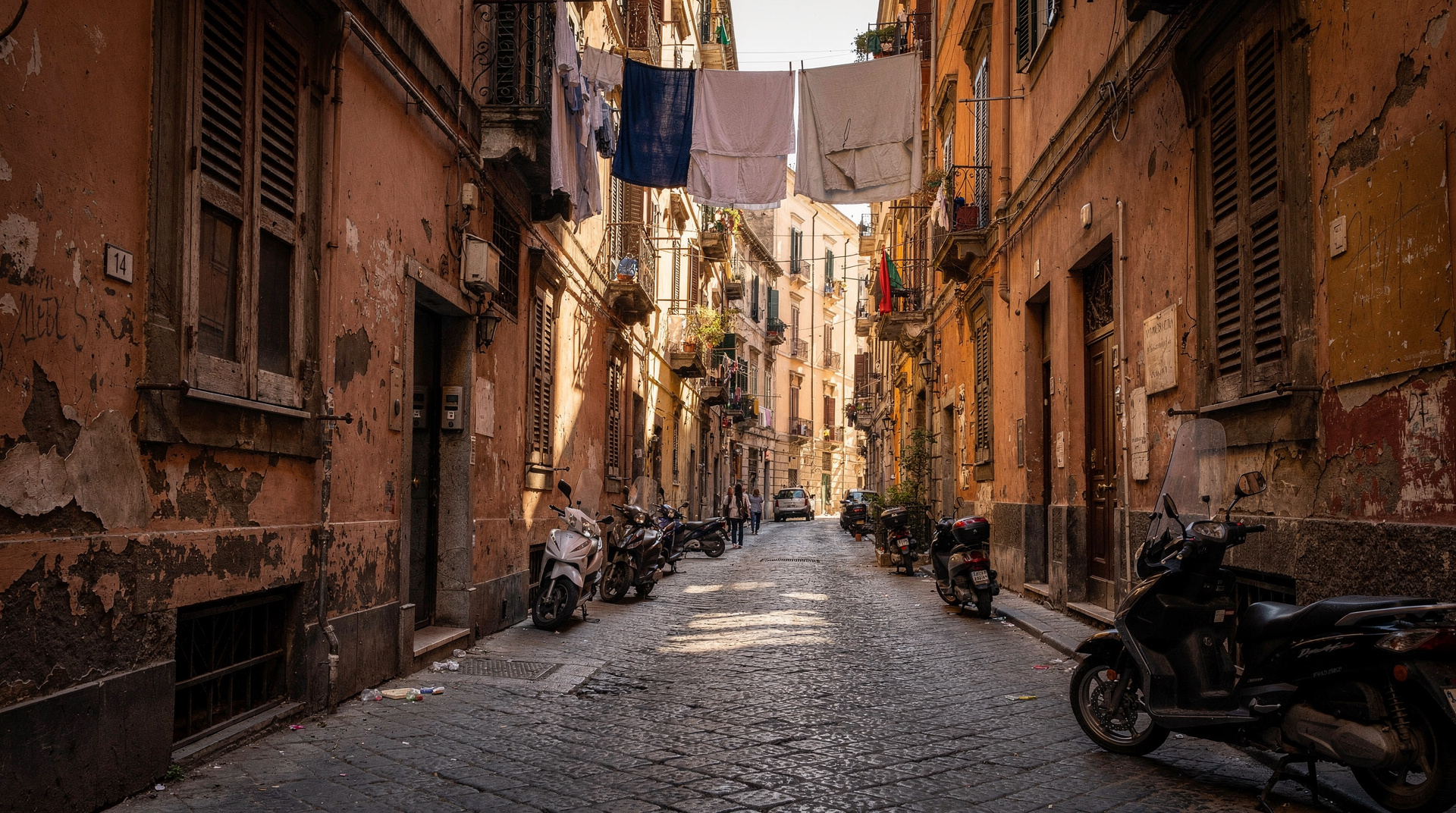
Rione Sanità sits in a bowl between the historic center and the Capodimonte hill, cut off from the city above by the 17th-century elevated road (Corso Amedeo di Savoia / the overpass above Via Sanità) that Spanish viceroy builders flung across the valley. For decades, this infrastructure decision sealed the neighborhood in a kind of enforced isolation — the elevated road carried traffic above while the alleys below remained their own world.
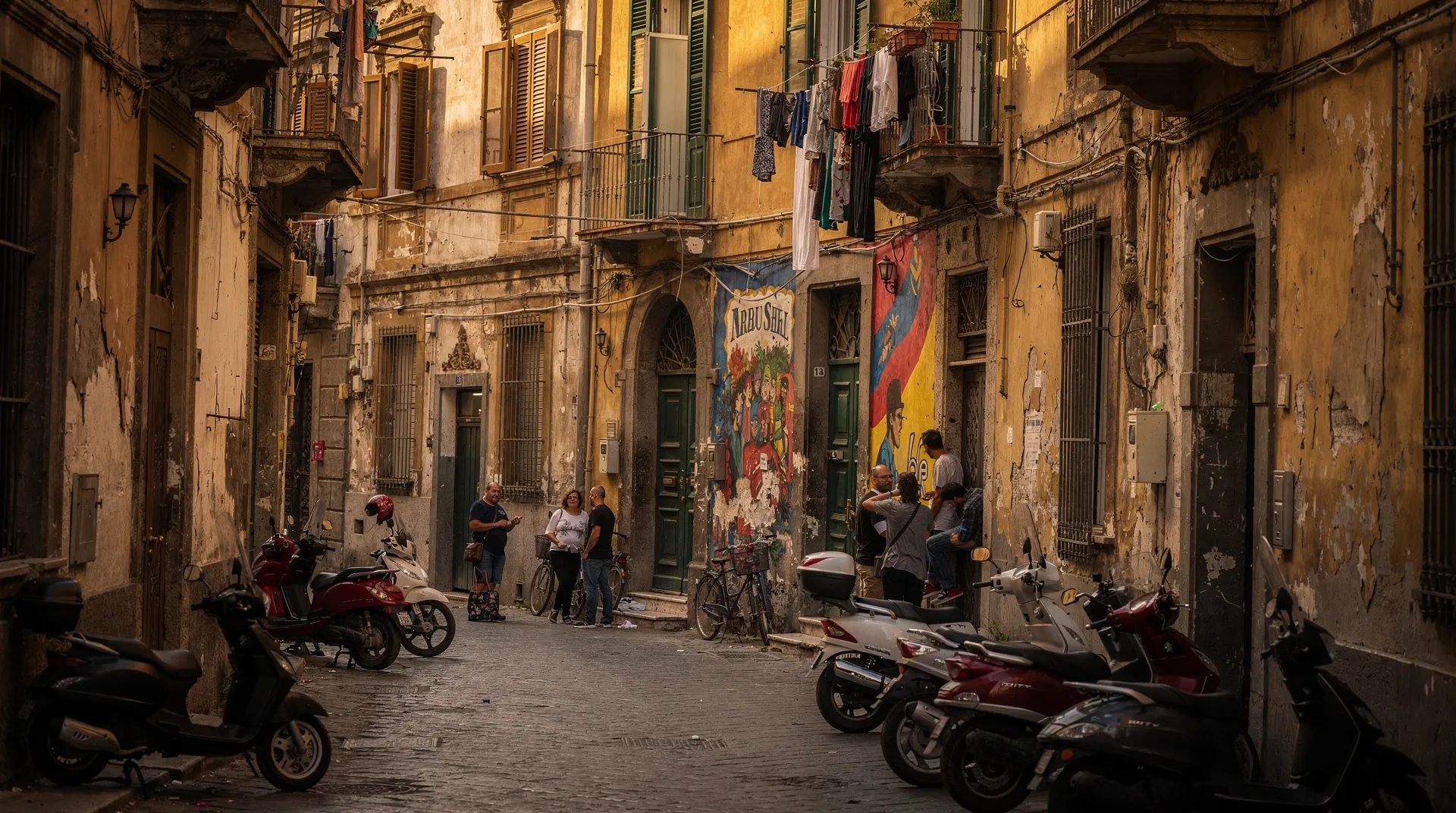
That world is intensely, exhaustingly Neapolitan: a vegetable market that starts before dawn, bassi (ground-floor rooms that are also front doors and sometimes workshops), shrines at corners, the smell of frying and coffee, children with footballs. It is also a neighborhood with real poverty, real organized crime history, and real contradictions.
What makes it worth understanding for visitors: the 2010s brought a deliberate rebirth. Young Neapolitans from the neighborhood established the catacombs cooperative, developed cultural programs, created the street art circuit, and began to reframe Sanità as a place with assets rather than just deficits. This project is ongoing and genuinely interesting — not a tourism-industry creation but a community-led one.
A Sanità catacombs and neighborhood folklore tour connects the underground sites with the above-ground neighborhood life.
The Catacombs of San Gennaro
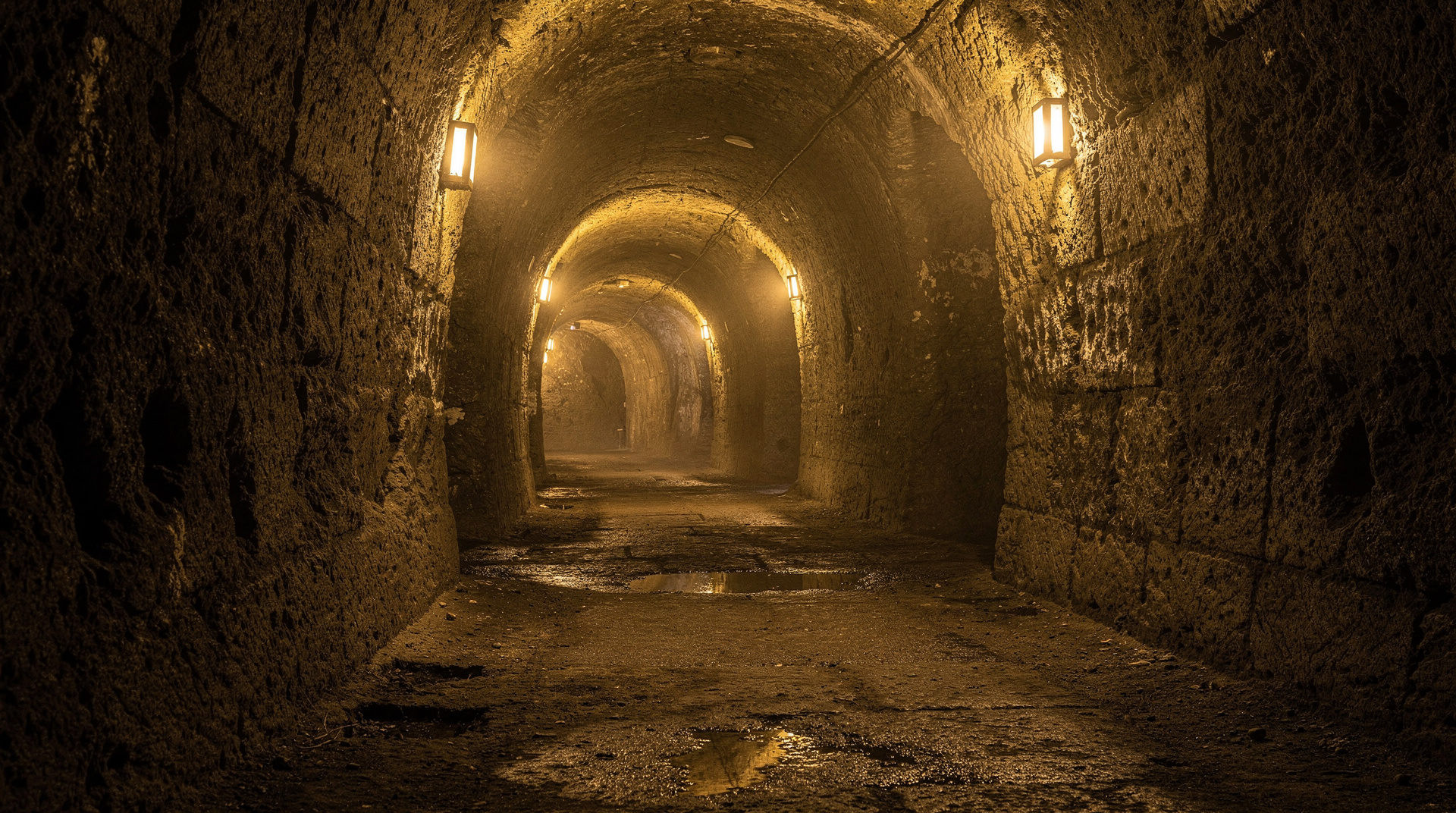
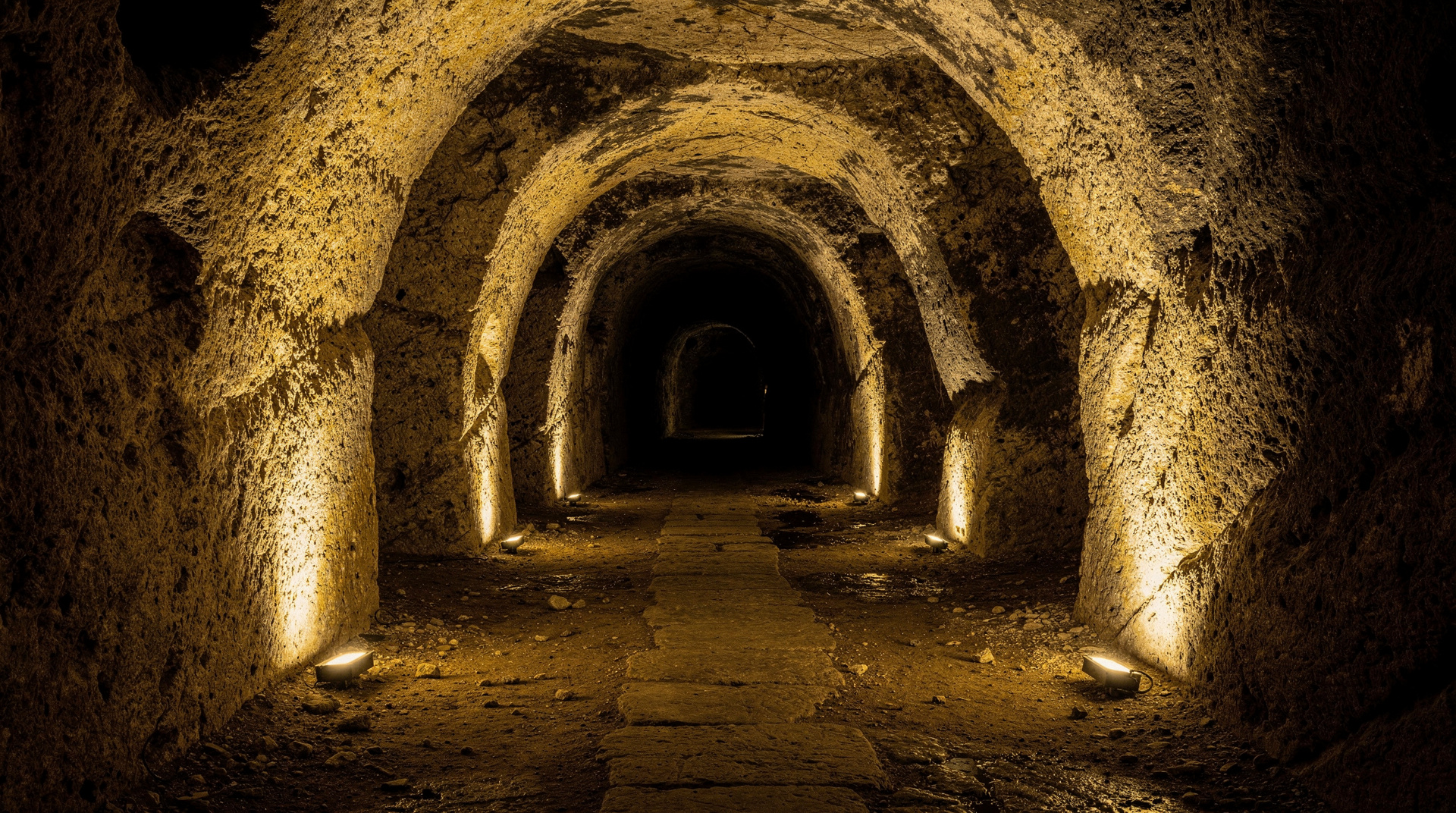
The Catacombs of San Gennaro are the single most important reason to visit Rione Sanità, and one of the most significant early Christian sites in Italy. The complex tunnels through four hectares of volcanic tuff below the hill of Capodimonte, at two levels (upper and lower), extending over three kilometers of galleries.
History: The site was already used as a pagan burial place before the 2nd century AD. As Naples’ Christian community grew, it became a dedicated Christian burial space. The body of San Gennaro (Naples’ patron saint) was reportedly kept here before being moved. The frescoes, mosaics, and tomb inscriptions are among the earliest surviving examples of Christian iconography in the western Mediterranean.
What you see: Family sepulchres with elaborate fresco programs, the “Vestibolo dei Vescovi” (a hall decorated with portraits of early bishops), the tomb of San Gennaro himself (marked by a 5th-century fresco), and corridors that extend into near-darkness. The guided tour (about 50 minutes) makes the historical context comprehensible.
Practical: Tours depart from Via Capodimonte 13 (above the neighborhood, accessible from the road above). Hourly departures 10:00–17:00, seven days a week. Entry €9. The cooperative that runs the catacombs employs local guides from the neighborhood — they are good, engaged, and personally invested in making the visit worthwhile.
Tickets: Book online for the weekend. Weekday visits usually walk-in fine.
The Catacombs of San Gennaro guided entry is the standard ticketed access.
The Catacombs of San Gaudioso
A second, smaller catacomb complex lies directly under the Basilica di Santa Maria della Sanità — the neighborhood’s main church, built in 1602 over a much older site. The Catacombs of San Gaudioso date from the 5th century and hold the remains of San Gaudioso, a North African bishop who died in Naples around 450 AD.
These catacombs have a specific and disturbing feature: sections of wall decorated with 17th-century frescoes that incorporate the actual skulls of entombed individuals into painted portrait frames. The artistic convention of the period required the skull to function as the painted figure’s head. The effect is simultaneously macabre and artistically interesting.
Practical: Entry only via guided tour from inside the Basilica di Santa Maria della Sanità, Via Sanità 124. Tours run Thursday–Tuesday (check current schedule). Entry approximately €9. Fewer visitors than San Gennaro — worth visiting if you have half a day in the neighborhood.
The Catacombs of San Gaudioso guided visit accesses the frescoed galleries under the basilica.
The Fontanelle Cemetery
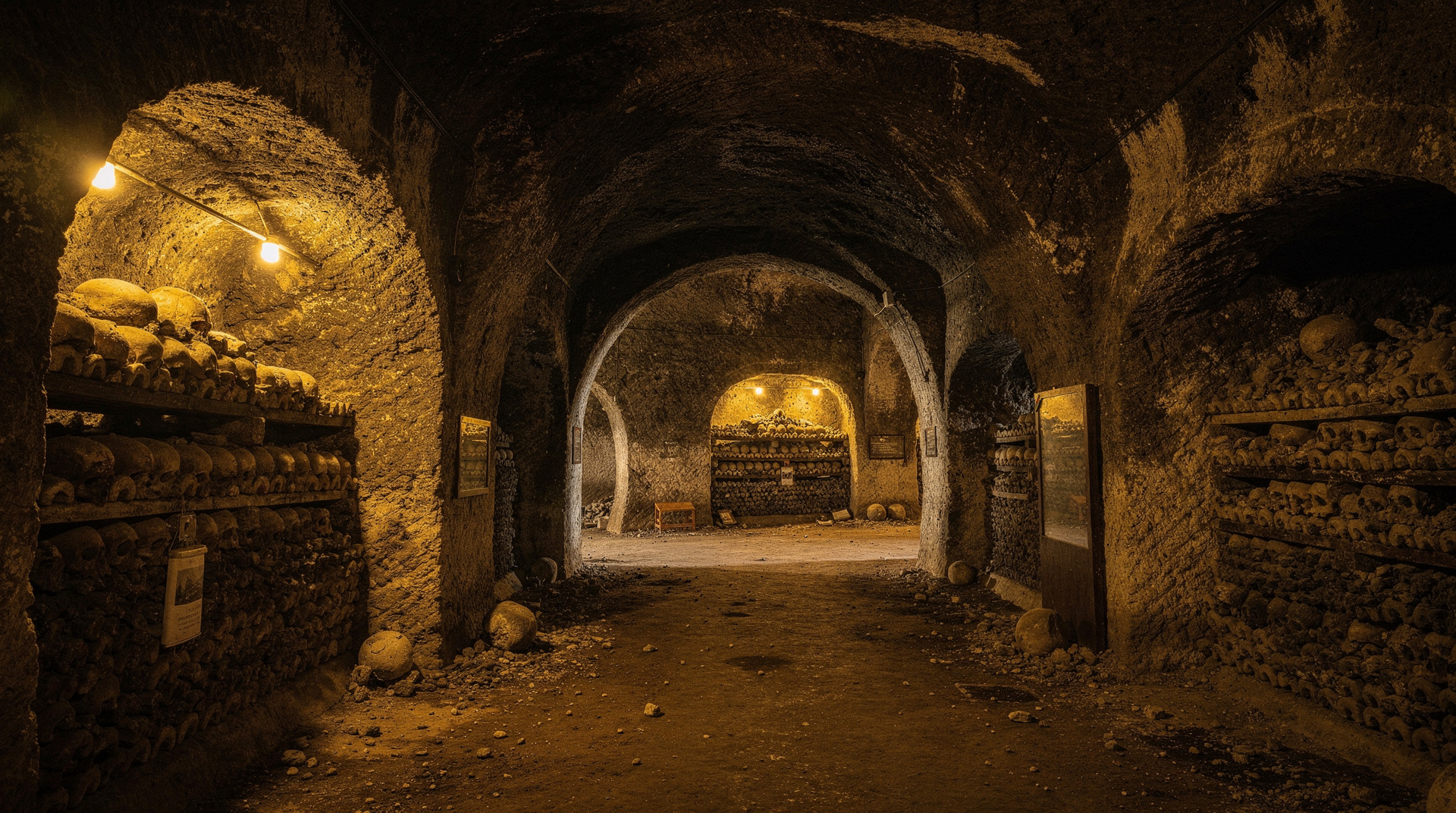
The Fontanelle Cemetery occupies a vast natural cave in the volcanic tuff cliff at Via Fontanelle 80, a 10-minute walk from the main catacombs area. The cave holds the bones of an estimated 40,000 people — primarily plague victims from the 1656 epidemic, plus bones relocated from other cemeteries.
In the 18th and 19th centuries, a popular cult developed around the skulls here. Individual families “adopted” skulls, gave them names and identities, prayed to them, left offerings, and expected intercession in return. The Catholic Church banned the practice in the 1960s and cleared most offerings, but evidence of the cult remains: scattered coins, old photographs, candle stubs.
The space itself is extraordinary — a cavern 70 meters deep, roughly cathedral in scale, bones organized in shelves and piles covering the walls and floor to several meters deep. It is free to visit, managed by the city, and one of the strangest and most powerful spaces in all of Naples.
Opening hours: Variable — currently Tuesday–Sunday 10:00–17:00 (confirm before visiting, as funding and staffing affect hours). No entry fee. No guided tour required but a volunteer guide is sometimes present and worth asking for.
Tone: Come with appropriate seriousness. This is not a horror attraction — it is a genuine place of burial and historically a place of genuine religious practice. Photography is generally permitted but read the posted signs.
The street art circuit
Since 2012, a dozen-plus large-scale murals have been commissioned on the exterior walls of buildings around Piazza Sanità and the adjacent streets. The project was initiated by local organizations and has involved significant artists from Italy and internationally.
Key works:
- Pino Daniele and Diego Maradona double portrait (near Piazza Sanità): the most photographed mural, a tribute to two Neapolitan cultural icons both of whom died relatively young
- Various commissioned works on Via Stella, Via Capodimonte approach streets, and the lower Via Sanità itself
Walking the circuit independently takes 45–60 minutes — the murals are clustered enough to cover on foot. A guided walk with a local provides the stories behind the commissions and the neighborhood context.
The morning market
Every morning until around 13:00, Via Sanità and its side streets function as a working-class neighborhood market — fish laid out on ice, crates of tomatoes, aged women selecting mozzarella from the dairy stall, men arguing over football. The fish market near the Porta San Gennaro entrance is particularly strong.
This is not a tourist market — there are no souvenirs, no English menus, no performance. It is a working food supply system that has operated in this form for centuries. Come early (08:00–10:00 is best) and watch.
The neighborhood’s social history
Rione Sanità has been simultaneously one of Naples’ most culturally significant and most economically marginalized neighborhoods. The Camorra (the Neapolitan organized crime network) maintained a strong presence in the neighborhood for decades, and the scars of that history are real.
The 2010s cooperative model — young people from Sanità running the catacombs, creating employment, developing cultural programming — represents a specific and interesting response to that history. The cooperative is now the primary employer of guides in the neighborhood and has reinvested ticket revenue into the community. This is the honest background to what otherwise might look like a generic “authentic neighborhood” tourism pitch.
For visitors, the practical implication is: the catacombs guides are locally embedded and informed. They know the neighborhood’s complexity and don’t pretend otherwise. The visit is richer for it.
Practical logistics
Getting there:
- On foot from Piazza Dante: 20 minutes north through Via dell’Anticaglia then Via Salvator Rosa
- Metro Line 1 to Piazza Cavour (“Museo” station), then 15 minutes walk north on Via Foria
- Bus from Napoli Centrale: lines 201, R4 direction Capodimonte
Within the neighborhood:
- The catacombs complex (San Gennaro) is on Via Capodimonte, above the valley floor — some uphill walking
- The Fontanelle Cemetery is about 10–15 minutes walk west of the catacombs entrance
- San Gaudioso is on Via Sanità, in the valley floor
Time needed: Half day covers San Gennaro catacombs + Fontanelle Cemetery. A full day adds San Gaudioso, the street art walk, morning market, and lunch.
Lunch: Trattoria Carmela (Via Sanità) and Bar Poppella (Via Arena alla Sanità, the original location of the famous pastry shop) are the two standout eating options.
Frequently asked questions about Rione Sanità
Why is it called Rione Sanità?
“Sanità” means “health” in Italian. The neighborhood name derives from the church of Santa Maria della Sanità — the titular Madonna was credited with ending a plague in the neighborhood, hence her attribute as protector of health.
Is the street art in Sanità comparable to Shoreditch or Kreuzberg?
Not in scale or density. The Sanità murals are a dozen significant works spread across a neighborhood, not a concentrated wall-to-wall street art district. The quality is high and the context (community-driven in a neighborhood with genuine social challenges) makes the works more meaningful. Visitors expecting a full street art tour will find it modest; visitors interested in the community story will find it interesting.
Can children visit the catacombs?
The San Gennaro catacombs are manageable for children aged 8+ who are comfortable in low-lit underground spaces. The Fontanelle Cemetery (bones on an industrial scale) is better suited to teenagers and adults — younger children may find it disturbing. The cooperative has some family-oriented programming; ask when booking.
Is there a good café near the catacombs?
Bar Poppella (Via Arena alla Sanità 1) is the original home of the “fiocco di neve” pastry — now famous throughout Naples but still best at the original location. Open from early morning. Worth visiting as part of any Sanità visit.
Are there any hotels in Rione Sanità worth staying in?
A few B&Bs have opened in renovated historic buildings. Quality is variable. The best option is a property that explicitly markets itself as part of the neighborhood’s regeneration — these tend to have locally embedded hosts who can give genuine recommendations. Verify recent reviews for cleanliness and wi-fi, which are the two most variable factors. For most first-time visitors, though, Vomero or Chiaia remain the more practical base, with Sanità as a half- or full-day visit rather than a place to sleep.
How Sanità compares to the historic center
Visitors who have already spent a day around Spaccanapoli and the Centro Storico sometimes assume Sanità is more of the same — it isn’t. The Centro Storico is dense with churches, shops and restaurants built around centuries of tourism; Sanità has almost none of that infrastructure, which is precisely its appeal and also its friction.
There are fewer signs in English, fewer places set up for a quick coffee-and-go, and no equivalent of Via San Gregorio Armeno’s crib-maker shopfronts. What Sanità has instead is the Naples underground at a genuinely ancient scale (the catacombs predate the more commonly visited Napoli Sotterranea circuit), and a neighborhood identity that has not been shaped around visitors at all.
If your time in Naples is limited to one full day beyond the obvious sights, Sanità is the strongest single alternative to a second pass through the Centro Storico — see the hidden gems Naples guide for how it fits alongside other overlooked spots, and the Naples history guide for the deeper context behind what you are seeing underground.
Frequently asked questions about Rione Sanità guide: Naples' most authentic neighborhood
Is Rione Sanità safe for tourists?
What are the Catacombs of San Gennaro?
What is the Fontanelle Cemetery?
How do I get to Rione Sanità from the historic center?
What is the street art scene in Rione Sanità?
Is Rione Sanità good for families?
What does it cost to stay in Rione Sanità?
Top experiences
Bookable activities with verified prices and instant confirmation on GetYourGuide.