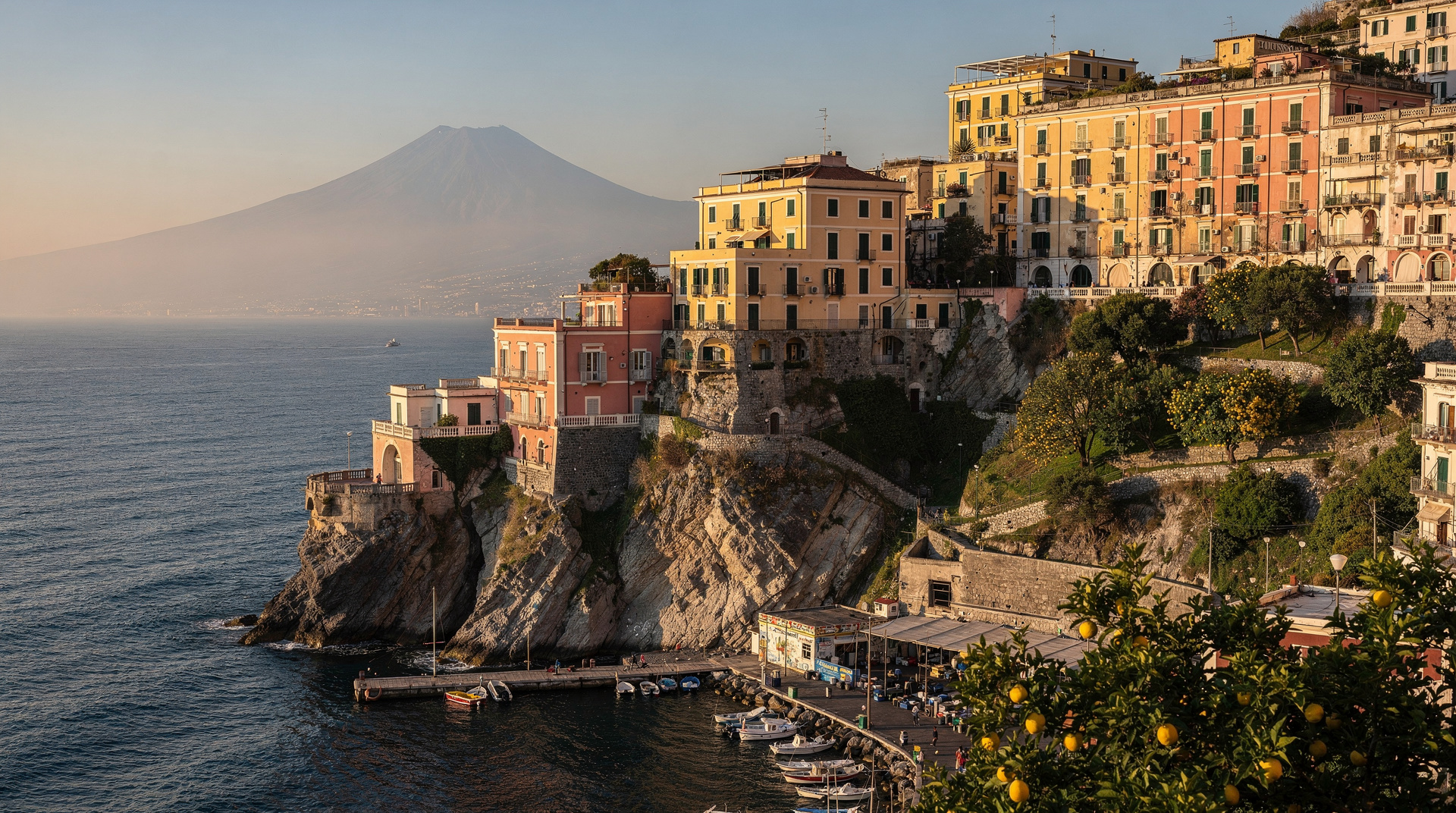
Sorrento as a base — should you stay in Sorrento instead of Naples?
Sorrento: Guided Walking Tour & Limoncello Tasting
Should you base yourself in Sorrento or Naples?
Sorrento is the better base for Capri and the Amalfi Coast. Naples is better for Naples itself, Pompeii, Herculaneum, and Vesuvius. For a week-long trip, many visitors split the stay — 3 nights in Naples, then 2–3 nights in Sorrento. The two towns are 65–70 minutes apart by Circumvesuviana train.
Sorrento or Naples as a base? Sorrento for Capri and Amalfi access. Naples for the city itself, Pompeii, and Herculaneum. Many visitors do 2–3 nights in each. The Circumvesuviana connects them in 65–70 minutes, so you are not choosing between access to one or the other — you are choosing where to sleep.
| Best for | Capri and Amalfi Coast access |
| Naples journey | 65–70 min by Circumvesuviana |
| Typical stay | 2–4 nights, often paired with 2–3 in Naples |
| Extra cost vs Naples | Around 20–40% more for equivalent quality |
| Getting around | Walkable centre; Circumvesuviana, SITA buses and ferries for everything else |
The fundamental question
When planning a Campania trip, the base decision matters more than it might seem. The region’s attractions spread across a large area — Naples city, the archaeological sites (Pompeii, Herculaneum), the Amalfi Coast, the islands (Capri, Ischia, Procida), and more. No single base is equidistant from all of these.
Naples places you 0 minutes from the city, 30 minutes from Pompeii, 50 minutes on a hydrofoil from Capri, 30–40 minutes from Ischia, and 2+ hours from the Amalfi Coast without a car.
Sorrento places you 65–70 minutes from Naples city, 30 minutes from Pompeii, 20–25 minutes from Capri, and under an hour from Positano by bus.
If you could only be in one place and wanted the maximum coverage of the region, Sorrento is the more central transport hub for the southern attractions. But if Naples itself is a priority, staying in Naples and day-tripping to Sorrento for Capri connections works just as well.
The case for Sorrento as primary base
Capri access — 20–25 minutes by hydrofoil from Marina Piccola versus 45–50 minutes from Naples Beverello. This matters if you are planning multiple Capri visits or want to do the first morning ferry without a very early Naples departure.
Amalfi Coast — SITA buses from Sorrento to Positano (1 hour), Amalfi (1.5–2 hours). From Naples, you add a 65-minute train ride before catching the bus. Sorrento as a hub for the coast is measurably more efficient.
Environment — Sorrento is calmer, more compact, and by conventional safety metrics more straightforward than Naples for first-time visitors or those travelling with children. The town centre is easily navigable, the streets are pedestrian-friendly, and the evening atmosphere is pleasant without requiring specific neighbourhood knowledge.
Quality of rest — Sorrento hotels tend to be quieter than equivalent Naples properties. The noise level in Naples city centre (particularly near the train station) can be significant. Sorrento’s relatively small centre and clifftop position means most hotels experience less traffic noise and more sea air.
The case for Naples as primary base
The city itself — Naples is one of Europe’s most extraordinary urban experiences. The MANN (National Archaeological Museum), the underground city, Spaccanapoli, the Cappella Sansevero, the street food circuit, the metro stations of art — none of this is accessible from Sorrento without a 65-minute train journey each way. For anyone prioritising Naples, staying in Naples is simply more time-efficient.
Pompeii and Herculaneum — from Naples, Pompeii is 30 minutes by Circumvesuviana, Ercolano 10 minutes. From Sorrento, add 30 minutes in each direction. Not a deal-breaker, but meaningful if you are doing multiple archaeological day trips.
Cost — Naples accommodation is generally 20–40% cheaper than equivalent Sorrento accommodation. This matters on longer trips.
Variety — Naples has vastly more hotels, apartments, B&Bs, and hostels across different price points and neighbourhoods. Sorrento’s accommodation market is smaller and more concentrated in the mid-to-upper price range.
The split-stay approach (most popular among experienced travellers)
For a 7-day Campania trip, many experienced travellers find this split works well:
Days 1–3: Naples
- Day 1: Arrive, explore Spaccanapoli, dinner in the old town
- Day 2: MANN museum, Cappella Sansevero, street food circuit
- Day 3: Pompeii or Herculaneum day trip
Days 4–7: Sorrento
- Day 4: Circumvesuviana to Sorrento, afternoon exploring the town
- Day 5: Capri day trip from Marina Piccola
- Day 6: Amalfi Coast (Positano and Amalfi by bus)
- Day 7: Vesuvius or Procida, return to Naples for evening flight
This itinerary uses each base for its natural strength and avoids long daily commutes from a single fixed point. The luggage transfer between Naples and Sorrento (Circumvesuviana with suitcases) is manageable but requires care on crowded trains.
Cost comparison
| Category | Naples (central) | Sorrento |
|---|---|---|
| Budget hotel/B&B double | €60–100 | €90–140 |
| Mid-range hotel double | €100–180 | €150–250 |
| Cliff-view/luxury | €200–400 | €250–600 |
| Restaurant main course | €12–22 | €15–28 |
| Coffee at the bar | €1–1.20 | €1.20–1.50 |
These are 2026 estimates. Prices peak in July–August in both locations.
Tours and experiences based from Sorrento
For a walking tour with wine and local foods:
Sorrento walks and food tourFor a full-day Amalfi Coast tour from Sorrento:
Full-day Amalfi Coast tour from SorrentoFor a combined Capri, Anacapri, and Blue Grotto full-day from Sorrento:
Capri, Anacapri and Blue Grotto full day from SorrentoPractical transport from Sorrento
Getting to Sorrento — see getting-to-sorrento for all transport options from Naples and beyond.
Circumvesuviana — see circumvesuviana-guide for the Naples-Pompeii-Sorrento train in detail, including the pickpocket situation, Campania Express alternative, and station logistics.
Day trips — all the main Campania day trips are covered in our planning section. See best-day-trips-from-naples for an overview of all options with journey times.
Frequently asked questions about basing in Sorrento
Do I need a car if I am based in Sorrento?
No. The Circumvesuviana handles Naples and Pompeii/Herculaneum. SITA buses cover the Amalfi Coast. Ferries cover the islands. Within Sorrento, walking is sufficient. A car is only useful if you want to explore the Sorrento peninsula (Massa Lubrense, Sant’Agata sui Due Golfi) independently — and even then, the narrow roads with limited parking make it more trouble than a taxi or scooter.
Is Sorrento suitable for families with young children?
More suitable than Naples in terms of navigability and safety. The town centre is relatively compact, the evening passeggiata culture works well for families, and ferry access to Ischia (beaches) and Capri (older children) is easy. The main disadvantage is cost — family rooms in Sorrento are expensive, and four people add up quickly.
When is Sorrento most crowded?
July and August — cruise ship excursions, Italian domestic tourists, and international visitors all converge simultaneously. Piazza Tasso can be genuinely hard to cross in mid-August. May, June, September, and early October are significantly calmer and represent better value for money.
Are there any negative reviews of Sorrento as a base?
Some visitors find Sorrento too commercialised — that the main streets feel designed for tourist extraction rather than authentic experience, and that after one day the town has been largely explored. This is a fair criticism of the tourist-facing parts. Visitors who venture into the old town lanes, go down to Marina Grande, and take day trips beyond the main circuit find more to appreciate. Sorrento works best as a base when you are spending most of your time elsewhere and returning in the evening.
How do I get to the Amalfi Coast from Sorrento without a tour?
SITA bus from the station forecourt (buy tickets at the tabaccheria next to the bus stop, not from the driver). Take Line S1 toward Amalfi. The service is regular in season but can be extremely crowded in July and August — the road between Positano and Amalfi operates car restrictions in summer, but buses continue regardless. Allow extra time during peak hours. See amalfi-coast-bus-sita.
Can I stay in Sorrento for the Amalfi Coast and still visit Naples properly?
Yes. The Circumvesuviana from Sorrento to Naples Garibaldi takes 65–70 minutes and runs every 30 minutes. A full Naples day (9am–6pm) from a Sorrento base is entirely feasible, leaving and returning on the train. You lose 2–2.5 hours total to travel, which is the main tradeoff.
Booking accommodation in Sorrento: what to look for
When choosing a Sorrento hotel for a multi-day base, several factors make a meaningful difference to the overall experience.
Location within Sorrento — properties in the historic centre (within 5–10 minutes’ walk of Piazza Tasso) are the most convenient. The area south of the main street, closer to the cliff, has quieter hotels with sea or garden views. Hotels on Corso Italia itself can be noisy in the mornings from traffic and scooters. The hill above the Via Capo road (further from the centre but with sea views) has some excellent options but requires a taxi or bus to reach the town centre and port.
Access to Marina Piccola — if you are planning multiple Capri ferry trips, proximity to the descent to Marina Piccola matters. The port is about 15 minutes on foot from Piazza Tasso via the cliff steps. Some hotels have their own access to the water level. Budget for a taxi on days with heavy luggage.
Pool vs cliff view — a small but significant decision. Hotels with swimming pools are typically set back from the cliff edge (you cannot have both a pool and a sheer cliff drop in the same position). Cliff-edge hotels have the dramatic bay view but limited or no pool. For families, a pool matters more; for couples or adults, the view often wins.
Breakfast — Sorrento hotel breakfasts are generally good and include local products (sfogliatella, cornetti, fresh fruit, local cheese). The buffet model is standard at mid-range and above. At budget properties, breakfast may not be worth the supplement — the same meal costs €5–8 at a local bar.
Check-in time — if arriving mid-morning (as most visitors transferring from Naples do), your room may not be ready. Most hotels offer luggage storage and will hold bags until the room is available. Ask about this when booking or on arrival.
Day-by-day planning from a Sorrento base
A practical 4-day Sorrento-based itinerary:
Day 1: Arrive, settle in, afternoon walk through Sorrento old town and down to Marina Grande, dinner at a harbour trattoria.
Day 2: Early ferry from Marina Piccola to Capri. Monte Solaro chairlift in Anacapri, lunch in Anacapri, afternoon around Capri town and Piazzetta, return ferry by 5:30pm.
Day 3: SITA bus to Positano (8am from the station forecourt). Morning in Positano, continue by bus to Amalfi for lunch, bus back to Sorrento by 5pm.
Day 4: Circumvesuviana to Pompeii Scavi (30 min), spend the morning, option to continue to Naples for afternoon or return to Sorrento.
This covers the four main day-trip destinations from Sorrento and leaves evening time in the town each night. The itinerary is repeatable with modifications — replace Pompeii with Ischia, replace Positano with Procida, add the Path of the Gods on a day with good weather.
Rainy day options from a Sorrento base
Sorrento is predominantly an outdoor destination — the appeal of the town, the ferries, and the surrounding region is largely landscape-dependent. A day of rain during a Sorrento-based trip is worth planning for.
Stay in Sorrento: the Museo Correale di Terranova (regional art and antiques, covered galleries) makes a pleasant 2-hour visit. A cooking class or limoncello-making session works well in any weather. The old town lanes are sheltered and interesting in rain. The intarsia woodcraft workshops have no weather dependency.
Go to Naples instead: the city has abundant covered indoor attractions — the MANN (National Archaeological Museum with the entire Pompeii fresco collection), the Cappella Sansevero, the Galleria Umberto I, the Certosa di San Martino. A rainy day in Naples can be one of the best sightseeing days of a Campania trip. The Circumvesuviana runs regardless of weather.
Go to Pompeii: the archaeological site is partially covered by roofs over key structures. Rain also reduces the crowd substantially — a wet Pompeii morning with almost no other visitors is genuinely atmospheric. Bring waterproof shoes (the ancient stone streets become slippery) and a waterproof layer.
Avoid: rainy-day coastal boat trips (rough water, no visibility), the Amalfi Coast road (beautiful in sun, gloomy in rain with landslide risk warnings in heavy precipitation), and beach-focused activities.
Getting the most from Sorrento evenings
The passeggiata — the Italian tradition of evening walking and social contact — is worth participating in rather than just observing. The best time is 6:30–8:30pm when the light is declining, Piazza Tasso is animated, and the gelato shops and cafés on Corso Italia are at their most social.
After the passeggiata, dinner in Sorrento is served from 7:30pm. The standard advice of eating where locals eat (two streets back from the tourist strip) applies. For a special dinner, Il Buco on Via II Rampa Marina is the most ambitious kitchen in town and requires advance booking. For a more casual evening, Inn Bufalito on Via Fuorimura does excellent buffalo mozzarella-based dishes at reasonable prices.
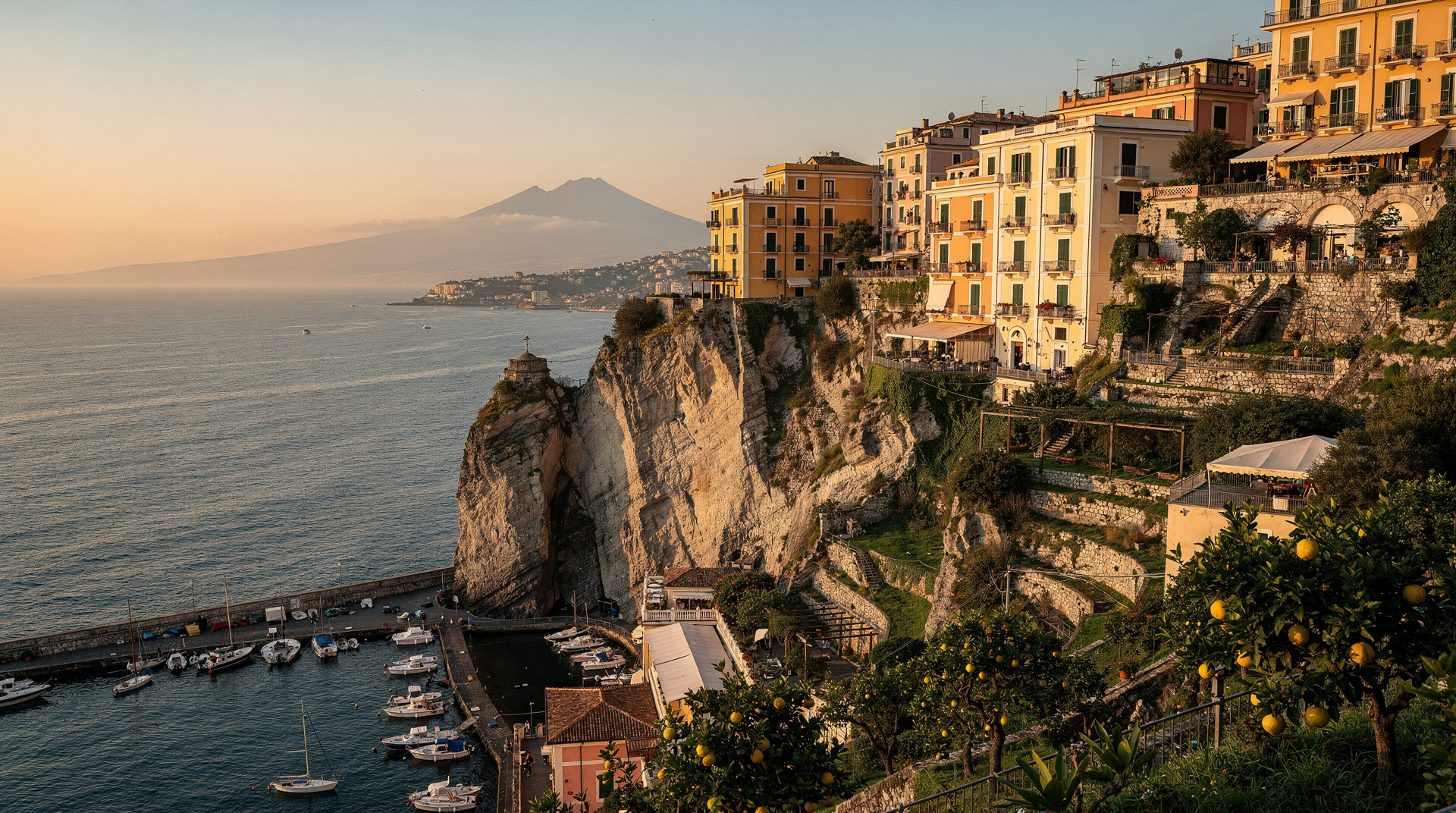
The evening light from the Villa Comunale cliff at 8pm in September — the sky orange behind Vesuvius, Naples lit along the waterfront, the bay entirely still — is one of those moments that justifies all the planning.
Practical checklist before you commit to Sorrento
Before booking a Sorrento-based stay, run through a short set of practical questions that determine whether it genuinely suits your trip. First, how many nights total does your Campania trip run — under 5 nights makes a single Naples base usually more efficient, while 6+ nights makes the split-stay approach worthwhile. Second, how many times do you plan to visit Capri — a single visit works fine from either base, but two or three visits make Sorrento’s shorter crossing add up in saved time.
Third, are you travelling with luggage that will need to move between bases — if so, factor in a slower, less crowded Circumvesuviana transfer time (late morning or early afternoon) rather than assuming you can do it during rush hour. Fourth, what is your accommodation budget — if it is tight, Naples stretches further and Sorrento’s premium may not be worth it for a short stay. Answering these four questions honestly resolves most of the uncertainty that this guide’s FAQ section addresses individually.
Ischia and Procida from a Sorrento base
Sorrento’s port has direct ferries to Capri, but Ischia and Procida connections mostly run through Naples’ Beverello or Pozzuoli terminals, which means an extra Circumvesuviana leg first. If those two islands are a priority for your trip, it is often simpler to add a night in Naples rather than chase island connections from Sorrento. See the Ischia day trip guide and Procida day trip for the practical routing either way. Travellers set on all three islands from a single base generally find Naples the more efficient hub, even though Sorrento wins for Capri specifically.
Packing and logistics for a split-stay trip
If you do choose the split-stay approach, a few small logistics decisions make the Naples-to-Sorrento transfer noticeably smoother. Pack with one bag per person rather than shared luggage where possible, since the Circumvesuviana platforms and steps are easier to navigate solo per bag than juggling shared cases.
Keep a day’s change of clothes and any electronics accessible in a daypack rather than buried in the transfer luggage, in case the checked bag is delayed getting to your Sorrento room before check-in. Confirm both hotels’ luggage storage policy in advance — most Naples and Sorrento hotels store bags for early arrivals or late departures without charge, which removes the pressure of timing the transfer around exact check-in and check-out windows.
Who should skip Sorrento entirely
Not every itinerary benefits from a Sorrento stay. If your trip is short (3–4 nights total) and weighted toward Naples city, the archaeological sites, and food culture, adding a Sorrento base mostly adds transfer time without adding proportional value — day trips to Capri or the Amalfi Coast from Naples remain fully workable, just a little longer each way. Sorrento earns its place on longer trips (7+ nights) or when the Amalfi Coast and Capri are the trip’s main focus rather than a side excursion. See how many days in Naples for help sizing the whole itinerary before deciding whether a second base is worth the packing and unpacking.
Sorrento walking tour with limoncello tastingFrequently asked questions about Sorrento as a base — should you stay in Sorrento instead of Naples?
What are the advantages of basing in Sorrento?
What are the disadvantages of basing in Sorrento?
Is accommodation more expensive in Sorrento than Naples?
Is Sorrento safe for tourists?
Can I do Pompeii and Herculaneum easily from Sorrento?
How many nights in Sorrento do I need?
What type of traveller is Sorrento best for?
Top experiences
Bookable activities with verified prices and instant confirmation on GetYourGuide.