Sorrento vs Amalfi — which town to use as a coast base?
From Sorrento: Amalfi & Positano Full-Day Trip by Boat
Should I base in Sorrento or Amalfi town for the Amalfi Coast?
Sorrento is the better base for most visitors — it has a train connection to Naples and Pompeii, ferry access to Capri and Ischia, good accommodation supply at a range of price points, and easy bus access to the coast. Amalfi town is more atmospheric and central on the coast, but its accommodation is limited and expensive, road access is challenging, and it has no train. Use Sorrento as a hub and Amalfi as a full-day excursion.
Sorrento or Amalfi as your base? Sorrento wins on transport links, accommodation range, and practicality. Amalfi wins on coastal atmosphere and position. For most visitors planning a 3–5 day Campania coast trip, Sorrento is the logical hub with Amalfi as a day trip destination.
| Sorrento | Amalfi town | |
|---|---|---|
| Train access | Yes — Circumvesuviana terminus | None |
| Accommodation range | €40–300+, wide supply | €150–600+, limited supply |
| Best for | Multi-region trips, transport hub | Short, atmosphere-focused stays |
| Evening scene | Lively after dark | Quiet by 9pm |
Two towns at opposite ends of the coast planning equation
Sorrento and Amalfi town are about 45 km apart by road, with the entire Amalfi Coast between them. They are both attractive, both excellent in their ways, and both frequently considered as bases for exploring the region. The choice between them shapes your entire trip logistics.
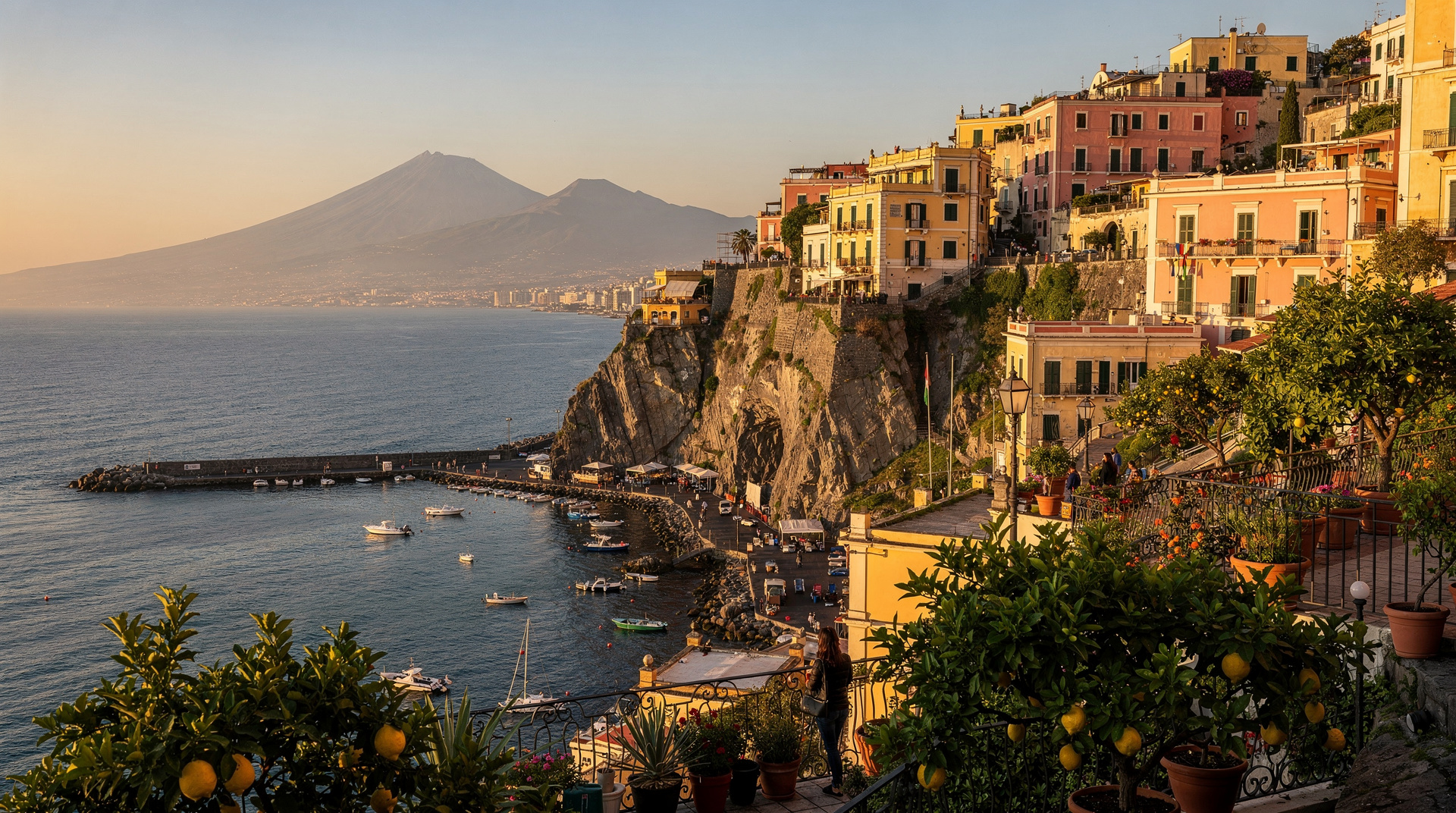
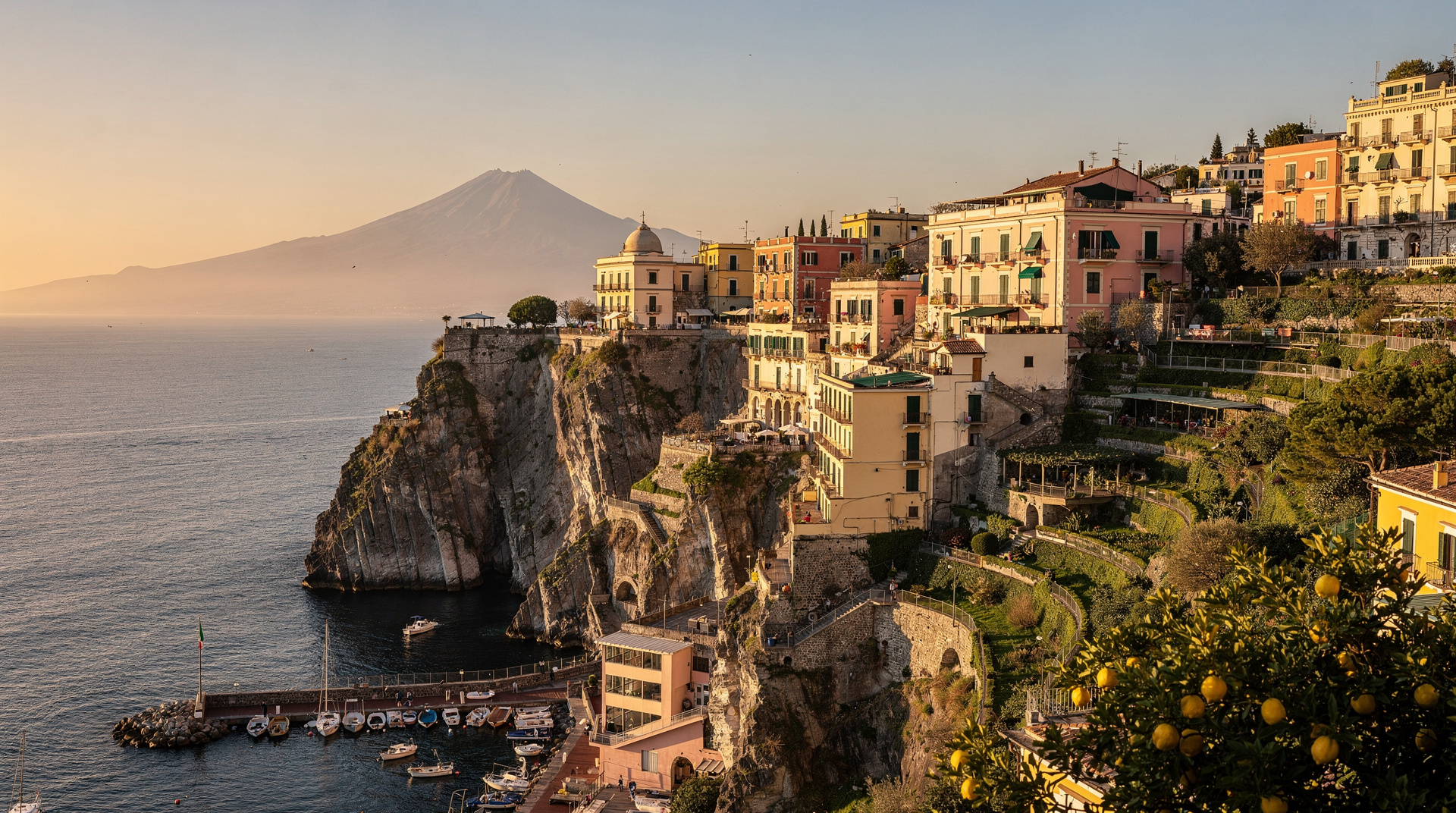
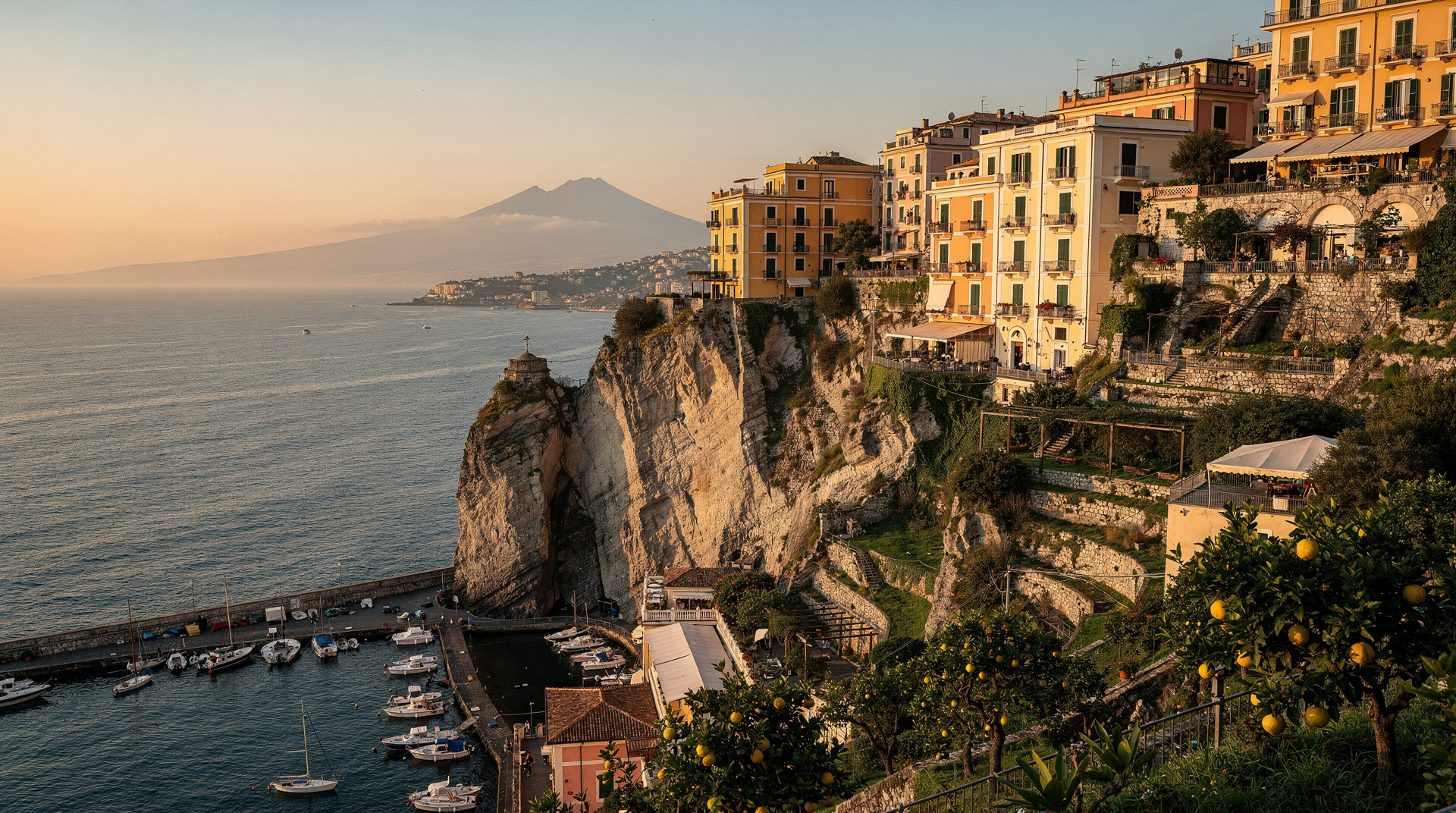
Sorrento sits at the northern end of the Sorrentine Peninsula, on a cliff above the Bay of Naples. It is a resort town of about 16,000 people, historically the gateway between Naples and the southern coast. Its great practical advantage is its transport: the Circumvesuviana railway terminating here from Naples, ferry connections to Capri and Ischia, and bus connections along the entire coast.
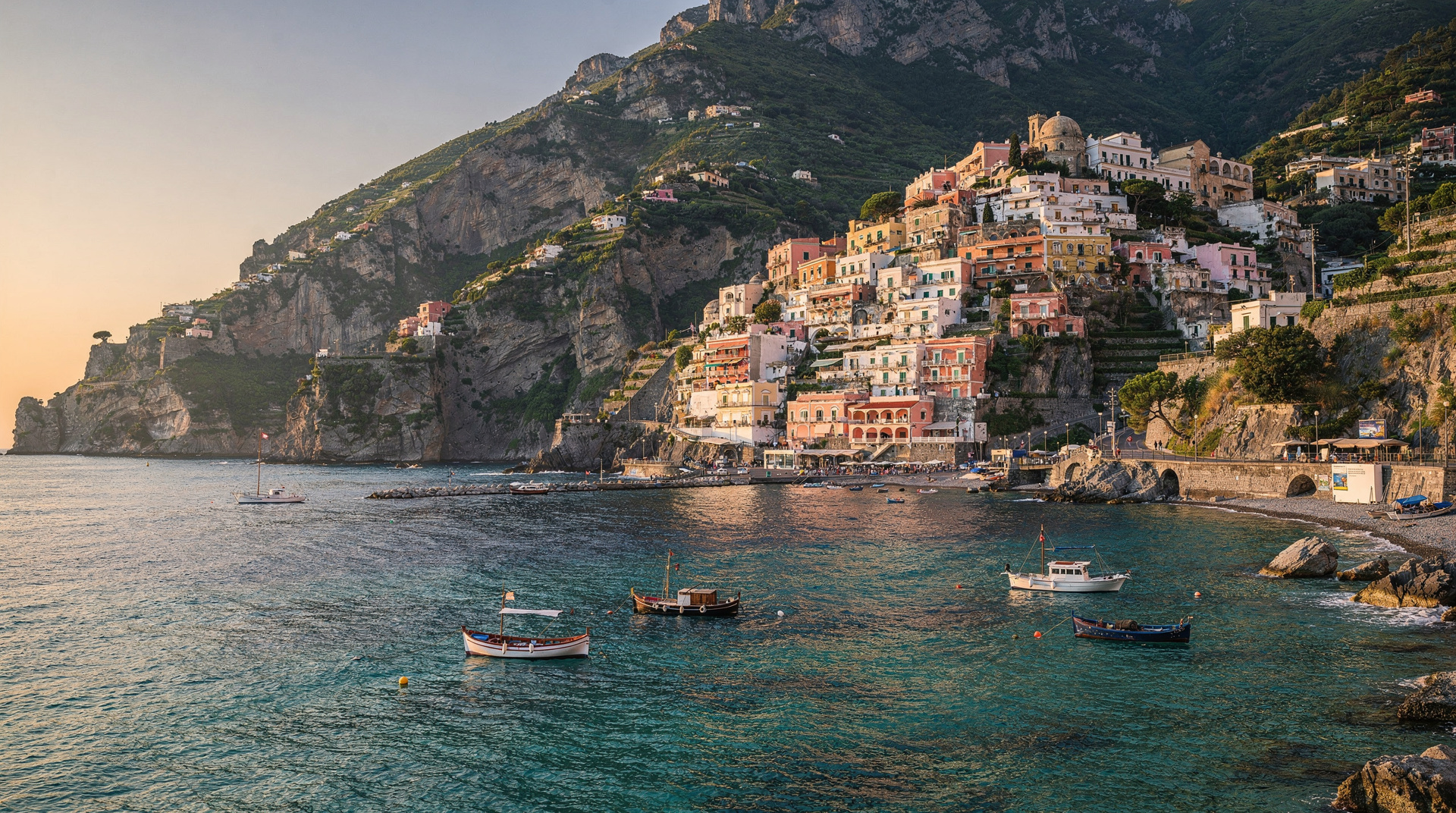
Amalfi town sits at the mouth of a narrow valley in the centre of the coast — the largest settlement on the Amalfi Coast proper, and the town that gives the coastline its name. It was a powerful medieval maritime republic (the Duchy of Amalfi) before Naples absorbed it, and its cathedral, cloister, and narrow lanes retain traces of that grandeur. But it is accessible only by road or sea, has limited accommodation, and the road in is one of the most congested routes in southern Italy in summer.
Transport reality: a decisive asymmetry
The transport comparison between the two towns is the most important practical factor in this decision.
From Sorrento:
- Naples: 65 minutes by Circumvesuviana train (every 30 min)
- Pompeii: 30 minutes by Circumvesuviana train
- Capri: 20–25 minutes by hydrofoil
- Ischia: 50–60 minutes by hydrofoil
- Positano: 1 hour by SITA bus
- Amalfi town: 1.5 hours by SITA bus
- Ravello: 2 hours by bus via Amalfi
From Amalfi town:
- Naples: 2+ hours by bus to Sorrento then Circumvesuviana, or 1.5 hours by ferry to Salerno then train — no simple direct connection
- Pompeii: 2.5+ hours by bus and train, complex
- Capri: 40–80 min by ferry (seasonal, expensive)
- Sorrento: 1.5 hours by SITA bus
- Positano: 30–40 min by SITA bus
- Ravello: 30–45 min by local bus
If your Campania trip includes Naples, Pompeii, and the islands, basing in Amalfi makes those visits significantly harder. If your trip is entirely coast-focused (Positano to Ravello, no city or archaeological sites), Amalfi’s central position is an advantage.
See amalfi-coast-bus-sita for SITA bus timetables and getting-to-sorrento for Sorrento transport in detail.
Accommodation: Sorrento has more choice
Sorrento has a large and well-developed accommodation sector ranging from budget guesthouses (€40–80 per double) through mid-range hotels (€100–200) to luxury cliff-facing properties (€300+). The supply is substantial enough that booking 2–3 weeks in advance is usually sufficient outside of peak August.
Amalfi town has limited accommodation, concentrated in a few cliff-and-valley-facing hotels. Mid-range options in Amalfi start at around €150–180 per double in summer; the quality brand hotels (Hotel Luna Convento, Hotel Santa Caterina) run €300–600+. Budget accommodation essentially doesn’t exist in Amalfi town — the supply is too small to support low price points.
The price differential is real and meaningful. A week of accommodation in Sorrento costs €700–1,400 for a mid-range room. The equivalent week in Amalfi, if you can get a room, runs €1,050–2,100+.
The summer road problem
The SS163 — the Amalfi Coast road — is one of Italy’s most spectacular and most congested roads. In peak summer (June–September), a regulation system controls traffic: on even calendar dates, cars with even-numbered plates have priority from Positano to Amalfi; on odd dates, odd-numbered plates (scooters and buses are exempt). This alternating access system runs 10am–6pm.
The practical result: driving to Amalfi town in summer requires checking whether your rental car’s plate number is allowed that day. Buses are exempt but can be delayed significantly by the resulting traffic. Journey times on this road can double or triple in peak season. See driving-amalfi-coast-ss163 for a full explanation of the SS163 rules.
This logistical complexity affects Amalfi-based visitors more than Sorrento-based ones, because leaving or returning to Amalfi requires navigating this road. From Sorrento, day trips to Amalfi are manageable precisely because you are not driving back late at night.
Sorrento to Positano, Amalfi, and Ravello guided day tripA closer look at the shoulder-season difference
The Sorrento-versus-Amalfi calculation shifts noticeably outside July–August. In May, June, September, and October, Amalfi town’s accommodation shortage becomes far less painful — rooms that are fully booked and premium-priced in summer become available at 20–30% lower rates with a week or two of lead time, and the SS163 road traffic that causes the worst delays in peak season eases considerably.
For visitors with flexible dates, shifting a Campania trip to shoulder season changes the calculus enough that basing in Amalfi for 2–3 nights becomes a realistic option even for budget-conscious travellers, rather than the luxury-only proposition it is in August. The trade-off is milder swimming weather in May and October, though September remains warm enough for the sea.
What Amalfi town has that Sorrento doesn’t
Amalfi town is genuinely more atmospheric than Sorrento in specific ways:
The Cathedral: The Duomo di Sant’Andrea, with its striped Romanesque-Byzantine facade, Arab-Norman cloister, and crypt housing the relics of Saint Andrew, is one of southern Italy’s most impressive medieval buildings. Entry to the cathedral is free; cloister and crypt cost approximately €3–5. It opens at 9am and is at its best in morning light before the day-tripper surge (most tours arrive between 10:30am and 3pm).
Medieval town structure: Amalfi’s lanes, staircases, and vaulted passages are the remnants of a functioning medieval city rather than a resort that developed later. The Paper Museum (Museo della Carta, in a 13th-century paper mill in the Valle dei Mulini) is a genuine historical curiosity.
Position on the water: Sitting at sea level with a direct beach below the main piazza gives Amalfi a watery intimacy that hilltop Sorrento lacks. The ferry arrivals, fishing boats, and summer water traffic create an active harbour scene.
Fewer tourists than you’d expect — at the right time: The day-trippers who flood Amalfi arrive between 10am and 4pm, largely on SITA buses and ferry excursions. At 8am and after 5pm, the town returns to something approaching its actual character — locals, residents, and overnight guests. This effect only works if you are staying there.
What Sorrento does better
Evening culture: Sorrento’s passeggiata on Corso Italia, the Via San Cesareo market streets, aperitivo bars in the old town, and ferry access for evening returns from Capri give it a better evening infrastructure than Amalfi, which winds down by 9pm when the day visitors leave.
Range of things to do: Sorrento has limoncello factories open for tastings (Limone is a local product), the Correale Museum (local ceramics, decorative arts), cooking classes, and a small but genuine historic district. The Marina Grande quarter below the cliff is a functional fishing village with excellent restaurants. See sorrento-guide for the full picture.
Safety of the harbour walk: Sorrento’s Lungomare walk between the main port and Marina Piccola is a pleasant stroll without the road hazard of the Amalfi waterfront. In summer, the walk in the evening towards the Villaggio Delfino viewpoint offers some of the coast’s best sunset views over the bay.
Amalfi Coast boat tour from SorrentoConnectivity and everyday services
Sorrento’s larger resident population supports a fuller range of everyday services — pharmacies, banks, supermarkets, and a genuine medical clinic — that matter more than they might seem on a short trip but become relevant on longer stays or if anything goes wrong. Amalfi town’s smaller scale means fewer such services, concentrated in fewer locations, with visitors sometimes needing to travel to Salerno or Sorrento for anything beyond the basics.
Mobile network coverage is solid in both towns’ centres, though Amalfi’s position at the base of a narrow valley occasionally creates weaker signal pockets than Sorrento’s more open cliff-top position, worth factoring in if you rely on real-time navigation or translation apps while exploring either town on foot.
Who should base in each town
Base in Sorrento if:
- Your trip combines Naples/Pompeii with the coast (most trips do)
- You want to visit Capri — Sorrento’s 20-minute crossing is far better than Naples’ 50 minutes
- You have a varied trip and need transport flexibility
- You are on a mid-range or budget accommodation budget
- You want a full evening scene after day trips
- You are travelling with children or less mobile family members
Base in Amalfi town if:
- Your trip is entirely coast-focused (no Naples, no islands)
- You specifically want to wake up in Amalfi and walk to the cathedral at dawn
- Your accommodation budget is €200+ per night
- You enjoy the dramatic enclosed valley setting
- You are visiting for a short stay (2 nights) and want the most atmospheric location
Base in Positano as a middle option: Positano, midway between Sorrento and Amalfi, offers more atmosphere than Sorrento and better practicality than Amalfi. It has ferry connections, bus connections in both directions, and a range of accommodation above and below the town. It is more expensive than Sorrento and busier than either town in peak summer. See positano-guide for planning detail.
Practical differences in daily logistics
Beyond the headline transport comparison, daily life differs between the two towns in ways that matter over a multi-day stay. Grocery shopping and everyday errands are far easier in Sorrento, which has a genuine resident population and functioning supermarkets alongside the tourist shops; Amalfi’s small permanent population means everyday services are thinner and geared more toward serving hotels than independent travellers self-catering.
Pharmacies, ATMs, and basic services are more plentiful and more centrally located in Sorrento. For travellers who value having a “normal town” feel to retreat to after day trips — rather than a purely scenic, tourism-oriented base — this is a meaningful, if understated, point in Sorrento’s favour that rarely appears in the more headline-grabbing transport and cost comparisons.
The boat option: seeing the coast from the water
One important factor: in summer, ferries operate between Sorrento, Positano, and Amalfi. This means a Sorrento-based visitor can reach Amalfi by sea (40–60 minutes, approximately €15–20 one-way), avoiding the road entirely. This is the best way to experience the coastline between the two towns, and it resolves much of the transport disadvantage of being based in Sorrento for coast visits.
Full-day Amalfi Coast tour from SorrentoFrequently asked questions about Sorrento vs Amalfi
Is Ravello better as a base than either Sorrento or Amalfi?
Ravello is a hilltop village above Amalfi, more tranquil than either. It is an excellent choice for a short cultural break (the Villa Rufolo, Villa Cimbrone, and summer Ravello Festival are exceptional) but a poor base for touring. It has no ferry connection, limited accommodation, and the bus down to Amalfi for onward travel runs every 30–60 minutes. See ravello-guide for what Ravello itself offers.
Which town is better for a honeymoon or romantic trip?
Amalfi for a very short intense stay (2 nights) — the drama, the small-town intimacy, and the location are genuinely romantic. Sorrento for a longer romantic trip where logistics matter and evening culture adds to the experience. The ideal romantic Amalfi Coast itinerary often stays one or two nights in Positano and one night in Amalfi, using Sorrento as the logistical hub at either end.
How long do I need at Amalfi town as a day trip?
3–4 hours is sufficient for the main sights (Cathedral, cloister, Paper Museum) and a meal. Arriving by ferry from Sorrento or Positano and returning the same way is the most pleasant option. If you want a leisurely day including swimming and lunch, plan 5–6 hours.
Is it possible to drive between Sorrento and Amalfi yourself?
Yes, but with caveats. The SS163 is a spectacular drive on a quiet morning. In summer with the odd/even plate rule, you need to plan your date accordingly. The road is narrow, has no passing places in many sections, and tourist buses are frequent and wide. For inexperienced drivers or anyone uncomfortable on mountain roads, hiring a driver or taking the bus is a significantly better option. See driving-amalfi-coast-ss163 for full guidance.
Are there budget accommodation options anywhere on the Amalfi Coast?
The coast itself — from Positano to Amalfi — has almost no genuinely budget accommodation. The cheapest options are in Maiori and Minori (the less famous towns east of Amalfi) or in Salerno, which is less scenic but well-connected by ferry to the coast. For budget Campania coast travel, Sorrento remains the best base with the widest price range.
What a mixed itinerary actually looks like
Most visitors who read this comparison end up not choosing one town exclusively, but sequencing both. A common and effective pattern for a 5–7 day Campania trip: 2–3 nights in Naples for the city and archaeology, 2–3 nights in Sorrento using it as the transport hub for Capri and a first coast day trip, then 1–2 nights actually sleeping in Amalfi or Positano to get the early-morning, day-tripper-free version of the coast before returning to Sorrento or Naples for departure. This sequencing captures Sorrento’s practicality and Amalfi’s atmosphere without forcing a single trade-off for the whole trip. See how many days in Naples for help sizing the total trip length around this kind of split.
Frequently asked questions about Sorrento vs Amalfi — which town to use as a coast base?
Which is easier to get to — Sorrento or Amalfi?
Is Amalfi town worth staying in?
How long is the bus from Sorrento to Amalfi?
Which town has a better beach?
Is Sorrento too touristy?
Which is better for day trips?
Which town has better restaurants?
Top experiences
Bookable activities with verified prices and instant confirmation on GetYourGuide.