Ravello guide: gardens, music, and the view from above the coast
From Ravello: Amalfi Coast Private Day Trip
Is Ravello worth visiting and how do I get there?
Yes, especially if you prefer gardens and quiet over beaches and crowds. Take the SITA bus from Amalfi (30 minutes, €1.50) or the steep mule-track walk (1 hour). Allow 3–4 hours for both Villa Rufolo and Villa Cimbrone. Entry to each garden is €7–10.
| Where | 350m above the Amalfi Coast, above Amalfi and Minori |
| Cost | Around €15–20/person for both gardens |
| Time needed | 3–4hrs for both Villa Rufolo and Villa Cimbrone |
| Getting there | SITA bus from Amalfi (30min, €1.50) or mule track (1hr) |
| Best time | Before 10:30 to beat the tour-bus rush |
Why Ravello is different from the rest of the coast
At 350 metres above sea level, Ravello is not really on the Amalfi Coast — it is above it. The view from the Belvedere of Infinity in Villa Cimbrone, or from the concert terrace of Villa Rufolo, looks straight down over Minori, Maiori, and the sea all the way to Paestum on a clear day.
This elevation explains Ravello’s particular character. While Positano and Amalfi are essentially beach towns that became upscale, Ravello was always a town for the contemplative and creative. Richard Wagner stayed here in 1880 (Villa Rufolo’s garden inspired the magic garden of Klingsor in Parsifal). D.H. Lawrence wrote parts of Lady Chatterley’s Lover nearby. André Gide, Virginia Woolf, and Gore Vidal all lived or worked in Ravello for extended periods. The Ravello Festival has been staging concerts against the sea backdrop since 1953.
None of this makes Ravello immune to tourist commerce — the approach to Villa Cimbrone through the medieval town centre has its share of limoncello shops and lace tablecloths. But the basic structure of the town, the buildings, the gardens, and the views remain extraordinary.
Getting to Ravello
By SITA bus from Amalfi: The standard and most efficient route. SITA buses depart from the Amalfi waterfront stop (Piazza Flavio Gioia) every 1–1.5 hours. Journey: 30 minutes, steep serpentine road with hairpins. Fare: approximately €1.50. Buy tickets at tabacchi shops in Amalfi before boarding. See Amalfi Coast bus guide.
On foot (mule track from Amalfi): A stepped path climbs from the north end of Amalfi through the Valle del Dragone, passing lemon terraces and small farming settlements. Total ascent: about 320 metres. Time: 1 hour at a steady pace. More interesting than the bus — you see working terraces and have good views mid-route. Return by bus (the descent is hard on the knees and faster by vehicle).
By car: There is a small car park near the entrance of the town. Approach via the SS373 from Amalfi. Note that the road is narrow; coaches and tour vans make the approach more complicated. In summer the car park fills by mid-morning.
By guided tour from Naples or Sorrento: Most coast day trips include Ravello as a third stop after Positano and Amalfi. The logistical advantage is that the guide handles transport timing between all three. See Amalfi Coast from Naples.
Day trip: Ravello, Amalfi, Positano, and Sorrento from NaplesVilla Rufolo
The older of the two main gardens, built in the 11th century by the wealthy Rufolo merchant family and added to through subsequent centuries by various owners including Charles I of Anjou. The complex includes a medieval tower (climbable, with views), a two-level Arab-Norman cloister with interlaced arches, and a series of terraced gardens.
The tower dates from the 11th century and has the architectural combination — Arab-Norman pointed arches, geometric pattern work — that characterises Amalfitan medieval buildings. The view from the top reaches Ravello’s piazza below and the sea beyond.
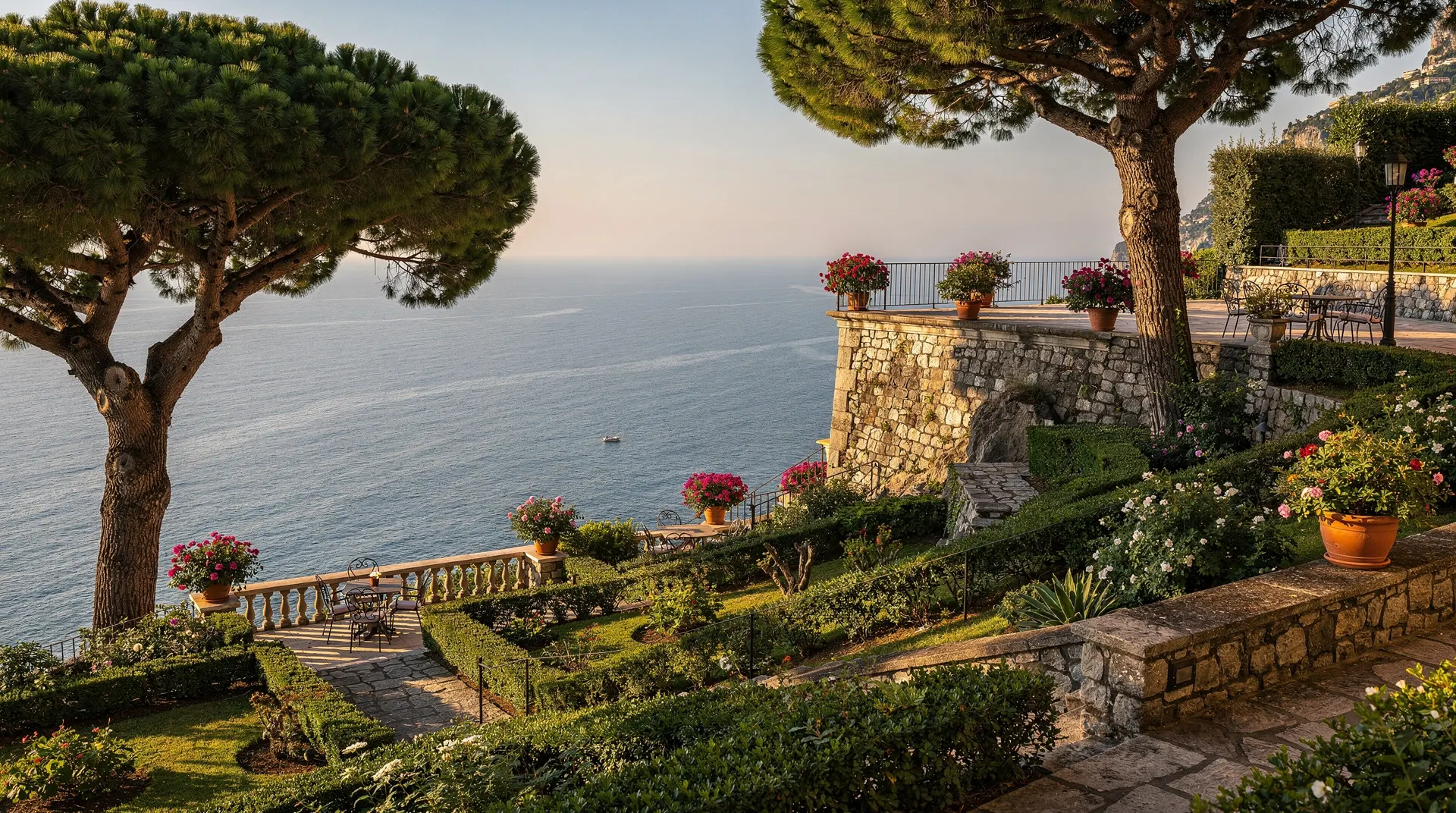
The terraced gardens are formal and well maintained, with seasonal plantings of roses, bougainvillea, and citrus. The lower terrace (the concert stage of the Ravello Festival) is suspended on the cliff edge with an unobstructed view over the coast.
Entry: €7 adults. Combined ticket with other Ravello sites sometimes available.
Opening hours: 9:00–20:00 in summer; shorter in winter. Last entry 1 hour before closing.
Villa Cimbrone
Built in the early 20th century by the English lord William Beckett on the site of a medieval structure, Villa Cimbrone is a creation of English Romanticism applied to southern Italian materials. The garden is a winding sequence of terraces, pergolas, rose gardens, small temples, and sculptural installations.
The main draw is the Belvedere of Infinity (Belvedere dell’Infinito) at the end of the main garden axis — a long terrace lined with marble busts of Roman and mythological figures, looking south-southwest over the sea towards Paestum. The view is one of the most reproduced in all of Italy. On clear days (best in spring and autumn) the visibility extends 60–70 kilometres.
The path between the Villa Cimbrone entrance and the Belvedere (about 400 metres through the garden) is the main experience. Allow 1–1.5 hours for the full circuit including all the secondary paths.
Entry: €8–10 adults. The Villa also operates as a luxury hotel (Belmond Villa Cimbrone) — the garden is open to non-guests during visiting hours.
Opening hours: 9:00 to sunset.
The Duomo of Ravello
The Cathedral of Ravello (San Pantaleone, 11th century) faces the main piazza. Less visited than the two gardens but architecturally interesting: the marble ambo (pulpit) of 1272 by Nicola di Bartolomeo da Foggia is the finest piece of Campanian Romanesque sculpture on the coast, with inlaid coloured marble in intricate interlace patterns. Entry is free.
The adjacent Museo del Duomo (small admission) has the original bronze 12th-century doors and a collection of Roman marble, medieval sculpture, and archaeological fragments.
The Ravello Festival
Running from late June to mid-September, the Ravello Festival is one of southern Italy’s premier classical music events. The centrepiece is the Concerti sul Belvedere — outdoor concerts on the terrace of Villa Rufolo, staged as the sun sets over the sea. The programme typically includes international orchestras, chamber music, and opera (in recent years the Orchestra of the Teatro San Carlo, Naples has been a recurring presence).
Tickets range from approximately €25 (lawn areas) to €80 (reserved terrace seats closest to the stage). Book through the festival website or authorised agencies. The most popular concerts (opening night, closing night, and any concerts with internationally famous soloists) sell out months in advance.
Beyond the main concerts, the festival includes chamber music in the cathedral crypt, film screenings, and dance performances across various Ravello venues.
Walking beyond the gardens
Ravello sits at the centre of a network of mule tracks connecting the hillside villages (borghi) of the Lattari Mountains. Several walks start from the main piazza or from paths below the garden entrances:
Ravello–Scala circuit: Scala is the village directly opposite Ravello across the Valle del Dragone, reached by a 45-minute path. The route goes down into the valley and up the far side. Scala has a Norman cathedral (restored) and views back to Ravello. Return the same way or via the road from Scala back to Amalfi.
Ravello to the sea (Minori): A descending path from the Piazza Fontana below Villa Cimbrone leads to Minori in about 45 minutes of steep descent. Return by bus.
Where to eat
The restaurant choice in Ravello is smaller and generally less tourist-saturated than Positano. A few specific recommendations:
Ristorante Salvatore (Via della Repubblica, near Villa Rufolo) is consistently cited by locals for traditional Ravellese cooking — pasta with local vegetables, grilled fish, and the local white wine (Bianco di Ravello). Not cheap but not as inflated as the piazza restaurants.
Bar Calce (Piazza Duomo) is a bar-café operated since the 1960s, serving espresso, sfogliatella, and granita at reasonable prices. The terrace has the piazza view without the restaurant premium.
Small-group day trip: Amalfi and Ravello from NaplesPractical details
When to arrive: Before 10:30 to have the gardens partly to yourself. The main rush arrives on tour buses between 10:30 and 14:00. Afternoons quieter.
Footwear: The garden paths are paved but uneven. Comfortable walking shoes required; heels will be difficult on the cobbles of the town centre.
Photography: Both gardens are fully open to photography. The Belvedere of Infinity at Villa Cimbrone is at its best in the golden-hour light of late afternoon (May/June) or morning.
Accommodation: Ravello has a small number of hotels ranging from mid-range to luxury (Belmond Villa Cimbrone, Hotel Palumbo). Staying overnight gives access to the piazza in the evening when it is completely empty — an experience significantly different from the daytime.
Combining with Amalfi: The standard half-day works well: bus from Amalfi to Ravello at 9:00, Villa Rufolo and Villa Cimbrone (3 hours), lunch at Ristorante Salvatore, bus back at 14:00, rest of the afternoon in Amalfi.
Frequently asked questions about Ravello
Is Ravello worth visiting for just 2 hours?
Two hours is enough for either Villa Rufolo or Villa Cimbrone, but not both. If forced to choose one for a brief visit, Villa Cimbrone for the Belvedere (the view) or Villa Rufolo if the Ravello Festival concert terrace is the interest. For a full experience, 3.5–4 hours covers both gardens comfortably.
How is Ravello different from Positano and Amalfi?
Ravello has no beach and no ferry pier — it is not a coastal town in the traditional sense. Its appeal is entirely the view, the gardens, the music, and the quiet. Positano and Amalfi are beach destinations with commerce and activity; Ravello is a cultural and contemplative destination for people who want to look at the coast rather than be on it. See Amalfi Coast towns compared.
Does the Ravello Festival require advance booking?
Yes for the best events. The main outdoor concerts on Villa Rufolo terrace sell out quickly — particularly the opening night in late June and any events with famous orchestras or soloists. Minor events and chamber concerts are often available on shorter notice. Book through the official Ravello Festival website (ravellofestival.com).
Is Ravello accessible for people with limited mobility?
The town centre from the bus stop to Piazza Duomo is mostly flat and cobbled. Villa Rufolo has some slope but most areas are accessible. Villa Cimbrone has more uneven paths and steps — contact the villa directly for specific accessibility information. The path from Amalfi on foot is not suitable for mobility impairments.
Can I visit Ravello in winter?
Yes, though some tourist facilities close. The gardens are open year-round (shorter hours). The Ravello Festival is seasonal. The town in November–February is very quiet — mostly used by people staying in the hillside villages. The views are clear and the atmosphere serene. Accommodation prices drop significantly.
Ravello as part of a longer coast trip
Most visitors see Ravello as the third stop on a Naples-to-Amalfi-Coast day, after Positano and Amalfi town itself. That order works well logistically — Positano and Amalfi are sea-level and photogenic in the morning light, while Ravello’s gardens and the Belvedere of Infinity are better suited to late morning or early afternoon once the haze has burned off. If you are building your own itinerary rather than joining a guided coast tour, the Amalfi Coast guide covers how to sequence all three towns realistically in a single day, and the fuller Naples and Amalfi Coast 5-day itinerary gives Ravello a proper half-day rather than a rushed hour.
Private 2-hour walking tour of RavelloFor travellers weighing up whether to base themselves in Ravello for a night rather than day-tripping, the trade-off is straightforward: no beach and a genuinely steep approach, against an evening piazza that empties completely once the last coach leaves. The where to stay on the Amalfi Coast guide covers how Ravello compares to a coastal base like Amalfi or Minori for a multi-night stay.
Frequently asked questions about Ravello guide: gardens, music, and the view from above the coast
How do I get from Amalfi to Ravello?
What is the Ravello Festival?
What is the difference between Villa Rufolo and Villa Cimbrone?
Is Ravello crowded?
Is there a beach in Ravello?
Can I do Ravello as a half-day from Amalfi?
Top experiences
Bookable activities with verified prices and instant confirmation on GetYourGuide.