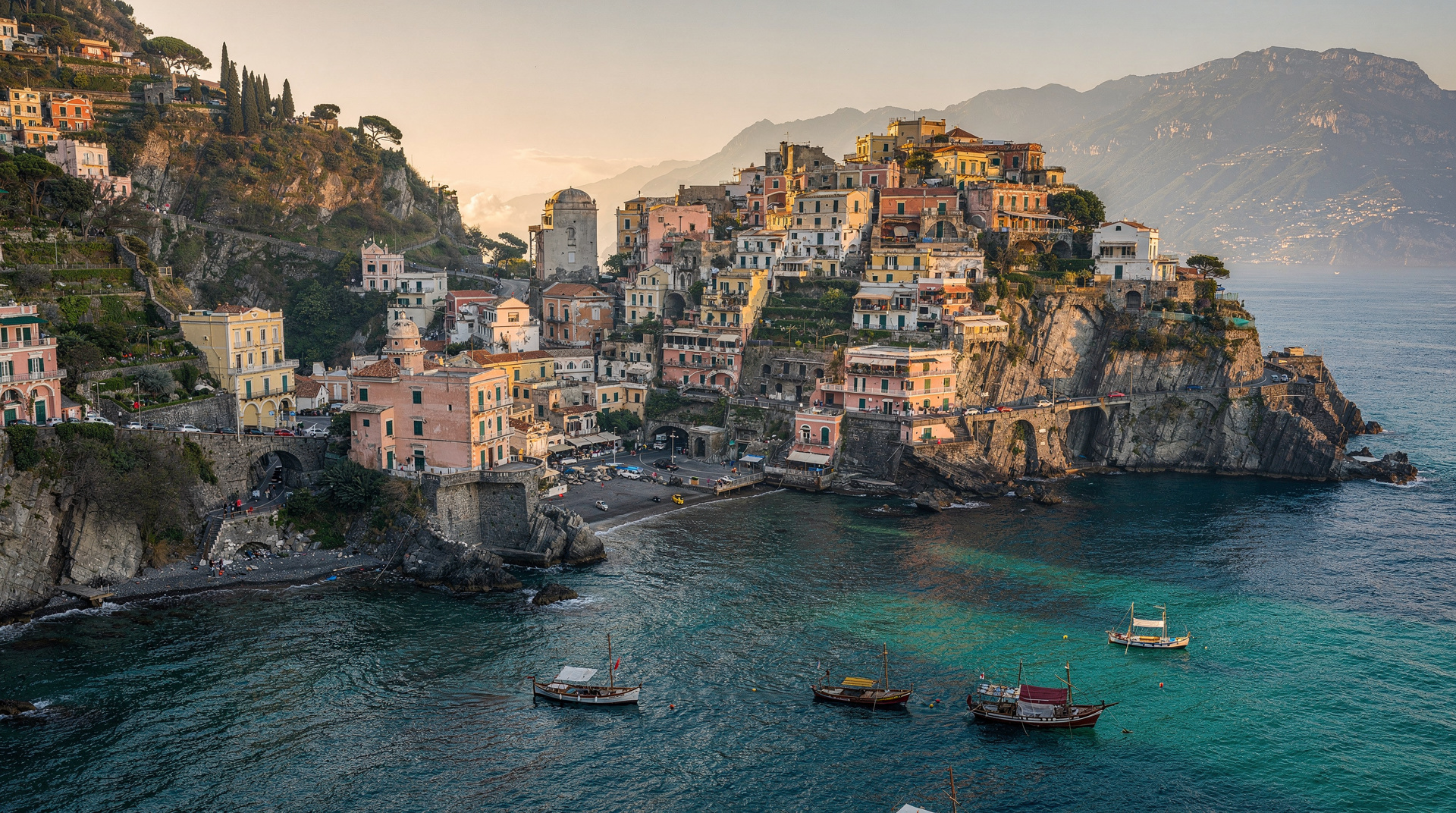
Amalfi town guide: the medieval republic and how to explore it
From Naples: Amalfi Coast with Ravello Small Group
What should I see in Amalfi town and how long do I need?
Allow 3–4 hours minimum. The Cathedral of Sant'Andrea (free, extraordinary Byzantine bronze doors), the Cloister of Paradise, the Arsenale della Repubblica (medieval shipyard), and the lanes of the town centre are the main draws. The Valle delle Ferriere walk adds another 3 hours if you have a full day.
| Where | Central Amalfi Coast, ~25 min ferry from Positano |
| Time needed | 3–4 hours minimum, full day with Valle delle Ferriere |
| Cost | Duomo complex €3, Paper Museum ~€4 |
| Getting there | Ferry or SITA bus from Sorrento/Naples |
| Best time | Morning for the Duomo, before 10:00 for the valley walk |
Amalfi before the tourists: understanding what this town was
Amalfi town is easy to underestimate. Today it is one stop on a coastal day trip, known for a cathedral and a piazza lined with souvenir shops. What is less obvious is that this town of 5,000 people was, between the 9th and 11th centuries, one of the four great maritime republics of Italy — trading with the Byzantine Empire, the Levant, and North Africa at a time when most of what is now Europe had no ocean-going commercial fleet.
The Tavole Amalfitane — the Amalfitan Tables, the oldest surviving maritime code in the world (11th century) — originated here. The town had diplomatic relationships with the Pope, the Byzantine Emperor, and the Arab caliphates simultaneously. This context doesn’t make the souvenir shops more interesting, but it helps explain why the buildings in this small town are out of proportion to its current size.
The Cathedral of Sant’Andrea
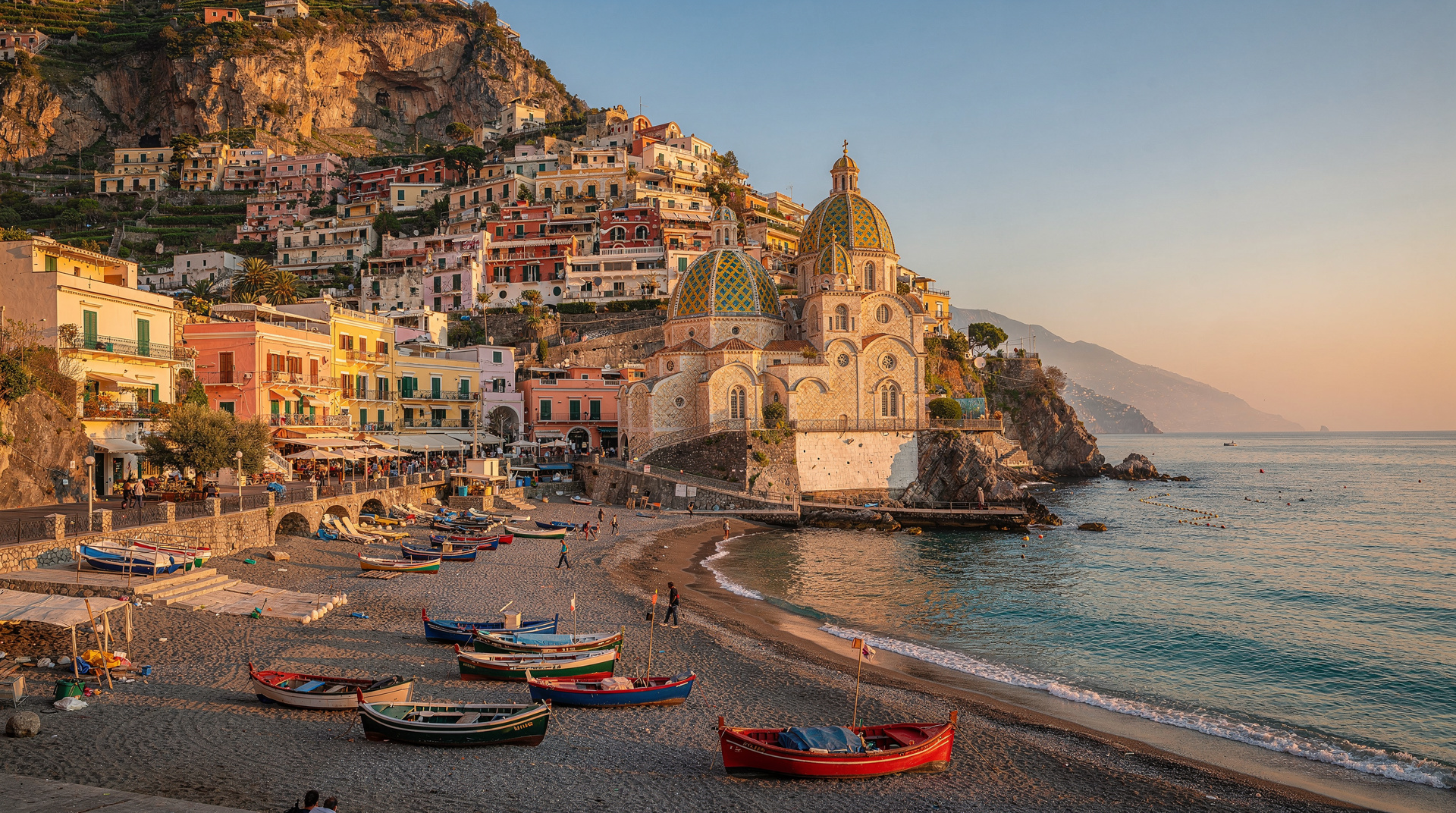
Everything in Amalfi leads to the Duomo, and the Duomo is worth the lead. The facade of the Cathedral of Sant’Andrea combines Romanesque, Gothic, and Arab-Norman elements — a visual record of the trade connections that made Amalfi wealthy. The black-and-white geometric patterns on the facade are direct imports of Arabic decorative vocabulary; the Gothic pointed arches came later.
The Byzantine bronze doors (1066 AD) were cast in Constantinople and commissioned by the Amalfitan merchant Pantaleone di Mauro. 54 panels depict Christ, the Virgin, saints, and prophets. They were among the first bronze doors in Italy and set a model that other cities (including Naples) later copied.
The interior has accumulated multiple layers of renovation and is less unified than the exterior. The crypt holds the relics of Sant’Andrea, which is the reason the cathedral exists.
Entry: The cathedral itself is free. The full complex — including the Cloister of Paradise, the Baroque chapel, and the crypt — requires a ticket: €3. Worth paying.
Opening hours: 9:00–19:00 (shorter hours November–February). The Cloister of Paradise closes 45 minutes before the cathedral.
The Cloister of Paradise
Built in 1268 by Archbishop Filippo Augustariccio as a burial place for Amalfitan nobles and prominent citizens, the Cloister of Paradise (Chiostro del Paradiso) is a peaceful Arab-Norman cloister with interlaced pointed arches supported on pairs of columns. The name comes from the whiteness and serenity of the space.
The ancient sarcophagi lining the walls were moved here from various locations around the town. The garden in the centre has a single palm tree. The atmosphere is one of the most genuinely calm spaces on the entire coast.
Small-group day trip: Amalfi and Ravello from NaplesThe Arsenale della Repubblica
The Arsenale (boat yard) of the Amalfitan Republic dates to the 11th–12th centuries and is one of the oldest surviving medieval arsenals in Italy. The massive vaulted hall at the port end of town was where the republic’s war galleys and merchant ships were built and maintained. You can see the pointed arches and enormous stone spans from the waterfront even when the Arsenale is closed.
Inside, there is a small museum of maritime history and examples of traditional local boats. Entry is free or by small donation. The Arsenale is not always open — check for current hours on arrival; the tourist office on Piazza Duomo has current information.
Comparing Amalfi to the coast’s other main towns
Amalfi’s substance and connectivity mean it wins comparisons on almost every practical measure — but not every measure. If your priority is the single best photograph, or you’re choosing purely on atmosphere, Positano still has an edge, and quieter travellers may prefer Ravello’s gardens over Amalfi’s history. The full Amalfi Coast towns compared guide sets out the trade-offs town by town.
Getting around and moving between towns
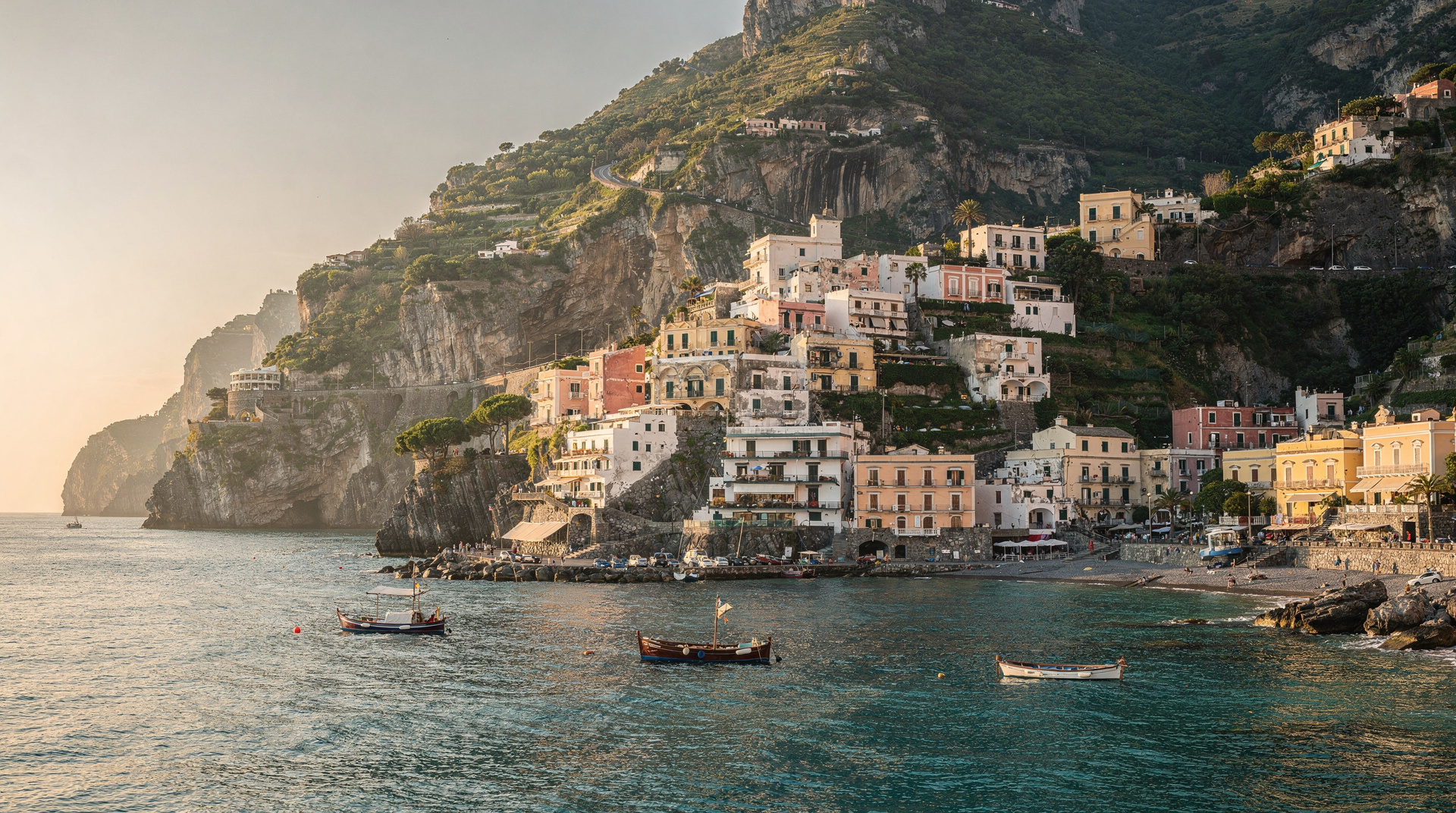
Amalfi sits almost exactly in the centre of the coast, which makes it the logical hub for day exploration. Ferry to Positano takes 25 minutes. Ferry to Salerno takes 35 minutes. Bus to Ravello takes 30 minutes.
SITA buses run along the SS163 in both directions from the main bus stop on the waterfront (ask for Piazza Flavio Gioia). Tickets at tabacchi shops on Via Lorenzo d’Amalfi. The bus stop can be confusing — there are several bays for different directions. For transport details, see Amalfi Coast bus guide.
Ferries depart from the pier at the eastern end of the waterfront. Multiple operators. Timetables change seasonally — check the board at the pier or at Via Lorenzo d’Amalfi travel agencies. See Amalfi Coast by boat.
The Valle delle Ferriere walk
The most underused attraction associated with Amalfi town is the Valle delle Ferriere nature reserve, a 3-hour round-trip starting from the north end of the town on Via Fiume. The walk climbs through dense lemon terraces and chestnut forest along a stream, passing the ruins of a 13th-century paper mill (Amalfi’s specialty export was paper, using the Arab technique of cotton-rag pulp). The valley ends at a 30-metre waterfall with a natural pool.
The trail is mostly shaded, well-marked, and free to enter. Wear proper walking shoes — the path is uneven and wet near the stream. Start before 10:00 in summer to finish before the midday heat.
See hiking near Naples for more options, and the hiking-outdoors guide for the Path of the Gods from Positano.
The paper museum
Amalfi was the first European town to produce paper using Arab techniques (cotton-rag pulp rather than parchment), from at least the 12th century onwards. The Museo della Carta (Paper Museum) on Via delle Cartiere shows a working paper mill and the history of Amalfitan paper production. Small admission (~€4), worthwhile for 30 minutes.
Where to eat
The tourist trap geography of Amalfi is straightforward: restaurants facing Piazza Duomo and on the main waterfront charge the maximum and generally offer mediocre food. Walk any distance off the main square and the quality-to-price ratio improves.
Trattoria da Gemma (Via Fra’ Gerardo Sasso 10) has been family-run since 1872. The menu is traditional Amalfitan — scialatielli al limone, totani e patate, sfogliatella frolla — without tourist adaptation. Reserve for dinner.
Ristorante La Caravella (Via Matteo Camera) is the coast’s most established fine-dining option (Michelin-starred at various points). Not cheap but uses genuinely local produce and preparation.
La Pansa (Piazza Duomo) is the best bar on the main square, serving coffee, sfogliatella, delizie al limone, and granita at prices only slightly above normal. The bakery side does takeaway pastries.
For a quick lunch: a panino or bruschetta from any of the small alimentari shops on Via dei Dogi — a fraction of restaurant prices.
A realistic one-day plan
Morning (9:00–12:00): Duomo and Cloister of Paradise before the day-trip crowds arrive around 11:00. Coffee at La Pansa.
Midday (12:00–14:00): Lunch off the main piazza (Trattoria da Gemma or a Via dei Dogi alimentari), then the Arsenale and a wander through the lanes.
Afternoon (14:00–17:00): Either the Valle delle Ferriere walk if you have the energy, or the bus up to Ravello for the gardens — both take roughly 2.5–3 hours round trip.
Evening: Stay for dinner if you can — Amalfi after the day-trippers leave (from around 18:00) is a genuinely different, calmer town, and this is when a base here pays off compared with a rushed day trip from Naples; see Amalfi Coast from Naples for how a day-trip schedule compares.
Beaches near Amalfi town
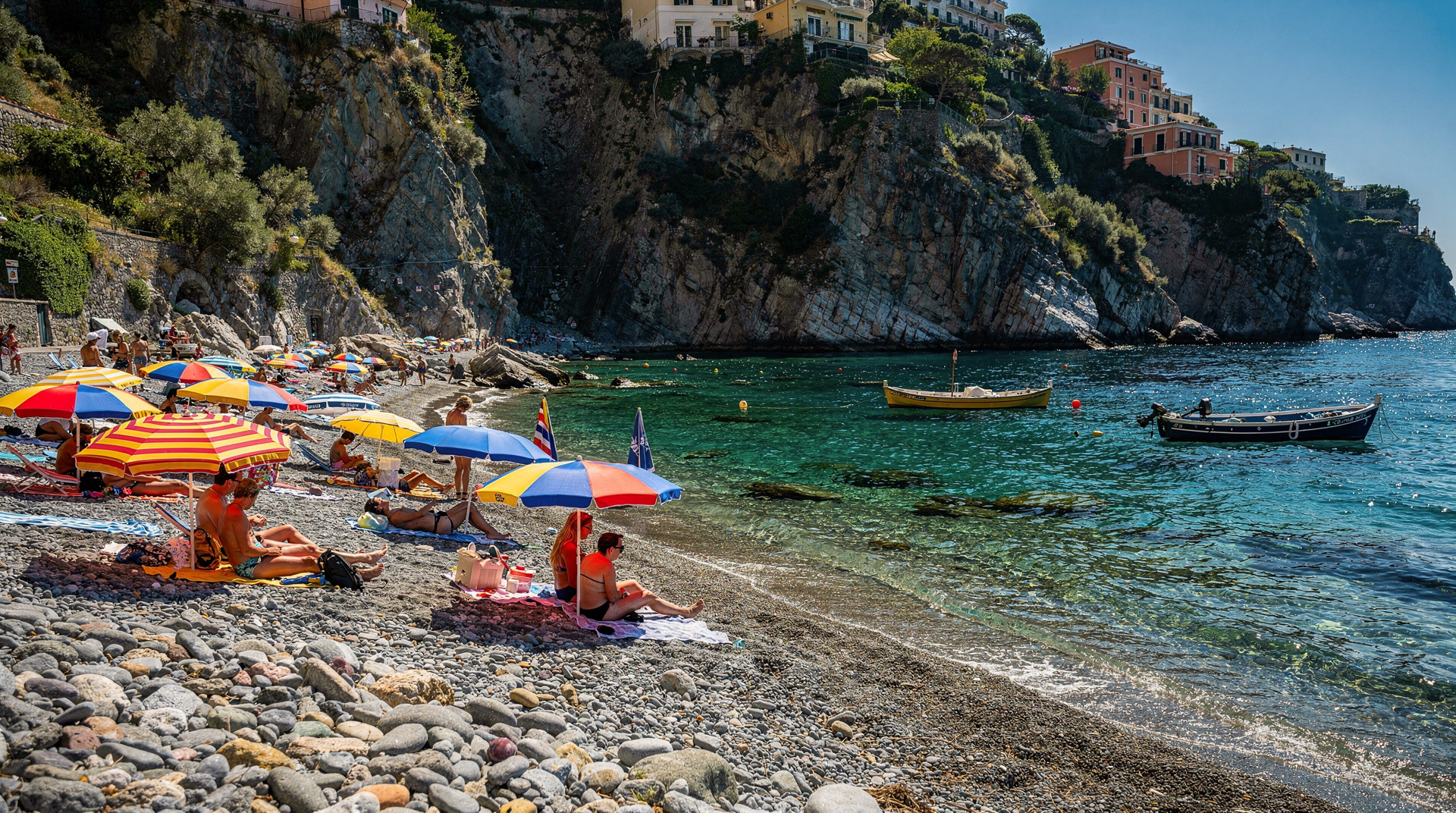
The town beach (Marina di Amalfi) is a small gravel strip next to the ferry pier — functional but not the reason to come here. Better beaches nearby:
- Atrani (10-minute walk east along the shore) has a quieter beach, a piazza with a coffee bar, and real local atmosphere.
- Duoglio (accessed by boat or a steep path from Via Mauro Comite) is a cove beach about 1.5 km west of town, partially free-access.
- Santa Croce (15 minutes by boat or a steep descending path from Pogerola) is a secluded cove with turquoise water and no commercial beach facilities.
For a full comparison of coast beaches, see best beaches on the Amalfi Coast.
Private guided day: Positano, Amalfi, and RavelloPractical information
Arriving by car: Amalfi has a small car park at the eastern end of town (paid, often full by 9:00 in summer). Better to park in Vietri sul Mare or Salerno and take the bus or ferry west.
ATMs: Two ATMs on Via Lorenzo d’Amalfi; they often have queues in summer.
Luggage storage: No official storage facility. Hotels will hold bags after checkout; travel agencies on Via Lorenzo d’Amalfi sometimes offer this service for a fee.
Toilets: Near Piazza Duomo (paid, €0.50). No free public toilets.
Tourist information: Office on Piazza delle Repubbliche Marinare (waterfront), open mornings.
Wi-Fi and connectivity: Mobile signal is reliable in town but patchy in the Valle delle Ferriere. Most cafés and restaurants offer free wi-fi to customers.
Pharmacy: One on Via Lorenzo d’Amalfi, standard Italian pharmacy hours (closed for the midday break, roughly 13:00–16:00).
Frequently asked questions about Amalfi town
Is one day in Amalfi enough?
For the main sights (Duomo, Cloister, Valle delle Ferriere) plus a lunch and a ferry, one day is comfortable. To add Ravello (30-minute bus), allow a full day in the Amalfi area. Two days gives you more walking time and evening access when the day-trippers leave.
How does Amalfi compare to Positano?
Positano is more glamorous and more photogenic. Amalfi is more historically substantial, more functionally connected, and more affordable. As a base, Amalfi wins. As a backdrop for photographs, Positano wins. For a full comparison, see Amalfi Coast towns compared.
What is scialatielli?
A fresh pasta shape invented in Amalfi in 1978 by chef Enrico Cosentino — flat, thick, and slightly irregular, made with basil in the dough. It is now used throughout the coast with seafood sauces (particularly with mixed seafood — frutti di mare). Any local restaurant on the coast should have it.
Is Atrani worth visiting from Amalfi?
Yes, for 45 minutes. Atrani is the smallest municipality in Italy by area, immediately east of Amalfi along the beach path. It is architecturally interesting (two old churches, a small piazza on a cliff above the beach), genuinely local in feel, and almost completely tourist-free. The beach café at Atrani is markedly cheaper than anything in Amalfi.
Can I climb to Ravello from Amalfi on foot?
Yes — there is a stepped mule track climbing from the northern edge of Amalfi to Ravello, taking about 1 hour. It passes through the Valle del Dragone with terraced gardens and good views. More interesting than the bus but strenuous. Return by bus is sensible. See Ravello guide for details.
Frequently asked questions about Amalfi town guide: the medieval republic and how to explore it
Is Amalfi town a good base for the coast?
How do I get to Amalfi from Naples?
What is the Cloister of Paradise?
Is there a good walk from Amalfi?
What are the best restaurants in Amalfi town?
How do the ferries work from Amalfi?
Top experiences
Bookable activities with verified prices and instant confirmation on GetYourGuide.