Naples metro art stations: the underground galleries on Line 1
Naples: Hop-On Hop-Off Bus Tour with Audio Guide
Which Naples metro station is most famous for its art?
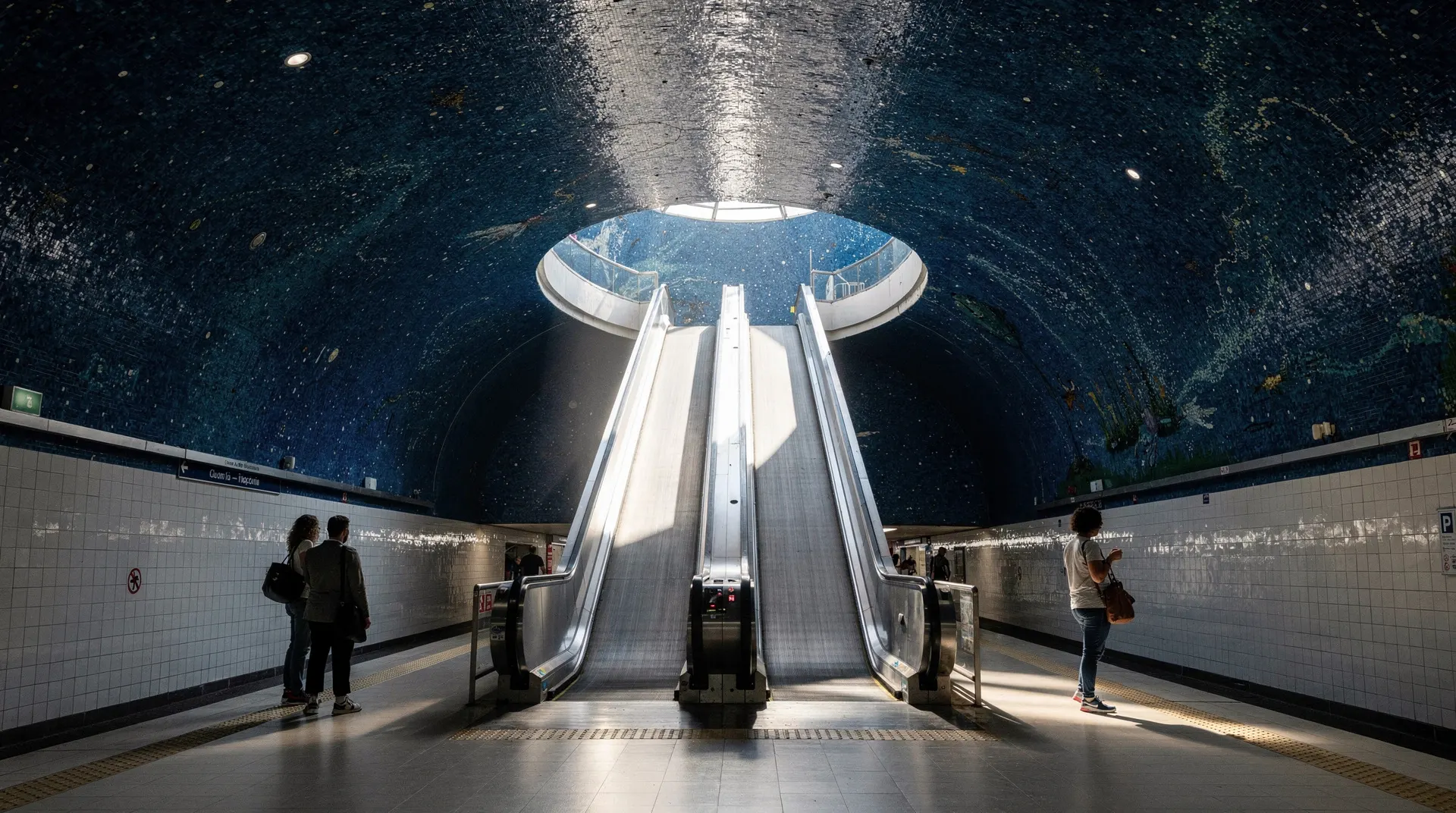
Toledo is the most acclaimed — it was voted the most beautiful metro station in Europe by the Daily Telegraph and features a spectacular blue mosaic atrium by artist William Kentridge. Municipio (for Castel Nuovo) and Università also have significant installations. All are on Line 1. A standard €1.30 metro ticket is all you need to see them.
| Where | Metro Line 1, Garibaldi to Piscinola |
| Cost | €1.30/ride or €4.50 day pass |
| Time needed | 2–3 hours for the full route |
| Must-see station | Toledo (voted Europe’s most beautiful) |
| Best time | Early morning or 14:00–16:00, quieter |
Underground art worth stopping for
When the City of Naples expanded its metro network from the 1990s onwards, the decision was made to treat each new station as an architectural and cultural commission rather than just functional infrastructure. The result is a network the Italian press calls “la metropolitana dell’arte” — the art metro.
Line 1 is where this programme is most developed. Each station between Garibaldi and Piscinola was designed by a different internationally recognised architect, with site-specific artworks commissioned from significant artists. The standard of work is genuinely high — not decorative tiles but major pieces from artists like William Kentridge, Jannis Kounellis, Joseph Kosuth, Michal Rovner, and Mimmo Paladino.
All of it accessible with a €1.30 metro ticket.
Toledo: the most famous station
Line 1 stop. Access to: Via Toledo, Spanish Quarter, Piazza del Plebiscito (~10 min walk).
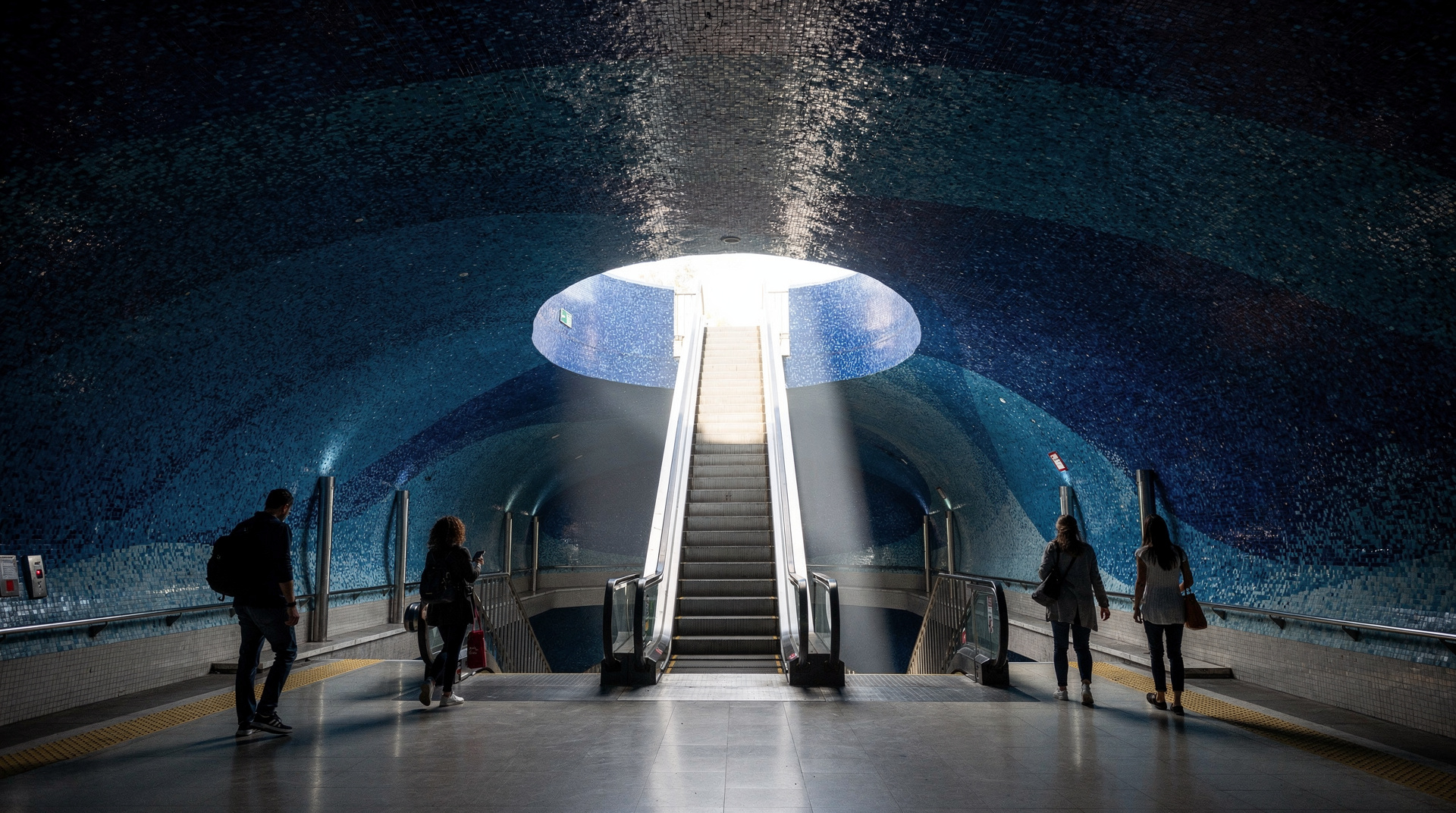
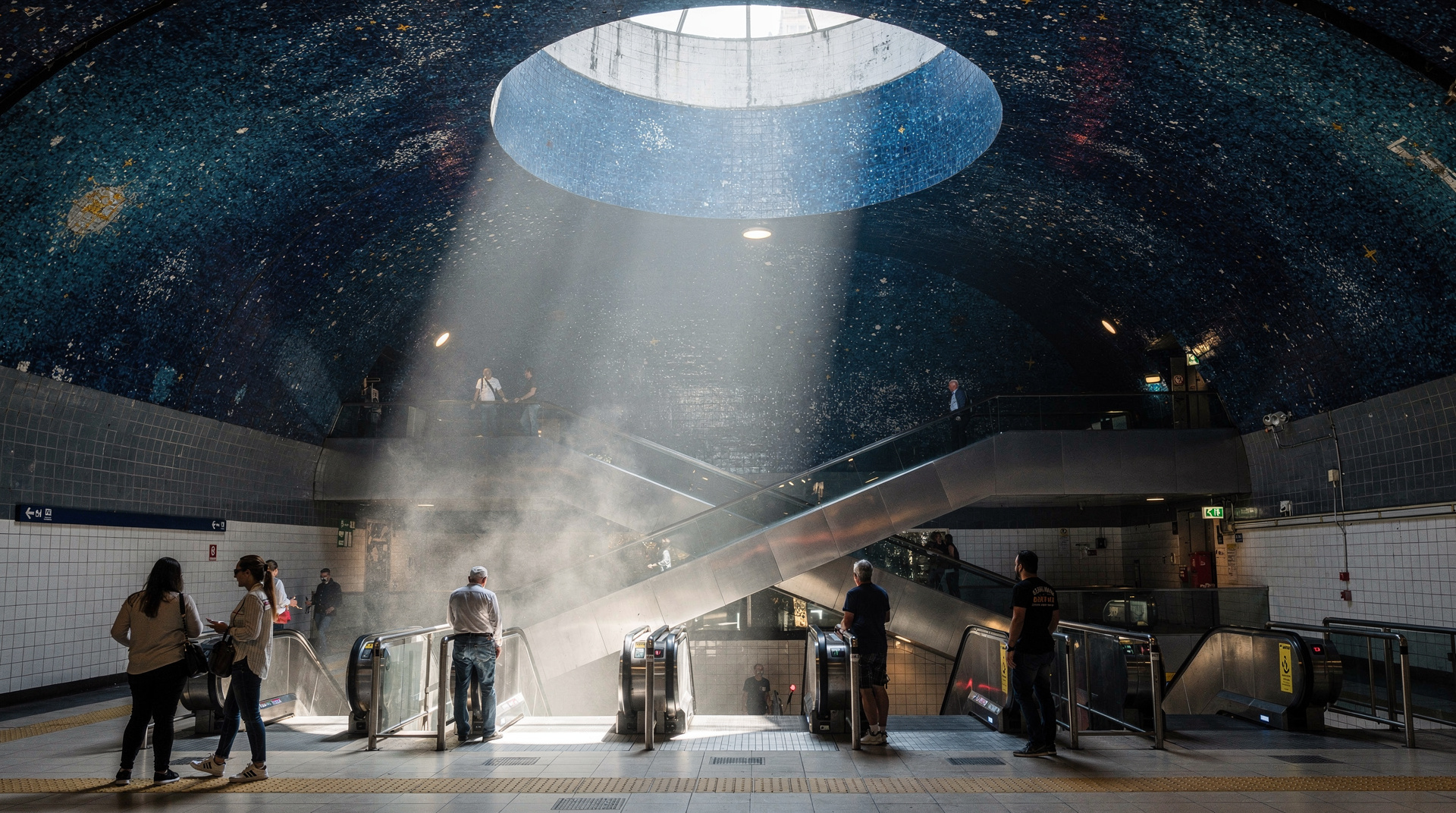
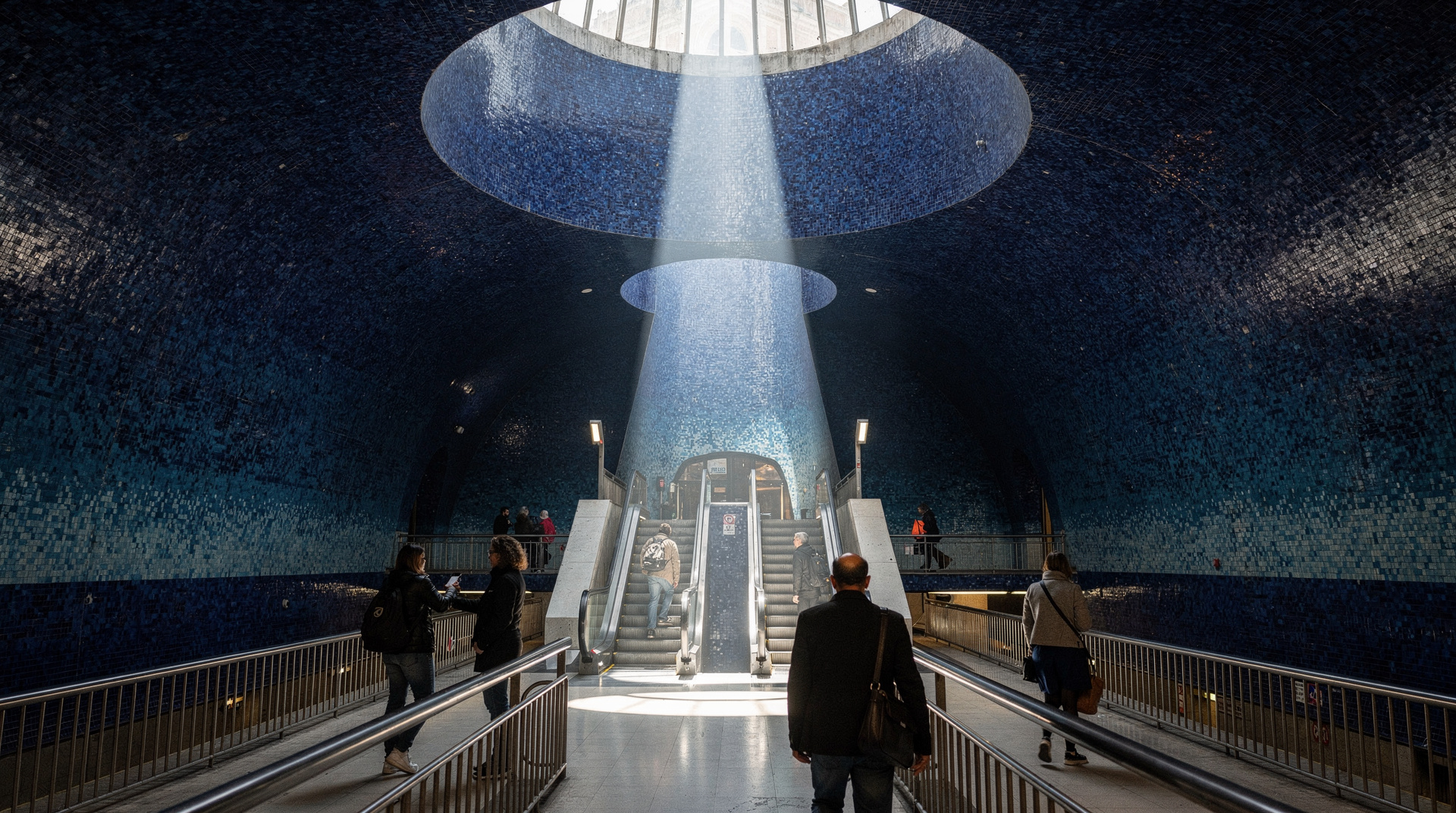
Toledo is the station everyone photographs and for good reason. Designed by Spanish architect Oscar Tusquets Blanca, it descends to platform level through a series of escalators clad in deep blue mosaic, with a cosmic dome at the ceiling. The effect is of descending into a liquid or underwater space.
The focal artwork is by William Kentridge — a mosaic sequence along the walls and ceiling depicting episodes from the history of Naples and the Bay. Kentridge is primarily known as a South African artist working in drawing and film; this permanent mosaic commission was one of his largest public works.
Photography notes: The deep blue light and extreme depth of the station make it a challenge and a reward for photographers. The best images are taken on the escalator descent, looking up at the dome. Midday is acceptable; early morning or late evening light inside the station is consistent since it is entirely artificial.
Getting the most out of Toledo: If you are exiting here for Via Toledo or the Spanish Quarter, take a few extra minutes before leaving. Walk back down the escalators after viewing the platform level if you want to photograph the dome from below. Staff are used to it.
Municipio: archaeology integrated into architecture
Line 1 stop. Access to: Castel Nuovo (Maschio Angioino), Molo Beverello (ferry port), Piazza del Municipio.
Municipio station was extraordinary in its construction: workers digging for the metro found significant Roman-era remains, including sections of the ancient port of Neapolis. The decision was made to incorporate the finds into the station rather than remove them — glass panels in the platform floor and walls reveal Roman stonework, amphorae, and harbour infrastructure exactly where archaeologists found them.
The station is designed by architects Alvaro Siza and Eduardo Souto de Moura (both Pritzker Prize laureates). The result is austere, grey, and deliberately undecorated — the archaeology is the art.
What to look for: Peer through the glass floor panels and floor-level display windows to see the Roman dock structures. Informational panels in Italian and English explain what was found and when. This is one of the few places in Naples where Roman urban infrastructure is visible at ground level.
Università: video and text
Line 1 stop. Access to: Piazza Bovio, Via Mezzocannone, historic university district.
Università was designed by Atelier Mendini (Alessandro Mendini). The most distinctive element at platform level is a video floor installation by Israeli artist Michal Rovner — images of human figures projected or embedded into the floor surface, giving the impression of figures moving beneath you.
Text-based neon works by Joseph Kosuth also feature, with philosophical and literary texts in Italian appearing as neon fixtures integrated into the station architecture. Kosuth has worked in several Line 1 stations.
Garibaldi: scale and neon
Line 1 stop (and Line 2). The main Naples transport hub, adjacent to Napoli Centrale railway station and the Circumvesuviana.
Garibaldi is the largest and busiest station, designed by Dominique Perrault. The station is enormous — significantly larger than it needs to be functionally, which gives it an almost theatrical scale. Large text installations by Joseph Kosuth run along the walls.
This is the station most visitors arrive at (from the airport Alibus or high-speed trains from Rome), and it is worth looking up and around rather than rushing through. The scale of the concourse and the quality of the finishes mark it as architecturally significant, even if it is more restrained than Toledo.
Dante: mythology and ancient culture
Line 1 stop. Access to: Piazza Dante, Via Port’Alba, start of the historic cardo/decumanus grid.
Designed by Gae Aulenti, Dante station features works by Jannis Kounellis and Mimmo Paladino. Kounellis is associated with Arte Povera — his work uses industrial and organic materials in juxtaposition. Paladino is among the most prominent Italian neo-Expressionist painters and sculptors, and his connections to Naples (he was born in Campania) give his contribution here a local resonance.
The station connects to Piazza Dante, where a large 18th-century square with a neoclassical hemicycle and a statue of Dante provides an appropriately literary context for heading to the old city’s bookshop district (Via Port’Alba has several historic bookshops).
Materdei and Salvator Rosa: for the Rione Sanità connection
Materdei: Line 1 stop. Access to: Via Materdei, upper Rione Sanità, Catacombs of San Gennaro (20-min walk).
Materdei station, designed by Uberto Siola, has significant works by Sandro Chia — large figurative paintings integrated into the station space. Chia is part of the Italian Transavanguardia movement of the 1980s; his style is expressive, mythological, and colourful.
Salvator Rosa: Designed by Meinhard von Gerkan, this station features ceramic works by Nino Longobardi. Less visited by tourists, it is on the route toward the upper city neighbourhoods.
Quattro Giornate and Vanvitelli
Vanvitelli: the Vomero exit. This is the most used station for reaching the Certosa di San Martino, Castel Sant’Elmo, and the Vomero residential neighbourhood. Design by Michele Capobianco.
Quattro Giornate: Named for the four days of Neapolitan popular uprising against Nazi occupation in September 1943 — a significant event in local memory. The station has mosaic works referencing the event.
Rione Alto and Piscinola: the northern end
The northern terminus stations are less visited by tourists but continue the art programme. Rione Alto (designed by Pierluigi Nicolin) and Piscinola both have commissioned works, though neither is a specific destination for art tourism.
The self-guided art metro route
The most efficient way to see the stations as art is to take the entire Line 1 in one direction, stopping briefly at each station of interest, then return:
Suggested route (3 hours, €1.30 ticket per direction):
- Start at Garibaldi — take in the Perrault architecture and Kosuth texts
- Università — video floor, Rovner installation
- Municipio — exit and spend 10 minutes looking at the Roman archaeology in the floor
- Toledo — the primary destination; 20–30 minutes minimum; ascend and descend the escalators for the full Kentridge mosaic experience
- Dante — Kounellis and Paladino; natural break point if you want to step out into Piazza Dante
- Continue to Materdei — Chia paintings
- Continue to Vanvitelli — exit for Vomero views or Certosa
Each station is 1–3 minutes apart. You can cover all of them comfortably in 2–3 hours at a leisurely pace.
Practical information for 2026
Ticket: €1.30 per single journey (validates for 90 minutes). A €4.50 day pass is worth buying if you plan to use the metro more than three times in a day.
Trains: Metro Line 1 runs every 6–10 minutes during the day, less frequently in evenings and on Sundays.
Photography: Freely permitted with phone or compact camera. No tripods in crowded peak hours.
Best time to visit: Early morning (07:00–09:00) or early afternoon (14:00–16:00) when the stations are less crowded and better for photography. Avoid morning and evening rush hours.
For deeper coverage: See Naples metro art photography for lighting tips, best angles, and photography advice specific to each major station.
Comparing the stations: where to focus if you’re short on time
Not every station deserves equal time, and the honest recommendation depends on what you’re after:
| Station | Best for | Time to allow |
|---|---|---|
| Toledo | The single most impressive station overall | 20–30 min |
| Municipio | Roman archaeology visible through glass floors | 10 min |
| Università | Video installation and neon text | 10 min |
| Dante | Sculpture, mythology, connects to Piazza Dante | 10–15 min |
| Materdei | Figurative painting, less crowded | 10 min |
If you only have 30 minutes on a stopover, Toledo alone is the right call — it is the station that appears in international “best metro stations” rankings and the one most people mean when they talk about Naples’ underground art.
Getting to and from the art stations
Line 1 connects directly to the rest of the city’s transport network, which makes the art-station route easy to fold into a normal day of sightseeing rather than treating it as a separate excursion. Garibaldi sits beneath Napoli Centrale station, so arriving travellers pass through it automatically.
Toledo and Municipio are both a short walk from Piazza del Plebiscito and Castel Nuovo, and Vanvitelli connects directly to Vomero and the Certosa di San Martino above the city. For general orientation across Naples’ metro, funicular, and bus network, see getting around Naples.
Naples hop-on hop-off with audio guide — combine with the metro art routeFrequently asked questions about Naples metro art stations
Is there a guidebook or map of the art in the metro stations?
ANM (the transport authority) publishes occasional leaflets and there is information on their website. The most complete resources are the individual station pages at the metropolitanadellarte.it project website, which details each commission. Physical information panels at each station provide artist biographies and descriptions in Italian and English.
Can I photograph Toledo station from the ticket hall without buying a ticket?
The most spectacular parts of Toledo — the blue mosaic escalator descent and the dome — are only accessible once through the turnstile. You can see some elements from the ticket hall, but the full effect requires going to platform level.
Which station should I prioritise if I only have 30 minutes?
Toledo, without question. It is on Line 1, accessible from the city centre, and the single most architecturally impressive metro station in Italy. Buy a ticket, descend to platform level, ride up and down the escalators once, and you will have seen the centrepiece of the whole programme.
Are the art installations at risk of vandalism or deterioration?
The stations are monitored by CCTV and staffed during operating hours. The materials used (mosaic, glass, neon, integrated video) are designed for high-traffic public spaces. Some elements require maintenance over time; the occasional temporary closure of a feature is possible.
How does the Naples metro art compare to Stockholm’s metro art?
Stockholm’s Tunnelbana is often cited as the world’s longest art gallery, with art in over 90 stations accumulated over 70 years. Naples has fewer stations but the individual commissions at Toledo, Municipio, and Università are arguably more coherent and architecturally integrated. Both are worth experiencing.