Vomero
Vomero sits above Naples on a hill, reached by funicular. Home to Castel Sant'Elmo, Certosa di San Martino, and the city's best panoramic views.
Naples: Panoramic Private Tour by Vintage Fiat 500 or 600
Duration: 5h
Quick facts
- Altitude
- ~180 m above sea level
- Access
- Three funiculars from the city below (Centrale, Chiaia, Montesanto)
- Character
- Calm residential hill neighbourhood, quieter than the historic centre
- Key attractions
- Castel Sant'Elmo, Certosa di San Martino, Museo Pignatelli
- Best view
- Belvedere San Martino — Vesuvius, bay, Capri on clear days
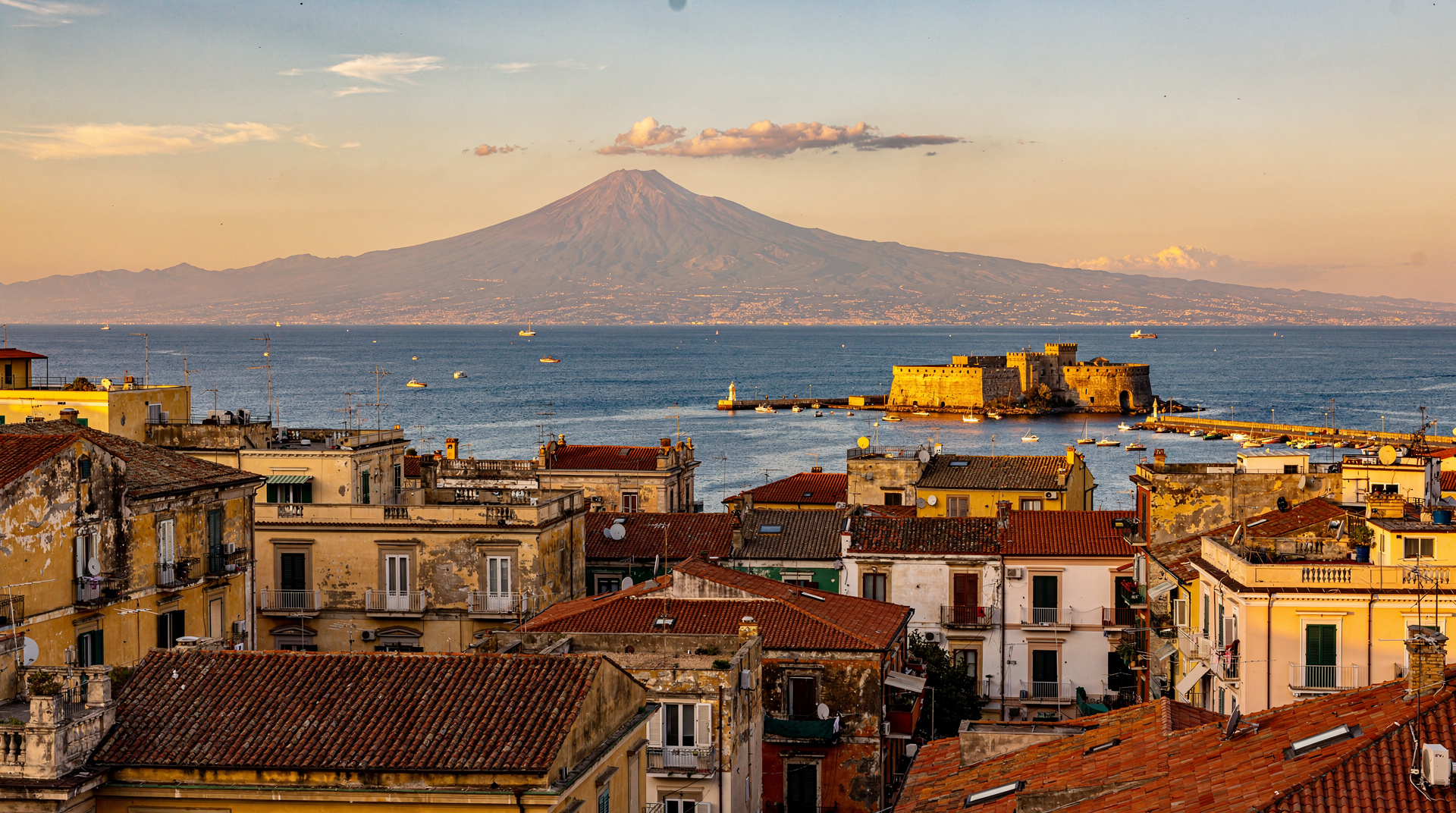
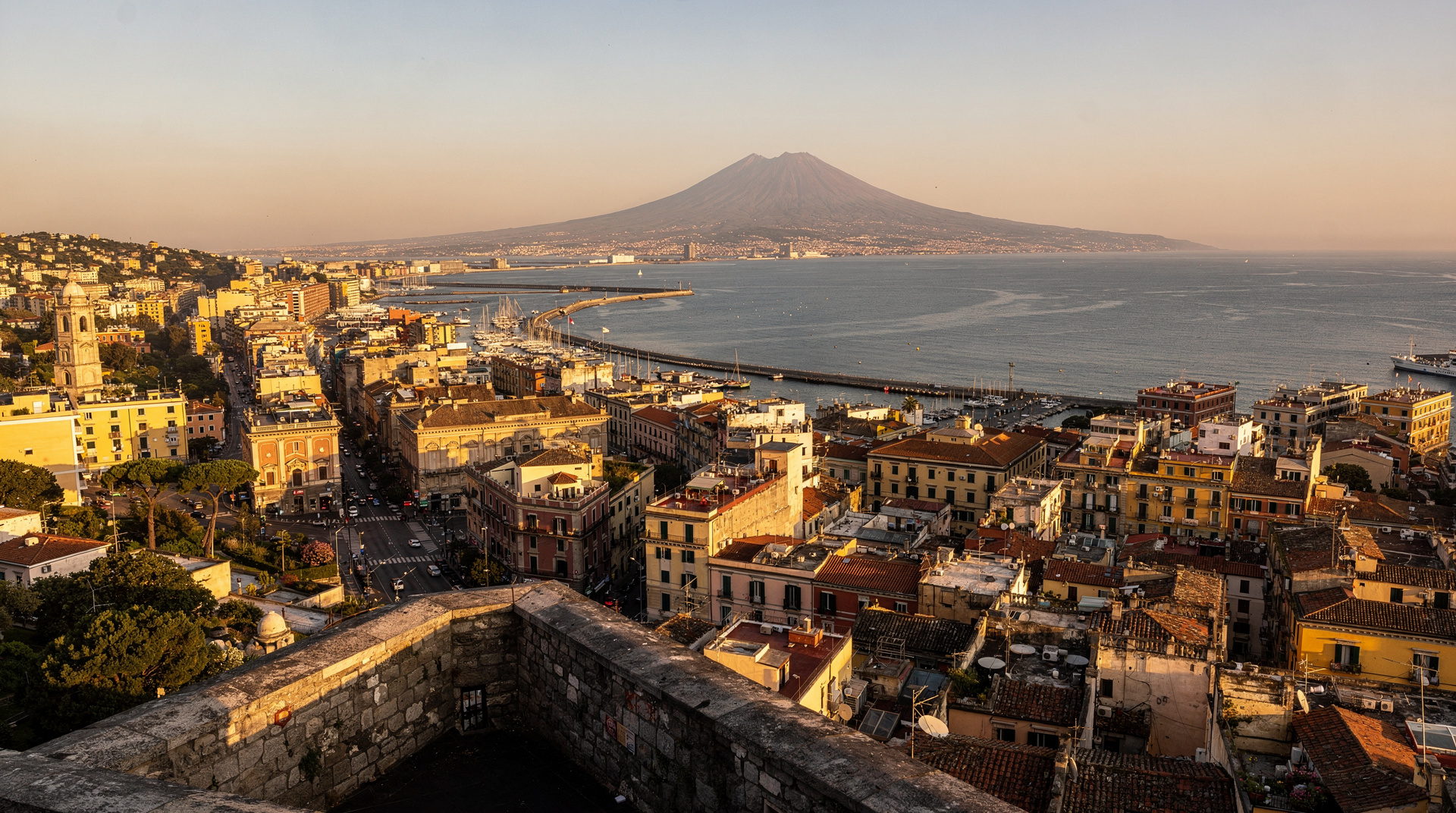
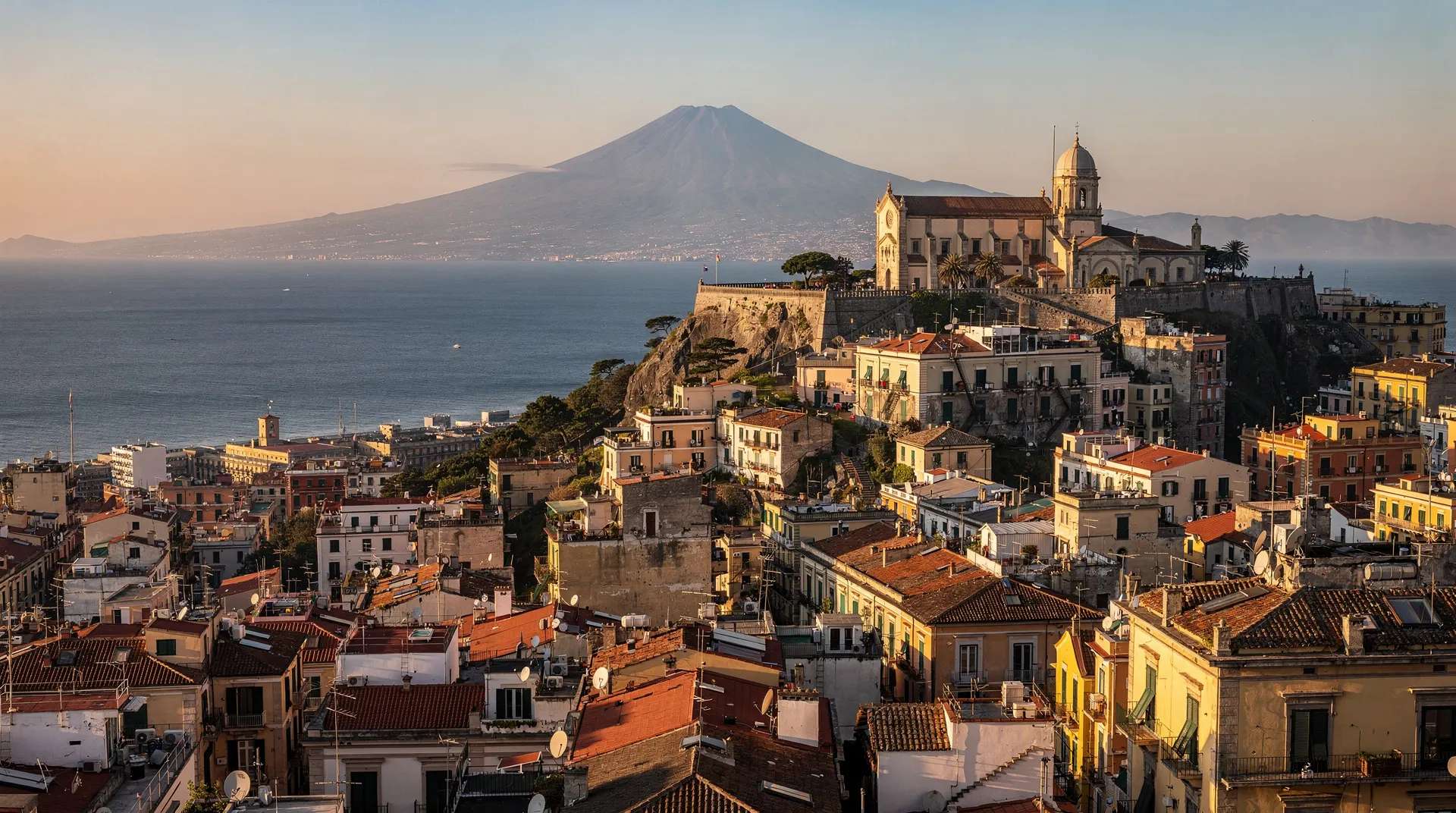
Naples is a city of hills, and Vomero is the most central of them. Sitting at roughly 180 metres above sea level, the neighbourhood looks down on the flat historic centre to the east and north, and across the bay to Mount Vesuvius and the Sorrentine Peninsula. On clear days — more common in autumn and spring than in the hazy summer months — you can see Capri from the Belvedere San Martino.
| Where | Hilltop neighbourhood above Naples, ~180 m elevation |
| Cost | Free to walk around; Castel Sant’Elmo ~€5, Certosa ~€6, funicular €1,20 |
| Time needed | Half day for the main sights; combine with a full day in centro storico |
| Getting there | Funicular from Via Toledo, Piazza Montesanto, or Piazza Amedeo, ~4 min |
| Best time | Year-round; clearest views on autumn and spring mornings |
The hill’s character is distinct from the city below: wider streets, less traffic noise, fewer tourists at any given moment. Residents describe it as a neighbourhood where Naples’ middle class actually lives — shopping on Via Luca Giordano, coffee at local bars, children on the streets after school. It is often recommended for families and for travellers who want good access to Naples’ sights without the full sensory intensity of the historic centre.
Getting up to Vomero
Three funiculars connect Vomero to the city below. All run on standard ANM tickets (1,20 € for 90 min, valid on metro and bus as well):
- Centrale funicular: from Via Toledo (near Piazza Montesanto metro) to Via Enrico Cimarosa at the top. Runs frequently, ~4 min journey.
- Chiaia funicular: from Via Parco Margherita (near Piazza Amedeo in Chiaia) to Via Cimarosa. Convenient if you are coming from Chiaia.
- Montesanto funicular: from Piazza Montesanto (accessible from metro) to Via Morghen. Runs to a different part of the hill, useful for Castel Sant’Elmo.
Operating hours: roughly 7h–22h daily (reduced on Sundays; check current schedules as maintenance closures occur). For full detail on all four funiculars (including the Mergellina/Posillipo one), see the Naples funiculars guide.
The alternative is walking up — steep staircases connect Chiaia and the historic centre to Vomero, if you want the exercise.
Castel Sant’Elmo
The most visible landmark of Vomero is the star-shaped castle that crowns the hill. The original fortification dates from the 14th century (Angevin period); the current structure was rebuilt by the Spanish viceroys in the 16th century in a six-pointed star plan, designed to give maximum coverage in all directions. It served as a political prison for several centuries (Tommaso Campanella was held here) and as a military installation until 1976.
The castle is now a state museum with rotating contemporary art exhibitions. The entry fee (around 5 €) gives access to the ramparts, which provide the single best 360-degree view of Naples: the historic centre and the bay to the south and east, the Campi Flegrei (Phlegraean Fields) to the north-west, Vesuvius dominating the eastern horizon, and on clear days, the profiles of Capri and Ischia at sea.
Time required: 30–60 min depending on whether an exhibition holds your interest. The panoramic terrace alone is worth the entry.
Certosa di San Martino
Immediately adjacent to Castel Sant’Elmo (connected by a path and accessible via the same hilltop area) is the Certosa di San Martino — a former Carthusian monastery that is now one of Naples’ most important museums.
The monastery was founded in 1325, expanded throughout the 17th century, and eventually confiscated from the monks during the Napoleonic period and later under Italian unification. The building itself is a demonstration of Neapolitan Baroque at its most elaborate: polychrome marble inlays, frescoes by Luca Giordano (who gives his name to the main commercial street below), and a cloister with a perspective trick built into its floor. The museum inside covers Neapolitan history, decorative arts, presepi (the Cuciniello collection contains one of the finest 18th-century nativity scenes in Italy), and paintings.
Entry around 6 €. Allow 2 hours minimum. See the Certosa guide.
Belvedere San Martino
The terrace in front of the Certosa is the most famous viewpoint in Naples. Postcards of the city — the bay, the islands, Vesuvius in the background — are typically taken from here or from adjacent points on the Vomero ridge. The best viewing conditions are morning light in spring and autumn; the summer haze reduces visibility significantly. Winter mornings after rain are often spectacular.
For a curated list of all the city’s viewpoints, see Naples viewpoints and best photo spots Naples.
Panoramic Fiat 500 tour — Vomero, Posillipo, seafront highlightsVia Luca Giordano — the neighbourhood life
Via Luca Giordano is Vomero’s main commercial street — a pedestrianised or semi-pedestrianised road running through the centre of the neighbourhood with shops, bars, and restaurants used primarily by residents. The contrast with the tourist-facing streets below is immediate: here you are an outsider in a working neighbourhood rather than a target demographic.
Coffee at a bar here costs the same as anywhere in Naples (1–1,20 € at the counter). Lunch options are practical, local, and reasonably priced.
Where to stay in Vomero
Vomero has a smaller hotel offer than Chiaia or the centro storico, but several well-regarded B&Bs and small hotels. The appeal is a calmer environment, slightly cooler temperatures in summer (the altitude makes a difference), and the funicular commute to the city below — which most visitors find pleasant rather than inconvenient.
Practical note: the funiculars close around 22h; after that, getting down requires a taxi or bus. This is rarely a problem but worth knowing if you plan late nights in the historic centre.
For a full comparison, see best areas to stay in Naples.
Museo Nazionale della Ceramica Duca di Martina
Inside the Villa Floridiana — a neoclassical villa with gardens on the Vomero hill, not far from the Centrale funicular stop — this ceramics museum holds one of the most important collections of European and Asian decorative arts in southern Italy. The collection was assembled by the Duke of Martina in the 19th century and donated to the state: Chinese and Japanese porcelain, Meissen, Sèvres, Venetian glass, majolica. The villa’s grounds (a formal garden with sea views) are free and pleasant. Museum entry around 3 €. Often completely empty of other visitors.
Via Scarlatti and local shopping
Parallel to Via Luca Giordano is Via Scarlatti — another pedestrianised street with a more upscale range of shops, including a notable concentration of pastry shops. Pasticceria Ferrieri is one reference point; there are several others. This is where Vomero residents come for weekend pastry shopping — sfogliatelle, babà, pastiera depending on season — and the quality is reliably high because the clientele is local and knows what it is doing.
Day-to-day Vomero: cafes, morning routine
The Vomero bar culture is a good illustration of the coffee ritual in Naples at its most undistorted. At any bar on Via Luca Giordano before 9h, the espresso costs 1–1,20 € at the counter. The brioche (a soft sweet roll, sometimes filled with cream or Nutella) is 1,20–1,80 €. You stand at the bar; there is a coperto surcharge if you sit. The transaction takes 90 seconds. This is the Neapolitan morning.
Avoid the bars immediately adjacent to the funicular exits — they know they are capturing tourist traffic and price accordingly (not dishonestly, but at a slight premium). Walk one block inland.
The view from Castel Sant’Elmo on a clear day
To be specific about what you see from the top of Castel Sant’Elmo: looking south-east, Vesuvius is the dominant feature — on a clear day you can see both the main cone and the secondary cone of Monte Somma. Pompeii and Herculaneum are not visible (too small and obscured by the suburbs) but the curve of the Bay of Naples leading toward the Sorrentine Peninsula is clear. Capri appears as a low dark shape 25 km out. Ischia and Procida are visible to the west. Closer in, you can see the entire flat historic centre spread below, with the Duomo bell tower identifiable, and the port with its ferry infrastructure. The view justifies the entry fee to the castle even if you skip the exhibitions.
Combining Vomero with the rest of Naples
Vomero works best as a morning excursion or a half-day extension to a longer Naples visit, not as a standalone destination. The logical combination:
- Half-day Vomero: take the funicular up, walk to Castel Sant’Elmo for the view, tour the Certosa di San Martino, lunch on Via Luca Giordano, funicular back down to Chiaia.
- Full day (Vomero + centro storico): morning in Vomero, afternoon on Spaccanapoli or at MANN.
- 2-day Naples: see the 2-day Naples itinerary for a schedule that integrates Vomero efficiently.
Maradona and Vomero
A note on an unexpected Vomero connection: Diego Armando Maradona lived for a period in the Vomero neighbourhood during his years at SSC Napoli (1984–1991). The apartment building where he lived on Via Scipione Capece is sometimes pointed out on tours; there is no museum or official marker, but locals know it. Maradona’s cultural presence in Naples is pervasive — shrines appear in the centro storico, a large mural is in Quartieri Spagnoli — but the Vomero connection is more residential and less ostentatious. For the full Maradona-in-Naples cultural context, see the Maradona and Naples guide.
Day trips from Vomero
The funicular connects to the metro system, which puts the entire Naples transport network at your feet in under 10 minutes. From Vanvitelli station (top of the Centrale funicular), you can connect to:
- Garibaldi station (lower level) for the Circumvesuviana to Pompeii, Herculaneum, and Sorrento
- Museo station for the MANN
- Molo Beverello (via taxi or walk from the seafront) for island ferries
This means Vomero is not significantly disadvantaged relative to the centro storico for day-trip logistics — add 10 minutes to any transit journey.
The Vomero funicular experience
The three funiculars accessing Vomero are themselves worth noting as an experience. The Centrale funicular, built in 1928 (replacing an earlier 1891 version), carries you in about 4 minutes from Via Toledo — the main commercial street of the historic centre — to Via Cimarosa on the hilltop. The cabins pass each other at the midpoint. The tunnel is lit; the approach to the upper station opens to a view of rooftops and sky.
Functionally: a standard ANM transit ticket (1,20 €) covers the funicular, so there is no surcharge. The funiculars are busy at rush hours (8h–9h30 and 17h–19h30); outside those times you can usually get a seat. They operate approximately 7h–22h daily; reduced hours on public holidays. The funiculars guide covers all four lines (including Mergellina/Posillipo) with current schedules.
What to buy in Vomero
Vomero’s shops are oriented toward residents, not souvenir hunters. This is an advantage if you want to take home things that local people actually use:
Linen and household goods. Several shops on Via Luca Giordano sell quality Italian household linen, ceramics, and kitchenware at normal retail prices.
Local food products. A few well-stocked alimentari (grocery shops) stock local products — mozzarella di bufala, nduja, local wines, limoncello. Prices are lower than tourist-facing shops in the historic centre.
Shoes. Naples has a tradition of shoe manufacturing; Vomero has several independent shoe shops where the selection skews toward Italian-made products rather than international brands.
Books. The Feltrinelli bookshop on Via Luca Giordano is a good general bookshop; there are also second-hand options in the surrounding streets.
Budget eating in Vomero
The Vomero neighbourhood is cheaper for daily eating than the tourist-facing areas below. A pizza margherita at a local pizzeria: 5–7 €. A lunch at a neighbourhood trattoria (two courses + water): 12–18 €. Supermarkets (Carrefour, Esselunga) for self-catering are also available on Via Luca Giordano.
The neighbourhood’s bakeries and pastry shops are good for breakfast — cornetti, sfogliatelle, and espresso at counter prices. The general rule in Naples applies: sit-down costs more, standing at the bar costs standard price.
Weather on Vomero versus the city below
The altitude difference (180 m) between Vomero and the flat historic centre creates a measurable temperature differential. In July–August, the hill is typically 2–4 °C cooler than the city below — which matters during heatwaves. The wind is also more consistent on the hill; the historic centre, hemmed in by buildings, can feel airless. For visitors sensitive to heat, this is a practical reason to consider a Vomero base in summer.
In winter, the hill occasionally sees frost and fog when the bay is clear — unusual by Naples standards but not unheard of.
Evening in Vomero
After the funiculars reduce service around 22h, the neighbourhood goes quiet relatively early by Italian standards. The bars on Via Luca Giordano tend to close by 23h–24h; the aperitivo scene is lively from 18h–21h but does not extend to late-night club territory. This suits families and travellers who prefer early starts for day trips.
For late-night options, the historic centre (Piazza Bellini, Quartieri Spagnoli) and Chiaia are better. The funicular commute back at midnight requires a taxi if the funiculars are closed. Budget 10–12 € for a taxi from the centre to Vomero.
Comparing Vomero to Naples’ other neighbourhoods
Travellers choosing where to base themselves in Naples often want the trade-offs laid out directly:
| Neighbourhood | Character | Access to sights | Best for |
|---|---|---|---|
| Vomero | Calm, residential, elevated | Funicular + short walk (add ~10 min) | Views, families, cooler summer nights |
| Centro storico | Dense, historic, intense | Walking distance to almost everything | First-timers, nightlife, maximum immersion — see centro storico guide |
| Chiaia | Upscale, seafront, calmer than centro | Short walk or funicular | Shopping, restaurants, a middle ground — see Chiaia neighbourhood guide |
| Posillipo | Residential, coastal, hillside | Bus or taxi, less central | Sea views, quiet, less practical without a car — see Posillipo guide |
For a fuller comparison across all of these plus hotel-price bands, see best areas to stay in Naples.
Vomero for a longer Naples stay
For visitors spending three days or more in Naples, Vomero works well as a half-day extension rather than the anchor of the trip. A practical sequence that keeps transit time low:
- Morning: funicular up from Via Toledo, Castel Sant’Elmo for the view, then the Certosa di San Martino next door.
- Midday: lunch on Via Luca Giordano or Via Scarlatti, away from the funicular-exit bars.
- Afternoon: funicular back down to Chiaia or the centro storico for the rest of the day’s sightseeing, or continue to the Museo Archeologico Nazionale (MANN) via the metro from Vanvitelli.
This sequencing avoids the common mistake of treating Vomero as an isolated day trip; it is designed to be threaded into a longer Naples visit rather than visited in isolation. The 2-day Naples itinerary shows one way to schedule it against the rest of the city.
E-bike panoramic tour — Vomero, Posillipo, and the Naples seafrontVomero by season
Vomero’s appeal shifts less dramatically with the season than the coastal towns, since its main draws — the castle, the museum, the views, the neighbourhood life — are indoor or short-outdoor activities available year-round. Still, conditions vary enough to matter for planning:
| Season | Conditions on the hill | View quality | Notes |
|---|---|---|---|
| Spring (Mar–May) | Mild, breezy | Excellent — often the clearest air of the year | Good balance of comfortable walking weather and visibility |
| Summer (Jun–Aug) | Hot in the city below, 2–4°C cooler on the hill | Hazy at midday, better in early morning | Consider a Vomero base specifically to escape the heat |
| Autumn (Sep–Nov) | Mild, occasional rain | Very good, especially after rain clears the air | A strong second choice to spring for photography |
| Winter (Dec–Feb) | Cool, occasional frost/fog | Variable — spectacular on clear days after rain | Fewer crowds at the castle and museum |
For visitors planning primarily around views and photography, cross-reference this with the Naples viewpoints and best photo spots Naples guides, both of which cover conditions at other vantage points across the city.
Vomero’s other churches and quiet corners
Beyond Castel Sant’Elmo and the Certosa, Vomero has a handful of smaller sights that reward unhurried exploration rather than a checklist approach. The Chiesa di San Gennaro ad Antignano, on the northern edge of the neighbourhood, is a modest parish church with a much older foundation beneath the current 18th-century structure — rarely visited by tourists and a useful contrast to the grandeur of the Certosa. The public gardens around Villa Floridiana (mentioned above for the ceramics museum) are worth a slow walk even without visiting the collection inside: mature trees, sea-view terraces, and a level of quiet that is hard to find elsewhere in Naples on a weekend afternoon.
Frequently asked questions about Vomero
How do I get to Vomero from the historic centre?
The Centrale funicular from Via Toledo is the most direct option — roughly 4 minutes. The Montesanto funicular (from Piazza Montesanto, near metro) is an alternative. Both cost 1,20 € on a standard ANM transit ticket.
Is it worth staying in Vomero?
Yes, if you prioritise quiet, cooler temperatures, and a residential feel. The funicular commute is quick and reliable. If you want maximum walking access to the historic centre, Chiaia or the centro storico itself are closer.
What are the opening hours of Castel Sant’Elmo?
Generally Tuesday–Sunday, 9h–19h30 (last entry 18h30). Closed Mondays. Check ahead as the castle sometimes closes for special events. Entry around 5 €.
Can I walk between Castel Sant’Elmo and Certosa di San Martino?
Yes, they are immediately adjacent — connected by a path and both accessible from the hilltop area. They are effectively combined as one visit by most people.
What is the best time of day to go to the Belvedere for views?
Morning light (before 11h) in spring and autumn gives the clearest conditions with the best contrast on Vesuvius. Sunset is popular but the western orientation means the mountain is in shadow. Avoid midday in July–August (haze and heat).
Is Vomero safe?
Consistently among the safest areas in Naples. It is a middle-class residential neighbourhood with a low presence of tourist-related petty crime. Standard urban awareness applies.
Top experiences
Bookable activities with verified prices and instant confirmation on GetYourGuide.