Maradona and Naples: the footballer who became a city's symbol
Naples: Street Food and Maradona Murales Walking Tour
Why is Maradona so important to Naples?
Diego Maradona played for SSC Napoli from 1984 to 1991 and delivered the club its only two Serie A championships (Scudetti), in 1987 and 1990. For a city accustomed to being treated as inferior by northern Italy, winning the national title with a southern club was a statement of civic pride that went far beyond football. Maradona became — and remains — a civic symbol, saint-like figure, and the most visible subject of Naples' street mural tradition.
When Diego Maradona died on 25 November 2020, the flags above the Naples city hall flew at half-mast. Local government issued a statement of condolence. Spontaneous altars of candles, football shirts, and flowers appeared in the streets within hours. The mourning was not organised; it was immediate, personal, and citywide — the same quality that Italian sociologists have for decades described as one of the distinguishing features of Neapolitan collective emotional life.
Maradona played for SSC Napoli from 1984 to 1991. He won the club’s only two Italian league championships. He was the best footballer in the world during this period by most reasonable assessments. But the relationship between Maradona and Naples was never simply about football. It was about a southern Italian city’s relationship to its own place in a country that had long treated it as inferior — and about what it meant for the south to beat the north through the agency of a player who came from another kind of poverty, another kind of historically disadvantaged city, in a different hemisphere.
| Where | Quartieri Spagnoli (murals), Fuorigrotta (stadium and museum) |
| Cost | Murals free; stadium museum entry varies, check SSC Napoli site |
| Time needed | 45–60 min for the mural walk; half-day with the stadium |
| Getting there | Walk from Via Toledo (murals); Metro Line 2 to Campi Flegrei (stadium) |
| Best time | Daytime for photography; any time — murals are always accessible |
How Maradona arrived in Naples
In 1984, Diego Maradona was 23 years old, already considered the best player in the world, and was leaving FC Barcelona under difficult circumstances — two difficult seasons punctuated by injury, a famously violent foul that broke his ankle, and a strained relationship with the club’s management. Napoli, at the time, was a mid-table Serie A club with significant support and no major trophies. The club’s president, Corrado Ferlaino, paid a world-record transfer fee of approximately $10.5 million — an extraordinary financial commitment for a club of Napoli’s size.
Maradona arrived in Naples in June 1984. The reception at the Stadio San Paolo was described by witnesses as overwhelming: 75,000 people attended a presentation event, with more outside. Contemporary footage shows a crowd that was specifically emotional — not the polite applause of a wealthy club presenting another acquisition, but a city greeting someone it had chosen to believe in.
Whether Maradona genuinely loved Naples or whether he performed the narrative of loving Naples with such skill that the distinction became irrelevant is a recurring question in the extensive literature on the subject. What is clear is that his public embrace of Neapolitan identity — his adoption of the dialect, his expression of identification with the city’s southern marginalisation, his willingness to be seen as a Neapolitan as well as an Argentine — was accepted as genuine and was reciprocated.
The 1987 Scudetto: what it meant
The first championship came on 10 May 1987, after a 1-1 draw against Fiorentina. The mathematical certainty that Napoli had won the Serie A title for the first time in the club’s 61-year history produced scenes in the streets of Naples that participants and observers consistently describe in extraordinary terms — comparable in scale and emotional intensity to liberation celebrations after WWII.
The specific charge of the moment requires context. In Italian popular discourse of the 1980s, the gap between north and south — economic, cultural, self-perceived — was explicit and widely commented on. Northern Italian supporters of Juventus, Inter, and AC Milan (the clubs that had dominated Italian football for decades) had for years expressed their contempt for Naples and the south in ways that were both common and accepted at Italian football grounds.
When Napoli — with a southern Italian squad, southern Italian supporters, and a world-class player who had identified with the city — beat Juventus, Inter, and Milan to the title, the victory had a resonance that Italian football journalists explicitly acknowledged: this was not just football, it was a symbolic reversal of the north-south hierarchy that had defined post-unification Italy.
The murals in the Quartieri Spagnoli began appearing with more intensity after 1987. Maradona’s face, his initials, the Napoli badge — these were statements of civic identity as much as football loyalty.
The second Scudetto and the World Cup complication
The second championship (1989–90) arrived with an additional complication that became part of the mythology. The 1990 Football World Cup was held in Italy; one semifinal — Argentina versus Italy — was played at the Stadio San Paolo in Naples.
Maradona, playing for Argentina, asked Naples and Neapolitans publicly to support Argentina rather than Italy, on the grounds that the Italian state had historically treated Naples and the south as inferior — had never treated Neapolitans as fully Italian. The appeal was not without logic: Italian nationalism had always been a more complicated proposition in the south than in the north, and Maradona’s framing resonated with a significant portion of the Naples crowd.
The match ended with Argentina eliminating Italy on penalties. The reaction in Naples was mixed — some felt Maradona had gone too far; others agreed with him completely; many were simply navigating genuine ambivalence. The episode remains controversial and is discussed in every substantial account of Maradona’s time in Naples.
The murals: where to find them
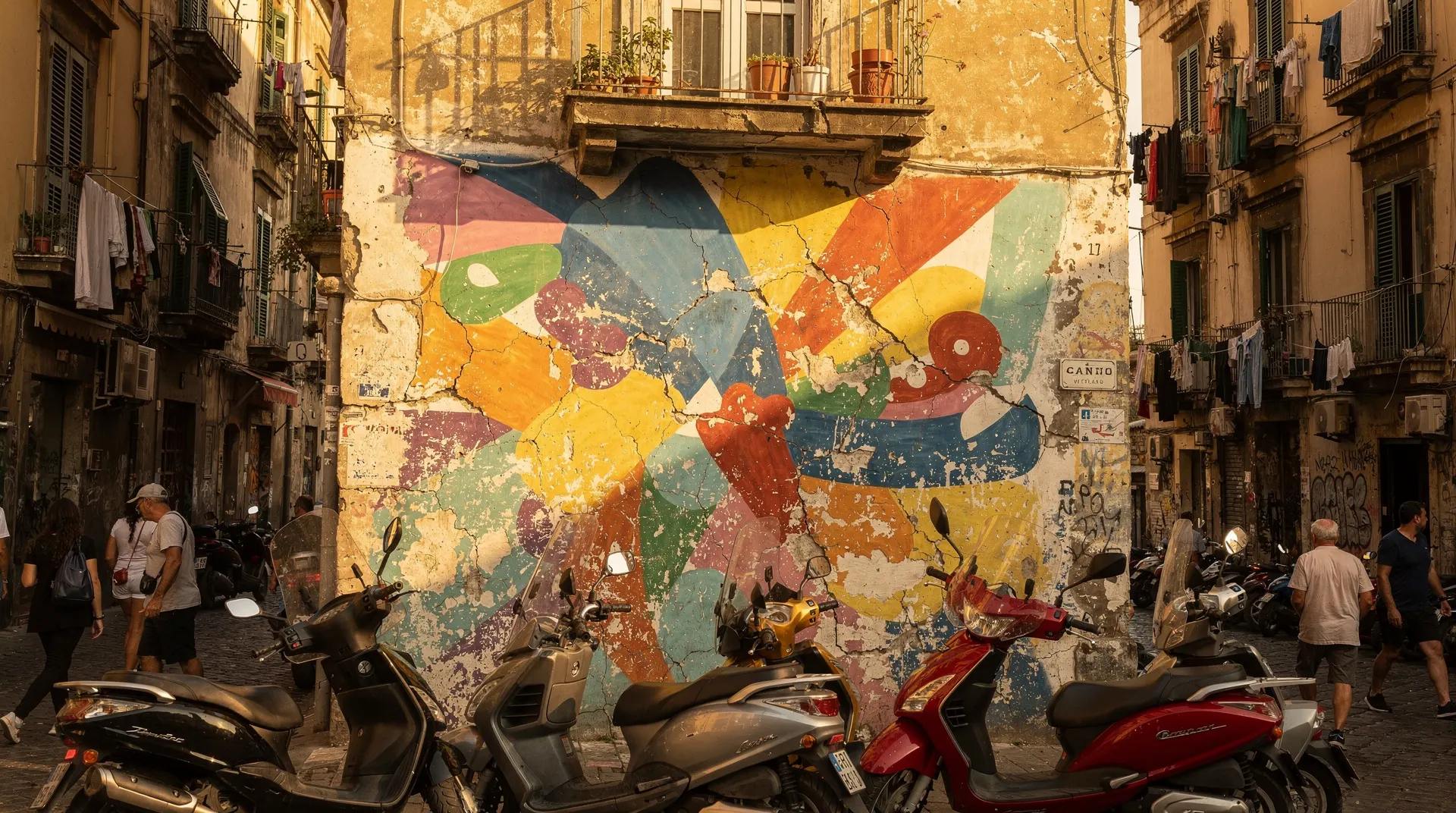
The Quartieri Spagnoli — the Spanish Quarter, the dense grid of streets west of Via Toledo built for Spanish garrison troops in the 16th century — is the primary location for Maradona murals. The neighbourhood’s narrow streets, which make large outdoor surfaces visible at close range, became the natural medium for the Neapolitan street art tradition.
The original famous mural (Via Emanuele De Deo 22): This is the one reproduced most often in articles about Maradona and Naples. It dates to 1990 and shows Maradona’s face in his Napoli blue. The location is on an external wall of a building partway up the street; finding it requires looking up as you walk the narrow vicolo.
The post-2020 murals: After Maradona’s death in November 2020, the number of murals, street art pieces, and memorial installations in the Quartieri Spagnoli and throughout Naples increased substantially. New murals were added by local artists, and existing murals were restored or extended. The SSC Napoli badge, Maradona’s number 10 shirt, and various renderings of his face now appear across a significant area of the neighbourhood.
Other neighbourhoods: Maradona imagery appears in the Rione Sanità, along Via Toledo, and in Fuorigrotta (the neighbourhood around the stadium). The Quartieri Spagnoli concentration is the most accessible for visitors staying in the centro storico.
Combining the mural walk with street food
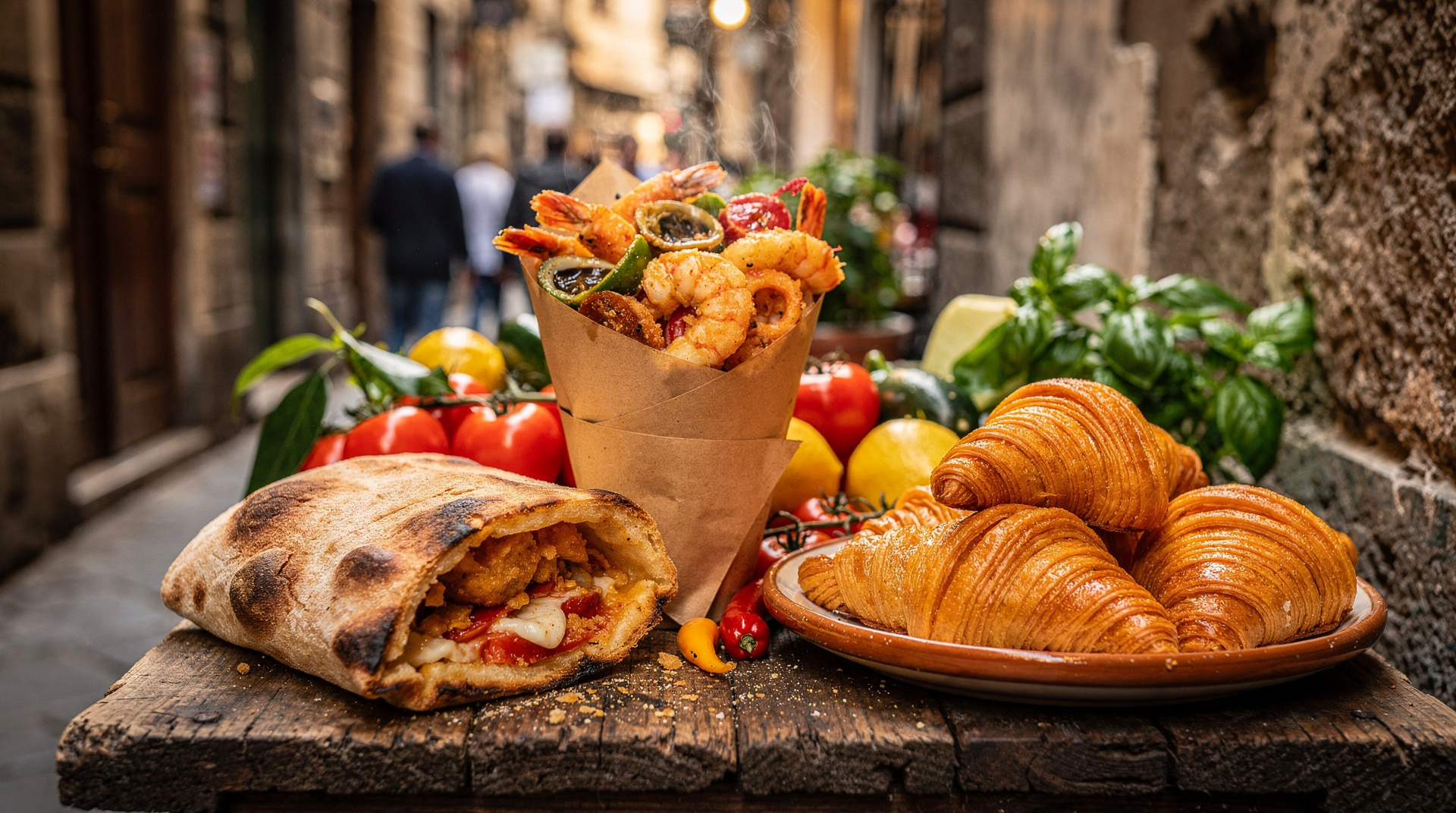
The Quartieri Spagnoli is also one of the best neighbourhoods in Naples for unpolished, genuinely local street food — friggitorie selling fried snacks by weight, small pizzerias without English menus, and a slower pace than the more touristed streets around Via dei Tribunali. A guided street food walk through this specific neighbourhood, timed around Maradona sites, is a good way to combine the two interests in a single outing.
Naples street food tour through Maradona’s Quartieri SpagnoliFor a broader introduction to the neighbourhood’s history and layout beyond the murals, see the centro storico guide, which covers the district immediately adjacent to the Quartieri Spagnoli.
The stadium: Diego Armando Maradona Stadium
The Stadio San Paolo, built in 1959 and extensively renovated for the 1990 World Cup, was renamed the Stadio Diego Armando Maradona in November 2021. It is in the Fuorigrotta district, about 6 km west of the centro storico, accessible on Metro Line 2 (Campi Flegrei station, then a 10-minute walk) or Line 6 (Mostra station).
SSC Napoli plays Serie A home matches here; the atmosphere at Napoli home games is considered one of the most intense in Italian football. Ticket prices range from approximately €15 for Curva (standing/lower tier) to €60+ for central seats. Checking the match calendar well in advance is essential for July–August visitors as the pre-season schedule differs from the regular season.
On non-match days, the stadium and the SSC Napoli Museum are accessible for guided visits. The museum contains match footage on screen, original Napoli kits (including the 1986–87 championship season shirts), and various pieces of Maradona memorabilia — balls, boots, personal items.
Maradona in the broader Naples cultural landscape
The Maradona phenomenon in Naples is sometimes reduced, by outside observers, to a football story. The sociological and cultural dimensions are more complex.
Naples has a long tradition of creating local saints — figures (both religious and secular) who are adopted as protectors and intercessors, whose images are maintained in domestic and public spaces, who are petitioned in times of difficulty. The anime pezzentelle tradition at Fontanelle is the most explicit version of this, but it extends broadly into Neapolitan devotional culture. Maradona has been absorbed into this tradition in a way that is sometimes described, by both Neapolitans and outside observers, as quasi-religious: his image appears in domestic altars alongside traditional saints, his name appears in graffiti tags alongside San Gennaro’s.
Whether this is sincere or ironic — whether the Neapolitans who maintain Maradona shrines are devout, playful, or both simultaneously — is a question that Neapolitan culture declines to resolve. The same ambiguity runs through a lot of Neapolitan religious practice. The important point for visitors is that the Maradona imagery in the Quartieri Spagnoli and elsewhere is not a tourist product; it emerged from a specific cultural tradition and continues to be maintained by people who live in and around the spaces it occupies.
The 2023 Scudetto: the third championship
On 4 May 2023, SSC Napoli won the Serie A title for the third time in the club’s history — and the first time since Maradona. The championship was won in Udine; the celebrations in Naples began before the final whistle and continued through the night. The Piazza del Plebiscito filled with an estimated 100,000 people.
The 2023 title was inevitably framed through the Maradona lens: placards bearing his face appeared in the crowds; the stadium bears his name; the victory was described repeatedly as a tribute to him. The championship also confirmed that the 1987 and 1990 wins were not isolated miracles of one player’s individual genius — Napoli under manager Luciano Spalletti and a squad dominated by no single superstar had assembled a genuinely great team.
Practical guide for Maradona visitors
Quartieri Spagnoli walk: Enter the Spanish Quarter from Via Toledo at any cross-street heading west — Via Santa Brigida, Via della Concezione, Via Pasquale Scura. Walk north-south through the vicoli looking at exterior building walls. The Maradona murals are concentrated in the northern section closer to Via dei Tribunali but appear throughout. Plan 45–60 minutes for a relaxed walk.
Stadium visit (non-match day): Metro Line 2 to Campi Flegrei, or Line 6 to Mostra. SSC Napoli Museum is open Tuesday–Sunday 10:00–18:00. Check the official SSC Napoli website for current admission prices and hours.
Match day: Tickets via the official SSC Napoli website (sscnapoli.it). Foreign visitors do not need an Italian identity card for most tickets, but the process requires advance booking and some patience with the ticket system.
Photography of murals: All murals on public surfaces are freely photographable. Some murals are on private property (building walls visible from the street) — photographing them from the public street is not restricted.
Maradona and Naples’ wider culture of remembrance
The Maradona phenomenon connects to a broader Naples cultural pattern worth understanding before you visit: this is a city that memorialises intensely and visibly, whether the subject is religious, historical, or — as with Maradona — a footballer absorbed into civic identity. The Naples history guide covers this pattern more broadly, from the city’s saints’ cults to its street-level commemorative culture, and helps explain why Maradona’s murals feel less like fan art and more like devotional images to many Neapolitans.
If your interest is in Naples’ living culture and traditions generally rather than football specifically, the Neapolitan culture and traditions guide situates the Maradona cult within the city’s wider relationship to memory, faith, and identity — useful context for understanding why a single footballer occupies so much public space fifty years after his prime playing years, and still four decades after he first arrived in the city.
Frequently asked questions about Maradona and Naples
Why do some Italians have a negative view of Maradona?
Maradona’s career includes the “Hand of God” goal against England in the 1986 World Cup (which he acknowledged publicly as deliberate handball), subsequent drug abuse admissions, and the 1990 World Cup episode in Naples. For northern Italian supporters of clubs that lost championships to Napoli, he is also simply a rival. His personal conduct — the documented drug use, the relationships, the legal disputes — provides material for critics.
Is there a specific time of year when Maradona is particularly commemorated in Naples?
Maradona died on 25 November — around this date each year, new candles, flowers, and tributes appear at the major murals. His birthday (30 October) is another focal point. The anniversary of the 1987 Scudetto (around 10 May) sees specific SSC Napoli commemorations.
Does SSC Napoli have a fan shop near the centro storico?
SSC Napoli has official stores in several locations including a shop on Via Toledo. Unofficial Napoli merchandise — scarves, shirts, Maradona posters — is sold throughout the Spanish Quarter and at street stalls near Piazza Garibaldi.
What is the best mural of Maradona from an artistic standpoint?
This is subjective. Among art and street-art commentators, the most artistically accomplished Maradona murals tend to be the larger-scale works commissioned from professional street artists after 2020. The original 1990 mural at Via Emanuele De Deo is the most historically significant. Several critics identify a large mural near Via Emanuele De Deo 22 painted in 2022 by Jorit (a Neapolitan street artist) as the most technically accomplished.