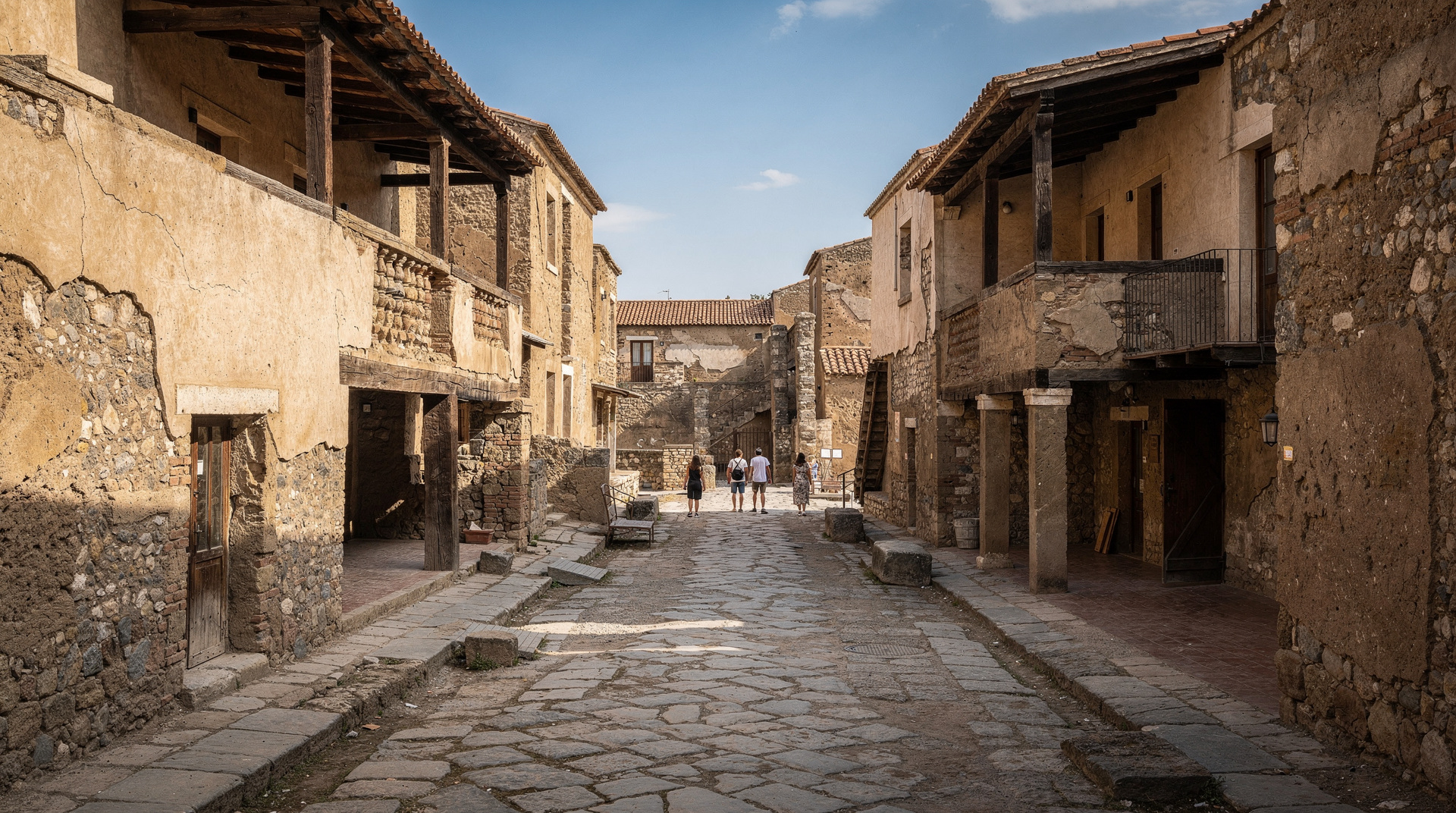
Pompeii with kids: tips, routes, and what to prepare for in 2026
Pompeii: 2-Hour Guided Tour with an Archaeologist
Duration: 2h
What is the best way to visit Pompeii with children?
Start at opening time (09:00) to beat the heat and crowds. Book a family-focused guided tour for children aged 7+ — the narrative engagement makes the difference. EU citizens under 18 enter free (bring ID). Bring water, sun hats, and snacks — the site has no shade outside the permanent structures. The most child-engaging elements are the plaster casts, the bakeries, the dog mosaic, and the fast-food counter (thermopolium).
The essential preparation: Arrive at 09:00, bring water + hats, have EU ID cards for children (free entry), book a child-aware guide for ages 7+, leave by noon in summer.
| Best age | 7+ for full engagement; under 5 needs a carrier |
| Time needed | 2.5–3 hrs highlights, 1–2 hrs under-5s |
| Entry cost | free EU under 18 (ID required), around €18 non-EU |
| Getting there | Circumvesuviana (around €3.30) or Campania Express |
| Best time | 09:00 opening, out by noon in summer |
| Book ahead | family tour a few days ahead in summer |
Why Pompeii works exceptionally well for children
Most museum visits ask children to look at things behind glass and imagine what they were. Pompeii asks nothing of the imagination — it shows you directly. The bread that was in the bakery oven when Vesuvius erupted in 79 AD is still there (carbonized, behind a glass panel). The jars in the fast-food counter still have their original contents identified. The dog mosaic at the House of the Tragic Poet says “Cave Canem” (beware of the dog) exactly as it did 2,000 years ago.
For children who have heard about ancient Rome, this concreteness is extraordinary. For children who haven’t, a good guide makes it so within the first 10 minutes.
The site is also physically large enough to feel like genuine exploration — 44 hectares, with streets stretching in every direction, buildings to peer into, and a sense that you could spend days and still find new corners. This freedom-of-movement quality is the opposite of most child museum experiences.
Getting to Pompeii from Naples with children
Circumvesuviana train (standard option)
Departs from Napoli Centrale/Garibaldi station (lower level). Trains run approximately every 30 minutes. Journey to Pompeii Scavi: 30 minutes. Fare: €3.30 one way.
Family reality: The Circumvesuviana is functional but uncomfortable for families. Trains are not air-conditioned, are often crowded in peak season, and have a documented pickpocket problem (keep children between adults, bags visible). Morning trains before 09:30 are least crowded. Return trains in the early afternoon (12:00–14:00) can be packed.
Campania Express (premium seasonal option)
The Campania Express is a supplemental service running on the same Circumvesuviana route, designed specifically for tourists. It is air-conditioned, has guaranteed seating, and stops only at tourist destinations (Pompeii, Herculaneum, Sorrento). Fare: approximately €7 one way.
Family verdict: Worth the premium for families, especially in summer. The air conditioning alone justifies the difference on a 38°C day. Check the Campania Express guide for current scheduling.
Direct tour from Naples
Several operators offer combined transport + guided Pompeii experiences that pick up from central Naples hotels. These eliminate the Circumvesuviana entirely. More expensive (€30–50 per adult for transport + guide) but significantly lower logistics stress for families with young children.
A private 2-hour Pompeii tour includes a licensed guide focused on your specific family group — the most child-responsive option.
Timing: the heat issue is not optional
October–May: The comfortable visiting window. Temperatures 12–22°C, manageable at any time of day. Spring flowers, fewer crowds, affordable transport.
June–September: Requires strict timing with children. The Forum and the main streets have no shade. By 11:00 in July, the heat is genuinely punishing. By 13:00, it is dangerous for young children without constant hydration and shade.
Family protocol for summer:
- Arrive at 09:00 (site opens)
- Visit the open areas first (Forum, Via dell’Abbondanza) when still cool
- Move to covered and shaded areas (the large Palestra, the House of the Faun, the Basilica) from 10:30
- Exit by 12:00 or 12:30 at the latest
Each child should carry or be given at least 1.5 liters of water per person. Sun hats are non-negotiable. SPF 50 on all exposed skin. There is water at the site (fountains, café) but bringing your own is essential.
The best child-focused route at Pompeii
This route covers the most child-engaging elements in approximately 2.5–3 hours, avoiding the areas with heavy adult academic content.
Start: Main Entrance Gate (Porta Marina or Piazza Anfiteatro depending on access) → Forum
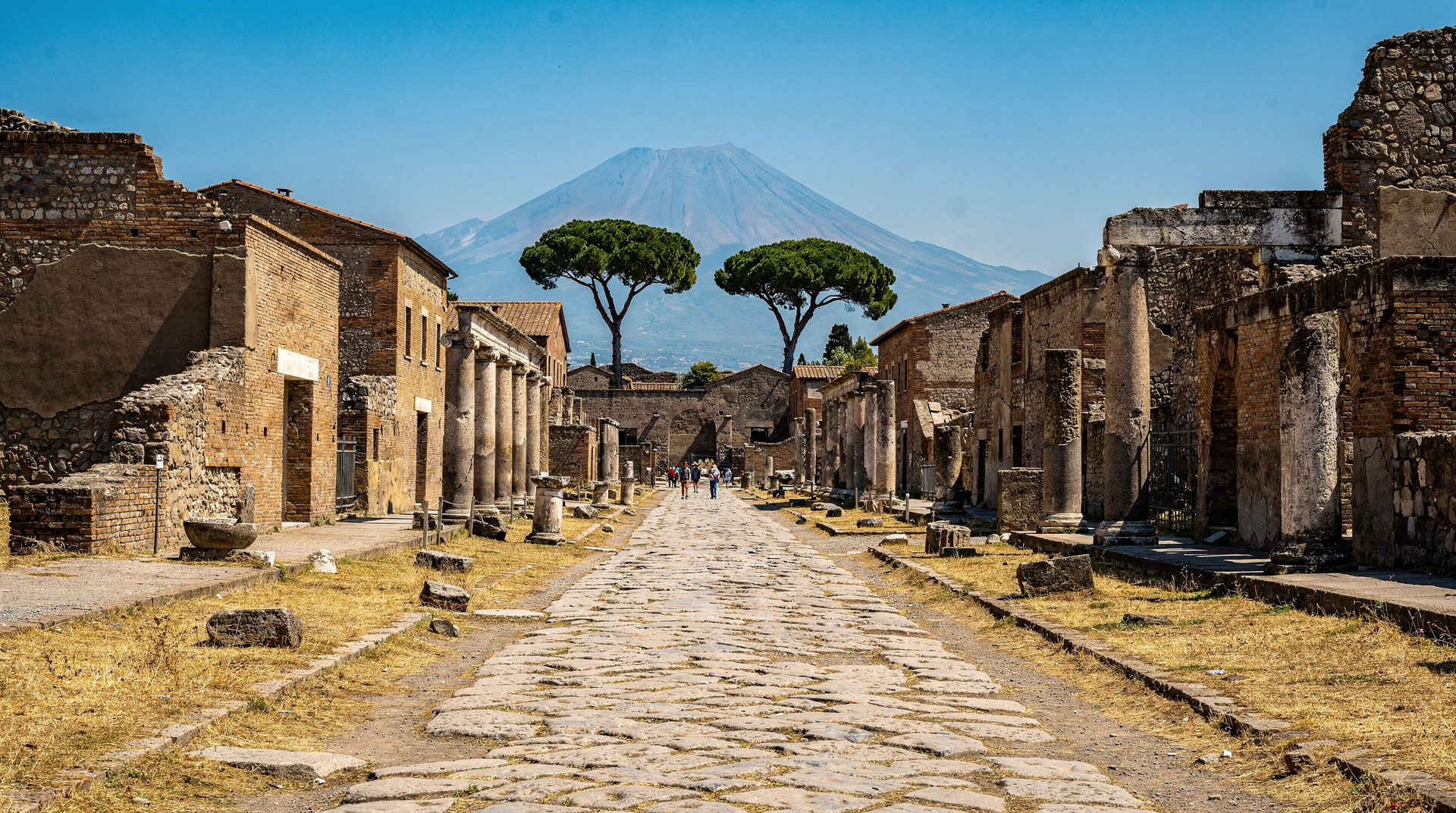
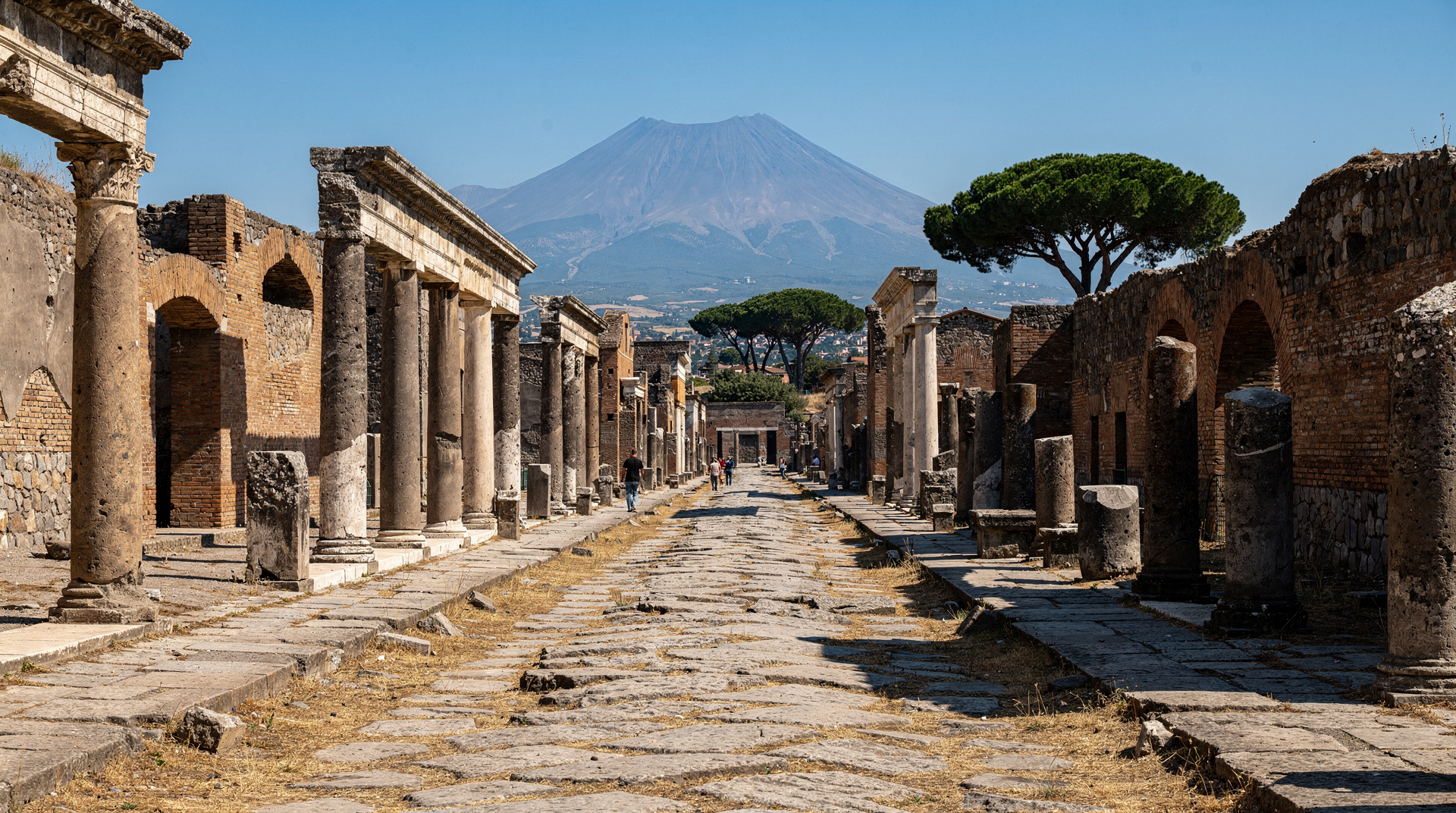
Forum: The central public square explains the layout of a Roman city. The columns, the official buildings, the covered market. Allow 20 minutes with a guide explaining what happened here.
Bakery (Forno di Modesto, near Via dell’Abbondanza): The best-preserved Roman bakery visible anywhere — large millstones for grinding grain, brick ovens, carbonized bread in display cases. Children immediately understand that these are ovens like modern ones and that real bread baked here.
Thermopolium (fast-food counter): The newly excavated thermopolium in Regio V (northern part of the site — ask your guide to include it) has food jars in situ with original contents identified (duck, pig, fish). Children’s reaction: “They had fast food?” is reliable.
House of the Tragic Poet / Cave Canem mosaic: The famous dog mosaic at the entrance, the dining room fresco, and the overall sense of stepping into a private house. 15 minutes.
House of the Vettii: One of the best-preserved houses in Pompeii, with garden fountains (restored to working order), fine frescoes, and a famous erotic panel at the entrance (parental discretion). The garden with its bronze garden furniture is excellent.
Garden of the Fugitives: The most emotionally powerful section — 13 plaster casts of people who sought refuge in a vineyard garden during the eruption and died there. The casts show men, women, and children in their exact death positions, preserved in the ash. How to explain this to children is addressed in the Pompeii with kids guide pompeii-with-kids.
Amphitheatre: The oldest surviving Roman amphitheatre in Italy, built 80 BC. Large enough to hold 20,000 spectators. Children can understand gladiatorial games here; the scale is impressive. Walking the arena floor is permitted.
End point: Exit via Piazza Anfiteatro or back via Via dell’Abbondanza.
What the plaster casts actually are (and how to explain them)
This is the question most parents prepare for wrong. Children aged 8+ can and should understand the honest answer: Vesuvius buried the city in ash. As the ash hardened around bodies, the organic material decomposed over centuries, leaving hollow spaces in the exact shape of the person or animal. 19th-century archaeologist Giuseppe Fiorelli realized these hollows existed and developed a technique of filling them with liquid plaster. What you see is that plaster cast — the exact three-dimensional shape of a human being from 79 AD.
The most affecting casts are:
- The dog (near the House of Orpheus): a dog on a chain, who could not escape, cast in exact detail
- The mother and child (House of the Golden Bracelet): a woman with a child on her lap
- The soldier (near the Herculaneum Gate): a man with a sword, who evidently tried to wait out the eruption
Children ages 8–14 consistently find these the most memorable part of Pompeii. Handle the explanation matter-of-factly — children respond better to honest answers than to evasion. See the extended explanation in the main Pompeii with kids guide.
Entry fees and the free-for-EU-under-18 rule
This rule saves families significant money but requires documentation:
- EU/EEA citizens under 18: Free. Must show EU national ID card or EU/EEA passport at the ticket desk.
- Non-EU children aged 3–17: Standard adult rate (€18 at time of writing). Verify the current policy at the site — it changes periodically.
- All children under approximately 3: Free regardless of nationality.
Practical: Have EU ID cards ready when approaching the ticket desk. The staff will ask for them. If you forget, you pay adult rate. Worth knowing in advance.
Combining Pompeii with Vesuvius for older children
A combined Pompeii + Vesuvius day trip works well for children aged 10+ who have enough physical energy. The Vesuvius hike (30–45 minutes to crater rim) is manageable and adds the geological “cause” to Pompeii’s historical “effect.”
A combined Pompeii and Vesuvius day trip handles the logistics of visiting both sites in a single organized day. The guided format ensures children stay engaged across both locations.
See the family day trips Campania guide for the full range of how Pompeii can be combined with other Campania sites on a family itinerary.
What to bring: the family Pompeii packing list
- Water (minimum 1.5 liters per person; more in summer)
- Sun hats or caps (required for children in summer; head sunstroke is faster than adults expect)
- Sunscreen SPF 50
- Comfortable closed-toe shoes with grip (the basalt cobblestones are uneven)
- Small snack or early lunch (the on-site café is basic and expensive; food is not permitted in most areas)
- EU national ID cards for children (free entry)
- Portable phone charger if using audio guide apps
- For stroller users: a baby carrier as backup
What not to bring: Wheeled luggage (no cloakroom for large bags). Tripods (not permitted). Excessive camera equipment.
Age-by-age quick reference
| Age | Realistic time | What works | What to skip |
|---|---|---|---|
| Under 5 | 1–2 hours | Amphitheatre, wide-open Forum | Long walks, house interiors |
| 5–6 | 2 hours | Bakery, dog mosaic, casts | Lupanare, academic detail |
| 7–12 | 2.5–3 hours | Thermopolium, casts, guided narrative | Nothing much — this is the sweet spot |
| 13+ | 3–4 hours | Full route including Lupanare (parental call) | — |
This is a good moment to also check Pompeii highlights: what to see for the adult-oriented priority list — cross-reference it with the child-focused route above if you’re travelling with a mixed-age group and want everyone to see at least a few of their own priorities.
If Pompeii feels like too much site for your family
Some families, especially with children under 6 or with limited stamina, do better with Herculaneum instead of or alongside Pompeii — it’s a fraction of the size, has more visible domestic detail (skeletons, wooden furniture, carbonised food) at close range, and the whole excavated area can be covered in under two hours.
If you’re weighing the two, our general Pompeii vs Herculaneum comparison covers the tradeoffs beyond the family angle specifically. For a broader view of what else works with children in the city itself before or after your Pompeii day, see Naples with kids and kid-friendly things to do in Naples.
Ticket logistics specific to families
Beyond the free EU-under-18 rule covered above, it’s worth reading the full Pompeii tickets explained guide before you go — the combined ticket that adds Herculaneum for a small supplement is often worth it for families doing more than one site, and understanding the entry-slot system in advance avoids a stressful moment at the gate with tired children in tow. If you’re arriving by train, the getting to Pompeii from Naples guide has the platform-level detail (which carriages are less crowded, where to stand) that the Campania Express section above only summarises.
Frequently asked questions about Pompeii with kids
Is Pompeii boring for children?
With preparation and a good guide: no. Without either: possibly. Children who visit Pompeii after seeing “Minecraft” archaeology, Roman-themed children’s books, or documentary film clips have context that makes the visit immediately engaging. Those who arrive cold may need more narrative scaffolding from a guide.
Is the brothel (Lupanare) appropriate for children?
The Lupanare is one of Pompeii’s most visited sites — a well-preserved small building with carved stone beds and erotic fresco panels above each room advertising the services provided. For children aged 13+, most parents are comfortable including it; the historical context (commercial sex work in a Roman city, how it was organized, who used it) is a legitimate part of understanding Roman life. For younger children, the decision is personal.
Can children with limited walking ability visit Pompeii?
The site has improved accessibility paths that avoid the worst cobblestones on some of the main routes. Electric cart service is available for visitors with mobility limitations. Contact the site in advance (pompeiisites.org) to arrange. Most of the main highlights are reachable on accessible paths.
What happens if a child gets heat exhaustion at Pompeii?
First aid stations are located near the main entrance areas. Medical staff are present during opening hours in summer. The treatment protocol is standard: shade, cool water, rest, oral hydration. Prevention is significantly easier than treatment — see the heat management section above.
Is audio guide rental worth it for families?
For families with teenagers, the self-guided audio guide (€8) gives independence that teenagers appreciate. For families with younger children, a live human guide who can read the child’s reactions and adjust the narrative is significantly better. The small-group tour with an archaeologist guide provides that responsive narrative for small groups.
Frequently asked questions about Pompeii with kids: tips, routes, and what to prepare for in 2026
What age is Pompeii suitable for children?
Is Pompeii free for children?
How hot is Pompeii in summer?
Can you use a stroller at Pompeii?
What are the must-see areas for children at Pompeii?
Is a guided tour worth it for families at Pompeii?
How long does a family visit to Pompeii take?
Top experiences
Bookable activities with verified prices and instant confirmation on GetYourGuide.