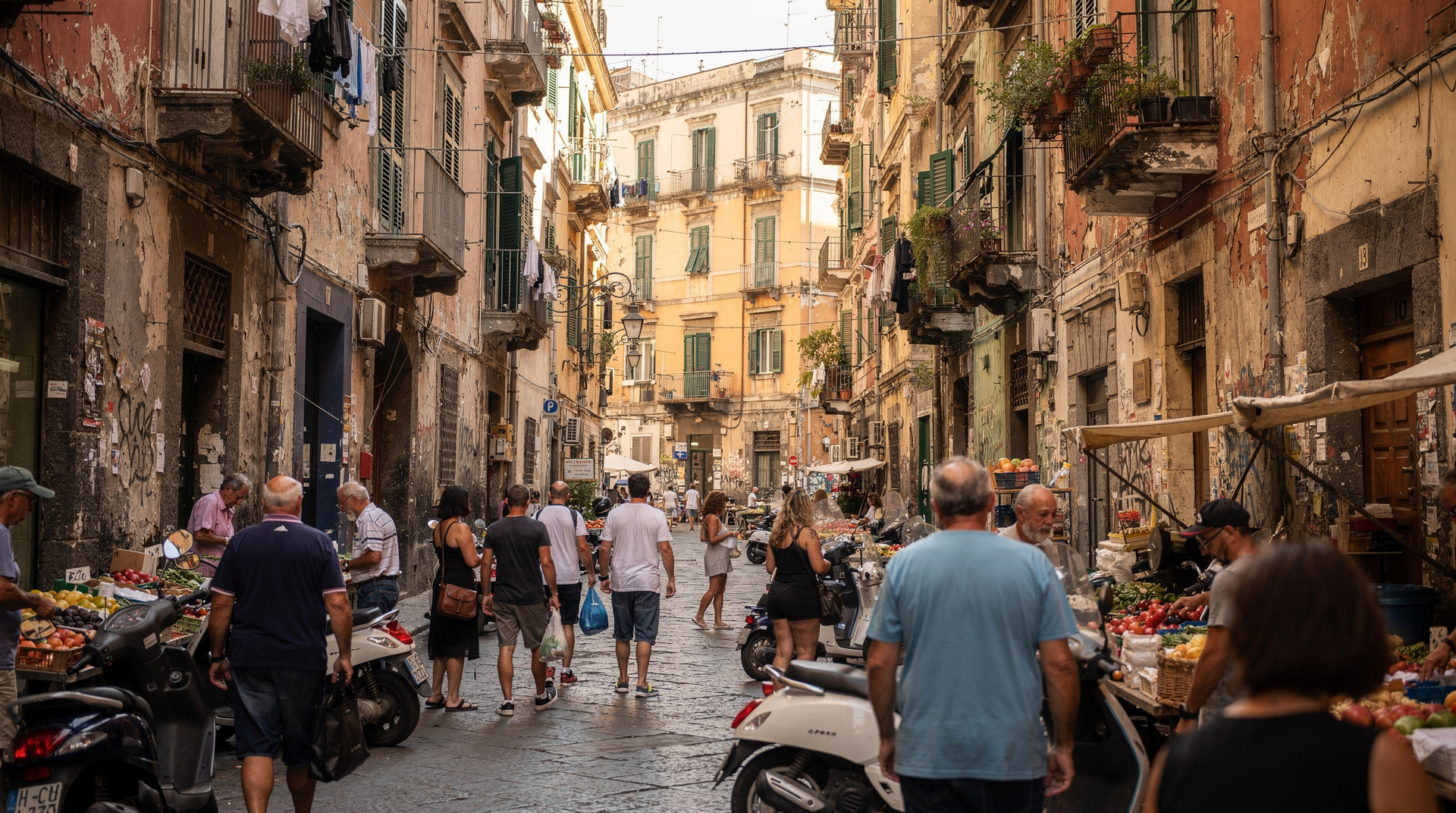
Naples travel tips: what to know before you go
Naples: Hop-on Hop-off Bus Tour 24-Hour Ticket
Duration: 24h
What do I need to know before visiting Naples?
Book Cappella Sansevero tickets online before you arrive — it sells out. Use the Circumvesuviana train to Pompeii but watch your belongings closely. Avoid unlicensed taxis by insisting on the fixed rate. Naples is safe in tourist zones; the reputation is worse than the reality. And eat the pizza standing — it costs half as much.
Quick answer: Book Cappella Sansevero before you arrive. Watch your belongings on the Circumvesuviana. Use only white licensed taxis. Naples is safe in tourist areas. Eat the pizza standing up — it is cheaper and better.
| Where | Centro storico, Chiaia, Vomero, Posillipo — walkable core |
| Currency | Euro; cards widely accepted, cash useful for street food |
| Getting around | Metro Linea 1, funiculars, Circumvesuviana, on foot |
| Book ahead | Cappella Sansevero (essential), Pompeii skip-the-line |
| Best time | April–May and September–October |
Getting the basics right before you land
Naples rewards travellers who do a small amount of preparation. Not a lot — the city is not complicated to navigate — but a few key decisions made in advance (tickets, neighbourhoods, transport strategy) prevent the most common frustrations.
This guide covers what experienced travellers wish they had known before their first visit.
Arriving: airport to city
Naples Capodichino airport (NAP) has no direct metro or train connection to the city as of 2026 (a Linea 1 extension is under construction but not yet open). Your options:
Alibus (ANM airport bus): 5 €, runs every 15–30 minutes, takes 15–30 minutes to Napoli Centrale/Piazza Garibaldi. On the same route, continuing to Molo Beverello (the port) takes about 35 minutes total. This is the most economical option.
Official taxi: Fixed rate 25–30 € from the airport to most city centre hotels. Confirm the fixed rate before entering the cab. Only white licensed taxis with the Naples municipality door panel.
Private transfer: Available from ~35 €, eliminates the fixed-rate negotiation and guarantees a named driver with your name on a board. Worth considering for late-night arrivals or travelling with heavy luggage.
More detail in the naples-airport-to-city-alibus guide.
Transport: what actually works in Naples
Metro Linea 1 is the most useful line for tourists — it connects Garibaldi (main station/Circumvesuviana) through the centro storico to Dante, Museo (MANN), and up to Vomero (Vanvitelli station). The stations are themselves artworks — Toledo station in particular is worth seeing even if you do not need the train.
Funiculars: Three connect the central neighbourhoods to Vomero (Centrale, Chiaia, Montesanto). A fourth goes to Posillipo/Mergellina. Same ANM ticket as the metro.
Circumvesuviana: For Pompeii and Herculaneum, this regional train departs from the lower level of Napoli Centrale (Garibaldi). Buy tickets at the windows or machines before boarding. The Circumvesuviana is frequently crowded, occasionally delayed, air-conditioned only on newer rolling stock, and has no baggage storage. Keep bags in front of you, not behind. The circumvesuviana-guide has full timetable and practical advice.
In summer, the Campania Express is a better-value alternative — it is a modern, air-conditioned service running to the main tourist stops (Pompei, Vico Equense, Sorrento) with guaranteed seating and fewer pickpocket risks.
On foot: The centro storico, Spaccanapoli, and Chiaia are best explored on foot. The streets are narrow, the traffic is chaotic, and walking is both faster and more interesting than any vehicle. Comfortable, flat shoes are essential — the cobblestones are uneven.
Naples: Hop-on Hop-off Bus Tour 24-Hour TicketSafety: the honest picture
Naples has a genuinely oversized criminal reputation, mostly based on imagery from the 1980s–90s that no longer reflects the reality of the tourist-facing city. Campania as a region records about 3 vehicle and bag thefts per 1,000 residents — lower than Milan and far lower than Barcelona or Paris.
Real risks for tourists:
- Pickpockets on the Circumvesuviana and at Napoli Centrale/Garibaldi station. Keep bags in front of you, zipped. Don’t use your phone while distracted near the train doors.
- Taxi overcharging — only use white licensed cabs and insist on the fixed rate or meter.
- Scam operators: “gladiators” on Via Toledo who demand money for photos; bonneteau (shell game) operators; fake monks offering strings or bracelets; sellers of counterfeit goods near tourist attractions.
Areas to avoid:
- Scampia and Secondigliano (north of the city, well outside tourist areas — you have no reason to be there)
- Avoid Forcella and Garibaldi quarter after midnight if alone
Genuinely safe for tourists:
- The entire centro storico (Spaccanapoli, Via dei Tribunali, Piazza Bellini)
- Chiaia and Posillipo
- Vomero
- The Lungomare / Mergellina waterfront
- Rione Sanità by day (slightly more caution needed in the evenings, though it is increasingly gentrified)
See is-naples-safe-the-data for the statistical breakdown and naples-scams-to-avoid for specific scenarios.
Booking ahead: what you need to reserve
Essential: Cappella Sansevero sells out. Book at least 3–4 days ahead in May, June, September–October; 1–2 weeks ahead in peak July–August. Do not arrive without a ticket and expect to walk in. The official booking site is the direct source — avoid third-party reseller markups.
Worth booking: Pompeii skip-the-line tickets save 20–40 minutes of queuing. The MANN does not usually have long waits, but pre-booking is still the cleaner option. Guided tours for Pompeii or Naples walking tours should be booked several days in advance in peak season.
Restaurant bookings: The very popular Naples pizzerias (Sorbillo on Via Tribunali, Di Matteo) can have queues, especially in the evening. At lunch, arriving at 12:30 usually avoids the worst of it.
Driving and ZTL: avoid entering Naples in a rental car
This is one of the most common and preventable problems. Naples has multiple ZTL (restricted traffic zones) that cover the centro storico (active 09:00–17:00) and several other areas. Cameras photograph every plate and fines arrive by post months later — often after you have returned the rental car, resulting in an administrative bill from the rental company plus their processing fee.
In practice: do not drive a rental car in Naples city. Use the train or taxi to reach your hotel, store your car in a paid car park at the city edges, or pick up the rental only on the day you leave for the Amalfi Coast.
If your hotel is inside a ZTL, the hotel can register your plate with the municipality (ask them to do this on arrival). This does not exempt you from ZTL restrictions but avoids the automatic fine system for guests.
Language and cultural tips
- Greet people with “Buongiorno” (morning/daytime) or “Buonasera” (afternoon/evening). Always greet when entering a shop or restaurant.
- “Permesso” is the word to squeeze past someone in a crowd.
- Neapolitan hospitality is genuine but boisterous — people speak at high volume and physically closer than Northern European norms. This is not aggression.
- Coffee is a ritual. Standing at the bar to drink your espresso is the local way; asking for a table just to have a coffee is technically fine but costs more. Some bars still offer the “coffee suspended” (caffè sospeso) tradition — paying for a coffee that someone in need can claim later.
- Dress codes: major churches require covered shoulders and knees. A small pashmina or sarong in your bag solves this.
Practical logistics
Currency: Euro. Cash is useful for street food, small vendors, and the Circumvesuviana. Cards accepted almost everywhere else.
Water: Tap water in Naples is safe to drink. Many piazzas have free drinking fountains (nasoni). Refill your bottle rather than buying plastic.
Pharmacies (Farmacia): Recognisable by a green cross. Pharmacists in Italy are trained medical advisors and can handle minor ailments without a doctor visit. Common medications like ibuprofen are available without prescription.
Public toilets: Scarce in the streets. Use café or restaurant toilets (normal practice to order something first). Paid public facilities exist at major sites.
Weather and clothing: In summer (June–August) dress for heat — light breathable fabrics, sun hat, sunscreen. Evenings stay warm. In spring and autumn, layers are useful as evenings cool quickly. In winter, a mid-weight jacket suffices; snow is very rare.
ETIAS and entry requirements in 2026
Italy is part of the Schengen Area. Citizens of the US, UK, Canada, Australia, New Zealand, and about 50 other countries can enter for up to 90 days in any 180-day period without a visa.
The EU’s ETIAS (Electronic Travel Information and Authorisation System) is expected to launch in Q4 2026 but was not yet operational as of mid-2026 and is therefore not yet required. There will be a transition period after launch before it is enforced. Check official EU or Italian government sources for the latest before travelling — this is an evolving situation.
The EES (Entry/Exit System), recording biometric data at Schengen borders, began its phased rollout in October 2025.
Money, connectivity, and staying in touch
Cash machines (Bancomat): Widely available in the centro storico, at the station, and near major squares. Use bank-branch ATMs where possible rather than standalone machines with high fees. Notify your bank of Italy travel dates to avoid a card freeze.
SIM cards and data: TIM, Vodafone, and WindTre all have shops near Napoli Centrale selling prepaid tourist SIMs with data, usually activated same-day with a passport. An eSIM bought before departure is the fastest option if your phone supports it — useful for navigating the ZTL zones and checking Circumvesuviana timetables on the go.
Wi-Fi: Most hotels and cafés in the centro storico and Chiaia offer free Wi-Fi. Coverage is patchy inside some funicular stations and on the Circumvesuviana.
Restaurant and café etiquette
Sitting at a table with table service costs more than standing at the bar — this applies to coffee, pastries, and drinks, and is normal practice, not a tourist markup. It is customary to order something (even just a coffee) before using a café’s toilet. Menus with photos and multiple languages posted outside are usually aimed at tourists and worth comparing against a place with an Italian-only menu and a fuller local crowd. Lunch service typically runs 12:30–15:00 and dinner from 19:30, later on weekends — arriving at an empty restaurant at 18:30 marks you as a tourist and the kitchen may not even be open yet.
What to pack for Naples
Comfortable, closed, flat shoes matter more here than almost anywhere else in Italy — the centro storico’s cobblestones (sanpietrini) are uneven and can be brutal in sandals or heeled shoes after a few hours of walking. Add a lightweight scarf or pashmina for church visits (shoulders and knees must be covered at the Duomo and most basilicas), a reusable water bottle for the free fountains, and a cross-body bag with a zip you can keep in front of you on transport. In summer, sun protection is essential — shade is scarce at Pompeii and along much of the coast.
Fitting this into your first days
If this is your first visit, pair these practical tips with the first-time-naples guide, which sequences the essentials into a realistic first 24–48 hours, and the naples-in-one-day-guide if your stay is short. For a fuller sense of what a week in the city and the coast looks like, the naples-three-day-budget diary walks through real spending.
Naples highlights walking tour with a local guideA guided first walk with a local is one of the fastest ways to absorb these logistics — routes, safe streets, and where to eat — without the trial and error.
Frequently asked questions about Naples travel tips
Is Naples easy to navigate without speaking Italian?
Yes. In hotels, most restaurants, and at major attractions, English is spoken well enough. In local bars, markets, and with taxi drivers, basic Italian phrases help. The metro and bus system has bilingual signs. On the Circumvesuviana, announcements are in Italian only — know your stop name.
Can I drink the tap water in Naples?
Yes. Naples tap water is safe to drink and passes EU standards. The city has a modern water system. Carry a refillable bottle and use the public drinking fountains in piazzas.
What should I do if I am a victim of theft?
Report to the nearest Polizia or Carabinieri station (questura). You will receive a denncia (police report), required for insurance claims. The process takes time — bring patience. Embassies can assist with emergency passport replacement.
Do I need travel insurance for Naples?
Standard travel insurance covering medical, cancellation, and theft is recommended for any trip to Italy. EU citizens have EHIC/GHIC coverage for medical treatment at state facilities; non-EU visitors should carry private health insurance.
Are there any scams I should specifically watch for?
The most common ones: fake “tour guides” approaching near Pompeii entrance offering unofficial tours; street traders near the port selling “designer” goods (counterfeit, and illegal to buy); men placing a bracelet on your wrist near the cathedral then demanding payment; people who “find” gold rings and ask for a share. The full list with strategies is in naples-scams-to-avoid.
Is Naples accessible for wheelchair users?
The centre historique cobblestones are challenging for wheelchair users. Some metro stations have lifts; others do not. The accessible-naples guide covers the practical situation in detail, including which attractions have ramps and lift access.