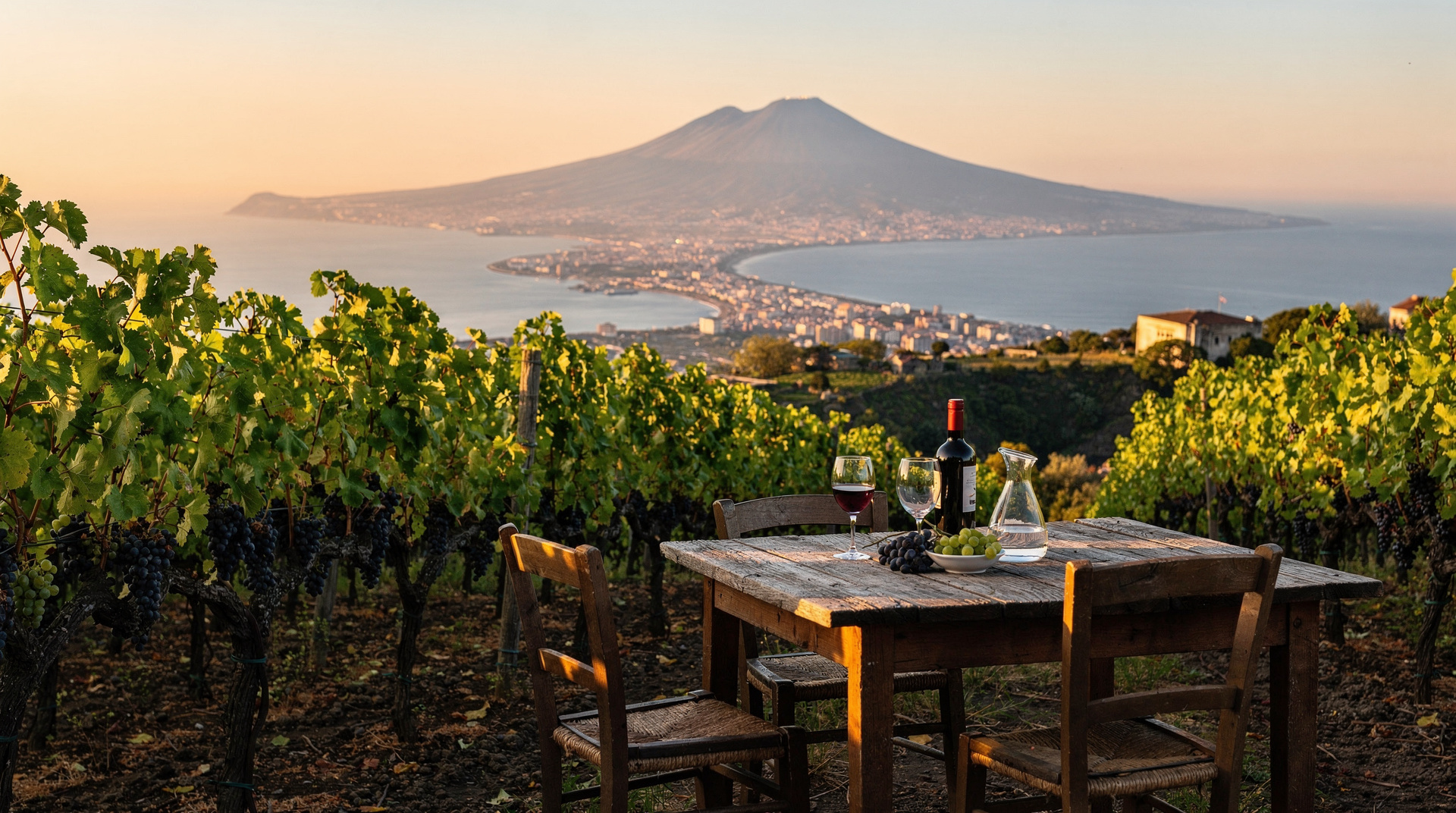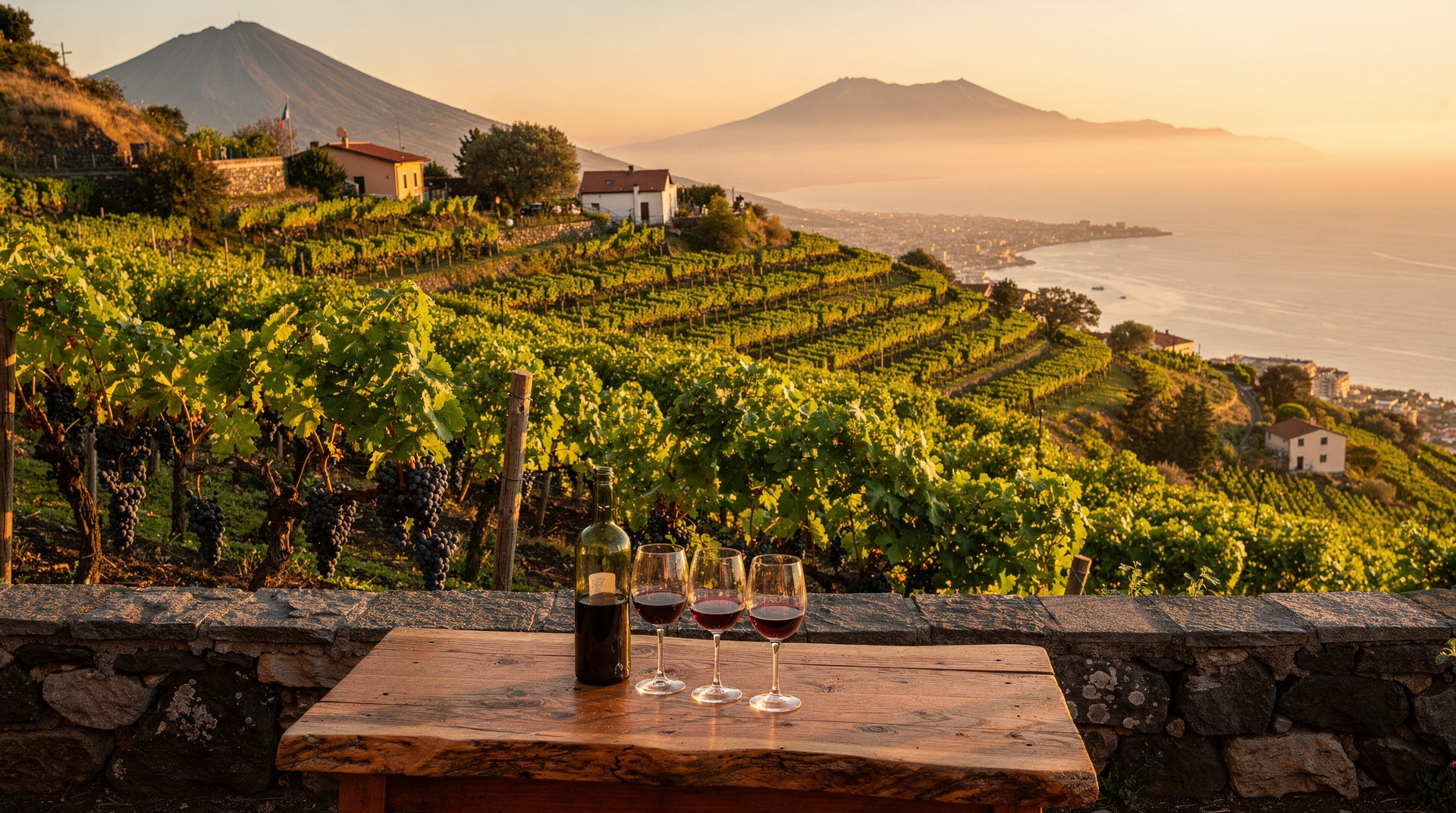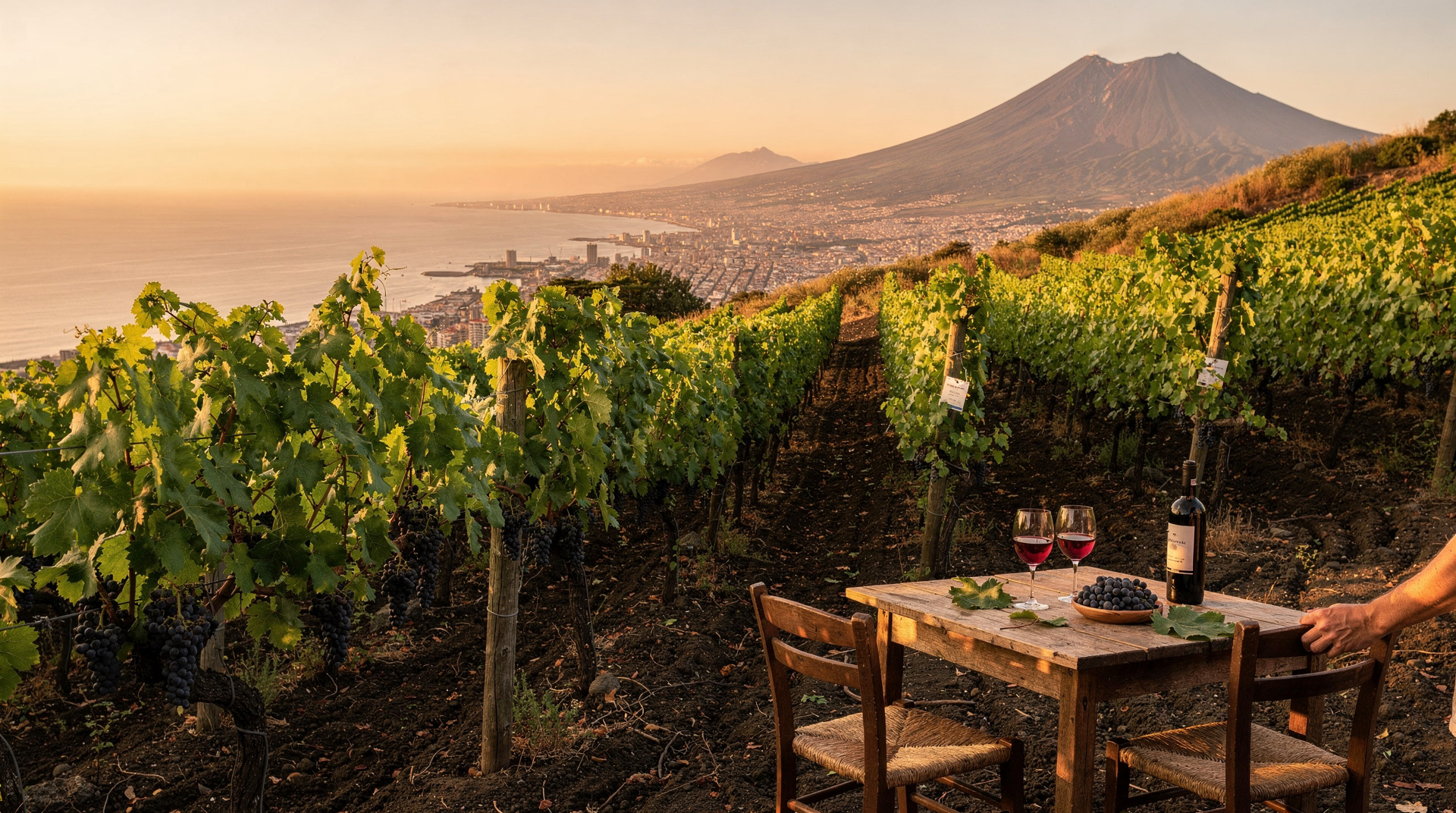
Falanghina and Aglianico — Campania's key wine grapes
Sorrento: Full Wine Tasting Experience in a Historic Winery
Duration: 2h
What is the difference between Falanghina and Aglianico wines?
Falanghina is Campania's most widely planted white wine grape — fresh, floral, mineral, made for early drinking. Aglianico is the great Campanian red grape — dark fruit, high tannins, high acidity, significant ageing potential. Falanghina pairs with lighter Naples food (seafood, pizza); Aglianico (in its Taurasi expression) pairs with braised meats and aged cheeses. Both are rarely exported and best tasted in Campania.
Two grapes that define southern Italian wine
| Falanghina style | Fresh, floral white — drink young (1–3 years) |
| Aglianico style | Structured, tannic red — best with 8+ years age |
| Where to taste | Chiaia enoteche in Naples, or vineyard day trips (Vesuvius, Sorrento, Campi Flegrei) |
| Typical bottle price | €8–14 (Falanghina), €20–50 (Taurasi) |
| Best pairing | Falanghina with seafood/pizza; Aglianico with braised meats, aged cheese |
Every wine region has its emblematic grape varieties, and Campania has two that stand apart from anything produced north of Rome: Falanghina, the ancient white grape that makes the fresh, mineral wine you drink with Neapolitan seafood; and Aglianico, the great red grape that produces the most powerful and age-worthy wines in southern Italy.
Neither is well-known internationally. This is not a quality problem — it is a distribution and cultural problem. Campanian wine producers have historically oriented toward local consumption. The result is that exceptional wines are available at prices that would be impossible if they had the international following of Barolo or white Burgundy.
This guide covers both grapes — their character, their production zones, their best producers, and why understanding them makes the wine you drink in Naples significantly more interesting.
Falanghina: the ubiquitous white
Falanghina is the grape on every restaurant wine list in Naples, in every hotel bar in the Amalfi coast towns, and in every enoteca in the Sorrento peninsula. It is the default answer to “what Campanian white wine should I drink?” — and for good reason. It is versatile, food-friendly, honest, and available everywhere at a price that rarely exceeds €14 per bottle at retail.
The character
Fresh Falanghina has:
- Aroma: white flowers (acacia, lime blossom), citrus (lemon, yuzu), green apple, sometimes a subtle mineral or volcanic note
- Palate: medium-bodied, fresh, dry, good but not aggressive acidity, clean and relatively simple finish
- Texture: lighter than Fiano di Avellino, less mineral than Greco di Tufo — the most immediately accessible of the three Campanian whites
The Falanghina dei Campi Flegrei (from the volcanic Phlegraean Fields west of Naples) shows more mineral and saline character than the inland Sannio versions — the volcanic tuff soil and sea air create a wine that some Campanian sommeliers describe as “the most Neapolitan of all whites.”
Most Falanghina is made for early drinking — within 1–3 years. Premium single-vineyard versions from serious producers can develop complexity over 5–7 years, but this is the exception.
Production zones
Falanghina del Sannio DOC (Benevento province): The largest production zone. The Sannio hills east of Naples produce floral, approachable Falanghina at good value. Most commercial Falanghina in Campanian restaurants comes from this zone.
Falanghina dei Campi Flegrei DOC (west of Naples): Smaller zone, more distinctive character. The volcanic soils and sea proximity create the most mineral, saline Falanghina. Cantine Astroni (inside the Astroni volcanic crater nature reserve) is the outstanding producer.
In Lacryma Christi Bianco: Falanghina is blended with Coda di Volpe in Lacryma Christi Bianco del Vesuvio — see the Lacryma Christi guide.
Best producers
Benito Ferrara (Greco di Tufo/Falanghina, Avellino zone): consistently excellent and honest pricing.
Cantine Astroni (Campi Flegrei): the volcanic-zone reference.
Feudi di San Gregorio (Benevento/Irpinia): the largest quality producer in Campania; their Falanghina del Sannio Serrocielo is the benchmark commercial expression.
Fontanavecchia (Sannio): reliable, good value.
Di Meo (Irpinia): fine Falanghina alongside excellent Greco di Tufo and Fiano.
Visiting Falanghina wine country from Naples
For the Campi Flegrei zone (20–30 minutes from central Naples), the day trip connects wine tasting with volcanic archaeology — Baia, Cuma, Astroni crater. See the Campi Flegrei day trip guide.
For the Sorrento peninsula, wine tasting combined with the lemon and food culture:
Sorrento garden wine tasting — 4 local Campanian winesAglianico: the great southern red
Aglianico is the reason serious wine professionals make pilgrimage to Campania. It is one of approximately six Italian grape varieties with an unambiguous claim to international greatness — alongside Nebbiolo, Sangiovese, Barbera, Corvina, and perhaps Nerello Mascalese. Unlike most of those, it is largely unknown outside Italy.
The character
Aglianico produces:
- Aroma: dark fruit (black cherry, blackberry, cassis), earthy/mineral notes (volcanic soil), tobacco, sometimes tar and dried roses in aged versions
- Palate: high tannins (grip, structure), high acidity (freshness and food-compatibility), full body, long finish
- With age (8–15+ years): the tannins integrate, tertiary aromas develop (leather, dried fruit, tobacco, spice), the wine opens and becomes complex
Young Taurasi (2–4 years old) can be austere — grippy, dense, not particularly charming. This is normal. The wine requires time. Buying a bottle of 2013 or 2016 Taurasi rather than 2022 is the practical advice for the visitor who wants to drink it in the near term.
The Barolo comparison
The “Barolo of the South” designation is imprecise but structurally accurate. Both Aglianico and Nebbiolo (Barolo’s grape) share:
- High tartaric acid (structural freshness)
- Pronounced polyphenols (tannin and colour compounds)
- Dark fruit aromas with earthy, mineral, and tar-like complexity
- Significant ageing requirement and ageing potential
- Difficulty in youth, magnificence with time
The key difference: Aglianico ripens later (often mid-October in mountain zones) and is cultivated at lower elevation than Nebbiolo. The warmth of Campania produces a more concentrated fruit profile; the high-altitude Irpinia sites temper this with freshness.
Taurasi DOCG: the flagship
Zone: 17 municipalities in the Taurasi area of Avellino province
Grape: minimum 85% Aglianico (most serious producers use 100%)
Ageing requirement: 3 years minimum (12+ months in oak); Riserva 4 years (18+ months in oak)
Price range: €20–50 (Riserva €40–80)
Taurasi achieved DOCG status in 1993, making it the first southern Italian red to reach the highest Italian quality designation.
Key producers:
- Mastroberardino: the historic family house that maintained Aglianico through decades when other producers abandoned it for international varieties. Their Radici Taurasi is the reference point.
- Feudi di San Gregorio: the modern standard. Their Piano di Montevergine single-vineyard Taurasi Riserva is consistently among the best in the DOCG.
- Cantina del Taburno: less famous, remarkable value — their Bue Apis Taurasi competes with wines at twice the price.
- Caggiano: boutique production, meticulous winemaking.
- Donnachiara: modern winemaking style, approachable earlier than traditional Taurasi.
Other Aglianico expressions
Aglianico del Taburno DOCG (Benevento province): a second DOCG for the grape, from the Taburno Camposauro massif. Typically lighter and earlier-drinking than Taurasi, with similar structure but less concentration. Excellent value.
Irpinia Aglianico DOC: a broader appellation covering the Irpinia zone. More approachable styles; good entry point for understanding the grape before committing to a bottle of Taurasi.
Aglianico del Vulture DOC (Basilicata): technically a different region (Basilicata, south of Campania) but the same grape on volcanic soil — interesting comparison for wine enthusiasts.
Getting to Taurasi from Naples
Taurasi itself is not easily reached without a car — approximately 1.5–2 hours east of Naples on the A16 motorway. For visitors without a car who want to taste Taurasi, the best approach is to buy it at a Naples enoteca rather than visiting the production zone.
For a wine experience more accessible from Naples, the Vesuvius combination is better:
Vesuvius vineyard lunch with Lacryma Christi wine tasting Sorrento historic winery and wine tastingComparing Falanghina and Aglianico with other Campanian varieties
The Campania wine guide covers all the major varieties. For comparison within the region:
| Variety | Style | Ageing | Best use |
|---|---|---|---|
| Falanghina | Fresh, floral, mineral | 1–3 years | Seafood, pizza, aperitivo |
| Coda di Volpe | Neutral, saline | 1–2 years | Lacryma Christi blend |
| Greco di Tufo | Mineral, citrus, structured | 3–7 years | Seafood, aged cheese |
| Fiano di Avellino | Aromatic, nutty, complex | 5–15 years | Fine dining pairings |
| Piedirosso | Light, red fruit, volcanic | 1–4 years | Pizza, light meat, seafood |
| Aglianico | Dark fruit, tannic, structured | 5–20 years | Braised meats, aged cheese |
How to read a Campanian wine label
Campanian labels use the Italian DOC/DOCG system, and understanding a few terms helps navigate an unfamiliar restaurant list. DOCG (Denominazione di Origine Controllata e Garantita) is the highest tier — Taurasi, Fiano di Avellino, and Greco di Tufo hold this status, requiring stricter yield limits and tasting approval.
DOC (Denominazione di Origine Controllata) is one level below, covering Falanghina del Sannio, Falanghina dei Campi Flegrei, Aglianico del Taburno, and Irpinia Aglianico. “Riserva” on a Taurasi label means an extra year of ageing (4 years total, 18+ months in oak) and typically denotes the producer’s top selection. None of this guarantees quality on its own, but it narrows the field — a DOCG Taurasi Riserva from a known producer is a safer bet than an unlabelled house red.
Beyond Falanghina and Aglianico: the fuller Campanian picture
These two grapes anchor the region but are not the whole story. Greco di Tufo and Fiano di Avellino are the other two serious Campanian whites, both from Irpinia and more structured than Falanghina; Piedirosso is a lighter, volcanic-soil red often blended with or drunk alongside Aglianico. The Campania wine guide covers the full range, and Vesuvius has its own specific wine identity built partly on Falanghina and Piedirosso — see the Lacryma Christi guide and the broader Mount Vesuvius guide for how the volcanic soil shapes the wine.
Organized tastings vs. buying it yourself
For visitors without a car or limited time, an organized tasting is the practical way to try both styles side by side without navigating unfamiliar wine lists. The wine tasting near Naples guide rounds up the main options by area — Vesuvius, Sorrento, and Campi Flegrei each have a distinct character worth comparing. If you’d rather explore independently, buying a bottle from a Chiaia enoteca and asking the staff to talk you through it is a low-cost way to get the same education — most Naples wine shop staff are happy to do this even for a €12 bottle.
Vesuvius vineyard tour with Mediterranean lunch and wine tastingWhere to buy in Naples
For Falanghina — any decent enoteca or wine shop in Naples. The Chiaia neighbourhood (L’Ebbrezza di Noè, Via Vetreria 9; Enoteca Belledonne, Via Belledonne a Chiaia) has the best selection of quality Campanian whites at honest prices.
For Taurasi — the same enotece, and the Enoteca area near Piazza Dante. Ask specifically for Mastroberardino, Feudi di San Gregorio, or Cantina del Taburno. Budget €20–35 for a bottle at appropriate drinking age.
If you’re unsure what to buy, describe the meal you’re planning — pizza and seafood versus a heavier braised dish — and let the shop staff steer you rather than guessing from the label alone. Most independent Naples enoteche have at least one member of staff who speaks enough English to give a genuinely useful recommendation, and asking is normal practice, not an imposition.
The Naples food markets guide notes that some market vendors and alimentari near Pignasecca also stock local wines, occasionally at below-retail prices.
Frequently asked questions about Falanghina and Aglianico
What does Falanghina taste like?
Fresh, floral (white flowers, citrus), light to medium bodied, dry, good acidity. More mineral when from volcanic zones (Campi Flegrei). Best within 1–3 years. Most approachable of the three main Campanian whites.
What does Aglianico taste like?
Dark fruit, high tannins, high acidity, earthy/volcanic notes. Young (2–4 years): austere and grippy. With age (8+ years): complex, integrated, magnificent. The Nebbiolo of the south.
Where is Falanghina grown?
Mainly Sannio (Benevento) for volume; Campi Flegrei (west of Naples) for the most mineral and distinctive expression; Vesuvius slopes as a Lacryma Christi component.
Where is Aglianico grown?
Primarily Taurasi DOCG (Irpinia) and Aglianico del Taburno DOCG (Benevento). Also Irpinia Aglianico DOC (broader zone). Same grape in Aglianico del Vulture (Basilicata).
Why is Taurasi called the Barolo of the South?
Both Taurasi (Aglianico) and Barolo (Nebbiolo) are high-acid, high-tannin wines with dark fruit, earthy complexity, significant ageing requirements, and ageing potential of 20+ years.
Are Falanghina and Aglianico exported?
Rarely. Falanghina has started appearing in specialist wine bars internationally. Taurasi is more visible but still limited. This is why prices in Campania are dramatically lower than equivalent-quality wines with international distribution.
What food pairs with Falanghina and Aglianico?
Falanghina: seafood, pizza, lighter pasta. Aglianico/Taurasi: ragù napoletano, braised meats, aged cheese.
Frequently asked questions about Falanghina and Aglianico — Campania's key wine grapes
What does Falanghina taste like?
What does Aglianico taste like?
Where is Falanghina grown in Campania?
Where is Aglianico grown in Campania?
Are there specific vintages of Falanghina or Aglianico to look for?
What is the historical background of these grapes?
Can I find Falanghina and Aglianico outside Italy?
What food pairs with Falanghina and Aglianico?
Top experiences
Bookable activities with verified prices and instant confirmation on GetYourGuide.