Renting a car in Campania: what you need to know before booking
Should I rent a car for a Campania holiday?
It depends where you are going. For Naples city and the islands, a car is unnecessary — public transport works well. For the Amalfi Coast (especially off-peak), Cilento, Paestum, Caserta, and rural Campania, a car gives you real flexibility. The key rules: avoid driving into Naples centre (ZTL fines), book an automatic and a small car for the Amalfi roads, and understand the SS163 coastal road restrictions before you go.
| Best for | Amalfi Coast off-peak, Cilento, Paestum, Caserta, rural villages |
| Skip it for | Naples city, the islands, Pompeii/Herculaneum |
| Cost | Small automatic from around €40–70/day in season |
| Key risk | ZTL camera fines (€200–400 per violation, billed weeks later) |
| Best time to drive SS163 | Early morning May, late afternoon September |
When a car makes sense in Campania
Campania is a region of contrasts for drivers. Naples city is a nightmare. The Amalfi Coast is famous for its vertiginous, narrow roads. But rural Campania, the Cilento national park, and small towns away from train lines are genuinely much more accessible with a car than without one.
Here is an honest breakdown of where a car adds value and where it does not.
Don’t rent a car for:
- Naples city centre (ZTL fines, intense traffic, expensive parking, metro does the job)
- Island visits (Capri, Ischia, Procida — take ferries)
- Pompeii and Herculaneum (Circumvesuviana is faster and easier)
Do consider a car for:
- Amalfi Coast (especially May, early June, and September–October when the road is manageable)
- Cilento coast south of Paestum (limited public transport)
- Paestum and the Greek temples (accessible by train but a car makes it easier to combine sites)
- Caserta Royal Palace (train exists, but car gives flexibility)
- Rural villages: Ravello (can be reached by bus but car is easier), Sant’Agata sui Due Golfi, Massa Lubrense
- Campi Flegrei and Pozzuoli (metro exists, but some sites need a car)
For a public-transport-only comparison, see getting around Naples and the Circumvesuviana guide — for most first-time visitors sticking to Naples, Pompeii and one coastal town, trains and ferries genuinely cover everything a car would, without the ZTL risk.
Picking up your rental car
Naples Capodichino airport: All major agencies represented (Hertz, Avis, Europcar, Sixt, Budget, Goldcar, etc.) with desks in the Arrivals hall. Convenient if you want the car from day one. Problem: you need to drive out of Naples to wherever you are starting.
Naples Capodichino but starting the car later: Reserve from the airport but ask to pick up on day 3 (after you have explored Naples by metro). Some travellers do a car-free first 2–3 days in the city, then pick up the car for the Amalfi section. Most agencies at the airport can accommodate this.
Napoli Centrale (train station): Multiple agencies in and around the station. Useful if arriving by high-speed train from Rome or Milan. Same challenge as the airport — you need to navigate out of Naples to start.
Sorrento or Salerno: Picking up a car here avoids Naples driving entirely. Take the Circumvesuviana to Sorrento, pick up the car, and start your coastal drive from there. Sorrento has several rental car offices near the town centre and train station.
Practical tip: Read the rental agreement carefully. Italian rental car companies vary widely in their excess/collision damage waiver terms, fuel policies, and ZTL fine procedures. Third-party CDW coverage (sold through credit card travel insurance or specialist providers) can be better value than the rental company’s own excess waiver.
The Amalfi Coast by car: what to actually expect
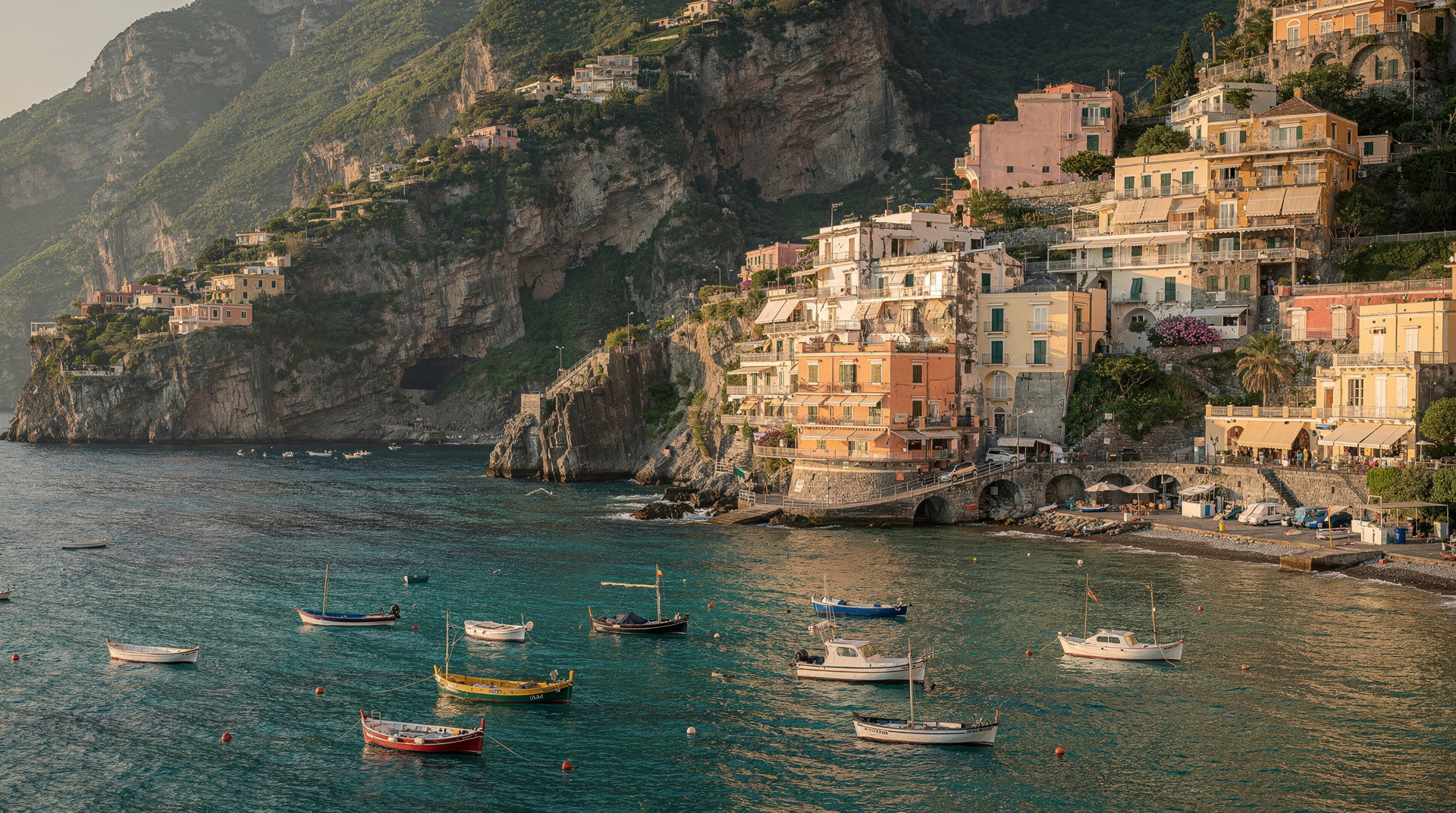
The SS163 (Strada Statale 163 “Amalfitana”) is one of the most scenically spectacular roads in Europe and one of the most stressful to drive. Built along near-vertical cliffs, it alternates between single-lane-width sections with passing places and slightly wider two-way stretches.
Key realities:
The road is genuinely narrow. In places, two cars can pass only with both hugging their respective edges and one driver exercising patience. SITA buses (which service the towns along the coast) are large and take full priority — if a bus is coming, you are reversing to the nearest passing space.
Summer months (July–August) bring traffic that can make the SS163 a near-stationary experience on weekend mornings. The odd/even plate restriction attempts to reduce this but is imperfectly enforced.
When it is actually enjoyable: Early morning in May, late afternoon in September. In the shoulder season with light traffic, driving the SS163 is genuinely spectacular — slow speeds by necessity, but you have time to take in the views.
Automatic transmission: Non-negotiable recommendation on the Amalfi Coast. The continuous hairpin bends, near-constant uphill/downhill, and narrow road demand full attention. Adding gear changes to the cognitive load significantly increases stress and error risk. Book an automatic when you first search — they book out early.
Car size: The smallest available. A Fiat 500 fits through gaps that a Ford Focus does not. Large SUVs are inappropriate for this road — not just uncomfortable but genuinely dangerous at some points.
Parking: Towns on the Amalfi Coast have limited parking, often in structures or designated lots on the cliff edges. Positano charges €3–5 per hour. Some hotels include parking; many do not. Parking a large vehicle in these towns ranges from difficult to impossible.
ZTL zones beyond Naples
ZTL restrictions are not unique to Naples — many Campanian towns have them, particularly in summer when traffic management is critical:
Positano: ZTL restrictions on the main access road, with time windows for vehicle access. Non-residents may be prohibited from driving into the lower town during peak hours. Hotels arrange access for guests.
Amalfi town: ZTL restrictions in the historic centre. The main car parks are outside town; a short walk or shuttle is needed.
Ravello: Limited vehicle access above the main car park. Pedestrian zone in the historic centre.
Sorrento: No major ZTL in the tourist areas, but the town centre is congested and parking is paid.
The pattern: check the specific ZTL rules for any historic town you plan to drive into, have your hotel register your plate if necessary, and budget for paid parking.
Insurance and excess
Italian roads require third-party liability insurance (included in any rental). The variable is the collision damage waiver (CDW) — what you pay if the car is damaged.
Rental company CDW: Typically reduces your excess to €0 but costs €15–30 per day. Check whether your credit card provides CDW coverage — some premium cards do, which eliminates the need for the rental company’s policy.
Excess levels: Without CDW, excess on a standard car is typically €1,000–2,500. On the Amalfi Coast, where minor scrapes on the narrow road are a real possibility, some level of CDW cover is wise.
Tyre and windscreen damage: Standard CDW often excludes tyres and glass. On Campanian roads (particularly the SS163), sharp drops and stones hitting windscreens are common. A comprehensive glass/tyre policy is worth considering for the coastal roads.
Tolls
Italian motorways (autostrade) are tolled. The A3 from Naples to Salerno (and beyond to the Cilento) has toll booths. Toll amounts: Naples to Salerno ~€3–5, Salerno to Paestum direction ~€2 additional. Pay by cash at staffed booths or by card at automated lanes. Telepass electronic transponder is available as a rental add-on if you plan extensive motorway driving.
Fuel
Petrol stations in southern Italy are generally open 07:00–13:00 and 15:00–19:00 with automated unmanned service after hours (credit card at the pump, though some require an Italian bank card). Highway service stations are open 24/7. Do not let the tank go below a quarter on the Amalfi Coast or rural Cilento roads — stations are spaced far apart in some areas.
Frequently asked questions about renting a car in Campania
Do I need to buy the extra insurance at the rental desk?
Check your existing coverage first. Credit card travel insurance (Amex Platinum, certain Visa Signature cards) often includes CDW for car rentals. Your personal auto insurance may extend internationally. If you have coverage, you do not need the rental desk’s expensive daily policy.
Can I pick up a car in Naples and return it in Rome?
Yes, with a one-way surcharge. For a Naples → Campania → Rome route, one-way makes logistical sense. Budget €50–150 for the one-way fee depending on the operator.
Should I book from a big brand or a local Italian agency?
Big international brands (Hertz, Europcar, Avis, Sixt) are more consistent in service quality, have better dispute resolution, and their ZTL fine procedures are more transparent. Local operators are sometimes cheaper but excess terms and ZTL handling can be less clear. For a trip where ZTL fines are a real risk, the extra clarity from a major brand is worth something.
Can I take an Italian rental car to Sicily or Sardinia on the ferry?
Most rental agreements explicitly prohibit taking the vehicle on ferries to Sicily or Sardinia, or overseas. Check the terms before booking if this is part of your itinerary.
A realistic self-drive route
If you do decide to rent, the most common sensible route looks like this: pick up in Sorrento or Salerno rather than Naples, drive the SS163 in the shoulder-season direction of light traffic, base yourself in a coastal town for two or three nights, and return the car before heading back into Naples by train. This avoids Naples traffic at both ends and keeps the most stressful driving (the coastal hairpins) to a single, well-planned stretch rather than a daily commute. It pairs naturally with the Amalfi Coast from Naples guide and the Naples–Amalfi Coast 5-day itinerary, both of which assume you are not driving inside Naples itself.
For day trips that do not need a full rental — Pompeii, Herculaneum, Vesuvius — the Circumvesuviana guide and Naples to Pompeii transport guide cover the train alternative, which is genuinely faster door-to-door than driving and parking at the archaeological sites.