D10S in the Quartieri Spagnoli: Following Maradona's Ghost Through Naples
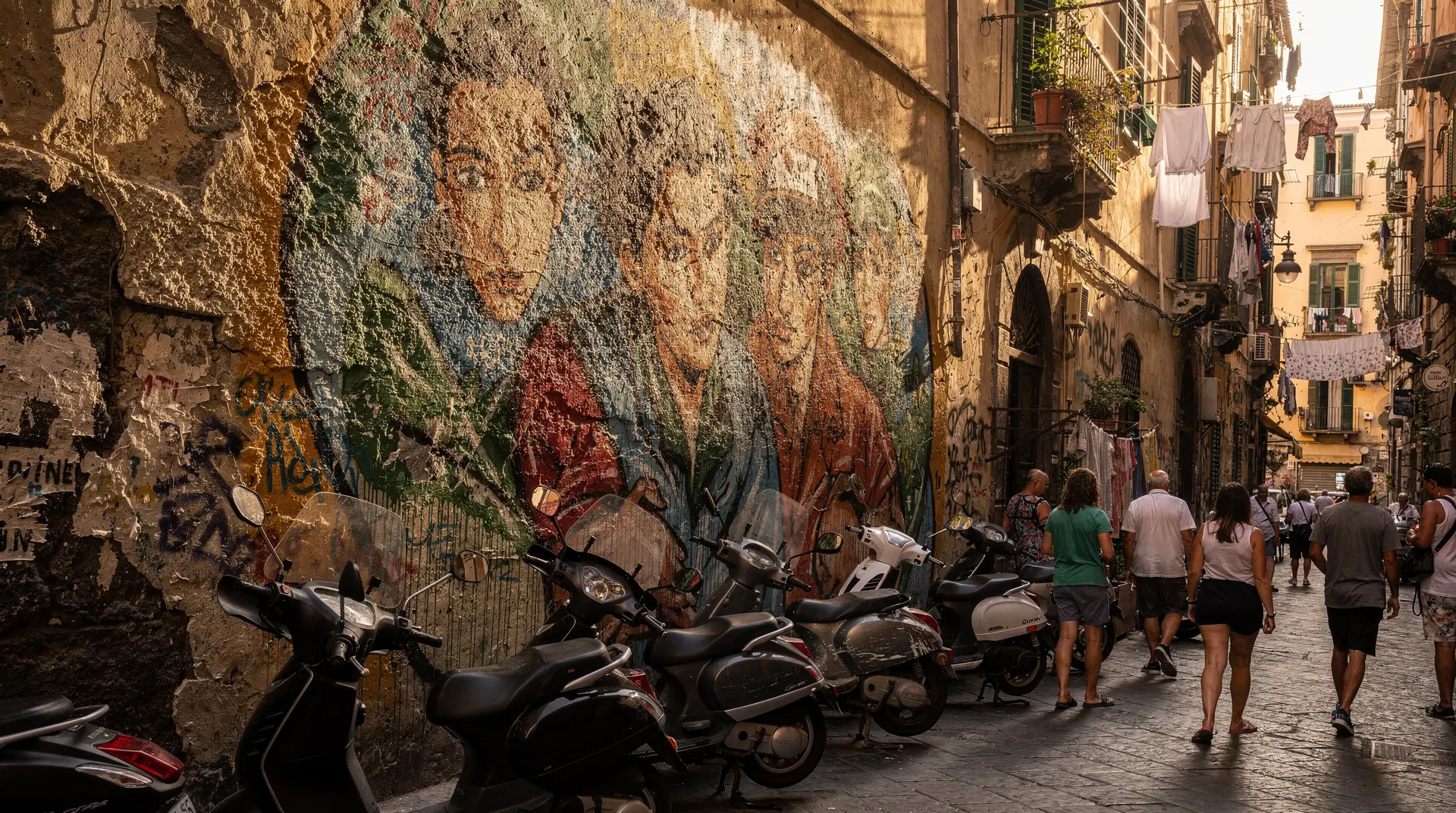
There is a corner of the Quartieri Spagnoli where the street narrows to the width of two people walking abreast, the laundry crosses overhead in the permanent geometry of Neapolitan living, and Diego Maradona looks down from the wall in a mural that is, by any honest measure, a religious icon. Not a sports poster. Not a piece of street art in the ironic contemporary sense. A shrine, tended, replenished with candles and football scarves and handwritten notes in Italian and Spanish and languages that belong to wherever the grieving writer came from.
I stood there for a long time.
| Where | Corner of Via Emanuele De Deo & Vico dei Dodici Apostoli, Quartieri Spagnoli |
| Cost | Free — no admission, no tour required |
| Time needed | 15–30 minutes for the mural, longer if you walk the neighbourhood |
| Getting there | 10 min walk from Piazza Municipio metro |
| Best time | Daytime; the neighbourhood is quieter and safer to navigate |
Who Diego Was to Naples
This requires some context if you did not grow up watching Italian football in the late 1980s. Maradona arrived at Napoli in 1984 for a then-world-record transfer fee of roughly €6.9 million. He came to a club that had never won the Serie A title, in a city that occupied a particular position in the Italian imagination — poor, chaotic, southern, looked down upon by the industrial north. “Italy ends at Rome,” goes the old dismissal. Everything below was, in the comfortable northern shorthand, a different country.
What Maradona did between 1984 and 1991 was win. Twice. Napoli took the Scudetto — the Serie A championship — in 1987 and again in 1990. They won the UEFA Cup in 1989. For a city that had spent its entire football history being patronised by Juventus and Inter and Milan, the championships were not sporting events. They were a reckoning.
The north had the factories and the money and the civic infrastructure. Naples had Diego. And for a few extraordinary years, Diego was enough.
The Mural and the Shrine
The original mural is on the corner of Via Emanuele De Deo and Vico dei Dodici Apostoli in the Quartieri Spagnoli. It was painted in 1990 by two local artists, Mario Filardi and Luigi Filosa, and it shows Maradona mid-celebration — arms wide, face tilted upward, the number 10 shirt unmistakable. The scale is what gets you first. It is enormous, filling the full height of the building’s facade, and it was painted when he was still alive and playing.
After his death in November 2020, the mural became something else. The neighbourhood had always maintained a small shrine at its base — flowers, candles, photographs, scarves — but the death transformed the scale of devotion. Pilgrims came from Argentina, from across Europe, from other parts of Italy. The shrine grew. It was replenished constantly. As of 2026, it continues to be tended by residents of the Quartieri, who treat its maintenance as a civic obligation.
The mural itself was restored and repainted in 2022. It is in better condition now than it was in the years before his death, which says something about what absence does to reverence.
D10S: The Theology of It
The conflation of Maradona with divinity is not entirely metaphorical in Naples. The nickname D10S — combining the number 10 with Dios, the Spanish word for God — has been in use here since the championships, but after 2020 it migrated from football chant to something more earnest.
In the Quartieri, you can buy prayer cards formatted exactly like Catholic santo cards, with Maradona’s image on one side and a quasi-devotional text on the other. There are altarpieces. There are at least two semi-permanent chapel installations in the neighbourhood that combine Catholic imagery with football iconography in ways that would be sacrilegious if the city were not, in some fundamental sense, treating them as entirely consistent expressions of the same faith.
This is not cynical. Naples has a long history of popular religiosity that operates outside the formal church — the cult of figures who are not canonised, the intense local devotion to particular saints, the street-level shrines that proliferate in every neighbourhood. Maradona slotted into an existing cultural grammar. The city already knew how to worship someone who had given it back its dignity.
Walking the Quartieri
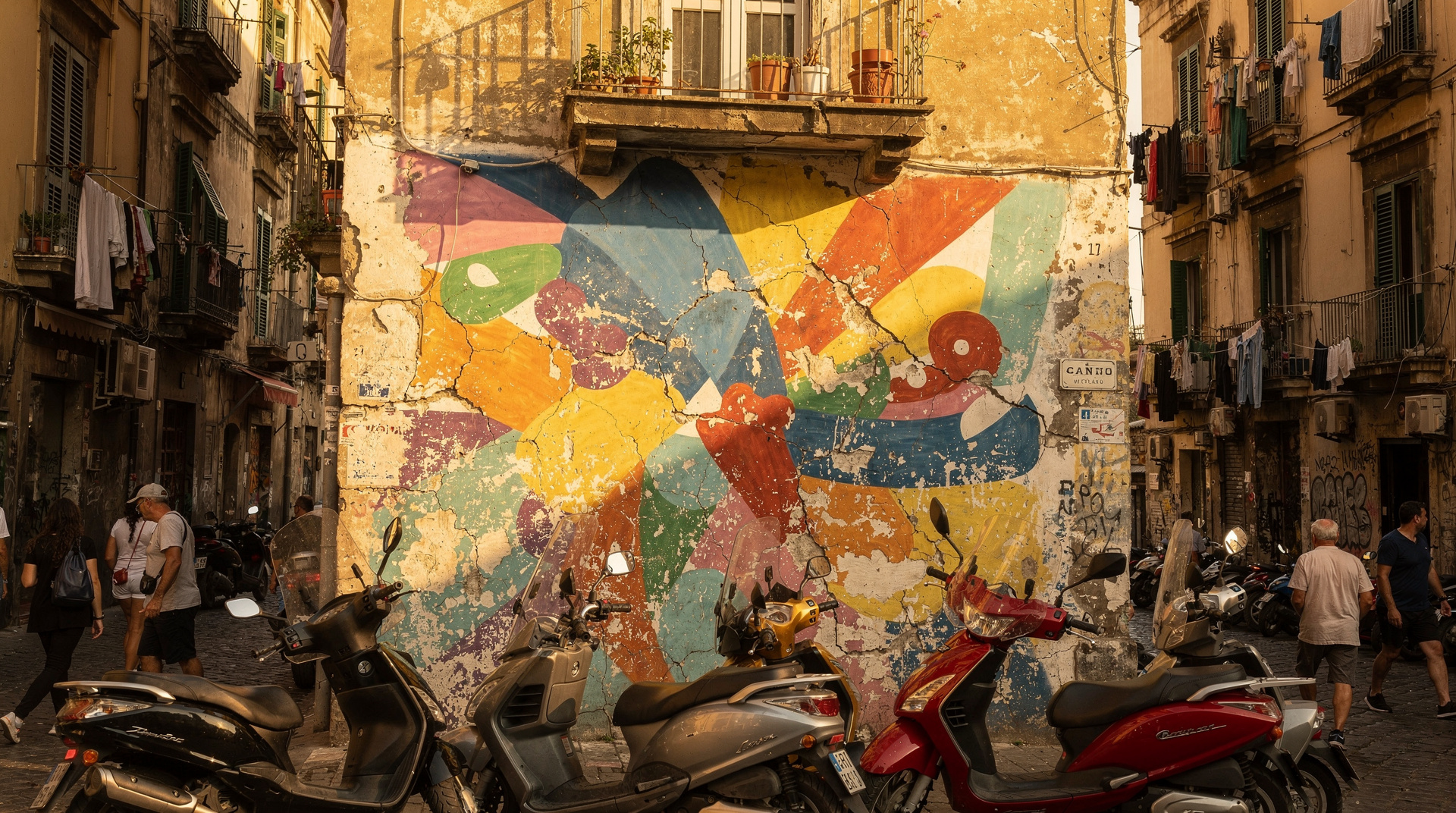
The Quartieri Spagnoli are not a tourist attraction in any conventional sense. They are a neighbourhood — dense, residential, occasionally overwhelming in the concentrated humanity of it. The grid of streets running uphill from Via Toledo was built by the Spanish viceroys in the sixteenth century to house their troops, which is where the name comes from. The streets are narrow by design (easier to control, harder to stage an uprising in) and the neighbourhood has maintained that compressed intensity ever since.
The best approach is simply to walk. Enter from Via Toledo and head uphill. The streets are safe — the Quartieri’s dangerous reputation is largely a hangover from a different era and a different city. What you find is children on bicycles, laundry overhead, cats on ledges, the sound of televisions and conversations from above, the smell of something frying, someone arguing with cheerful intensity about something that is none of your business.
The mural is not hard to find — follow Via Emanuele De Deo uphill from Via Toledo for about three minutes and you will see it. The shrine at its base is always there, always tended.
If you want to understand the neighbourhood’s food and street culture in the same visit, a street food tour through the Quartieri Spagnoli that includes the Maradona mural puts the shrine in the context of the area’s broader social life — the frittura shops, the pizza fritta vendors, the coffee culture that is inseparable from how Neapolitans use public space. It is a more grounded way to arrive at the mural than navigating alone with a phone map.
What It Means Now
Maradona died at sixty. The circumstances were complicated — disputed medical care, a life that had been difficult for many years. The grief in Naples was immediate and absolute. The city’s flags flew at half-mast. Games were stopped. Napoli wore black.
But there was something else in the grief — a kind of pride at the grief itself, at the scale of it. That this city, which had been told for decades that it did not matter, had once been the home of the greatest footballer on earth, and that the greatest footballer on earth had loved it back. That he had said so repeatedly, and meant it.
The 2023 Scudetto — Napoli’s first championship since Maradona’s era, won thirty-three years after the last one — was celebrated in the Quartieri with explicit invocations of Diego. His image was everywhere. The blue confetti fell on his mural. Supporters brought scarves and photographs to the shrine not just in mourning but in triumph, as if to say: we won again, and we thought you should know.
Beneath the City’s Surface
If the Maradona mural is the visible Naples — the one that operates at street level, in sunlight and noise — there is another Naples running in parallel, underground.
The city sits on a network of ancient tunnels, cisterns, and chambers dug from the tufa rock over two and a half millennia. The Greeks dug the first tunnels. The Romans expanded them. The Spanish and the Bourbon kings used them variously as aqueducts, bomb shelters, and disposal systems. Much of the subterranean network remains unexplored by casual visitors.
A tour of Naples Underground and the hidden city descends into the Greek-Roman aqueduct system under the centro storico — a literal underworld beneath the city that has been used in every century since its construction. The combination of the mural above and the tunnels below is, in its own way, a complete picture of Naples: the city of passionate surface and deep, layered, rarely visible history running underneath it.
Finding Your Way There
The Quartieri Spagnoli are a ten-minute walk from the central metro at Piazza Municipio or a fifteen-minute walk from Piazza del Gesù Nuovo. Via Toledo is the western edge of the neighbourhood.
There is no admission. There is no tour required. The mural is a public wall in a public street and the city has never tried to monetise it in any formal sense, which is itself a kind of testament. You show up, you look, you stay as long as feels right, and you leave whenever you are ready.
Take your time. Diego would have.
Reading the mural as part of a bigger story
Maradona’s shrine is a single, intense entry point into a much larger question of what Naples believes about itself. Our broader Maradona and Naples guide traces the fuller arc of that relationship beyond this one mural, and neapolitan culture and traditions situates the D10S devotion within the city’s wider, centuries-old habit of popular, semi-religious veneration. If the history behind all of it interests you, the Naples history guide covers the deeper context — the Spanish viceroys, the Bourbon kings, the long story of a city being underestimated by the rest of Italy — that this piece only touches on.
Where this fits on a Naples itinerary
The Quartieri Spagnoli rarely appear on a first-timer’s must-see list, which is exactly why they’re worth adding. Our hidden gems in Naples guide includes several spots in the same spirit as the mural — real, lived-in, and unmonetised. If your visit runs into the evening, Naples at night covers how the Quartieri and the wider centro storico change character after dark, which is relevant here since the shrine is at its most atmospheric with the candles lit at dusk.
Frequently asked questions about D10S in the Quartieri Spagnoli
Do I need a guide or tour to see the Maradona mural? No — it’s a public wall on a public street with no admission fee, and you can walk there independently in about ten minutes from Piazza Municipio metro; a guided street food tour is a nice-to-have for context, not a requirement.
Is the Quartieri Spagnoli safe to visit? Yes, during the day and early evening it’s a normal, if dense and lively, residential neighbourhood — its dangerous reputation is largely outdated, though as anywhere, stay aware of your surroundings and belongings.