Sant'Agata sui Due Golfi
Sant'Agata sui Due Golfi: hilltop village between the Gulf of Naples and Gulf of Salerno, panoramic views from Il Deserto, and top Campanian gastronomy.
Sorrento: Walking Tour with Local Guide
Duration: 2h
Quick facts
- Getting there
- Bus from Sorrento, ~25–30 min; car via SP145/SP163
- Elevation
- ~390 m above sea level
- Il Deserto viewpoint
- Panoramic terrace, monastery, free access most times
- Famous for
- Views over two gulfs; Don Alfonso 1890 restaurant
- Village size
- Small; ~3,000 inhabitants
- Best for
- Views, gastronomy, quiet atmosphere
| Where | Sorrentine Peninsula ridge, ~390 m elevation, ~25–30 min from Sorrento |
| Cost | Around €25–35/day (bus, coffee, lunch); €150–200/person at Don Alfonso |
| Time needed | Half a day; can extend to a full peninsula loop |
| Getting there | SITA bus from Sorrento, car, or scooter |
| Best time | Clear mornings, April–October, or October–November for the sharpest views |
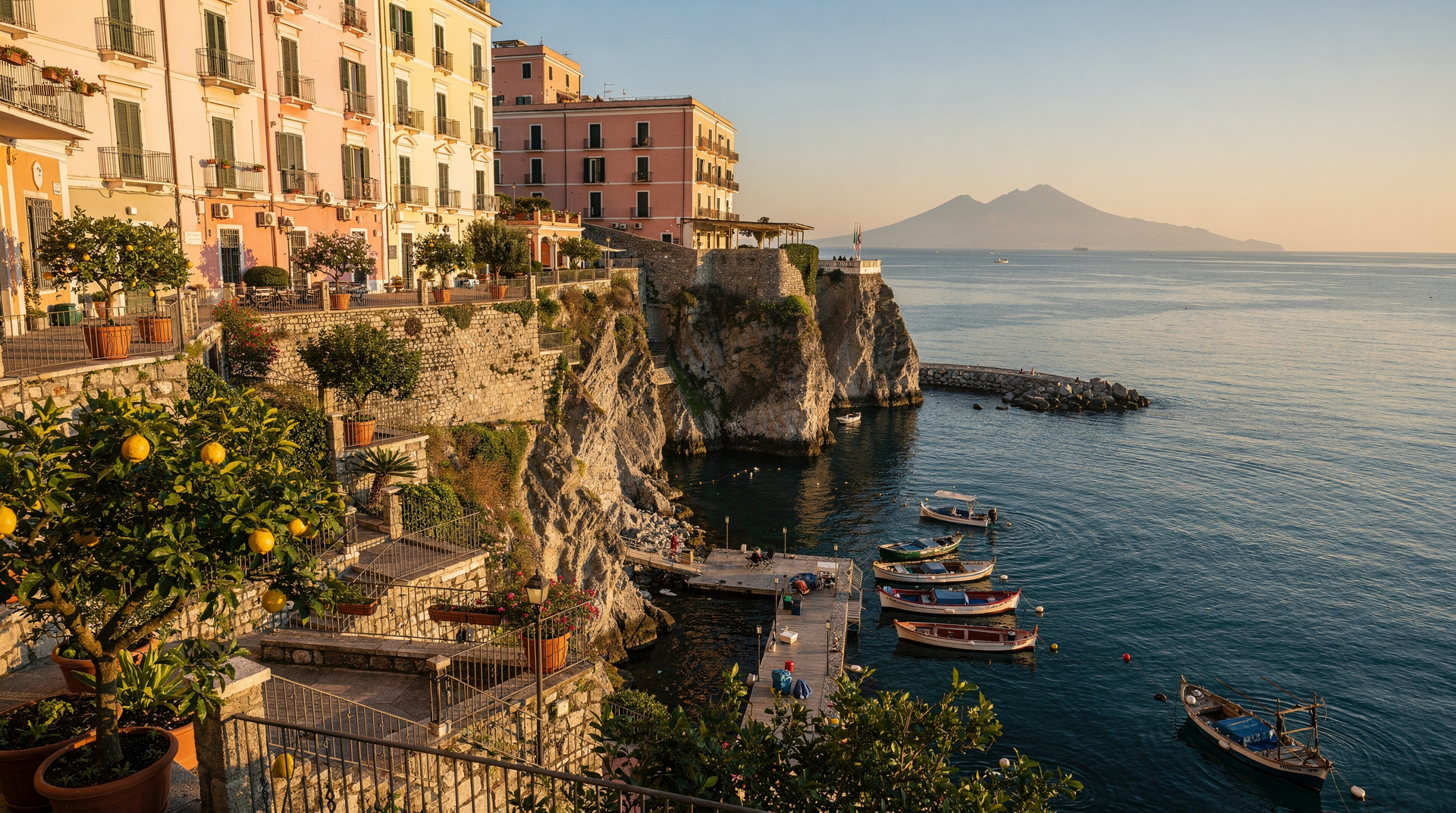
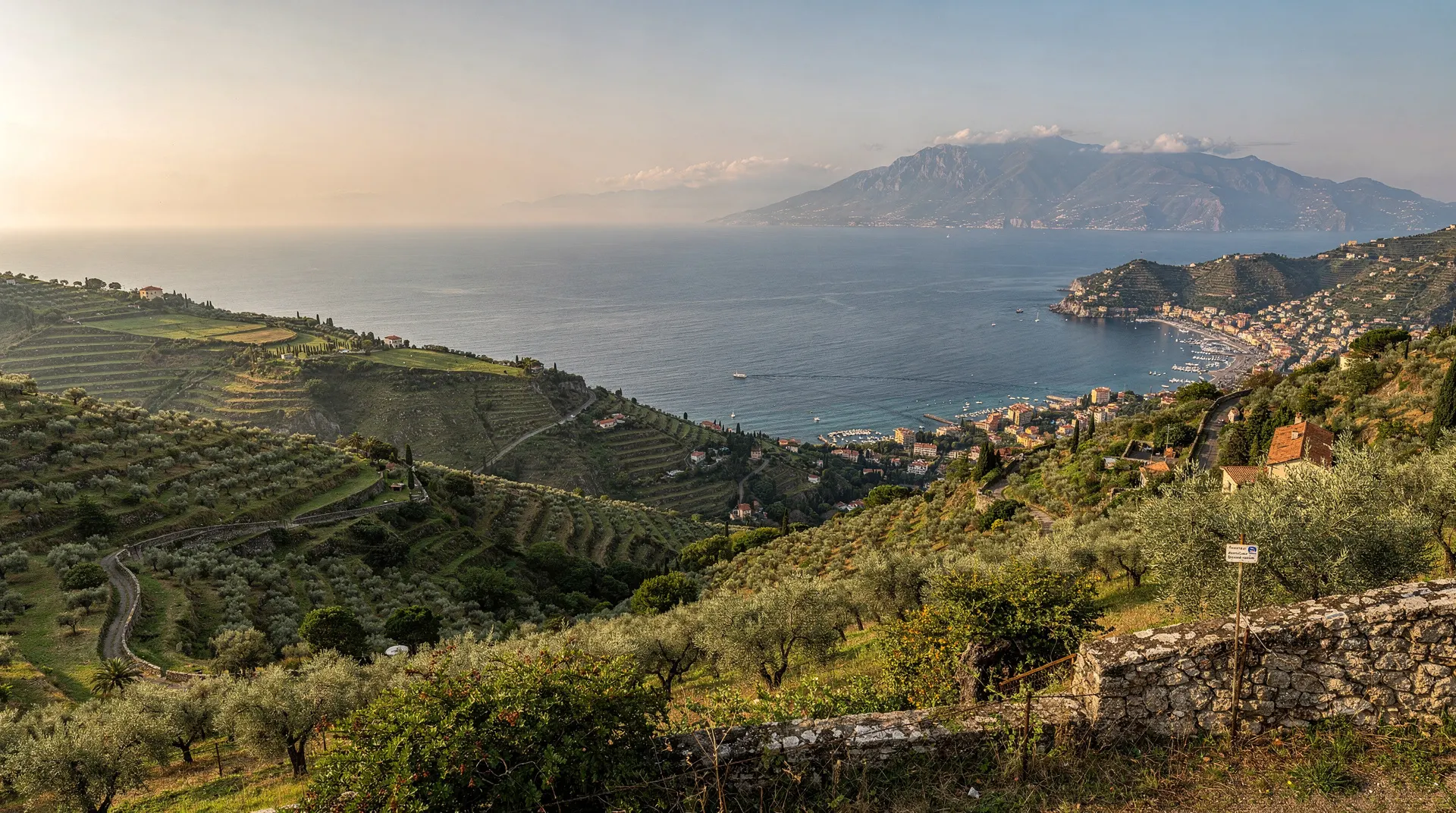
Sant’Agata sui Due Golfi translates literally as “Saint Agatha on the Two Gulfs”, and the name describes the village’s position exactly: at 390 metres above sea level on the ridge of the Sorrentine Peninsula, with the Gulf of Naples visible to the north and the Gulf of Salerno to the south. On a clear day from Il Deserto — the former Carmelite monastery on the edge of the village — both gulfs are simultaneously visible. This is the reason to come. That and one of the most respected restaurants in Campania.
Getting there from Sorrento
SITA buses from Piazzale De Curtis (Sorrento station) take about 25–30 minutes to Sant’Agata. The road winds steeply up from the coast; passengers on the right side of the bus get the better views on the ascent. Bus frequency is approximately every hour in summer, less reliable in winter.
By car: 12–15 minutes from Sorrento via Via Sant’Agata. Parking exists along the main village road. The car drive is straightforward enough to do even without local knowledge.
By scooter: the obvious way to combine Sant’Agata with Massa Lubrense and Marina del Cantone in a single peninsula loop.
Il Deserto viewpoint
The former Carmelite monastery of Il Deserto sits on the western ridge of the village at about 430 metres. The monastery was founded in the 17th century; it is still partly functioning as a religious community. The public access is to the terrace gardens and the rooftop viewing area, from which the panorama extends over both gulfs simultaneously.
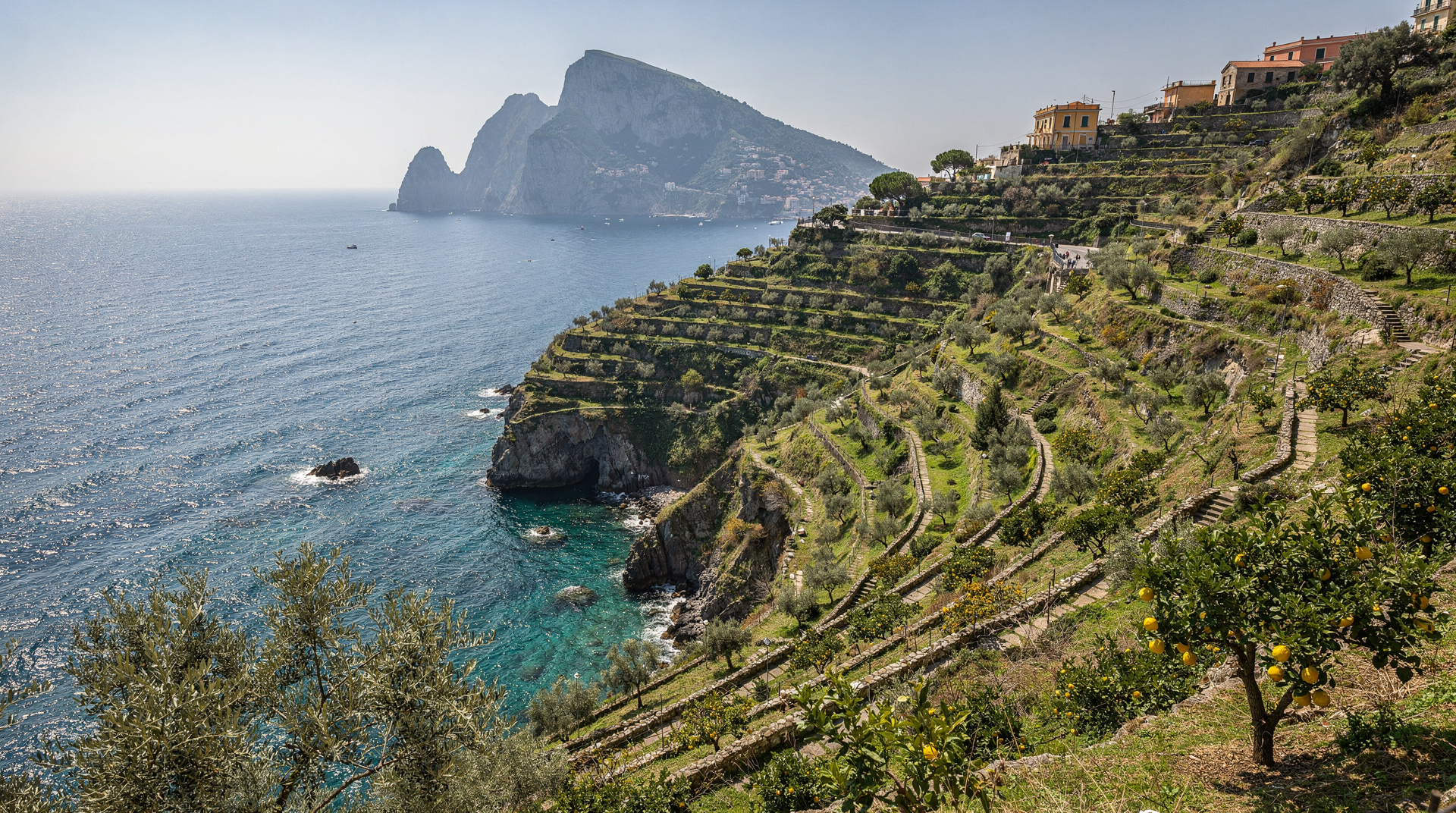
The viewing conditions depend heavily on the weather. A hazy July afternoon produces a flat, grey view. A clear May or October morning — after a night’s rain or the overnight tramontane wind from the north — produces clarity over both gulfs that can extend to the Ponza archipelago (60+ km north) and the Cilento coast (50+ km south). When the visibility is good, this is one of the finest panoramas accessible by bus on the entire Campanian coast.
Access to the terrace is typically free and informal — a bell at the monastery entrance, answered by a monk or lay brother. There is no official entry charge; a small donation is appropriate. Opening times are unofficial, typically 9am–12pm and 3pm–7pm (avoid midday and after evening prayer). The monks here are serious contemplatives, not tourist staff — behave accordingly.
The village itself
Sant’Agata is a small residential village with a central piazza, a 16th-century church (Santissima Annunziata, with a notable inlaid marble altar), a handful of bars and small restaurants, and a few shops selling local agricultural products. The olive oil produced on the peninsula’s slopes is excellent — extra virgin from small producers is sold in local shops at €8–14 per litre, considerably less than equivalent product in Naples tourist shops.
There is no tourist infrastructure to speak of — no guides, no information office, no queues for anything. This is the point. After a morning in Capri or Positano, Sant’Agata is a useful recalibration.
Don Alfonso 1890
The restaurant that put Sant’Agata on any culinary map. Don Alfonso 1890 was founded by Alfonso Iaccarino in 1973 and has held two Michelin stars since 1990. The kitchen focuses on Campanian products — tomatoes from their own garden on the Punta Campanella headland, local fish, lemons, olive oil — treated with a refined but not deconstructed sensibility. The setting is a 19th-century villa with a garden terrace.
This is a special-occasion restaurant. Tasting menus run €150–200 per person before wine. The wine list is exceptional and expensive. Booking several weeks in advance is necessary for summer evenings. But for travellers interested in serious Campanian cooking at its most considered, there is nowhere on the peninsula that compares directly.
For the rest of the time, the village’s casual trattorie serve lunch dishes of pasta al pomodoro and grilled fish at €12–18 — straightforward, honest, and a better use of the village’s actual character than treating it purely as a fine-dining pilgrimage.
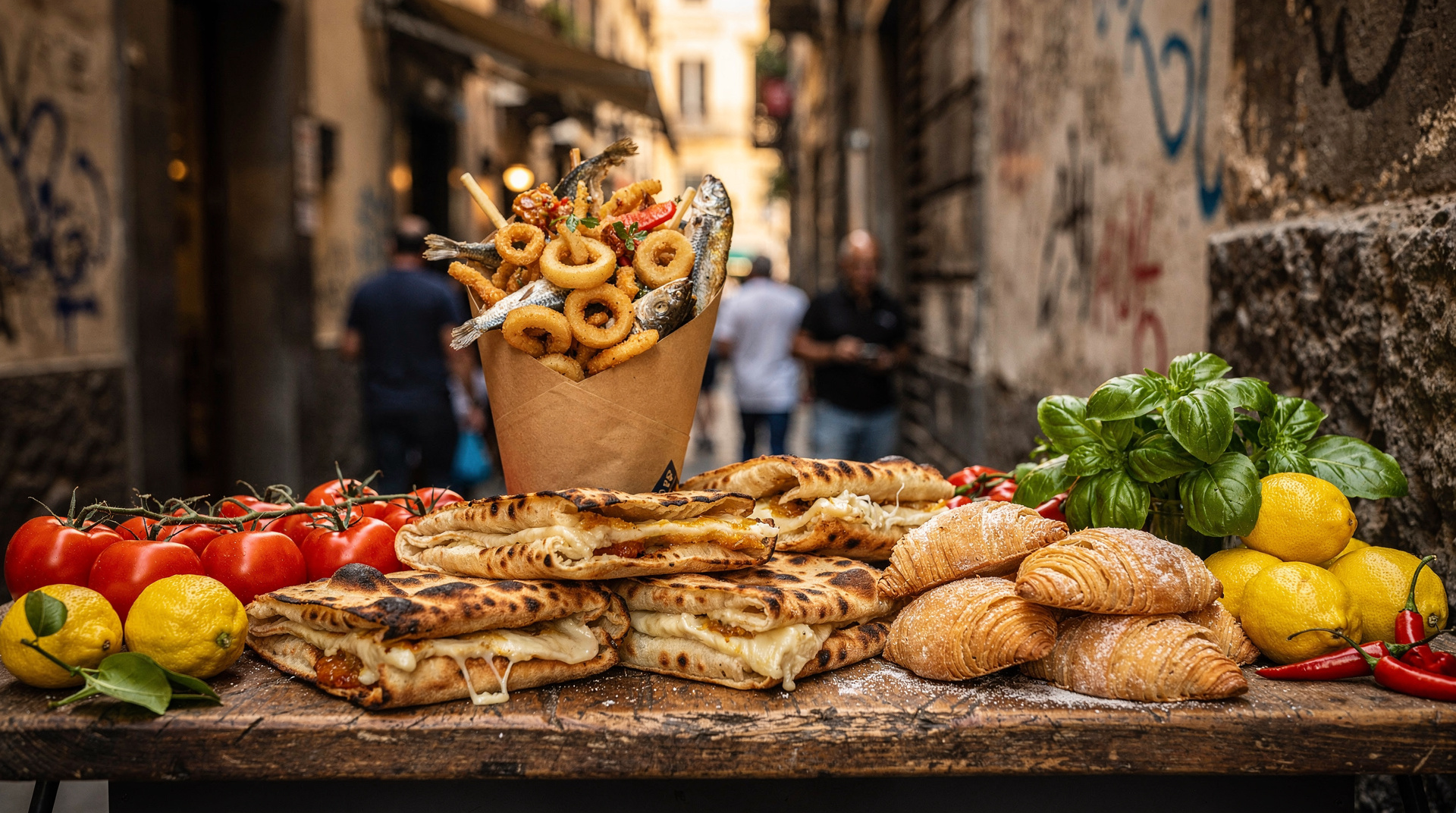
Sorrento area lunch with local lemon, olive oil, and wineCombining with the rest of the peninsula
Sant’Agata is logistically well-placed for combining with other peninsula stops. A possible day loop from Sorrento by bus or scooter:
- Morning: Sant’Agata sul Due Golfi — Il Deserto viewpoint
- Midday: descend to Nerano — spaghetti alla Nerano at Maria Grazia
- Afternoon: Marina del Cantone — swim, boat trip to Ieranto
- Return: bus to Sorrento or continue further toward Massa Lubrense
This circuit is about 25 km round trip from Sorrento. By scooter it is comfortable in 5–6 hours.
Olive oil, wine, and local products
Sant’Agata’s agricultural identity is bound up with olive oil production. The groves around the village and on the slopes toward the coast produce a genuinely excellent extra virgin — the same territory supplies the kitchen at Don Alfonso 1890, where the proprietors maintain their own groves at Punta Campanella.
Local shops and agritourist operations sell peninsula olive oil at €8–14 per litre (glass bottle, local producer). This is the product to buy here rather than in Sorrento shops, where the same type of oil in tourist packaging costs twice as much. Look for labels specifying “Penisola Sorrentina DOP”, the protected designation of origin.
Wine production on the Sorrentine Peninsula is modest in volume but includes Penisola Sorrentina DOC wines made from Falanghina, Aglianico, and Piedirosso grapes. The reds tend toward lighter body with volcanic minerality. Several agriturismo operators in the Sant’Agata area offer wine tasting with meals — an alternative to the more touristic wine experiences in Sorrento town.
Provolone del Monaco is the area’s defining cheese — a semi-hard aged cheese made from Agerolese cow’s milk on the Lattari Mountains above. It appears in spaghetti alla Nerano (see Massa Lubrense) and on every serious local cheese board. The PDO designation requires production on a specific geographic zone. A 300g piece from a local alimentari costs €7–10.
The Monastery of Il Deserto: more context
The Carmelite monastery was founded in 1679 by a group of friars who considered its remote hilltop position appropriate for a life of contemplation. “Il Deserto” (the Desert) referred not to a landscape but to the monastic concept of withdrawing from the world — the same usage as in the Egyptian desert hermit tradition.
The monastery is small and houses only a few monks at any given time. The main building includes a church (occasionally open for public mass, typically early morning), the monastic residential quarters, and the garden with the belvedere terrace. The belvedere was apparently added specifically because the geography of the site made both gulfs visible, turning a practical situation into a contemplative one.
The monks have historically been involved in local beekeeping and produce honey from their hives — occasionally available for purchase when in excess. Worth asking.
Combining with Agriturismo stays
Sant’Agata and its surrounding hamlets have a small but genuine agriturismo circuit — farm-based accommodation with meals using on-site products. These are not resorts with “agri” branding; they are working farms that take paying guests. Prices run €55–85 per person per night with breakfast and dinner, using vegetables, lemons, olive oil, and sometimes wine from the property.
For travellers who want immersion in Campanian rural life rather than coastal resort life, this is the alternative. The Sorrento as a base guide discusses how to use this area as an alternative staging point.
What a visit actually looks like
A typical Sant’Agata visit from Sorrento by bus runs roughly as follows:
Take the SITA bus from Piazzale De Curtis at 9:15am. Arrive Sant’Agata by 9:45. Walk 10 minutes to the Il Deserto monastery entrance and ring the bell. Spend 30–40 minutes on the belvedere terrace (on a clear day — longer if the visibility is exceptional). Walk back through the village, stop for coffee at the bar on the main piazza (€1.20 espresso). Browse the alimentari for olive oil and cheese. Eat lunch at a local trattoria (pasta al pomodoro with local basil, €10). Take the 2pm bus back to Sorrento, or descend to Nerano for the afternoon.
Total cost without Don Alfonso: €25–35 for the day including bus fares, coffee, shopping, and a simple lunch. This is significantly less than a day at Capri or a full Amalfi Coast excursion and leaves the afternoon free for other activities.
Practical information
Shops and ATMs: The village has a small supermarket and a tabacchi. No ATM in the village — use one in Sorrento before departing.
Weather: At 390 metres, Sant’Agata is noticeably cooler than the coast (3–5°C difference in summer). In spring and autumn this is pleasant; in winter the hilltop can be cold and occasionally misty.
Accommodation: A couple of B&Bs and agriturismi operate in and around the village at reasonable prices (€60–80 per room). Staying here gives a genuine sense of inland Campanian village life with day-trip access to both coasts.
The road between the two coasts
Sant’Agata occupies a strategic position on the peninsula road system. The SP145 from Sorrento climbs through Meta, Piano, and Sant’Agnello before turning toward the interior. From Sant’Agata, roads descend either north toward Sorrento and the Gulf of Naples, or south toward the Amalfi Coast via Colli di San Pietro and descending to Positano.
This makes Sant’Agata the literal crossroads of the peninsula for anyone travelling by car or scooter. The descent from Sant’Agata to Positano via the back road (SP145ter/Via Colli) is an alternative to the main SS163 Amalfi Coast road and involves fewer large vehicles. Local drivers use it regularly. The descent takes about 20 minutes to reach the Positano outskirts — steep switchbacks, but manageable with a normal car.
Combining Sant’Agata with Positano or Amalfi as part of a peninsula crossing is a logical itinerary for anyone with a car. Start in Sorrento, go up to Sant’Agata for the views, descend to the Amalfi Coast, and return via ferry from Positano or Amalfi to Sorrento or Naples.
Sant’Agata as a quiet alternative base
A small number of travellers choose to base their whole Sorrentine Peninsula stay in Sant’Agata rather than Sorrento itself, trading coastal convenience for altitude, quiet, and lower prices. The trade-off is real: no direct ferry access, less nightlife, and a smaller choice of restaurants. What you gain is a genuine village pace, cooler nights, and easy access to both the Amalfi Coast (via the back road toward Positano) and Sorrento’s transport hub. This works best for travellers with a car or scooter and at least three or four nights to spend in the area, since the daily commute down to the coast for beach time adds 20–30 minutes each way compared with staying in Sorrento directly.
Who actually comes to Sant’Agata
The visitor profile at Sant’Agata is different from Sorrento or Capri. International tourism is primarily:
- Culinary tourists specifically for Don Alfonso 1890
- Agriturismo guests staying at the surrounding farms
- Walkers and cyclists on peninsula routes
- Repeat visitors to the Naples area who have already done the main circuit
The day-tripper from Naples who allocates a single day for the coast is unlikely to reach Sant’Agata. It requires either a car/scooter, a specific interest in the views, or a reservation at the restaurant. This selectiveness is part of what makes it work — the village is not overrun.
For context on how Sant’Agata fits within a broader Campania itinerary, see the Sorrento as a base guide.
Seasonal considerations
Sant’Agata operates as a genuine village throughout the year, unlike many coastal resorts that partially close in winter. The Don Alfonso restaurant closes for a winter break (typically January–February); the monastery is accessible year-round in theory but winter visits are less predictable.
The village’s best season for the view is not summer but late autumn and early spring — October and November bring the clearest skies after summer haze, and March–April has excellent visibility before the tourist season begins. If your only goal is the Il Deserto panorama, an October morning after a cold front passes through is more spectacular than any August day.
For agricultural tourism — visiting farms, buying olive oil at harvest time, tasting wine — the October–November period covers the olive harvest and the tail of the wine production season. Several farms around Sant’Agata do small-scale harvests with visitor participation; this is an informal arrangement rather than a packaged agritourism product, but worth asking about if you are staying in the area.
What if the weather doesn’t cooperate
Because the entire appeal of Il Deserto hinges on visibility, it is worth having a backup plan for a hazy day. Sant’Agata’s village walk, the Santissima Annunziata church, and a leisurely lunch still work regardless of weather, and the drive or bus ride up the ridge is scenic in its own right even without a clear panorama at the top. If the forecast looks poor, consider descending instead to Massa Lubrense or the beaches near Nerano, where a swim doesn’t depend on atmospheric clarity, and saving Il Deserto for another morning if your itinerary allows a second attempt. Locals check the previous night’s wind direction; a northerly tramontana overnight is the most reliable predictor of a clear morning.
Distances and context
Sant’Agata’s geographic centrality on the peninsula makes the distances more manageable than a map suggests:
- Sant’Agata to Sorrento: 7 km by road, 12–15 minutes by car
- Sant’Agata to Nerano (pasta): 4 km, 10 minutes
- Sant’Agata to Marina del Cantone: 8 km via Nerano, 15 minutes
- Sant’Agata to the Positano descent junction: 3 km, 5 minutes
- Sant’Agata to Punta Campanella (by foot from Termini): 3 km trail, 45 minutes
A car or scooter turns Sant’Agata into the centre of a full-day peninsula exploration rather than an isolated village. Without a vehicle, the bus from Sorrento still makes it accessible for a targeted half-day.
Frequently asked questions about Sant’Agata sui Due Golfi
Can you really see both gulfs from the viewpoint?
On clear days, yes — both the Gulf of Naples and the Gulf of Salerno are simultaneously visible from Il Deserto. Visibility varies considerably by weather. The best conditions are after a frontal system passes through or on mornings following a night of north wind (tramontana). Hazy summer afternoons are less rewarding.
How do I visit Il Deserto?
Walk or drive to the monastery at the western end of the village. Ring the bell at the entrance. No official booking or entry fee; a donation is appropriate. Opening is informal and depends on the monastery’s schedule. The monks are genuine religious contemplatives — act accordingly.
Is Don Alfonso 1890 worth it?
If you are specifically interested in high-end Campanian cuisine, yes — it is among the best in the region. Tasting menus start at around €150 per person. For most travellers, a visit to Sant’Agata for the views and a simpler lunch makes more sense economically.
How do I get from Sorrento to Sant’Agata without a car?
SITA bus from the station square in Sorrento takes about 25–30 minutes. Check current timetables before going — frequency is approximately hourly in summer, less reliable in winter.
What is the best time of day to visit?
Morning, on a clear day. The light on the northern gulf (Naples side) is best before noon. Arriving as the monastery opens (around 9am) gives you the terrace before any other visitors and the clearest air of the day.
Top experiences
Bookable activities with verified prices and instant confirmation on GetYourGuide.