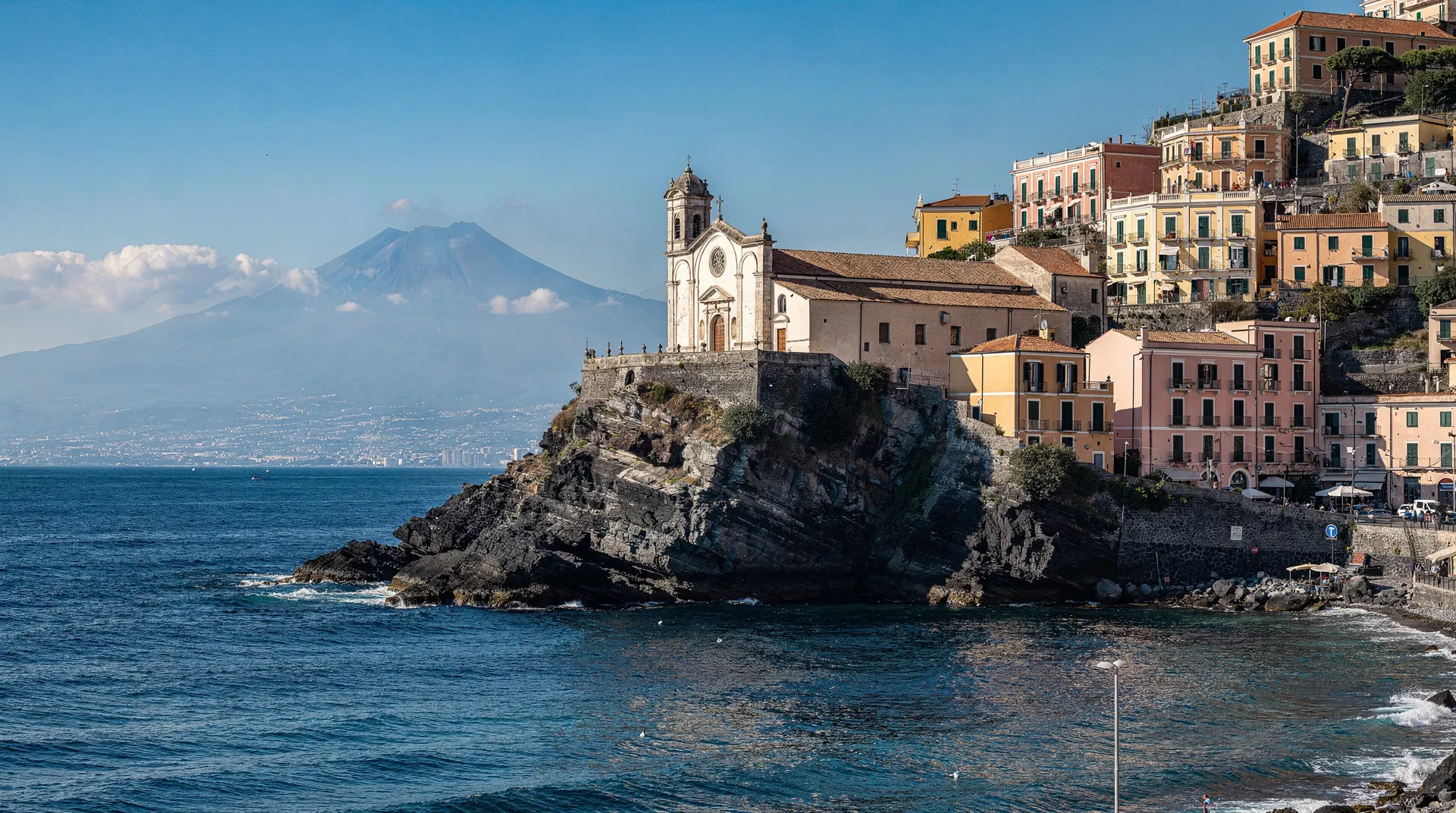
Vico Equense
Vico Equense: pizza a metro at Gigino, clifftop views, beaches, and a quieter stop on the Circumvesuviana between Naples and Sorrento.
Sorrento: Walking Tour with Local Guide
Duration: 2h
Quick facts
- Getting there
- Circumvesuviana from Naples ~50 min or Sorrento ~20 min
- Famous for
- Pizza a metro (pizza sold by the metre)
- Town position
- Clifftop above the sea, ~100 m elevation
- Beaches
- Several coves and lido beaches below the town
- Best for
- A lunch stop en route; a quieter base than Sorrento
- Season
- April–October; limited appeal in winter
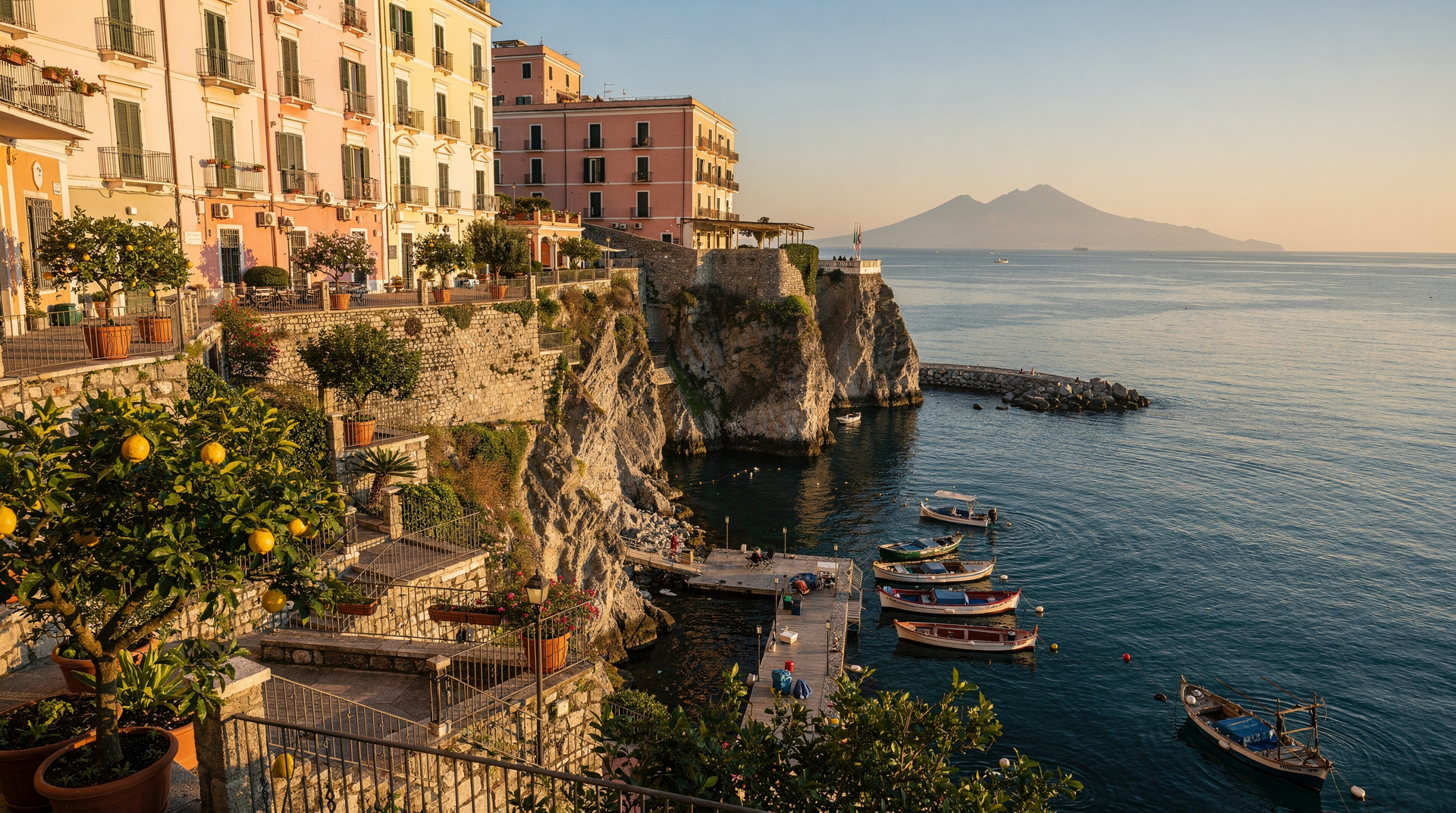
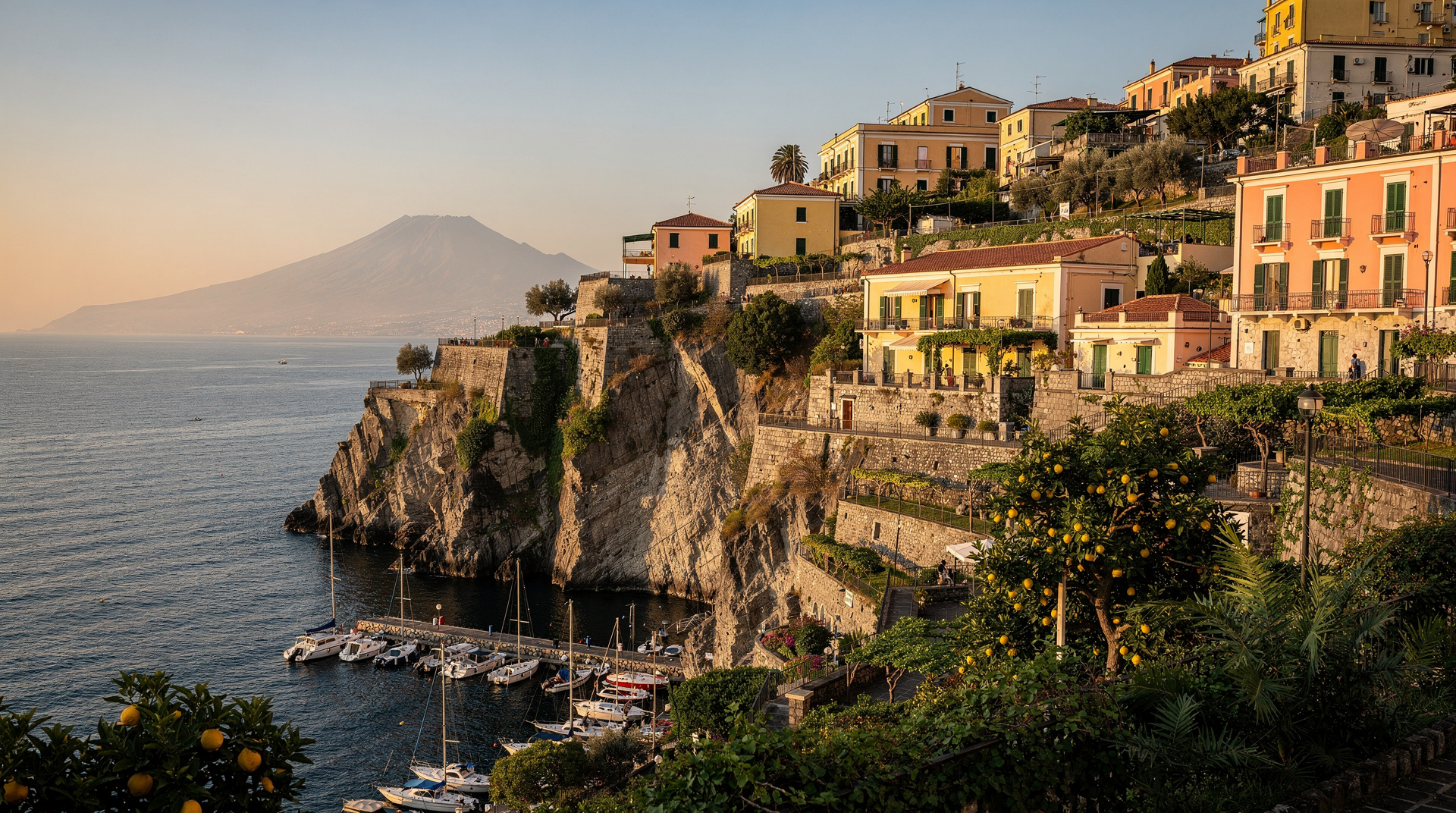
Vico Equense sits on a volcanic tufa promontory above the Tyrrhenian Sea, roughly midway between Naples and Sorrento on the Circumvesuviana rail line. It is a genuinely inhabited Campanian town rather than a resort village — locals live here year-round, there is a functioning high school, a market, a weekly fair — and its level of international tourist attention remains low compared to Sorrento. It is also where pizza a metro was invented and where the format is still done best.
| Where | Clifftop town on the Sorrento Coast, between Castellammare di Stabia and Meta di Sorrento |
| Cost | Free to walk around; pizza a metro around €5–9 per 30cm section; beach lidos around €15–25/day |
| Time needed | Half day as a lunch stop; 1 night if using it as a quiet base |
| Getting there | Circumvesuviana ~50 min from Naples, ~20 min from Sorrento |
| Best time | May–October for beaches and outdoor dining; the town works year-round for pizza and the view |
Getting there
The Circumvesuviana stops at Vico Equense on the Naples–Sorrento line. Journey times: approximately 50 minutes from Napoli Centrale (Garibaldi), about 20 minutes from Sorrento. Tickets cost €2.20–3.50 depending on journey length. The station is in the lower part of town; the centro and the clifftop views require a short walk uphill.
By car from Naples: the A3 autostrada and then the SS145 coast road. The drive takes about 45–55 minutes depending on traffic. Parking in the centre is limited but exists on the main streets.
Pizza a metro
Vico Equense is the birthplace of pizza al metro — pizza sold not by individual 30cm rounds but by the metre, typically sliced and served in long rectangular sections. This format was invented in the 1930s at Ristorante Gigino (officially Universita della Pizza, founded by Luigi Dell’Amura on Via Nicotera), which is still operating and still the primary destination for this style.
At Gigino, you order by the fraction of a metre — a “metro” is literally one metre long, and a group of four to six can share one with different toppings on different sections. The cost runs roughly €5–9 per 30cm section depending on topping. The dough is slightly different from standard Neapolitan pizza: thinner, crispier at the edges, with a consistently good crust. The tomato and fior di latte toppings are regional products.
The format has spread across the peninsula and to Naples, but eating it at the source in a town where it was invented and where the surrounding conversation is in Neapolitan rather than in tourist-directed Italian is a different experience from the export versions.
There is a second, much more expensive option in town: Ristorante Torre del Saracino (Via Torretta, Marina di Seiano). One Michelin star. Chef Gennaro Esposito has been working there since 1992. The cuisine focuses on Campanian seafood in refined treatments — about as far from pizza a metro as possible. Tasting menus around €120–150 per person. The sea terrace setting is exceptional.
The town itself
The historic centre is on the clifftop, around Piazza Municipio and the Gothic church of Santissima Annunziata (partly built into the cliff face, with a belltower visible from the sea). The church dates from the 14th century and has some good interior stonework that most visitors pass through quickly.
The views from the clifftop promenade looking east toward Sorrento and west toward Naples, with Vesuvius in the background, are among the better free viewpoints on the peninsula. They are less dramatic than the Amalfi Coast’s vertiginous drops, but the combination of Gulf of Naples, islands in the distance, and Vesuvius makes for a compelling backdrop.
Beaches
Vico Equense’s beaches are reached by descending from the town. The main ones:
Marina di Vico (Seiano): The main resort beach below the town. Lido establishments rent sunbeds and umbrellas; there are also free public sections. This is a straightforward beach — pebble and coarse sand, calm water in the bay.
Bikini Beach: Smaller cove further along the coast, with clearer water and less crowding than Seiano in shoulder season.
The beaches here are functional rather than exceptional — the best beaches near Naples guide provides a wider comparison. Their value is proximity: you can have lunch of pizza a metro in the centre and be on a beach below within 20 minutes.
As a base
Vico Equense makes a quiet alternative base to Sorrento for travellers who want Circumvesuviana access (to Naples, Pompeii, Herculanum) without Sorrento’s tourist pricing and summer crowds. Hotels and B&Bs here run €60–90 per night in shoulder season versus €100–150 in Sorrento. The trade-off is fewer direct ferry connections — Sorrento’s ferry services are significantly better — and less immediate access to the coastal bus network for the Amalfi Coast.
If your itinerary is heavily centred on Naples and Pompeii rather than Capri and the coast, Vico Equense as a base makes reasonable sense economically.
Guided walking tour of Sorrento and the surrounding areaThe town’s position on the Circumvesuviana route
Vico Equense’s Circumvesuviana stop makes it a natural waypoint for visitors doing the Naples–Pompeii–Sorrento circuit. Most people pass through without stopping; the ones who do stop typically do so for the pizza, realise the town is worth a walk around, and spend longer than planned.
From a logistics standpoint, Vico Equense sits between Castellammare di Stabia (the rail junction point north of the peninsula towns) and Meta di Sorrento. It is a much more pleasant stop than Castellammare, which is a mid-sized industrial port town with limited tourist appeal. If you are doing the Circumvesuviana route and want a lunch break that is not in Pompeii or Sorrento, Vico Equense is the obvious choice.
The train schedule means you can arrive from Naples at around noon, walk up to the centro, eat a pizza a metro, descend to the beach for an hour, and be on a late afternoon train to Sorrento or back to Naples comfortably within the same day.
The marina and thermal caves
Below Vico Equense, accessible by a path through the cliff, are the Marina di Vico proper and the surrounding area of Seiano. There is a small thermal spring cave (Grotta di Seiano) accessible at low tide — locals have bathed here for centuries. The cave is not a managed attraction; it is simply a rock fissure where mineral-rich water seeps through. No entry fee, no lifeguard, no infrastructure. Not suitable for children or non-swimmers.
The marina area has several restaurants that cater to a largely local weekend clientele rather than international tourists. Prices for seafood here are closer to Naples than to Sorrento’s tourist-zone rates.
Historical background
Vico Equense sits on a volcanic tufa promontory that was inhabited in pre-Roman times. The town name derives from “Aequa”, a Roman municipium. The current medieval town layout dates from the period of Angevin rule in the 14th century, when King Charles II of Anjou rebuilt the settlement after a Saracen raid.
The Gothic church of Santissima Annunziata was built by the Angevins in the 14th century and has been partially modified in subsequent centuries. Its position at the cliff edge — literally hanging over the sea on one side — is architecturally unusual. The campanile (bell tower) is a navigational reference point visible from ferries in the Gulf of Naples.
The town also has a significant Franciscan presence: the Convento di San Francesco, on the main road, dates from the 17th century and has a small cloister accessible to visitors.
The beach club economy vs free access
Like much of the Italian coast, Vico Equense’s beaches operate a mixed system. Lido establishments (beach clubs) rent sunbeds and umbrellas, control sections of the beach, and provide changing rooms and bar service. They charge €15–25 for a set of two sunbeds and an umbrella for a day. In peak July–August, the free sections can be crowded.
In shoulder season (May–June, September–October), the free sections are entirely usable and the beach clubs have available capacity at rates they are willing to negotiate.
If you are visiting primarily for the beach rather than pizza, arriving before 10am avoids the period when lido operators are at full occupancy and the free sections fill. The beach at Spiaggia degli Ontani (a slightly longer walk from the station, south of Seiano) has more free access and fewer organised lidos.
Practical information
Market: A weekly market runs in the main piazza on Thursday mornings. Local produce — lemons, tomatoes, cheeses, olives — at proper market prices rather than tourist shop prices.
ATMs: Available on the main street.
Bus connections: Local SITA buses connect Vico Equense to Sorrento and Meta; less direct service than from Sorrento toward the Amalfi Coast.
Circumvesuviana: Trains pass through roughly every 30 minutes in each direction during daytime hours. The station is small; buy tickets from the machine before boarding.
The surrounding area: hikes and nature
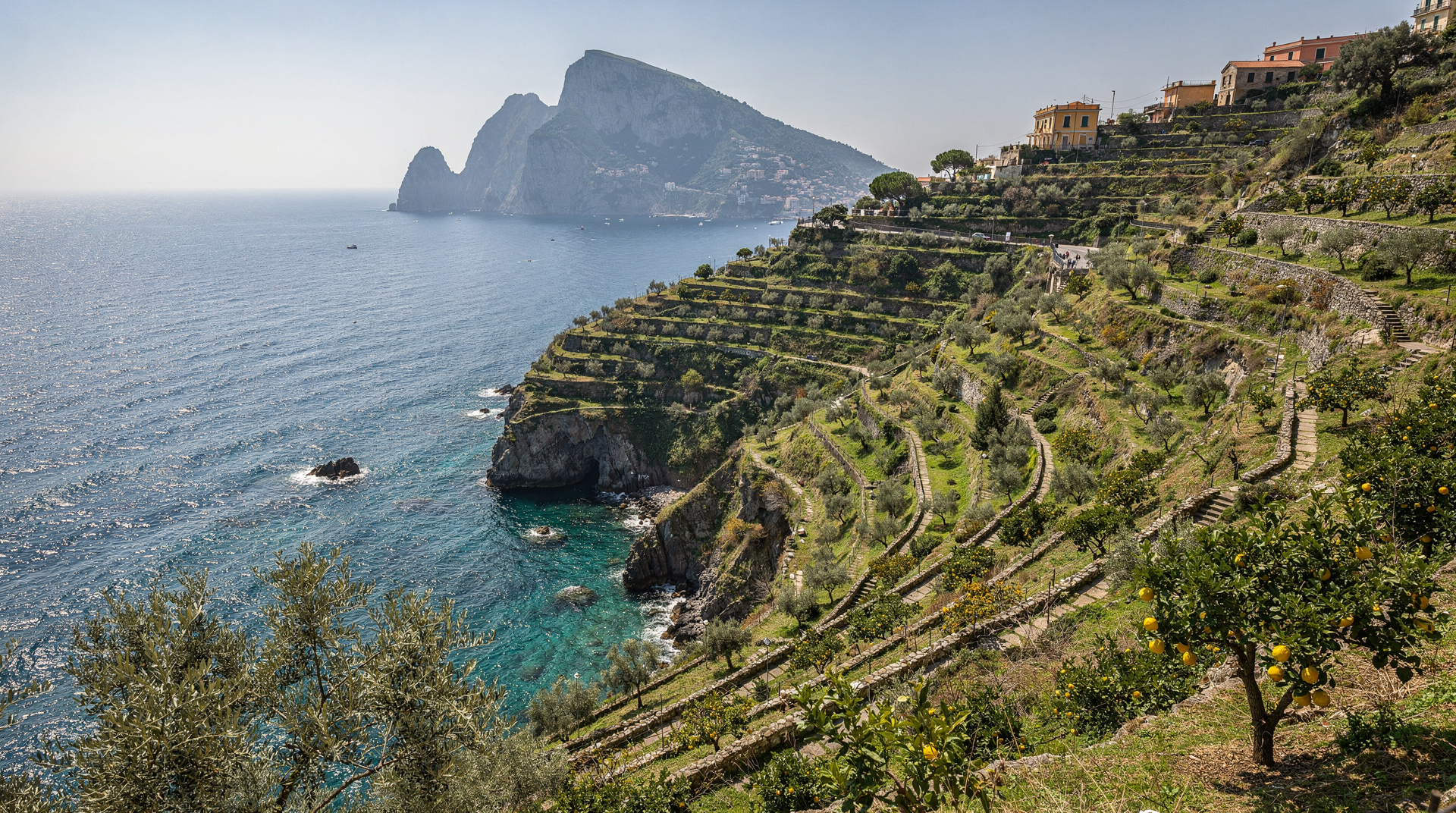
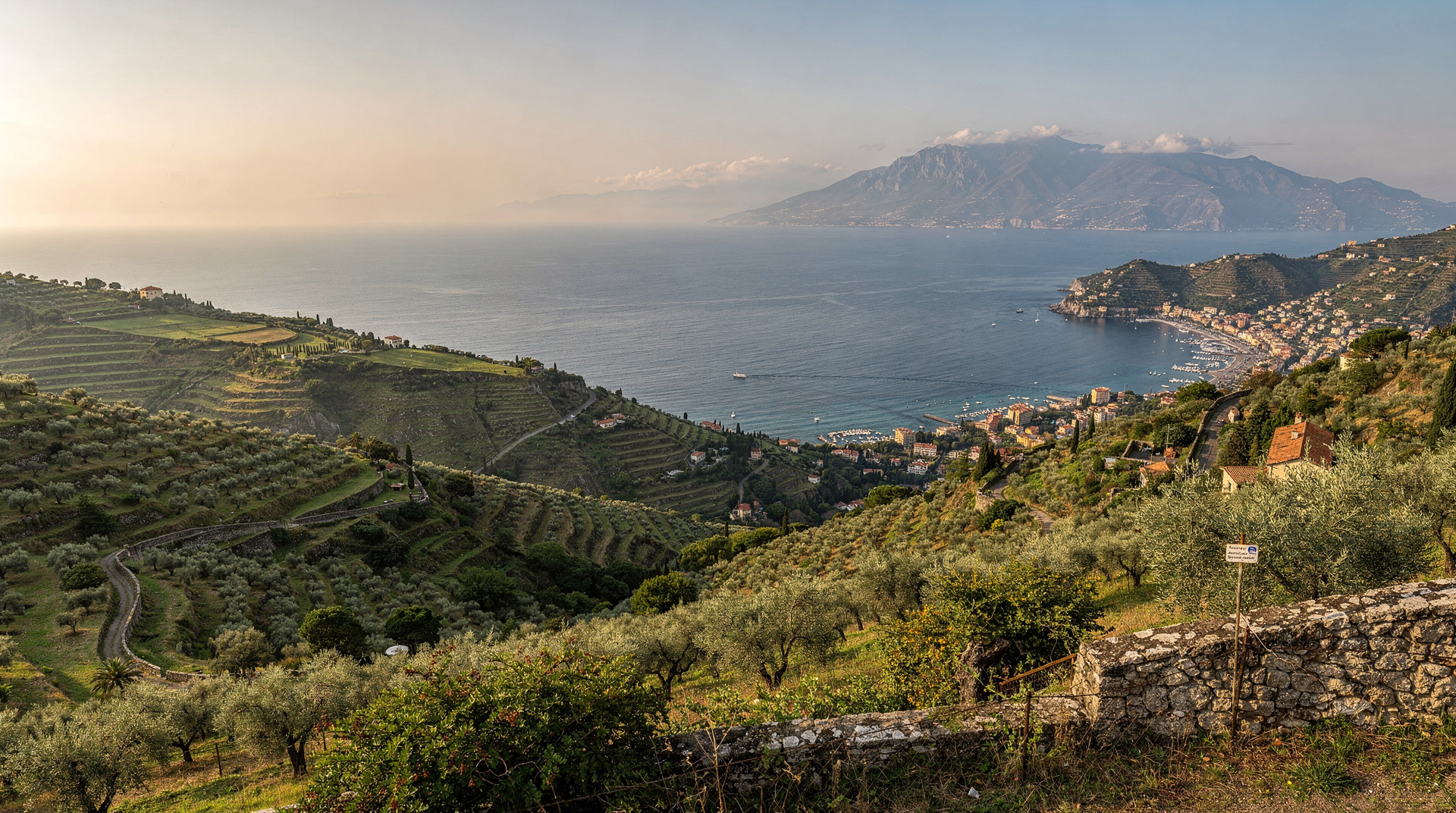
Above Vico Equense, the Lattari Mountains begin in earnest. The Alta Via dei Monti Lattari long-distance trail passes near the town, connecting eventually to both the Sorrento coast and the Amalfi side of the peninsula. Day section walks from Vico Equense include:
Santa Maria del Castello: A medieval church at 500 metres above the town, reachable on a trail from the upper part of Vico Equense in about 1.5 hours. The building dates from the 11th century and sits on an earlier Roman fortification. Views over the Gulf of Naples are excellent from the approach path.
Monte Faito: The high plateau above the town (1,100 metres), reachable by cable car from Castellammare di Stabia (one Circumvesuviana stop north of Vico Equense). The cable car runs in summer months and provides access to a cool, forested plateau used for walking. In summer heat, the temperature on Faito can be 10°C lower than at sea level.
The hiking near Naples guide covers these routes and others with full logistics.
Context: the Circumvesuviana circuit
Understanding Vico Equense’s position helps with planning the broader Naples-area trip. The Circumvesuviana from Napoli Centrale (Garibaldi) passes through:
- Napoli Portici (20 min) — not a tourist stop
- Torre del Greco (25 min) — port town, limited tourist appeal
- Torre Annunziata (30 min) — Oplontis Roman villa (under-visited)
- Pompeii Scavi (35 min) — the main archaeological site
- Castellammare di Stabia (45 min) — ferry port for some islands; Stabiae Roman villas
- Vico Equense (50 min) — pizza a metro
- Meta di Sorrento (55 min)
- Piano di Sorrento (60 min)
- Sant’Agnello (65 min)
- Sorrento (70 min — terminus)
From this list, the logical tourist stops in a single journey are Naples, Pompeii, and Sorrento — with Vico Equense as an optional lunch break. Oplontis in Torre Annunziata is genuinely worth considering as an addition for anyone interested in Roman sites beyond Pompeii.
Staying overnight in Vico Equense
For travellers who want to be on the Circumvesuviana circuit but not in Sorrento, Vico Equense offers an alternative. Accommodation prices are noticeably lower: a good three-star in Vico Equense runs €70–95 per night in shoulder season versus €110–150 for comparable Sorrento options.
The trade-offs are limited ferry connections (no direct Capri or Ischia services), fewer restaurant options, and less active nightlife. But if your itinerary is Naples and Pompeii-heavy rather than coast-and-islands-heavy, the cost savings and quieter atmosphere make Vico Equense work as a base.
The cliff-top location means some hotels have genuinely spectacular sea views at prices you would pay significantly more for in Positano.
Food beyond pizza
While pizza a metro is the defining Vico Equense experience, the town has a broader food offer worth knowing about.
The local fish market operates on weekday mornings near the marina. Restaurants serving the weekly catch from the Gulf of Naples include several unremarkable tourist-facing places near the station and a few genuinely good ones in the upper town and in Seiano.
Local pasta dishes use schiaffoni (large ridged tubes) with meat ragù — a different tradition from the Neapolitan tomato-based sauces, reflecting the town’s position between the fishing coast and the agricultural interior.
The Thursday market (mentioned earlier) also sells local cheese: provolone del Monaco from nearby Agerola farms and fresh caciotta from the Lattari Mountains. These are bought directly from producers at market prices.
Comparing Vico Equense to nearby Sorrento Coast stops
Travellers deciding where to base themselves, or which Circumvesuviana towns are worth stopping at, often want a side-by-side view rather than prose:
| Town | Character | Typical hotel price (shoulder season) | Best for |
|---|---|---|---|
| Vico Equense | Working town, clifftop, quiet | €70–95/night | Pizza a metro, budget base, beaches below |
| Sorrento | Resort town, full tourist infrastructure | €100–150/night | Ferries to Capri/Ischia, nightlife, coach access to Amalfi |
| Massa Lubrense | Rural, scattered hamlets | €80–120/night | Slow travel, coastal walking, sea views without crowds |
| Sant’Agata sui Due Golfi | Hilltop village between two gulfs | €90–130/night | Views of both gulfs, quieter still than Vico Equense |
None of these towns has Sorrento’s ferry connectivity, so anyone planning day trips to Capri or Ischia from a Vico Equense base should check timings on the getting to Sorrento guide before committing to lodging.
Day trip logistics from a Vico Equense base
Because Vico Equense sits on the Circumvesuviana line rather than requiring a transfer, it works reasonably well as a low-cost base for a Naples- and Pompeii-focused visit:
- To Pompeii: roughly 15 minutes back toward Naples on the Circumvesuviana, alighting at Pompei Scavi.
- To Naples: approximately 50 minutes direct, no transfer.
- To Sorrento: approximately 20 minutes, useful for connecting onward to Amalfi Coast buses or Capri ferries, though Sorrento’s own ferry timetable should be checked first — see Sorrento as a base.
- To Capri: no direct ferry from Vico Equense; the practical route is training to Sorrento first, then taking the ferry — see Capri from Naples vs Sorrento for the comparison of departure points.
Anyone assembling a wider itinerary around pizza, ancient sites, and the coast may also find the Naples food and pizza 3-day itinerary useful for sequencing Vico Equense against Naples’ own pizzerias.
Pompeii day trip by train with a local guideSeasonality: when the town is at its best
Vico Equense changes character considerably with the season, more so than Sorrento does, because so much of its appeal (pizza terraces, beach lidos, the clifftop promenade in the evening) depends on outdoor weather:
| Season | Weather | Crowds | Notes |
|---|---|---|---|
| April–May | Mild, occasional rain | Low | Beaches not yet fully operational; pizza and church visits are excellent; good hotel rates |
| June | Warm, mostly dry | Building | Beaches open properly; still manageable before the July peak |
| July–August | Hot, dry, humid at the coast | High | Beach clubs at capacity; book Gigino ahead for dinner; consider an early lunch |
| September–October | Warm days, cooler evenings | Moderate, falling | Arguably the best window — sea still warm enough to swim, crowds thinning, good light for the clifftop views |
| November–March | Cool, wetter, some closures | Very low | Beach clubs and some restaurants close; the pizza a metro and the church remain accessible; good for a quiet lunch stop without the coast in play |
Anyone planning around the beaches specifically should check the best beaches near Naples guide, since Vico Equense’s own beaches are only one option among several on this stretch of coast.
Frequently asked questions about Vico Equense
What is pizza a metro?
Pizza a metro is a format where pizza is baked in a long rectangular tray and sold by the fraction of a metre rather than as individual round pizzas. It was invented in Vico Equense and the original restaurant (Gigino/Universita della Pizza) still serves it. Cost is roughly €5–9 per 30cm section.
Is Vico Equense worth a dedicated visit?
For the pizza a metro experience and the clifftop setting, yes — it makes a very good lunch stop on the Naples–Sorrento route. As a place to spend a full day of sightseeing, there is limited beyond the town centre, church, and beaches.
How do I get from Naples to Vico Equense?
By Circumvesuviana: from Napoli Centrale (Garibaldi, lower level) on the Sorrento line. About 50 minutes, ticket around €2.20. Trains run roughly every 30 minutes. See the Circumvesuviana guide for the full logistics.
Is it cheaper than Sorrento?
Yes — noticeably so. Hotel prices run roughly 30–40% lower than comparable options in Sorrento town centre. Restaurants are priced for local clientele rather than international tourists.
Can I visit Vico Equense and Sorrento on the same day?
Easily. They are 20 minutes apart by train. A sensible route: spend the morning in Sorrento (ferry views, centro storico), take the Circumvesuviana to Vico Equense for a pizza a metro lunch, then return to Sorrento or continue toward Pompeii/Naples in the afternoon.
Top experiences
Bookable activities with verified prices and instant confirmation on GetYourGuide.