Pompeii and Vesuvius in one day: combined day trip from Naples
From Naples: Pompeii Ruins & Mount Vesuvius Day Tour
Duration: 7-7.5h
What the combined day actually covers
The Pompeii and Vesuvius day trip is the most popular full-day excursion from Naples, and with good reason: you visit the best-preserved Roman city in the world and then stand on the rim of the still-active volcano that buried it, all in under nine hours. The combination sounds almost too neat, but it works — and it works better with a guide than without.
| Duration | around 8–9 hours, hotel to hotel |
| Cost | tour price, often with both entries bundled — confirm at booking |
| Entries alone | Pompeii ~€18, Vesuvius park ~€10 (2026, per adult) |
| Best time | spring (Apr–mid-Jun) or autumn (Sep–Oct); book early slots in summer |
| Getting there without a tour | Circumvesuviana train to Pompei Scavi, then bus/taxi to Vesuvius car park |
Standard tour pickups from central Naples hotels run between 8:00 and 9:00 am. Transport is by air-conditioned minibus for most small-group products, with groups typically capped at eight to fifteen people. The drive to Pompeii takes 25–35 minutes depending on morning traffic on the A3 motorway.
Entry to the Pompeii archaeological park costs €18 per adult (2026 price). Entry to the Vesuvius national park for the crater trail costs €10 per adult. Most combined day trip packages bundle both admissions into the tour price — confirm this when booking, as some operators list these separately as “not included.”
Book the combined Pompeii and Vesuvius day trip from Naples — this product covers hotel pickup, licensed guide, both entry tickets, and return transfer in a single transaction.
How the itinerary flows: ruins first, crater second
Arrival at Pompeii is typically between 9:00 and 9:30 am. Your guide leads the group through the main entrance at Porta Marina or the Anfiteatro gate and spends two to three hours covering the essential areas: the Forum, the Temple of Jupiter, the Lupanar, the House of the Faun, the thermopolium on Via dell’Abbondanza, and the Garden of the Fugitives. With a good guide, those plaster casts of people caught mid-moment by the 79 AD eruption stop being exhibit pieces and become something genuinely affecting.
The limitation is real: Pompeii covers 44 hectares and a thorough visit takes a full day. On a combined tour you see roughly a third of the site in depth. That is enough to understand what you are looking at and to leave wanting more — which is, arguably, the right outcome.
Departure for Vesuvius follows the Pompeii visit, usually around noon to 12:30 pm. The minibus climbs from the coastal plain through increasingly dramatic landscape: first orange groves, then scrubby maquis, then the black lava fields of the 1944 eruption, bare and strange. The car park at roughly 1,000 m altitude is where you begin the crater trail on foot.
What you see at each site
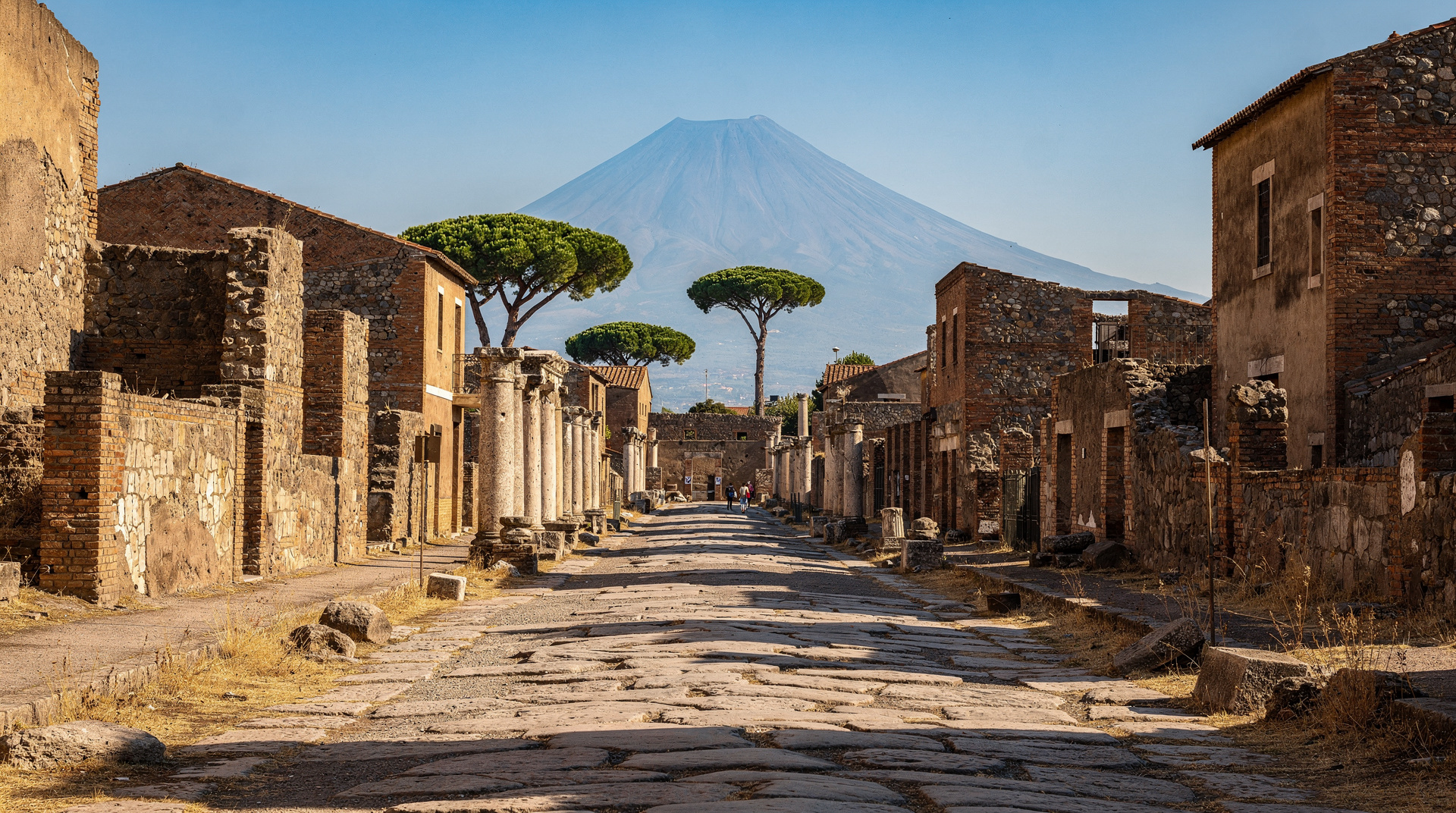
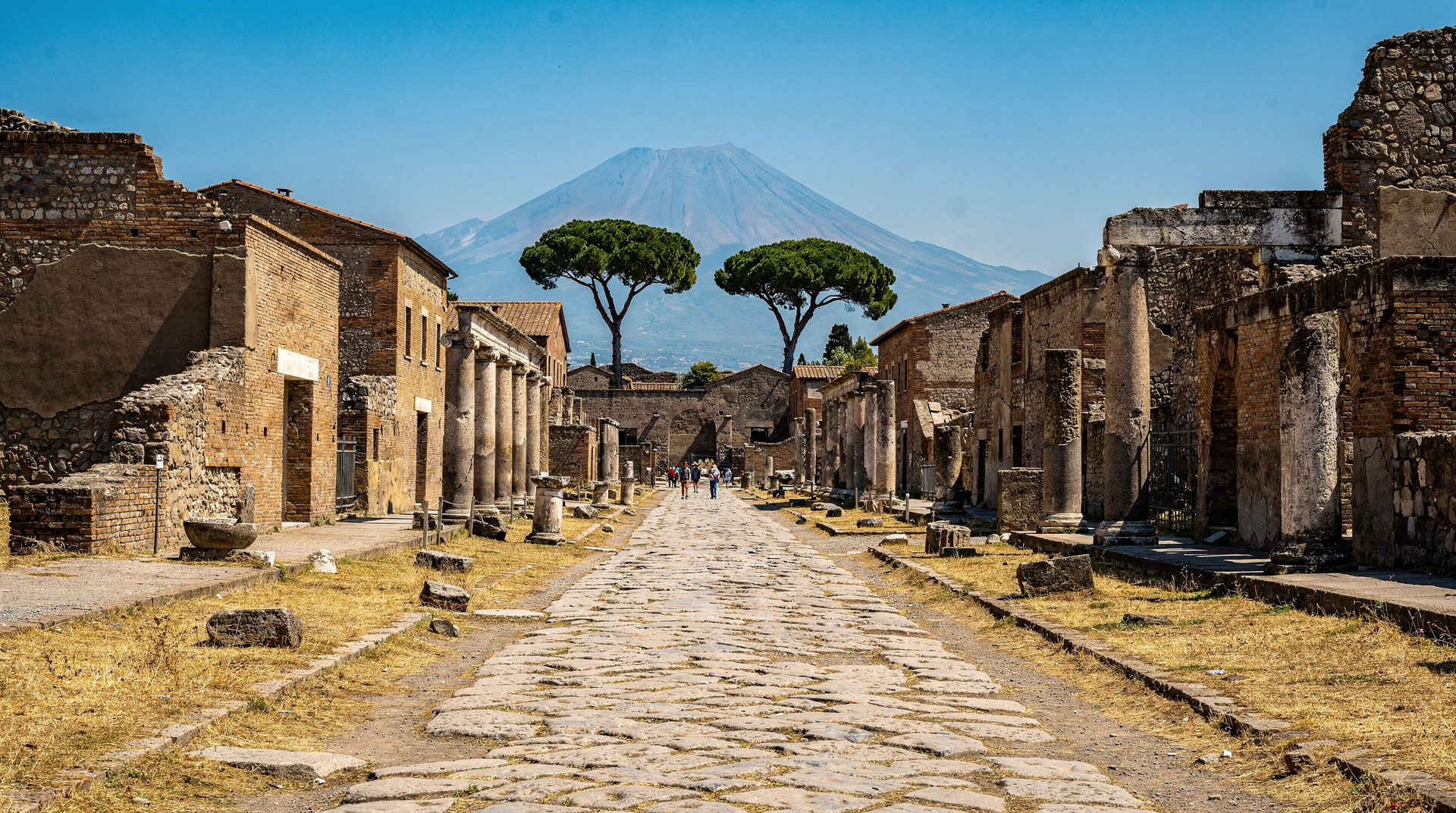
At Pompeii: The scale is the first thing that hits you. This is not a ruin — it is a city, still partly buried, with streets, shops, houses, frescoes and mosaics intact to a degree that is difficult to process. The ochre and terracotta colours of the walls, the wheel ruts worn into the paving stones, the graffiti scratched into plaster — all of it is startling in its specificity. In the morning light the Forum, with Vesuvius visible at the end of the main colonnade, is one of the most visually striking Roman spaces still accessible.
The plaster casts are haunting and worth seeing, but the broader lesson of the site is architectural: how a wealthy provincial Roman city was organised, what a street-level thermopolium looked like, how the elite displayed wealth through floor mosaics and atrium proportions. A guide turns this from a visual experience into a comprehensible narrative about a specific society on a specific morning in August of the year 79.
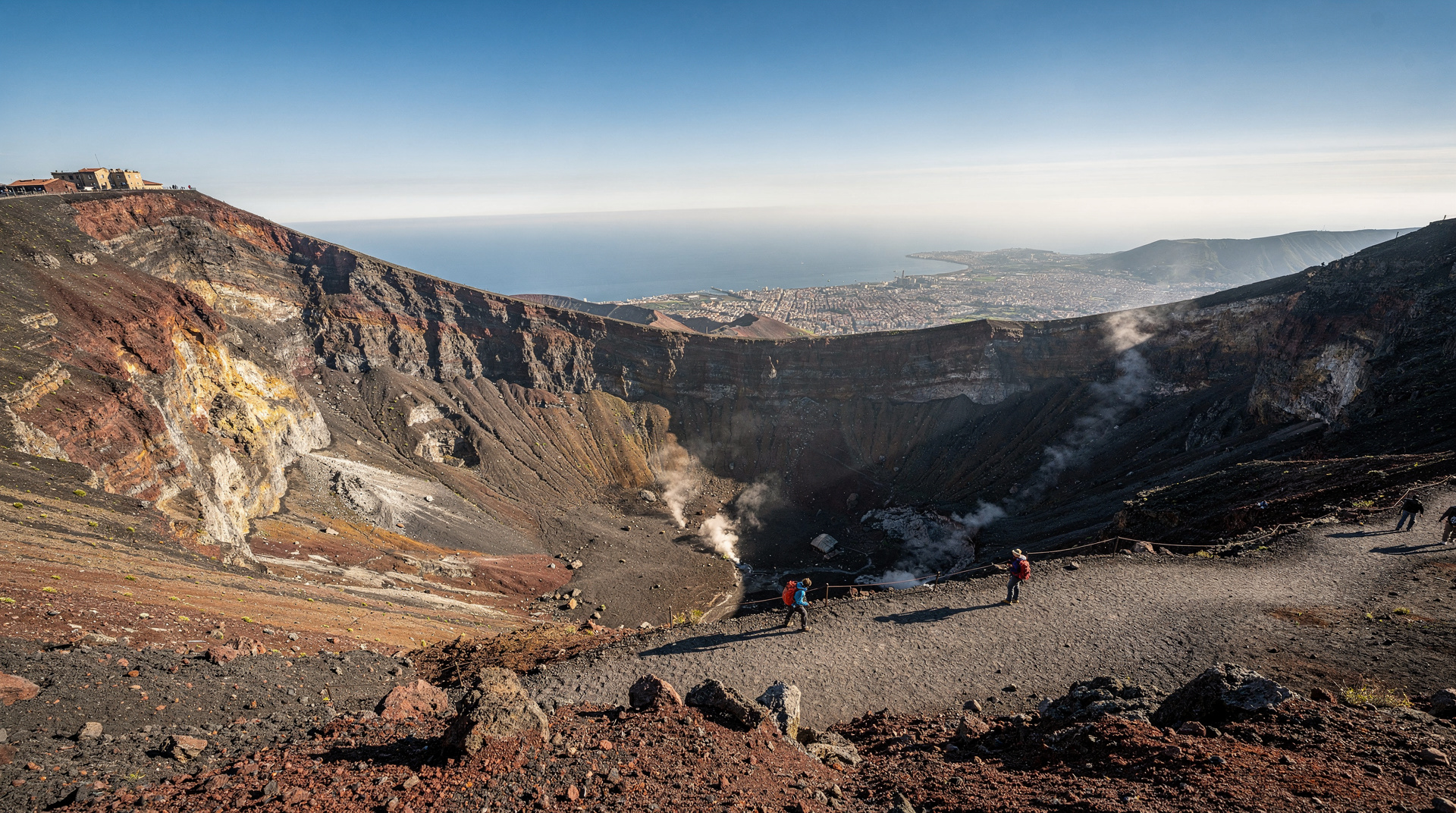
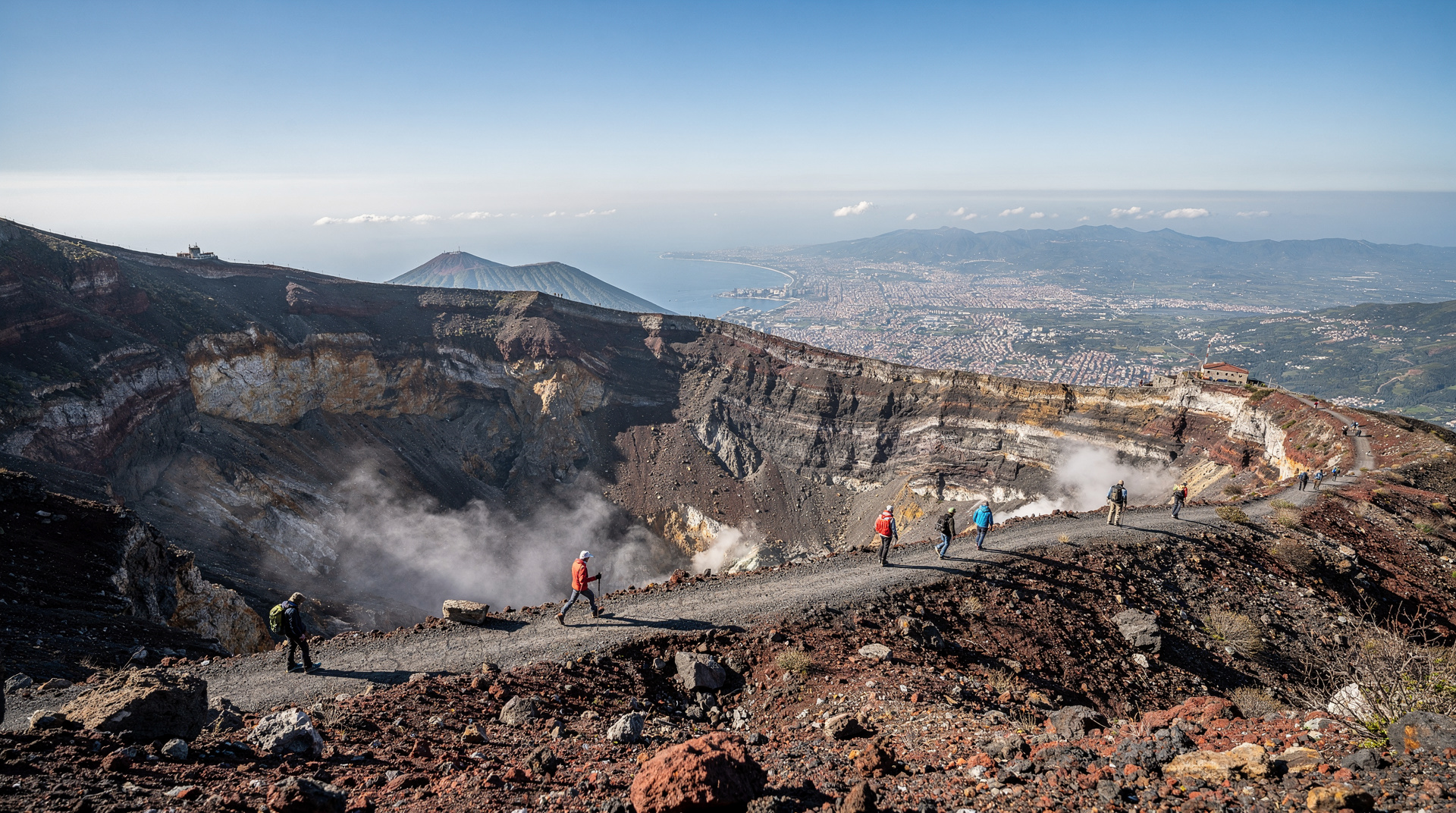
At Vesuvius: The 30-minute ascent from the car park is on a clearly marked path of compacted volcanic ash and gravel. It is steep enough to require pausing to breathe — the altitude and the gradient combined. At the crater rim you are looking into a 300-metre-wide, 200-metre-deep depression of yellow-tinged rock, with sulphurous gas venting from fumaroles on the inner walls. The views north over the Bay of Naples and south towards the Sorrentine Peninsula are exceptional on a clear day.
The guide interprets the geology: the outer cone from the 1631 eruption, the inner Gran Cono formed by the 1944 flows, the history of the twelve eruptions since 79 AD. It is not a geology lecture — it is contextualisation for what you are standing on. The summit visit lasts 45–60 minutes before the descent.
Who should book the combined tour — and who should split it over two days
The combined day trip suits visitors with a limited Naples window (two to three days) who want to cover both major volcanic sites without an additional journey. It also suits first-time visitors who lack a car — the logistics of reaching Vesuvius independently, particularly the summit access road, are significantly more complex than taking an organised transfer.
Consider splitting into two days if: you are genuinely passionate about Roman archaeology and would regret a compressed Pompeii visit; you are travelling with young children or anyone with limited mobility (the Vesuvius trail is not stroller-friendly); you are visiting in July or August when both sites are at peak heat and crowding; or you are already spending three or more nights in Naples and have the time.
The full-day Pompeii and Vesuvius extended tour allocates more time at the excavations — typically four hours at Pompeii — and is the right choice if you want to move at a slower pace and cover more of the archaeological park before heading to the crater.
Practical details: what to know before you go
Physical demands: Plan for six to eight kilometres of walking total — three to four at Pompeii, two at Vesuvius including the crater trail. Wear closed-toe shoes with grip; sandals are unsuitable for the volcanic gravel path and uncomfortable on Pompeii’s basalt streets. Bring a hat, sunscreen, and at least 1.5 litres of water per person — the Vesuvius car park kiosk sells water at inflated prices and the crater trail offers no shade.
Timing and heat: July and August tours begin by 8:30 am to complete the Pompeii section before midday heat. Even so, Pompeii in summer is exposed and demanding — the site has minimal shade except inside the larger buildings. Spring (April to mid-June) and autumn (September to October) are significantly more comfortable.
Lunch: Standard combined tours do not include lunch. Most guides allow 30–45 minutes at a restaurant near the Pompeii exit gate, typically around 12:00–12:30 pm before the drive to Vesuvius. Bring snacks for the summit in any case — the crater kiosk is expensive and has limited options.
The Pompeii and Vesuvius tour with lunch and wine tasting builds in a sit-down meal at a local restaurant between the two sites, which meaningfully improves the day’s pacing and eliminates the need to make lunch decisions under time pressure.
Weather and Vesuvius closures: The summit trail is managed by the Vesuvio national park authority and closes when wind speeds make the rim dangerous or when visibility drops below safe thresholds. Closures are more likely from November through February and during afternoon summer thunderstorms. If you are travelling in winter, book a product with a clear weather-cancellation policy. Most reputable operators issue a partial refund or reschedule for weather-forced closures.
Transport: Minibus tours pick up from centrally located hotels and drop back at the same points in the late afternoon, typically between 5:00 and 6:00 pm. Confirm the pickup point is convenient for your accommodation before booking — a few operators use a fixed meeting point near the central station rather than individual hotel pickup.
How it compares to the all-inclusive alternative
For travellers who want everything packaged without any coordination, the all-inclusive Vesuvius day trip from Naples bundles transport, guide, crater access, and a tasting experience in a single product. It prioritises the volcano over the ruins, making it the better choice for visitors who have already seen Pompeii or who are more interested in geology and volcanic landscape than Roman archaeology.
The core tradeoff in any combined product is depth versus coverage. A dedicated Pompeii tour gives you five to six hours at the site with expert interpretation of areas most combined tours skip: the Herculaneum Gate necropolis, the Villa of the Mysteries on the north edge, and the stadium complex. Our Pompeii complete guide breaks down what a full-day, standalone visit looks like. If Pompeii is the primary reason you are visiting the Naples region, it deserves its own day. Vesuvius, by contrast, is a two-hour site by any measure — and the summit visit slots naturally into a half-day before or after another attraction; see our Vesuvius day trip guide for the standalone version.
Doing it independently instead of on a tour
It is possible to visit both sites without a guide, but the logistics are noticeably harder than for Pompeii alone. Take the Circumvesuviana train from Naples to Pompei Scavi – Villa dei Misteri (around 35–40 minutes), visit the ruins on a self-guided or audio-guided basis, then find a shuttle bus or taxi from the site to the Vesuvius upper car park — there is no direct public transport link between the two. Our guide to reaching Pompeii from Naples and guide to reaching Vesuvius cover both legs in detail.
Independent visitors also need a pre-booked timed slot for the Vesuvius summit trail — check our Vesuvius closures and weather guide before travelling, since the trail shuts in poor conditions with little notice. Given the coordination required, most first-time visitors find a guided combined tour genuinely saves a stressful morning, even before factoring in the archaeological interpretation you would otherwise miss.
How the seasons change the day
| Season | Pompeii conditions | Vesuvius conditions |
|---|---|---|
| Spring (Apr–Jun) | Mild, green surroundings, moderate crowds | Clear-air days common, good visibility |
| Summer (Jul–Aug) | Intense heat, minimal shade, book 8:30am slots | Afternoon thunderstorms can force closures |
| Autumn (Sep–Oct) | Comfortable temperatures, fewer crowds than spring | Generally stable, occasional early cloud |
| Winter (Nov–Feb) | Quiet, cool, some rain | Highest closure risk from wind and storms |
If your travel dates are flexible, spring and autumn give you the best odds of a fully open, comfortable day at both sites — see our Naples best time to visit guide for the wider picture across the year.
Pairing it with the rest of your trip
Travellers building a short Campania itinerary often combine this day with time in Herculaneum, the smaller and better-preserved sister site to Pompeii — our Pompeii vs Herculaneum comparison explains why some visitors prefer it. If you would rather spread the ruins and the volcano over two calmer days instead of one packed one, the Naples and Pompeii two-day itinerary lays out a realistic split, and families in particular should read Pompeii with kids before deciding whether to combine or split.
Verdict
The combined Pompeii and Vesuvius day trip from Naples is one of the most content-rich day tours in Europe. In a single day you pass through two thousand years of geological and human catastrophe, stand in a city that was frozen mid-morning in 79 AD, and then walk to the rim of the volcano responsible. It is a packed, tiring, occasionally overwhelming experience — and almost universally worth doing.
Book the combined format if Naples is a short stop on a longer Italian trip. Book the full-day extended version if you are a history enthusiast who will regret a compressed Pompeii visit. And plan for sore feet by evening regardless of which version you choose — this is not a comfortable urban stroll. It is a serious day out, and it delivers.