The Bay Turns Gold: An Evening on Vesuvius
The last tour group left the crater at five-fifteen. By five-thirty, we had the rim mostly to ourselves — eight hundred metres above sea level, the April wind picking up from the southwest, and below us the whole Bay of Naples arranging itself for the light.
To the south, Pompeii. To the west, the city itself, white and terracotta and smog-grey all at once. Beyond it, Posillipo, Ischia, and if the visibility held, the faint silhouette of Capri against the Tyrrhenian. The bay was not yet gold — that would come in another twenty minutes — but the quality of the light had already changed. Everything had gone slightly amber, slightly softer, and the shadow of the cone was stretching east across the lava fields like a sundial.
| Cost | Entrance fee around €15 (included in most organised tours) |
| Time needed | 45 min up, similar back down, plus time at the rim |
| Getting there | Organised transfer, or car/bus + entrance from Naples/Pompeii |
| Best time | Last two hours before closing, for light and thinner crowds |
| What to wear | Closed shoes with grip — no sandals or heels |
Getting Up There
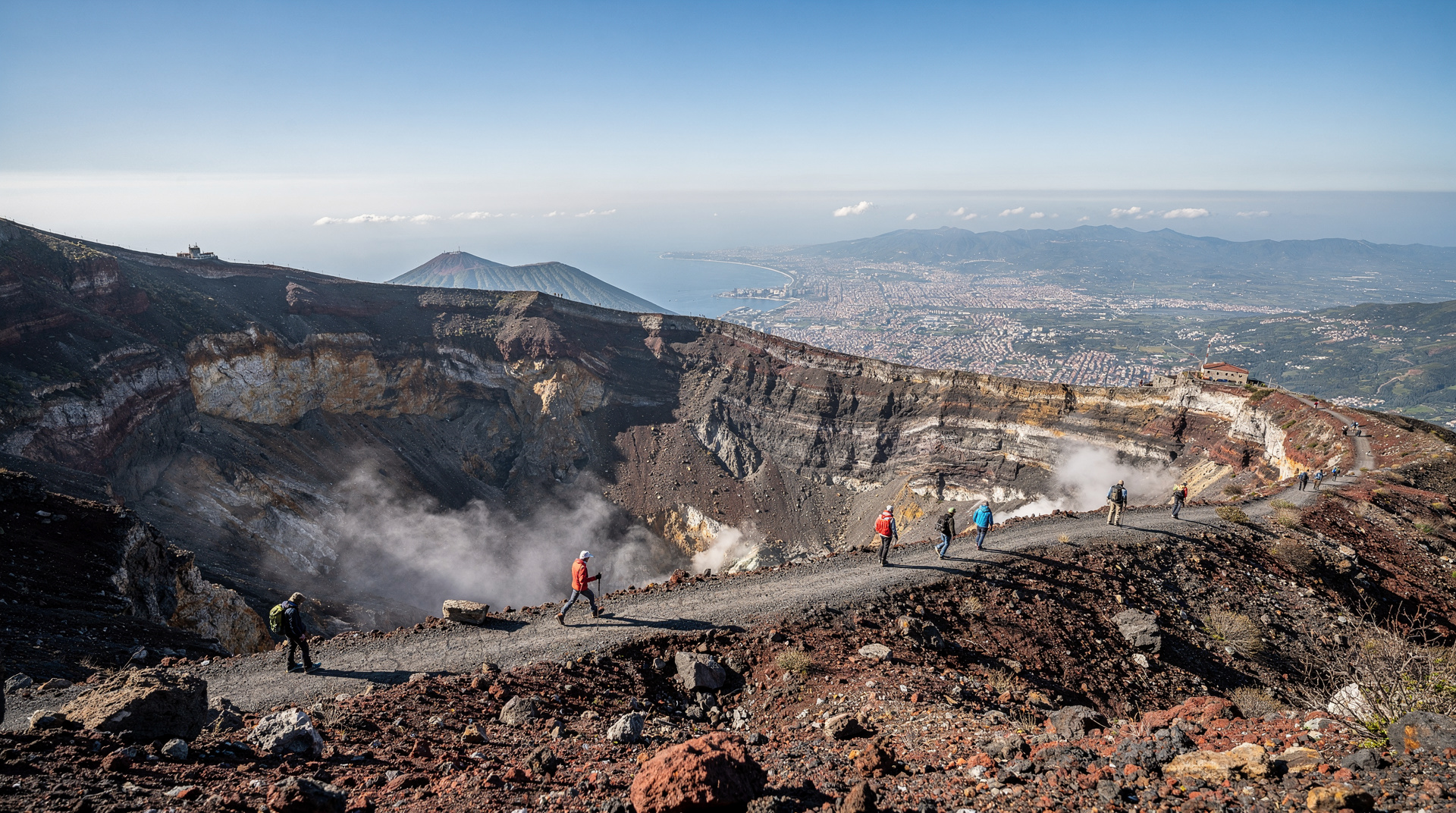
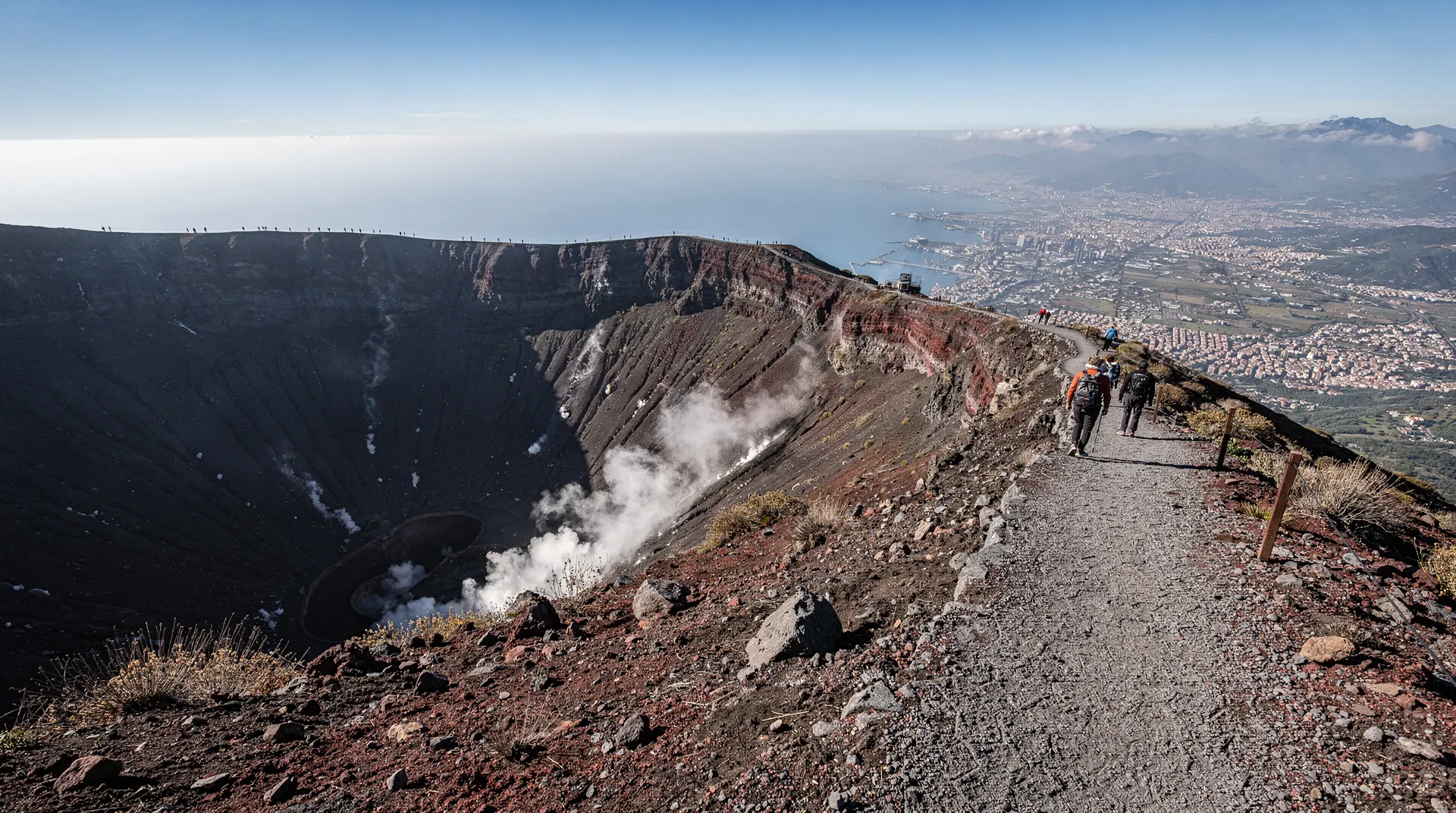
Vesuvius is not a technical climb. The approach road from the ticket booth to the crater rim is a well-maintained path of compacted volcanic gravel, roughly forty-five minutes at a comfortable pace, gaining about two hundred metres in elevation. The footing is firm but loose in places. Wear closed shoes with grip — not heels, not sandals, not the flip-flops I saw one man attempting in early May.
The practical question is how you get to the crater. The simplest route is an organised transfer from Naples or Pompeii, and an all-inclusive Vesuvius day trip from Naples handles the logistics — transport, crater entrance fee, and guide — without requiring you to navigate the buses or negotiate the parking at the summit.
The entrance fee for the crater path itself is €15 (included in most organised tours). The site opens at 9 am and closes at various times depending on season — in April, last entry was typically around 5 pm, which is what made our visit possible. Check the current closing time before you go; sunset in late April is around 8 pm, so arriving by 4:30 gives you the light without the rush.
The Crater Itself
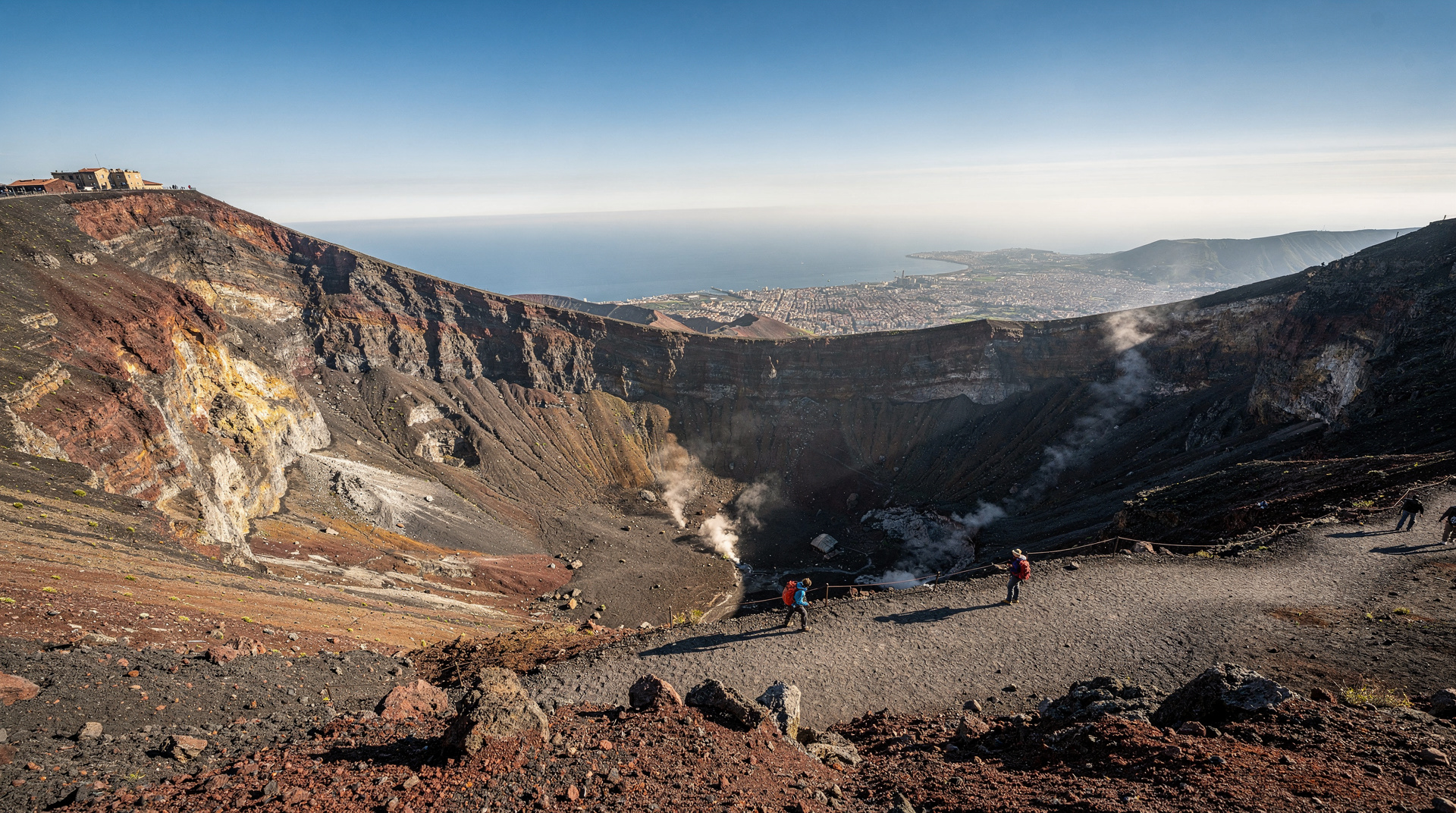
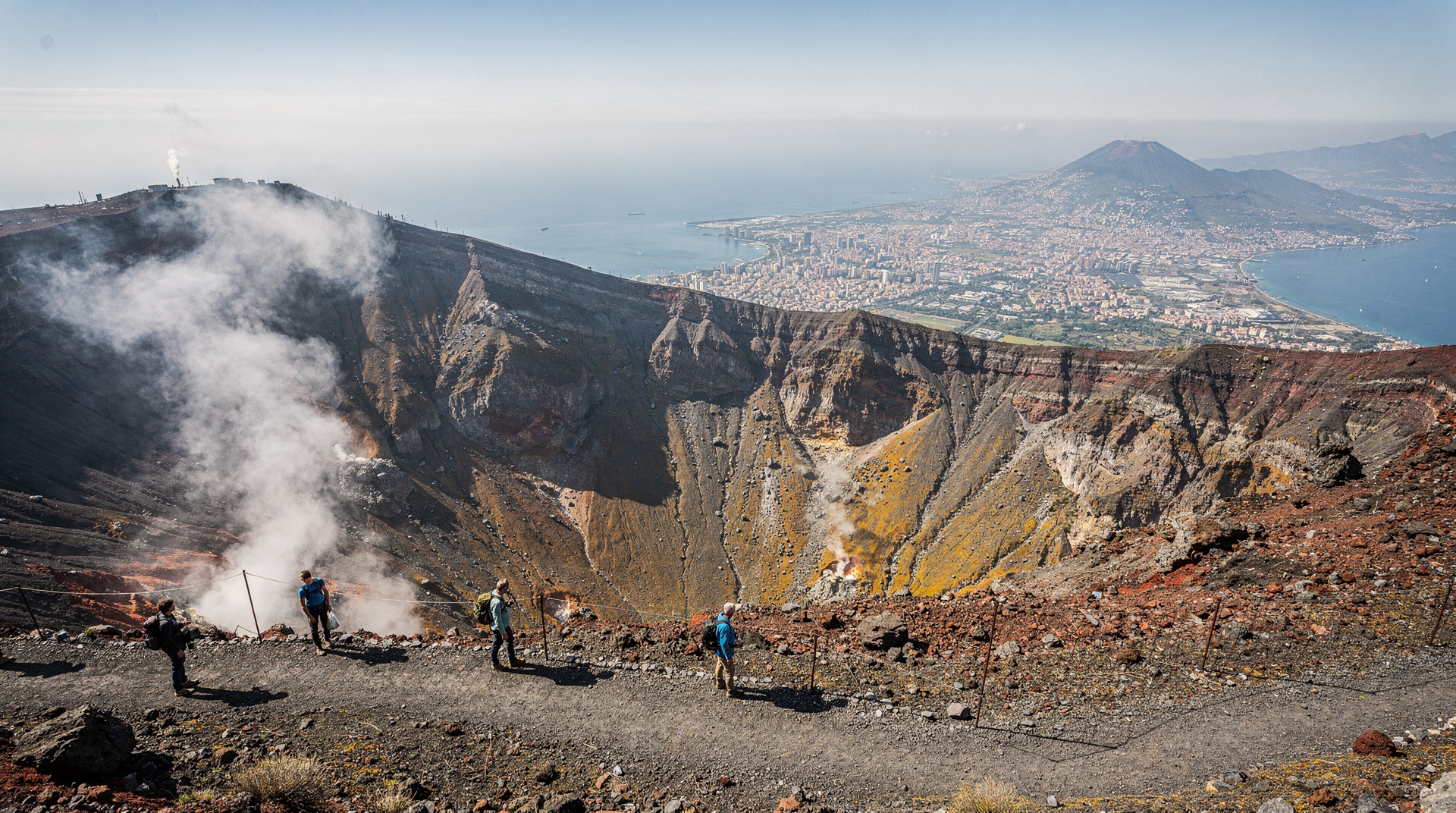
What strikes you first is the smell. Before you see the crater, you smell it — a sharp, eggy sulfur note that intensifies as you reach the rim, carried by the fumarole gases venting from the rock. The fumaroles are visible from the path: white wisps rising from cracks in the dark basalt, warm to the hand if you hold it close (do not hold it very close).
The crater is roughly seven hundred metres across and three hundred metres deep, formed in the 1944 eruption — the last one. Looking into it, the scale is genuinely hard to process at first. The walls are striated in black, grey, rust and ochre, layered like a geological calendar. The floor, a long way down, is grey rubble from which small plumes still rise on still days.
Volcanologists and geophysicists monitor Vesuvius continuously from the Osservatorio Vesuviano, established in 1841 and still active. The risk of a major eruption in any given year is statistically low; the risk in the long run is not. The two million people who live in the immediate area are not unaware of this. The Neapolitans have a particular relationship with fatalism and with beauty, and Vesuvius is where those two things converge most visibly.
The View Over Pompeii
From the southern section of the crater rim, the ancient city is laid out below you in a way that no site visit can replicate. Pompeii covers roughly forty-four hectares — a Roman town with grid streets, forums, theatres, houses, and the enormous necropolis at the gates — and from eight hundred metres up, you can read the entire outline.
It is a strange thing to stand above what destroyed a city and see the city still there, excavated and exposed, two thousand years later. The geometry of the streets is clear from up here in a way it is not when you are walking them. The fora and the amphitheatre and the large bath complexes are visible as distinct shapes. The gaps where excavation has not yet reached are also visible — about one-third of Pompeii remains unexcavated, deliberately so, because the science of preservation advances faster than the urgency to dig.
In the hour before sunset, the angle of the light across the ruins is particularly revealing. The shadows deepen the street-cut lines. The ochre stone goes warm. The whole site looks less like a ruin and more like a model of something that should not still exist but does.
The Vines Below
Between Vesuvius and the sea, the slopes are covered in vines. The volcanic soil — rich in potassium, minerals and a particular mineral sharpness — produces wines under the Lacryma Christi del Vesuvio DOC, one of the oldest wine appellations in Italy. The name translates roughly as “tears of Christ” and has a legend attached to it; the wine itself is distinct enough to earn its reputation.
If you want to see those vines from ground level, a Vesuvius vineyard tour with wine and lunch takes you into the working vineyards on the volcano’s lower slopes, with tastings of the local reds and whites and a meal built around Campanian produce. It is a good way to spend the following morning if the crater visit leaves you wanting more of the landscape rather than less.
Timing: Why It Matters
The difference between visiting Vesuvius at noon and visiting it in the last two hours before closing is not a small one. At noon, the car park is full and the crater path has a queue at the ticket booth. The light is flat, the shadows nonexistent, and the crater looks like grey rock — which it is, but only partly. At four in the afternoon, the crowds have thinned, the tour buses have turned back towards Naples, and the light is already doing the work.
By the time we reached the rim that April evening, there were perhaps thirty people distributed along the full circuit — enough for company, few enough for silence when you wanted it. The fumaroles were white against the darkening rock. The bay below us had gone to copper and then to rose.
At exactly six-forty, the sun crossed behind the ridge to the west of Posillipo and the bay went gold — genuinely, fully gold — for about four minutes. The water, the city, the white facades catching the last horizontal light. Then the colour faded through orange into the flat blue of dusk, and the first lights came on in Naples, and Vesuvius went dark behind us as we walked back down.
It is, without question, the best view in Campania. Possibly the best view I know.
Planning your own visit
This piece is a personal account of one particular evening, but the practical planning behind it is covered in more depth elsewhere. Our full Mount Vesuvius guide is the reference for opening hours, ticket tiers and route options across every season, not just the late-April visit described here. If the hike itself is your main interest rather than the sunset timing, hiking Vesuvius crater covers the trail in more technical detail, and getting to Vesuvius breaks down every transport option from Naples, Pompeii and the coast.
Vesuvius as part of a wider Campania day
Vesuvius rarely stands entirely alone on an itinerary. Our Vesuvius day trip guide covers how to combine the crater visit with Pompeii or Herculaneum on the same day, since all three sit within a short drive or train ride of each other. If volcanic landscape is the theme that draws you here, Naples and volcanoes situates Vesuvius within the wider Campi Flegrei volcanic system that most visitors never realise extends well beyond the one mountain everyone photographs.
Sunset timing by month
| Month | Approx. sunset | Suggested arrival at rim |
|---|---|---|
| April | ~8:00 pm | 4:30–5:00 pm |
| June–July | ~8:40–8:45 pm | 6:30–7:00 pm |
| September | ~7:30 pm | 5:30–6:00 pm |
| October | ~6:30 pm | 4:30–5:00 pm |
Frequently asked questions about Bay Turns Gold
Is it safe to visit Vesuvius, given it’s an active volcano? Yes — the crater path is a managed, regularly monitored tourist route, and the Osservatorio Vesuviano tracks activity continuously; the annual risk of a major eruption is statistically low, though the volcano is taken seriously in long-term regional planning.
What time should I aim to arrive for a sunset visit? Aim to reach the rim about 1.5–2 hours before sunset, accounting for the roughly 45-minute walk up from the ticket booth; check the site’s current closing time first, since last entry varies by season and can be earlier than sunset itself.